

Performance-based compensation ties your pay directly to measurable results — and when employers manipulate those metrics, withhold earned bonuses, or use subjective performance criteria to discriminate, you could be losing significant money you legally earned. Understanding how these structures work is the first step toward protecting your compensation rights.
Whether you’re an executive with a complex incentive package or a salaried employee whose bonus depends on hitting quarterly targets, the legal framework surrounding performance-based pay involves federal securities regulations, tax code requirements, and anti-discrimination protections that all work together to safeguard your earnings.
Key Takeaways
- Performance-based compensation includes bonuses, commissions, stock awards, and incentive pay tied to individual or company performance metrics.
- Federal and state laws protect your right to receive earned performance-based pay, including New York’s wage payment requirements that treat earned bonuses as wages.
- The EEOC prohibits compensation discrimination in all forms of pay, including bonuses, stock options, and profit sharing.
- Employers must use objective, consistently applied performance metrics — subjective or vague criteria can be evidence of discrimination.
- If your employer changes performance targets mid-cycle, withholds earned bonuses, or applies different standards to different employees, you may have legal claims.
Disclaimer: This article provides general information for informational purposes only and should not be considered a substitute for legal advice. It is essential to consult with an experienced employment lawyer at our law firm to discuss the specific facts of your case and understand your legal rights and options. This information does not create an attorney-client relationship.
What Is Performance-Based Compensation?
How does performance-based pay differ from a standard salary?
Performance-based compensation is any form of pay that depends on achieving specific results, rather than simply showing up and doing your job. While your base salary stays the same regardless of output, performance-based pay fluctuates based on whether you or your company hit predetermined goals.
This matters legally because the distinction between guaranteed and contingent compensation affects everything from how your pay is taxed under IRC Section 409A to what protections you have if your employer tries to change the terms mid-stream. Under federal tax law, performance-based compensation that depends on criteria measured over at least 12 months gets special treatment for deferral elections — and employers who don’t structure these plans correctly can create serious tax consequences for you.
What are the most common types of performance-based pay?
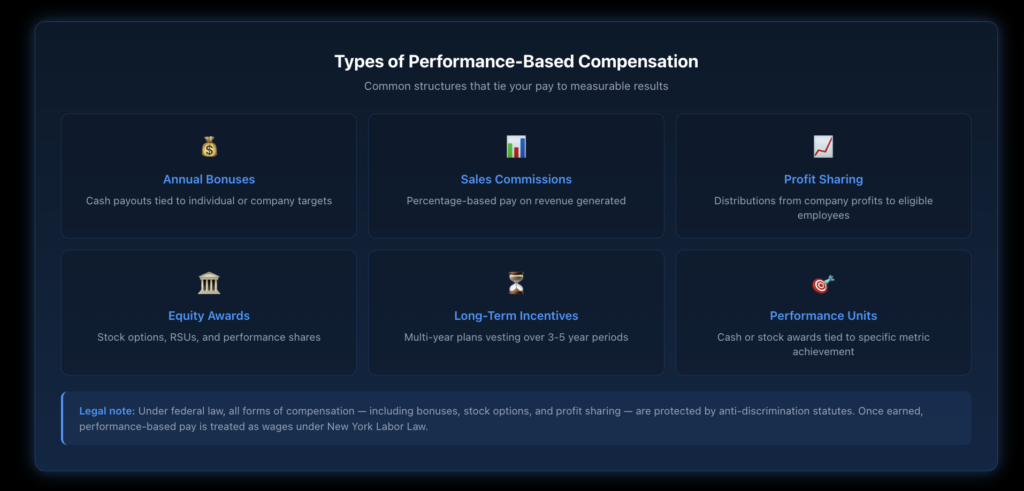
The most common structures include annual bonuses tied to individual or company metrics, sales commissions, profit-sharing plans, equity compensation like stock options and restricted stock units, and long-term incentive plans that vest over multiple years.
For executives specifically, performance-based compensation often represents the majority of total pay. The SEC requires public companies to disclose exactly how executive compensation connects to company performance through the Summary Compensation Table and Compensation Discussion and Analysis sections of proxy statements.
How Do Performance-Based Payments Work in Practice?
What metrics do employers typically use to measure performance?
Employers use two broad categories of metrics: objective measures like revenue targets, profit margins, or sales volume, and subjective measures like leadership effectiveness, teamwork, or manager evaluations. The legal significance of this distinction cannot be overstated.
Objective metrics leave less room for discriminatory application. When your bonus depends on hitting a $2 million sales target, and you hit $2.3 million, the math speaks for itself. But when your bonus depends on a manager’s subjective assessment of your “leadership potential” or “cultural fit,” the door opens for bias based on age, gender, race, or other protected characteristics.
The EEOC has made clear that all forms of compensation — including bonuses, stock options, and profit-sharing plans — are covered by federal anti-discrimination laws. If your employer’s performance evaluation system produces different compensation outcomes for employees in protected classes doing substantially equal work, that’s a potential legal issue regardless of whether the system appears neutral on its face.
How do performance-based bonuses interact with your employment agreement?
Your executive employment agreement is the foundation of your performance-based compensation rights. The specific language matters enormously — particularly around when bonuses are “earned” versus when they’re “paid.”
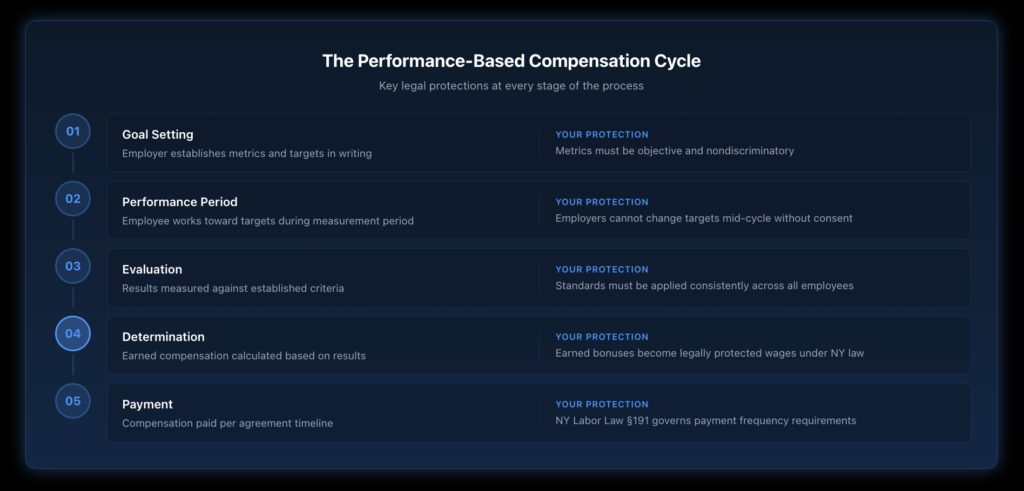
Under New York law, once compensation is earned, it’s treated as wages that your employer must pay. New York Labor Law Section 191 requires that incentive earnings and bonuses be paid according to the agreed terms of employment. An employer can’t simply decide after the fact that you didn’t “really” earn a bonus you were promised.
This is why the terms of your performance plan matter so much. If your agreement says you earn a bonus upon achieving certain metrics and you achieve them, your employer generally can’t withhold payment simply because they changed their mind or restructured the program after the performance period already started.
What Legal Protections Cover Your Performance-Based Compensation?
What federal laws protect your performance-based pay?
Several layers of federal law protect performance-based compensation. The Fair Labor Standards Act establishes baseline protections — nondiscretionary bonuses must be included in overtime calculations for non-exempt employees, and employers can use nondiscretionary bonuses to satisfy up to 10% of the minimum salary requirement for exempt employees.
For executives at public companies, SEC regulations under Item 402 of Regulation S-K require detailed disclosure of how performance-based compensation connects to company results. These transparency requirements exist specifically to prevent companies from designing compensation plans that enrich executives regardless of actual performance.
The IRS enforces strict rules under Section 409A governing how deferred performance-based compensation is structured and paid. Violations can trigger a 20% penalty tax on top of regular income tax, plus interest — consequences that fall on you as the employee, not your employer. This is why having a proper legal review of deferred compensation arrangements is so important.
How do anti-discrimination laws apply to performance-based pay?
Federal anti-discrimination statutes — including Title VII, the ADEA, and the ADA — prohibit compensation discrimination in all its forms. The Equal Pay Act specifically requires equal pay for equal work, and its protections extend to bonuses, incentive pay, and all other forms of compensation.
What makes performance-based pay particularly vulnerable to discriminatory application is the discretion involved. When board compensation committees set performance targets, choose which metrics to weight, and decide how to evaluate subjective criteria, each decision point represents an opportunity for bias to influence outcomes.
What Are the Challenges and Disadvantages of Performance-Based Pay?
When can performance-based pay systems become illegal?
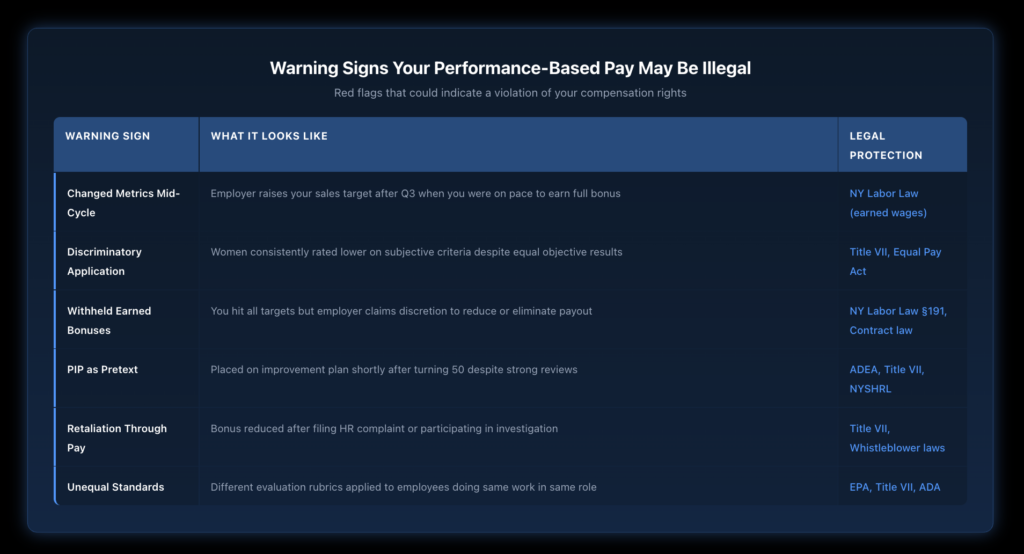
Performance-based compensation crosses the line from tough-but-fair to potentially illegal in several common scenarios. Using performance improvement plans (PIPs) as pretexts to reduce compensation for employees in protected classes is one of the most frequent patterns employment attorneys see.
Other red flags include changing performance targets after a performance period has begun, applying different evaluation standards to different employees doing similar work, using vague or undefined metrics that give managers unchecked discretion, tying compensation to metrics that disproportionately disadvantage protected groups, and withholding earned bonuses as retaliation for protected activities like filing complaints or cooperating with investigations.
What happens to your performance-based pay during a change in control?
When your company gets acquired or merged, your performance-based compensation can be at serious risk. Change in control provisions in your employment agreement should address what happens to unvested equity, in-progress performance periods, and bonus targets that may become impossible to measure under new ownership.
Without proper protections, acquiring companies can restructure performance metrics, cancel incentive plans, or terminate employees before bonuses vest. This is exactly why golden parachute provisions exist — to ensure executives receive fair compensation even when corporate transactions disrupt normal performance cycles.
How Can You Protect Your Performance-Based Compensation Rights?
What steps should you take to safeguard your earned compensation?
Protecting your performance-based compensation starts well before any dispute arises. Keep copies of all compensation plans, performance targets, evaluation criteria, and communications about your performance. Document your results against stated metrics in real time — don’t rely on your employer’s records alone.
Review your executive employment agreement carefully to understand when bonuses are “earned” under the agreement’s terms, whether clawback provisions allow the company to recover previously paid compensation, and what happens to performance-based pay if you’re terminated before a vesting date.
If you believe your employer is manipulating performance metrics, applying evaluation criteria inconsistently, or withholding earned compensation, consulting with an employment attorney can help you understand your rights before the situation escalates. The New York Attorney General’s office also provides resources for workers whose employers fail to pay earned wages, including bonuses and incentive compensation.
Understanding the connection between your performance-based pay and your severance and retirement benefits is equally important. Many disputes over performance compensation arise during separation negotiations, when employers may try to argue that unvested awards or in-progress bonuses don’t need to be paid.
Talk to an Employment Attorney About Your Performance-Based Compensation
If your employer has changed your performance targets mid-cycle, withheld bonuses you earned, or used subjective performance criteria in ways that seem discriminatory, you don’t have to accept it. An experienced employment attorney can review your compensation agreements, evaluate whether your employer’s actions violate federal or state law, and help you recover the compensation you’re owed.
Contact Nisar Law Group for a consultation to discuss your performance-based compensation rights and get practical guidance on your specific situation.
Frequently Asked Questions About Performance-Based Compensation
Performance-based compensation is any pay that depends on achieving specific, measurable results rather than simply fulfilling job duties for a set salary. It includes annual bonuses, sales commissions, profit-sharing distributions, equity awards like stock options and RSUs, and long-term incentive plans. These structures are common across industries but are especially significant for executives, where performance-based pay often makes up the majority of total compensation.
Yes, performance-based pay is legal and widely used. However, it must comply with federal and state employment laws. Employers cannot use performance-based systems to discriminate against employees in protected classes, and earned performance-based compensation must be paid according to the terms of the employment agreement. Under New York law, earned bonuses are treated as wages, meaning employers face the same legal consequences for withholding a bonus as they would for not paying a regular paycheck.
The biggest disadvantage is the potential for subjective manipulation. Employers can set unrealistic targets, change metrics mid-period, or use vague evaluation criteria that leave room for bias. Performance-based pay can also create uncertainty for employees trying to plan their finances, since a significant portion of expected compensation may depend on factors partly or entirely outside their control. For executives, complex performance plans also carry tax risks if not properly structured under Section 409A.
Typically, an employer establishes specific performance metrics at the beginning of a measurement period, which can be quarterly, annual, or multi-year. Employees or teams work toward those targets during the period. At the end, results are evaluated against the established criteria, and earned compensation is calculated and paid according to the plan terms. The specific payment timeline depends on the type of compensation and the terms of your agreement, but New York law requires payment according to agreed-upon schedules.
Being placed on a performance improvement plan is a significant employment event. While PIPs can serve legitimate purposes, they are frequently used as a paper trail to justify termination rather than as genuine improvement tools. If you’re placed on a PIP and your performance-based compensation is affected as a result, pay close attention to whether the PIP criteria are objective, whether similarly situated coworkers outside your protected class receive similar treatment, and whether the timeline is reasonable. An employment attorney can help you determine whether a PIP is being used appropriately or as a pretext.
This depends on your employment agreement and the specific plan terms. Under New York law, compensation that was already “earned” before termination must generally be paid regardless of your employment status. However, unvested equity awards, in-progress performance periods, and discretionary bonuses may be handled differently depending on the plan language. Reviewing your agreement’s termination and forfeiture provisions with an employment attorney before signing — or immediately after receiving a termination notice — can help you preserve your compensation rights.

