
Did the Government Violate Your Constitutional Rights?
We Can Help
When a government official crosses a legal line — whether it’s a police officer using excessive force, a public employer retaliating against you for speaking out, or a corrections officer ignoring your basic needs — the law gives you a way to fight back.
At Nisar Law Group, we represent individuals whose civil rights and constitutional protections have been violated by government actors. These cases are complex. They require a firm that knows the federal framework, understands how overlapping state and local protections work, and has the persistence to take on institutions that have every resource to defend themselves.
If you believe your rights were violated, the first step is a free consultation. Let’s talk through what happened and whether you have a claim.
Contact Nisar Law Group, P.C. at (212) 600-9534 to learn how we can be of service.
What Is a Civil Rights Violation?
Not every injustice is a civil rights violation in the legal sense. Civil rights claims have a specific meaning: they arise when a government actor — someone exercising state power — deprives you of rights guaranteed by the U.S. Constitution or federal law.
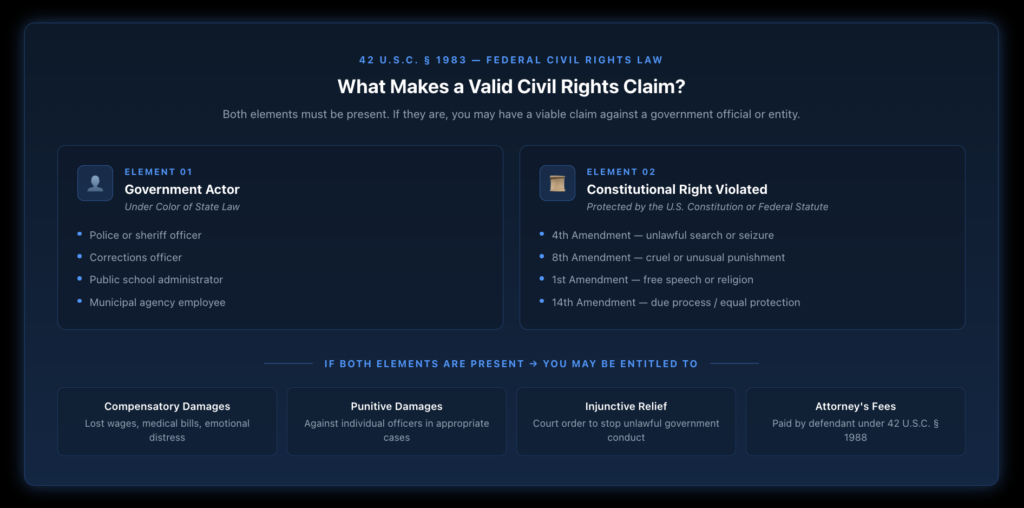
The primary legal tool for these cases is 42 U.S.C. § 1983, a federal law that allows individuals to sue state and local government officials for constitutional violations. To have a valid § 1983 claim, two things need to be true:
- The person who harmed you was acting under color of state law — meaning they were exercising government authority when the violation occurred
- Their actions deprived you of a constitutional right protected by the federal constitution or a federal statute
This covers a wide range of conduct: police officers using force beyond what the situation required, a public agency retaliating against someone for speaking out, or a jail failing to provide basic medical care. The common thread is a government actor and a constitutional right.
Many states and cities layer additional protections on top of the federal baseline — laws that apply more broadly and set a lower bar for proving a violation than federal law alone. The New York City Human Rights Law, for example, is among the strongest local anti-discrimination statutes in the country. Understanding what’s available in your jurisdiction is a key part of building the strongest possible case.
Who Can Be Held Liable?
One of the most common questions in civil rights cases is: Who exactly do you sue? The answer depends on the nature of the claim, but here’s how it typically breaks down:
Individual government officials are often named as defendants in their personal capacity. This includes police officers, corrections officers, public school administrators, and other government employees or agents who participate in the violative conduct. They can be held personally liable for their actions — though they may assert a legal defense called qualified immunity, which shields officials unless they violated a “clearly established” constitutional right. Understanding what constitutes a wrongful arrest is often the starting point for evaluating whether a claim exists against an individual officer, for example.
Municipalities and local governments can also be held liable under a theory established in Monell v. Department of Social Services (1978). Cities and counties aren’t automatically responsible every time an employee does something wrong. But if the constitutional violation resulted from an official policy, a widespread custom, or a deliberate failure to train employees, the government entity itself is on the hook. This is called a Monell claim, and it’s how you hold institutions — not just individuals — accountable.
To illustrate how Monell claims work in practice: according to the NYC Comptroller’s FY2024 excessive force report, the NYPD had 9,249 tort claim filings that year — a 31.8% increase — with excessive force complaints reaching their highest level since 2013. That volume of claims is precisely what supports a Monell pattern-and-practice argument against a department, not just an individual officer.
Worth noting for New York City cases specifically: in 2021, New York City became the first major U.S. city to pass a local law — Local Law 48 — that limits qualified immunity for NYPD officers in local court actions. If you were the victim of an unreasonable search, seizure, or excessive force in New York City, you may be able to bring a claim where that defense is not available to the officer. Some states, including New York, Colorado, New Mexico, and Massachusetts, have also passed laws limiting or eliminating the qualified immunity defense.
Claims We Handle
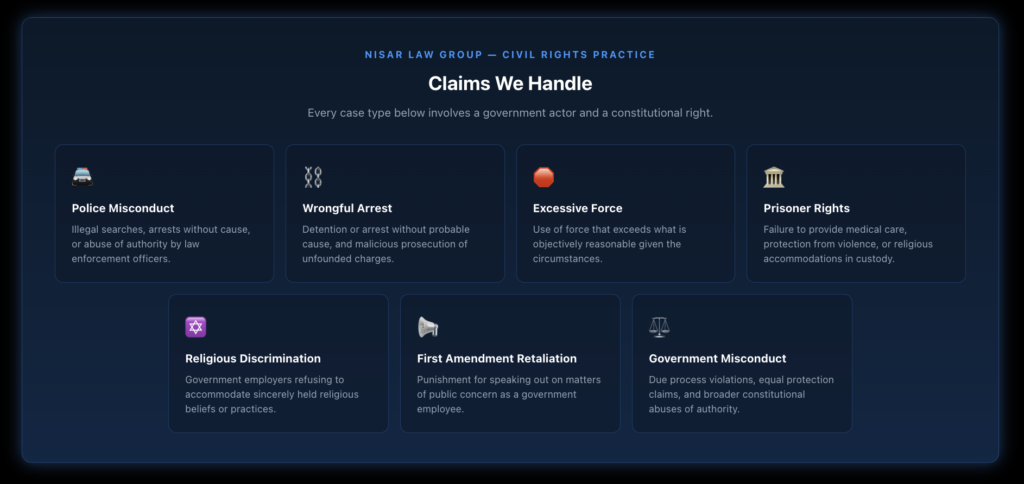
Our civil rights practice covers the full range of constitutional violations. Below is a summary of the specific case types we handle. Each links to a dedicated page with more details on the law, evidence requirements, and what to expect.
Police Misconduct
Police misconduct cases involve officers using their authority in ways that violate constitutional rights — whether that’s conducting an illegal search, using more force than the situation required, or making an arrest without probable cause. The availability of officer disciplinary records varies by jurisdiction, but where those records have been opened to the public — as happened in New York following the 2020 repeal of Civil Rights Law § 50-a — it can significantly change what evidence is available in these cases. Learn more about police misconduct claims →
Wrongful Arrest
A wrongful arrest claim arises when an officer detains or arrests someone without probable cause. When an arrest is made without a warrant, the burden typically falls on the government to prove probable cause existed — an important procedural advantage for plaintiffs. A related claim, malicious prosecution, covers what happens when a prosecution continues without proper justification and ultimately ends without a conviction. Learn more about wrongful arrest claims →
Excessive Force
Excessive force claims turn on whether the officer’s use of force was objectively reasonable under the circumstances. Courts look at factors like the severity of the suspected offense, whether the person posed an actual threat, and whether they were actively resisting. The standard depends on whether a reasonably trained and prudent law enforcement officer would know the actions taken were excessive. Learn more about excessive force claims →
Prisoner Rights
Prisoners retain constitutional rights even after conviction. The Eighth Amendment prohibits cruel and unusual punishment, including the failure to provide adequate medical care or protection from violence. Solitary confinement reforms vary by state — New York’s HALT Solitary Confinement Act, for example, limits isolated confinement to 15 consecutive days — though implementation has been inconsistent across jurisdictions. The federal Religious Land Use and Institutionalized Persons Act (RLUIPA) and the First Amendment also require jails and prisons to provide reasonable accommodations of any incarcerated person’s sincerely held religious belief, including access to group prayer services, religiously compliant meals, and religious materials. If you or a loved one has been subjected to conditions that violate these standards, there may be a viable claim. Learn more about prisoner rights claims →
Religious Discrimination by Government Entities
Government employers and public schools are required to provide reasonable accommodations for sincerely held religious beliefs under the First Amendment, Title VII of the Civil Rights Act of 1964, and the Religious Freedom Restoration Act (RFRA). When a public agency refuses to accommodate religious practice — or retaliates against an employee or student for requesting one — that may be an actionable civil rights violation. Learn more about religious discrimination by government entities →
First Amendment Retaliation
Government employers cannot punish employees for speaking out on matters of public concern in their capacities as private citizens. This protection — grounded in Pickering v. Board of Education and its progeny — covers a wide range of speech, from whistleblower disclosures to union advocacy. If you were disciplined, demoted, or terminated because you exercised your First Amendment rights as a government employee, that may be a viable civil rights claim. Learn more about First Amendment retaliation claims →
Government Misconduct / Constitutional Violations
This category covers the full range of constitutional violations by government actors that don’t fit neatly into one of the above buckets — due process violations, equal protection claims, and abuse of government authority more broadly. Learn more about government misconduct claims →
How a Civil Rights Case Works
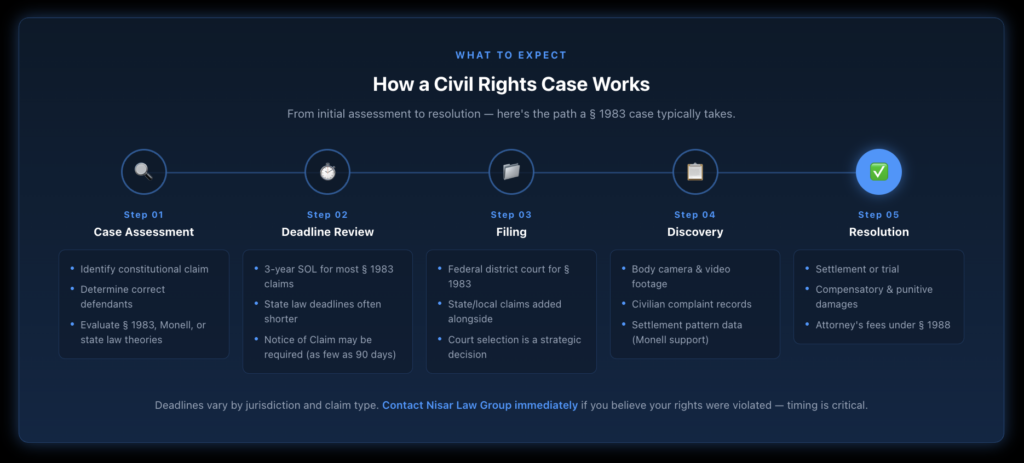
Civil rights cases move through a distinct procedural path. Here’s what to expect:
Step 1: Case assessment: An attorney evaluates whether the facts support a constitutional claim, identifies the correct defendants, and determines which legal theories apply — § 1983, Monell, federal statute, or state and local law claims.
Step 2: Deadline review: Civil rights claims have strict time limits that vary by state. For federal § 1983 claims, the statute of limitations is typically 1-3 years in most jurisdictions, borrowed from each state’s personal injury law. State law claims against government entities often carry shorter deadlines — and many jurisdictions require filing a Notice of Claim before any lawsuit can be filed, sometimes as quickly as 90 days after the incident. For New York City claims specifically, General Municipal Law § 50-e sets that 90-day window. Missing these deadlines permanently bars those claims, which is why timing must be assessed immediately.
Step 3: Filing in federal or state court: Most § 1983 cases are filed in federal district court, with state and city law claims often added alongside federal claims. The right court depends on where the violation occurred and which legal theories apply. The NYC Council’s Local Law 48 press release details both the federal and local causes of action available in New York City cases and illustrates why understanding which court to file in is a strategic decision with real consequences for any civil rights case, regardless of jurisdiction.
Step 4: Discovery: This is where the case gets built. Body camera footage, civilian complaint records, internal communications, medical records, and prior lawsuit history all come into play. Publicly available data on settlement patterns — which many jurisdictions publish — can support Monell claims about department-wide conduct. The NYC Comptroller’s annual claims report is one example of the kind of institutional data that strengthens a pattern-and-practice argument. Cases involving excessive force often hinge on video evidence obtained during this phase.
Step 5: Resolution — settlement or trial: Many civil rights cases settle before trial. Government entities resolve a substantial portion of misconduct claims through settlement rather than trial. If the case goes to trial, a successful plaintiff can recover compensatory damages (lost wages, medical expenses, pain and suffering, emotional distress), injunctive relief, and attorney’s fees under 42 U.S.C. § 1988 — meaning the defendant may have to pay your legal costs if you win. Damages vary significantly by claim type — wrongful arrest cases, for example, often involve different calculations than excessive force claims.
Why Nisar Law Group?
Nisar Law Group is a boutique employment and civil rights litigation firm. We represent individuals — not corporations, not government entities. Every client we take on is someone whose rights we believe in and whose case we’re committed to pursuing.
Here’s what that means in practice:
- No intimidation. We know government defendants have institutional resources and institutional lawyers. We’ve been doing this long enough not to be deterred by that.
- Nationwide federal court representation. We have litigated these claims all over the country and can bring the full weight of constitutional protections to bear against governments at every level, in every state.
- Deep legal expertise. We know the relevant circuit precedent and the local statutes — including jurisdiction-specific tools like NYC’s Local Law 48 — that can affect the outcome of your case.
- Contingency representation. We handle civil rights cases on contingency, which means you don’t pay legal fees unless we recover for you.
- Genuine communication. You’ll know what’s happening with your case. We don’t leave clients in the dark.
What Can You Recover?
If your civil rights claim is successful, you may be entitled to:
- Compensatory damages — to cover actual losses like medical bills, lost income, and emotional distress
- Nominal damages — available against individual officers where no economic losses exist to compensate for (often $1, but still triggers the right to seek attorneys’ fees as the prevailing party)
- Punitive damages — available against individual officers in appropriate cases (not against municipalities)
- Injunctive relief — a court order requiring a government entity to stop or change a practice (still triggers right to seek attorneys’ fees as prevailing party)
- Attorneys’ fees and costs — under 42 U.S.C. § 1988, the prevailing plaintiff’s attorneys’ fees are typically paid by the losing party.
The value of a civil rights case depends heavily on the specific facts, the nature and location of the violation, and the damages you suffered. We can give you a realistic assessment during your free consultation.
Have Questions? We're Ready to Talk.
Civil rights cases require a lawyer who understands both the law and what it actually takes to win in federal court. If you believe a government official violated your constitutional rights, don’t wait — deadlines in these cases are strict and unforgiving, and they vary by jurisdiction.
Contact us at (212) 600-9534 to schedule a confidential consultation.
Why We're the Right Choice
- Seasoned Litigators Who Have Handled Numerous Jury & Bench Trials
- Providing Representation with Clarity, Honesty & Integrity
- Building Long-Term Affiliations & Relationships
- Offering Consultations for All Case Types We Handle
Frequently Asked Questions About Civil Rights and Constitutional Litigation
A civil rights violation occurs when a government actor — someone exercising state or local authority — deprives you of a right guaranteed by the U.S. Constitution or federal law. That could be an unlawful arrest, excessive force by a police officer, retaliation for protected speech, or denial of adequate medical care or religious accommodations in custody. Not every injustice qualifies — the key elements are a government actor and a constitutional right that was actually violated.
Common violations include unlawful searches and seizures, arrest without probable cause, excessive or deadly force, racial profiling, retaliation for speaking out on matters of public concern, denial of religious accommodations by government employers, schools, and prisons, and cruel or inhumane conditions of confinement. These claims are typically brought under federal law (42 U.S.C. § 1983 and other statutes). Depending on where you live, state and local anti-discrimination laws may also apply — some jurisdictions offer broader protections and a lower burden of proof than the federal baseline alone.
Excessive force and unlawful arrest are among the most frequently litigated civil rights claims nationwide. Police departments across the country face thousands of misconduct claims each year, many resulting in substantial settlements. Beyond police conduct, workplace retaliation by public employers, denial of religious accommodations, and restrictions on free speech in publicly funded schools and universities are also among the most common claims we see.
Yes, in certain circumstances. If you are a U.S. citizen and were detained by federal immigration enforcement without a lawful basis, you may have a constitutional claim under the Fourth Amendment (unlawful seizure) and potentially the Fifth Amendment (due process). The strength of the case depends heavily on the specific facts of the detention. An attorney can help you assess whether you have a viable claim.
Constitutional litigation is the process of enforcing constitutional rights through the courts. In practice, that usually means filing a lawsuit under 42 U.S.C. § 1983 against a government official or entity that violated your rights. These cases can result in monetary compensation, court orders requiring the government to change its conduct, and attorneys’ fees paid by the losing party. Constitutional litigation is distinct from criminal cases — it’s a civil lawsuit brought by the individual whose rights were violated.
Constitutional lawyers handle cases where government actors have violated individual rights protected by the U.S. Constitution. That includes police misconduct, wrongful arrest, excessive force, prisoners’ rights violations, First Amendment retaliation, religious discrimination by government entities, and due process or equal protection claims. At Nisar Law Group, we focus specifically on these claims for individuals — we represent people, not institutions.
Willful deprivation of civil rights under color of law can be a federal crime, and the Department of Justice has authority to pursue criminal prosecution in serious cases — including those involving bodily injury or death. However, criminal prosecution is handled by the government, not by private attorneys. A civil rights attorney pursues a separate civil lawsuit on your behalf, which can result in financial compensation and injunctive relief regardless of whether any criminal charges are filed.