
Did a Police Officer Violate Your Rights?
You Have Legal Options.
Police officers have significant authority. But that authority has limits — and when officers cross those lines, the law gives you a way to hold them accountable.
At Nisar Law Group, we represent individuals whose constitutional rights were violated by law enforcement. Whether that’s an unlawful arrest, a search conducted without cause, or force that went far beyond what the situation required, these are serious violations — and they’re actionable.
To illustrate what documented systemic failure looks like: according to the NYC Comptroller’s FY2024 excessive force analysis, the NYPD had 9,249 tort claim filings — a 31.8% increase — with excessive force complaints reaching their highest level since 2013. That’s not a fluke. It reflects a documented, systemic pattern — and the courts have consistently said so. Similar patterns of institutional failure exist across police departments nationwide.
If you think an officer violated your rights, the conversation starts with a free consultation.
Contact Nisar Law Group, P.C. at (212) 600-9534 to learn how we can be of service.
What Is Police Misconduct?
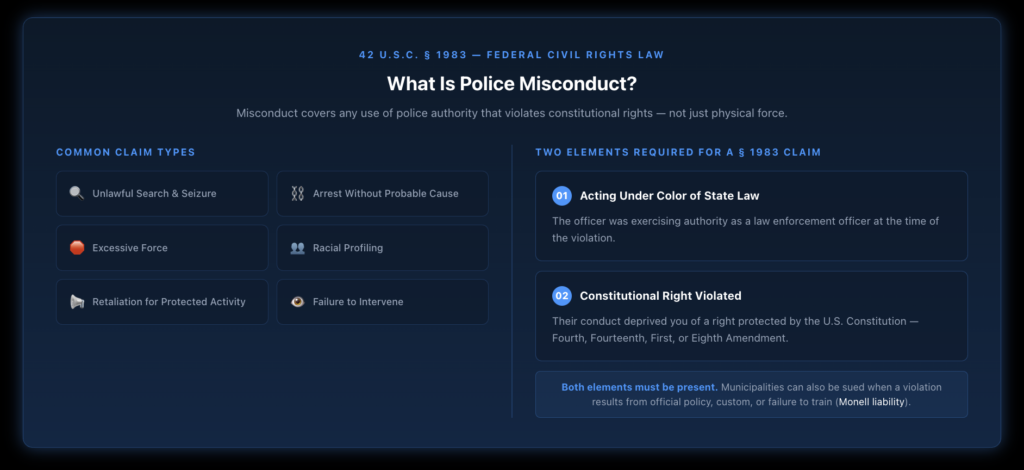
Police misconduct is a broad term that covers any situation where a law enforcement officer uses their authority in a way that violates a person’s constitutional rights. It’s not just about physical force — misconduct includes illegal searches, arrests made without probable cause, racial and religious profiling, coercion, and retaliation against people who exercise their legal rights.
The primary legal vehicle for these claims is 42 U.S.C. § 1983, the federal civil rights statute that allows individuals to sue government officials — including police officers — when those officials deprive them of constitutional protections. To have a valid claim, two things must be true: the officer was acting under the authority of their badge, and their conduct violated a right protected by the U.S. Constitution.
Many states and cities layer additional protections on top of the federal baseline. New York, for example, allows officers to be held accountable under the New York State Human Rights Law and the NYC Human Rights Law — one of the strongest anti-discrimination statutes in the country. And since 2021, NYC officers can no longer assert qualified immunity as a defense in local court actions involving unreasonable searches, seizures, or excessive force under Local Law 48. Understanding what additional protections exist in your jurisdiction is an important part of building the strongest possible case.
Common Examples of Police Misconduct
Not every difficult interaction with police rises to the level of a legal claim. But these situations frequently do:
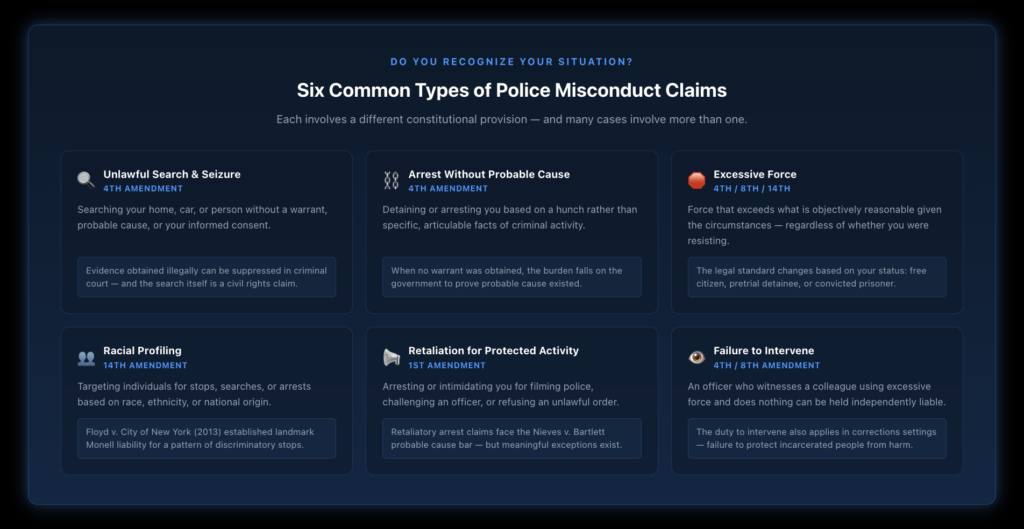
Unlawful Search and Seizure
The Fourth Amendment protects you from searches and seizures conducted without a valid warrant or a recognized legal basis. Officers generally cannot search your home, car, or person without probable cause or your informed consent. Evidence obtained through an illegal search can be suppressed in a criminal case — and the search itself can form the basis of a civil rights claim. Broader patterns of government misconduct often begin with exactly these kinds of unlawful searches.
Arrest Without Probable Cause
An officer needs more than a hunch to arrest you. Probable cause means the officer had specific, articulable facts suggesting you committed or were committing a crime. When an arrest is made without a warrant, the burden typically falls on the government to prove probable cause existed — a meaningful procedural advantage for plaintiffs in civil rights litigation.
Excessive Force
Force is only lawful when it’s objectively reasonable given the circumstances. Officers cannot use force that goes beyond what the situation actually requires — whether that’s a takedown during a minor stop, use of a chokehold, or drawing a weapon when no threat exists. New York’s Eric Garner Anti-Chokehold Act made chokeholds that cause serious injury a Class C felony in that state — one of the toughest use-of-force statutes in the country. For a full breakdown of what excessive force looks like legally — and what victims can recover — see our dedicated page.
Racial Profiling
Targeting individuals for stops, searches, or arrests based on race, ethnicity, or national origin violates the Fourteenth Amendment’s equal protection guarantee. Floyd v. City of New York — the landmark stop-and-frisk case — established that the NYPD had engaged in a pattern and practice of unconstitutional stops driven by race and national origin bias. Many of those stops resulted in wrongful arrests that are separately actionable. A federal monitor continues to oversee NYPD compliance today, and the case remains one of the most significant Monell rulings in recent decades.
Retaliation for Protected Activity
Officers cannot arrest or intimidate you because you exercised a constitutional right — including the right to film police in public, the right to verbally challenge an officer’s conduct, or the right to refuse an unlawful order. Retaliatory arrests are a recognized constitutional violation, and First Amendment retaliation claims can be brought alongside or separately from a wrongful arrest claim.
Failure to Intervene
Officers have an affirmative duty to stop misconduct they witness, though the contours of that duty can vary by circuit. An officer who stands by while a colleague uses excessive force can be held independently liable — even if they were not the one who threw a punch. This same duty to intervene extends to prisoner rights contexts, where corrections officers face liability for failing to protect incarcerated people from harm.
Who Can Be Held Liable?
In a police misconduct case, you may have claims against more than one party:
The individual officer can be sued personally for constitutional violations. In federal court, they may raise qualified immunity as a defense. In New York City specifically, Local Law 48 removes that defense for unreasonable searches, seizures, and excessive force — and state laws in Colorado, New Mexico, and Massachusetts similarly limit qualified immunity in some contexts.
The relevant government entity can be held liable under the Monell doctrine when the violation resulted from an official policy, a widespread departmental custom, or a failure to properly train or supervise officers. In many jurisdictions, the department itself is not a suable entity — the correct defendant is the municipality. In New York City, for example, the NYPD is not a suable entity; the City of New York is the correct defendant in most NYPD-related cases. The City almost always indemnifies its officers, meaning taxpayers bear the financial cost — a pattern extensively documented in the NYC Comptroller’s annual claims report.
Supervisors can face personal liability when they were directly involved, knew about a pattern of misconduct and ignored it, or created conditions that made a violation likely.
What Evidence Helps in a Police Misconduct Case?
Strong cases are built on documentation. Here’s what typically matters most:
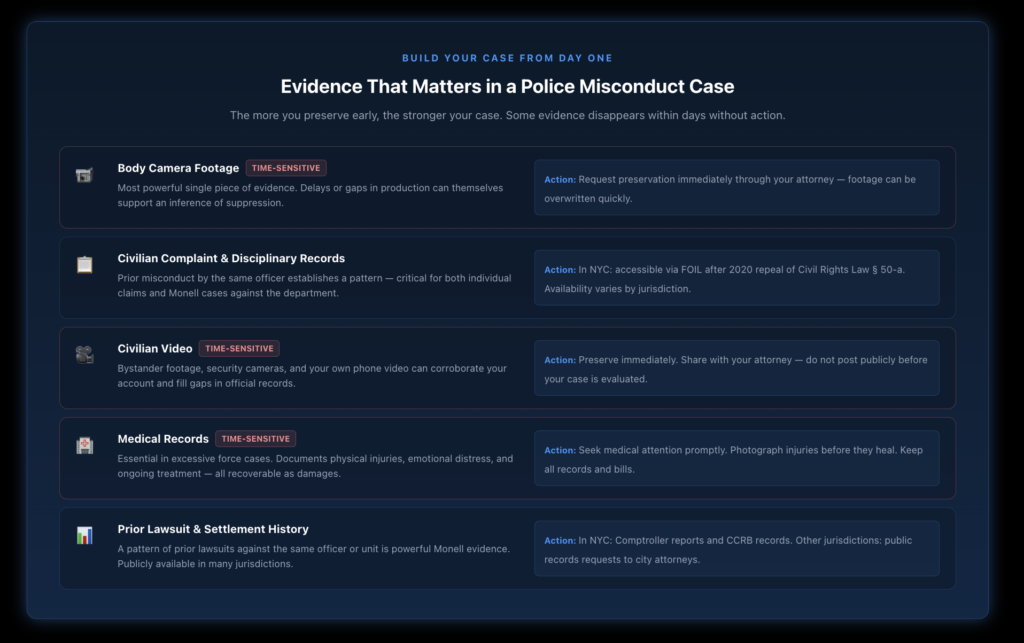
Body camera footage is often the most powerful piece of evidence. Most police officers are now equipped with body cameras. Footage can be requested through litigation, and delays in production can themselves raise inferences. Our civil rights practice overview explains what the discovery process looks like across all claim types.
Civilian complaint and disciplinary records — where accessible — can show a pattern of behavior by the officer or unit. In New York City specifically, the 2020 repeal of Civil Rights Law § 50-a opened CCRB complaints, disciplinary charges, and hearing transcripts to public access through FOIL requests. Other jurisdictions have their own civilian oversight mechanisms and varying disclosure rules. Review what falls within the CCRB’s jurisdiction if your claim involves an NYPD officer.
Civilian video — from bystanders, security cameras, or your own phone — can corroborate or contradict an officer’s account.
Medical records document injuries and are essential in excessive force cases.
Prior lawsuit history against the officer or department. Pattern evidence — showing prior misconduct by the same officer or unit — carries significant weight in Monell claims. The CCRB’s complaint process generates records that feed directly into civil litigation discovery for NYC cases.
Critical Deadlines You Cannot Miss
Police misconduct cases have strict filing requirements. Missing any of these windows can permanently bar your claim. The timelines vary by jurisdiction and by the type of claim, but you should assume you need to act quickly, potentially within 90 days of the incident, for certain state law claims.
- Notice of Claim — many jurisdictions require a Notice of Claim to be filed before any lawsuit against a government entity can proceed. In New York City, this must be filed within 90 days of the incident under General Municipal Law § 50-e. Requirements vary by state — confirm immediately whether your jurisdiction has this requirement.
- Federal § 1983 statute of limitations — typically 3 years from the date of the violation in most states, borrowed from state personal injury law. No Notice of Claim is required for federal claims, which is one reason many attorneys prefer federal court.
- State lawsuit commencement — in New York, suit on state law claims against the City must be commenced within 1 year and 90 days after filing the Notice of Claim under General Municipal Law § 50-i; confirm the equivalent deadline in your state
One important note: for claims involving wrongful arrest or false imprisonment, the federal clock starts running at the time of the arrest — not when charges are dropped. Wallace v. Kato, 549 U.S. 384 (2007). Don’t wait to see how the criminal case resolves.
What Can You Recover?
A successful police misconduct claim can result in:
- Compensatory damages — covering lost income, medical expenses, pain and suffering, and emotional distress
- Nominal damages — available when the civil rights violation is established but no specific compensable injury exists (often $1 but enables the plaintiff to seek attorneys’ fees as the prevailing party)
- Punitive damages — available against individual officers in cases of particularly egregious conduct (not against the municipality itself, and availability varies by jurisdiction)
- Injunctive relief — a court order requiring the law enforcement agency to change a specific practice
- Attorney’s fees — under 42 U.S.C. § 1988, if you prevail, the defendant is typically required to pay your legal costs
How the CCRB Fits In — And Why It's Not Enough
Most major jurisdictions have some form of civilian oversight board for law enforcement. In New York City, the Civilian Complaint Review Board (CCRB) is the independent agency that investigates complaints against NYPD officers in four categories: Force, Abuse of Authority, Discourtesy, and Offensive Language. Filing a CCRB complaint in NYC is free and can be done online, by phone at 800-341-CCRB, or in person at any NYPD precinct.
But there is a critical limitation that applies in New York City and in many other jurisdictions: civilian oversight board recommendations are typically not binding. In NYC, only the Police Commissioner can impose final discipline — and can deviate from CCRB recommendations without explanation.
A complaint with a civilian oversight board is not a substitute for a civil lawsuit. It can generate useful documentation for your case and may be required to preserve some state law claims, but it cannot get you compensation. And it does not protect your legal deadlines. If you were harmed by officer misconduct, a civil rights lawsuit is the mechanism that can actually deliver accountability and damages. For a broader view of how to navigate both, see our Civil Rights & Constitutional Litigation overview.
Ready to Talk Through Your Case?
Police misconduct cases are complex — they involve specific constitutional frameworks, strict deadlines, and institutions that have every resource to defend themselves. You need a lawyer who knows this terrain.
At Nisar Law Group, we represent individuals whose rights were violated by law enforcement. We take these cases on contingency, and we start every case with a free consultation.
Contact us at (212) 600-9534 to schedule a confidential consultation.
Why We're the Right Choice
- Seasoned Litigators Who Have Handled Numerous Jury & Bench Trials
- Providing Representation with Clarity, Honesty & Integrity
- Building Long-Term Affiliations & Relationships
- Offering Consultations for All Case Types We Handle
Frequently Asked Questions About Police Misconduct
Police misconduct is any action by a law enforcement officer that violates a person’s constitutional rights while acting under the authority of their badge. It covers a wide range — excessive force, unlawful searches, arrests without probable cause, racial profiling, religious discrimination, coercion, and retaliation for protected activity. Not every bad or unfair police interaction qualifies legally, but when an officer crosses a constitutional line, that conduct is actionable under federal law and applicable state and local law.
Excessive force and unlawful arrest are the most frequently litigated police misconduct claims nationwide. To illustrate the scale: the NYPD had 9,249 tort claim filings in FY2024 — a 31.8% increase from the prior year — with excessive force complaints reaching their highest level since 2013. Racial profiling is also widely documented: a federal monitor has been overseeing NYPD stop-and-frisk compliance since the Floyd v. City of New York ruling in 2013, and recent monitor reports continue to find systemic failures in officer discipline.
The strongest cases combine multiple forms of evidence: body camera footage, civilian complaint records, and disciplinary history (accessible in New York City after the 2020 repeal of Civil Rights Law § 50-a; availability varies by jurisdiction), civilian video, medical documentation, witness accounts, and prior lawsuit history against the officer or department. Pattern evidence — showing the officer or department has done this before — is particularly important in Monell claims. An attorney can help you identify what’s available and file the right discovery requests before evidence is lost or destroyed.
Officers cannot search you, your home, or your vehicle without a warrant, probable cause, or your informed consent. They cannot initiate a stop without reasonable suspicion. They cannot arrest you without probable cause. They cannot use force beyond what is objectively reasonable given the circumstances. They cannot target you for stops or arrests based on your race, ethnicity, or religion. They cannot retaliate against you for filming them in public, asserting your rights, or refusing an unlawful order. In New York specifically, the Eric Garner Anti-Chokehold Act makes chokeholds that cause serious injury a felony — one of the strictest use-of-force statutes in the country.
Police misconduct includes: excessive or deadly force, unlawful arrest or detention, illegal search and seizure, racial profiling, sexual assault or coercion, planting evidence or false reporting, failure to intervene when witnessing another officer’s misconduct, and retaliation against individuals for protected speech or activity. These claims are primarily brought under federal § 1983. Depending on your jurisdiction, state and local human rights laws may also apply — in New York City, for example, the NYC Human Rights Law and Local Law 48 provide additional protections and remove qualified immunity as a defense in local court actions.
You have a Fifth Amendment right to remain silent, and you are not required to answer questions beyond identifying yourself in certain circumstances. Anything you say can be used against you — in a criminal case or to complicate a future civil rights claim. If you believe your rights were violated, the most important thing you can do is document what happened as soon as possible: note the officer’s name and badge number, the time and location, and what was said and done. Then contact an attorney before giving any further statements.
The timeline varies depending on complexity, the number of defendants, and whether the case settles or goes to trial. Many misconduct cases settle before trial — sometimes within one to two years of filing. More complex cases, particularly those involving Monell claims against a municipality or contested facts, can take three to five years. The most important thing is not to let the statute of limitations run out while you wait — for federal § 1983 claims, you typically have three years from the date of the violation, though this varies by state.