
Did a Government Agency — Not Just One Officer — Violate Your Constitutional Rights?
We Can Help
Sometimes, misconduct isn’t just one bad officer making a bad decision. It’s a police department that systematically fails to train its officers. A city agency that has a known, documented practice of violating civil rights and does nothing to stop it. An institution that pays millions in settlements year after year but never changes the policies driving the harm.
When the violation isn’t just individual — when it’s institutional — the legal theory is different, and the defendants are different. At Nisar Law Group, we handle both claims against individual government officials and the broader constitutional litigation that holds institutions accountable for the policies and customs that made the violation possible.
If a government agency’s misconduct caused your rights to be violated — not just one employee acting alone — contact us to discuss whether you have a Monell claim or broader constitutional violation case.
Contact Nisar Law Group, P.C. at (212) 600-9534 to learn how we can be of service.
What Is Government Misconduct Under Federal Law?
Government misconduct and constitutional violations are brought under 42 U.S.C. § 1983, the federal civil rights statute that allows individuals to sue government actors who deprive them of constitutional rights. Most § 1983 claims target individual officers or officials. But a separate and often more powerful theory — established in Monell v. Department of Social Services (1978) — allows you to sue the municipality or government entity itself.
The critical rule from Monell: a government entity cannot be held liable just because it employed someone who did something wrong. You cannot sue a city simply because one of its employees violated your rights. What you can do is sue the city when that violation resulted from an official policy, a widespread custom, or a systemic failure for which the institution itself bears responsibility.
This distinction matters enormously. Individual officers can assert qualified immunity and may have limited personal assets. Municipalities cannot assert qualified immunity — and when you establish institutional liability, you are holding the full weight of the government entity accountable for what happened.
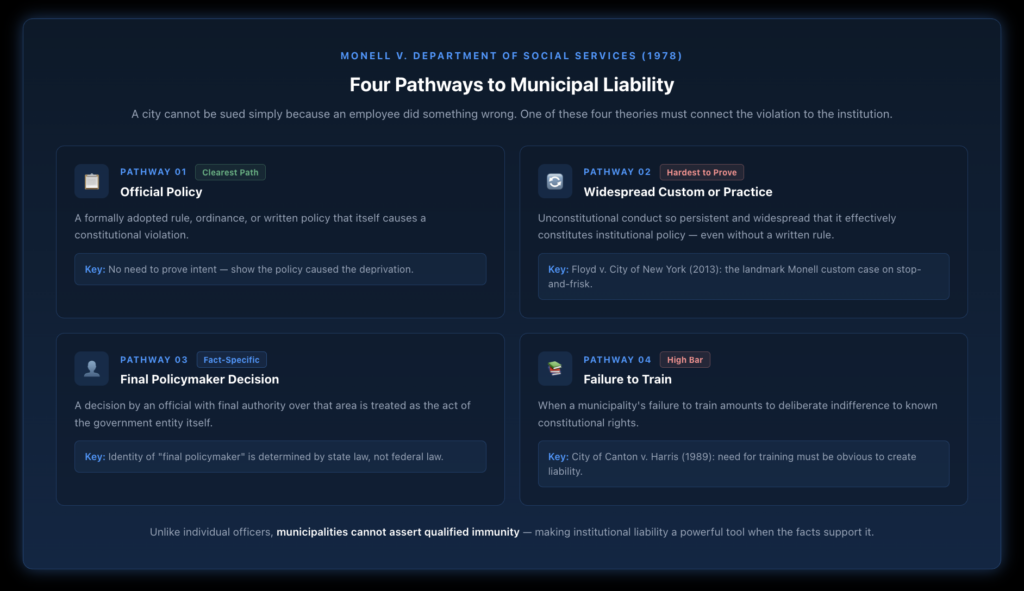
The Four Pathways to Municipal Liability
Official Policy
The clearest path to Monell liability: a formally adopted rule, ordinance, regulation, or written policy that itself causes a constitutional violation. If a department’s patrol guide authorizes conduct that violates the Fourth Amendment, or a city agency’s written procedures require employees to act in ways that deprive people of due process, the institution is liable for violations that flow from those policies. You don’t need to prove the city intended harm — you need to show the policy caused the constitutional deprivation.
Widespread Custom or Practice
Even without a written policy, a municipality is liable when unconstitutional conduct is so persistent and widespread that it effectively constitutes institutional policy. In Floyd v. City of New York, 959 F. Supp. 2d 540 (S.D.N.Y. 2013) — the landmark stop-and-frisk case and one of the most significant Monell decisions in recent decades — the court found the City liable under exactly this theory: not because of any written policy directing racial profiling, but because unconstitutional stops had become a de facto departmental practice that the institution deliberately ignored. The court imposed a federal monitor that continues to oversee compliance today, with recent reports finding the department continued to resist discipline for officers conducting illegal stops.
This is the hardest theory to prove — but also the most powerful in cases of systemic injustice. Pattern evidence is everything. Prior lawsuits, civilian complaint data, settlement history, and internal affairs records all feed into proving a widespread custom.
Decision by a Final Policymaker
When a government official with final authority over a particular area makes a decision — not just implementing policy but actually setting it — that decision is treated as the act of the government entity itself. The identity of a “final policymaker” is determined by state law, not federal law. A decision by a police commissioner not to pursue discipline against officers with documented patterns of misconduct, for example, is a final policymaker decision that can support Monell liability.
Failure to Train
Established in City of Canton v. Harris (1989), failure-to-train liability attaches when a municipality’s failure to train employees amounts to deliberate indifference to known constitutional rights. If the need for additional training was obvious — because officers regularly confronted a specific situation requiring legal judgment — and the city did nothing, that omission is itself an unconstitutional policy.
The Supreme Court has recognized that in some circumstances, a single violation may establish failure-to-train liability where the need for training was “so obvious” that the failure represents a deliberate choice. This is a high bar, but documented institutional failures of this kind — in areas like excessive force, stop-and-frisk standards, and bias-based policing — have supported multiple successful Monell claims in federal courts across the country.
What Constitutional Rights Are Most Commonly Violated by Government Actors?
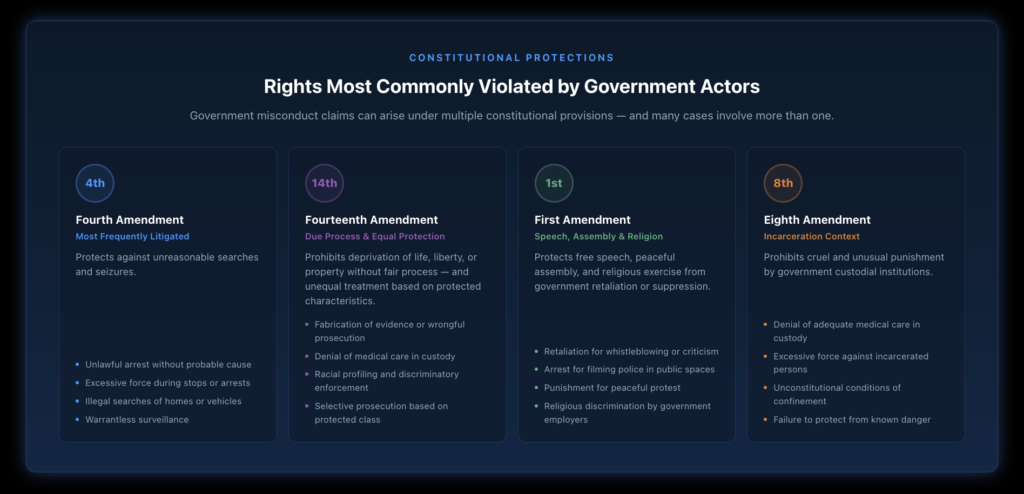
Government misconduct claims span the full range of constitutional protections:
Fourth Amendment — unreasonable searches and seizures, unlawful arrests, excessive force during stops, illegal searches of homes and vehicles. This is the most frequently litigated constitutional basis in civil rights cases, largely through police misconduct and wrongful arrest claims.
Fourteenth Amendment — Due Process — government deprivation of life, liberty, or property without fair procedures. Includes wrongful prosecution, fabrication of evidence, denial of medical care in custody, and arbitrary government action that “shocks the conscience.”
Fourteenth Amendment — Equal Protection — government targeting of individuals based on race, ethnicity, religion, national origin, sex, or other protected characteristics. Racial profiling, discriminatory enforcement, and selective prosecution all fall here.
First Amendment — government retaliation for protected speech, assembly, or religion. Public employees punished for whistleblowing, citizens arrested for filming police or attending protests, and government employees subjected to religious discrimination all have First Amendment dimensions. For cases specifically involving speech-based retaliation, see our First Amendment Retaliation page; for religious discrimination by government, see our Religious Discrimination by Government Entities page.
Eighth Amendment — cruel and unusual punishment by correctional institutions, including denial of medical care and excessive force against incarcerated individuals. These claims connect directly to our Prisoner Rights practice.
The Scale of Government Misconduct: What the Data Shows
Institutional data is one of the most powerful tools in a Monell case — and jurisdictions that publish it publicly provide a roadmap to proving a pattern-and-practice claim. New York City is one of the most documented examples in the country, and the numbers illustrate what systemic institutional failure looks like at scale.
According to the NYC Comptroller’s annual claims report, the City paid $1.94 billion in total settlements in FY2024 — the highest ever recorded — with NYPD alone accounting for 9,249 tort claim filings, up 31.8% from the prior year. A September 2025 Comptroller report identified 16 precincts with a 50%+ increase in civilian excessive force complaints, costing over $8.9 million in settlements from 2019–2024. More than 85% of residents in the four highest-complaint precincts are Black or Hispanic/Latino — a demographic pattern consistent with an equal protection violation, not random distribution.
The Comptroller recommended making city agencies financially responsible for their own settlement costs — a structural reform designed to create incentives for actual behavioral change. Under the current indemnification structure, individual officers face no personal financial consequences for misconduct, a policy critics have called a systemic moral hazard.
This kind of data — settlement histories, complaint concentration by unit, demographic breakdowns of who bears the burden — is exactly what Monell pattern-and-practice claims are built from. It exists in varying forms in most major jurisdictions. An attorney experienced in institutional civil rights litigation knows where to find it and how to use it.
Who Can Be Held Liable?
In a government misconduct case, the defendants can include:
Individual government officials — sued personally for their own unconstitutional acts. Subject to qualified immunity in federal court. In New York City specifically, Local Law 48 eliminates qualified immunity for unreasonable search, seizure, and excessive force claims brought under local law.
Supervisors — personally liable when they were directly involved in the violation, knew of a pattern of misconduct and were deliberately indifferent to it, or created the conditions that made the violation inevitable.
Municipalities and city agencies — liable under Monell when the violation resulted from official policy, widespread custom, a final policymaker’s decision, or failure to train. In many jurisdictions, the relevant government entity — not the department itself — is the proper defendant; in New York City, for example, the City is the proper defendant in most NYPD-related cases, not the NYPD as a standalone entity. Municipalities cannot assert qualified immunity.
The State — generally not a “person” under § 1983 and entitled to Eleventh Amendment sovereign immunity. Claims for declarative and injunctive relief against the State are asserted by suing the governor or agency heads in their official capacities under Ex Parte Young (1908). State officials can also be sued in their individual capacities for damages, though qualified immunity applies.
What Evidence Is Essential in a Government Misconduct Case?
Beyond the evidence of the specific violation, Monell claims require proof of the institutional failure. That means:
- Pattern evidence — prior lawsuits, civilian complaints, and settlement data involving the same unit, precinct, or type of conduct. Publicly available claims reports and databases — like the NYC Comptroller’s Claims Dashboard — are valuable starting points where they exist
- Civilian complaint records — where accessible, showing documented patterns of officer misconduct across time and unit
- Internal affairs bureau records — when obtainable through discovery, documenting what the institution knew and when
- Training materials and protocols — or the absence of them — to show whether the institution equipped its employees to act constitutionally
- Expert testimony on policing standards and practices — particularly in excessive force and stop-and-frisk cases
- Public statements by final policymakers — resolutions, press releases, and official communications that establish or acknowledge policy
Monell cases are complex and discovery-intensive. The institutional evidence that proves the policy or custom exists often requires litigation to obtain. Having experienced counsel from the start — before evidence is lost or destroyed — makes a significant difference.
How Long Do You Have to File?
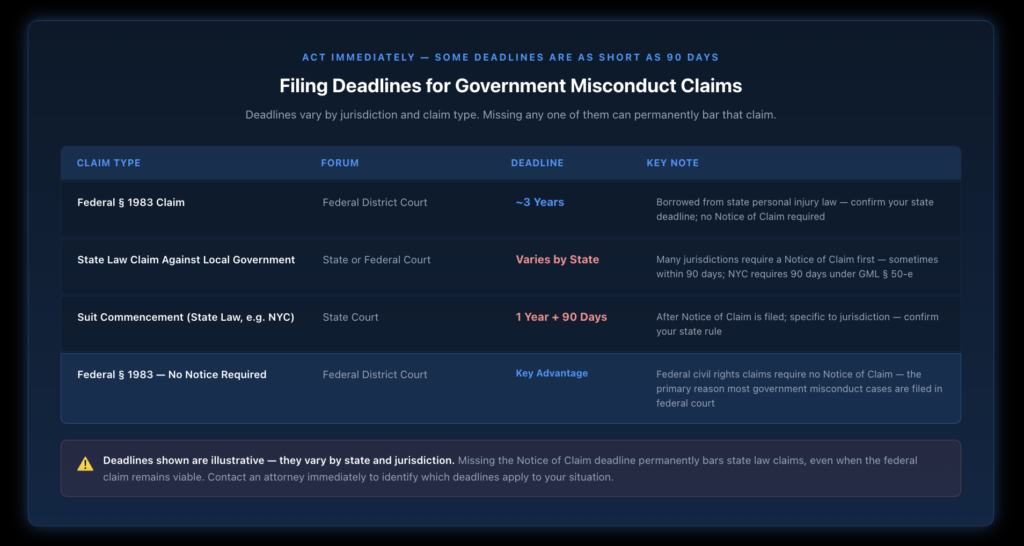
Deadlines in government misconduct cases vary by jurisdiction and by the type of claim. Identifying which deadlines apply must happen immediately — missing any of them can permanently bar certain claims.
- Federal § 1983 claims — typically 3 years from the date of the violation in most states, borrowed from the state’s personal injury statute of limitations; confirm the deadline in your state
- State law claims against local government entities — many jurisdictions require a Notice of Claim to be filed before suit can be brought, sometimes within as few as 90 days of the incident; in New York City, for example, a Notice of Claim must be filed within 90 days under GML § 50-e, and suit must commence within 1 year and 90 days under GML § 50-i
- Federal § 1983 claims do not require a Notice of Claim — a significant procedural advantage that makes federal court the preferred venue for most government misconduct cases
Missing any applicable Notice of Claim deadline for state law claims permanently bars those claims — even when the underlying federal claim remains viable.
What Can You Recover?
A successful government misconduct or Monell claim can result in:
- Compensatory damages — covering all actual losses: medical expenses, lost wages, lost earning capacity, physical pain and suffering, emotional distress, and reputational harm
- Nominal damages — available against individual government officials when no economic losses exist (often $1; triggers right to seek attorneys’ fees as prevailing party)
- Punitive damages — available against individual government officials in cases of particularly egregious conduct; not available against municipalities under City of Newport v. Fact Concerts, 453 U.S. 247 (1981)
- Injunctive relief — a court order requiring the agency to change a specific policy, practice, or custom. Floyd v. City of New York is the most significant recent example: the court not only awarded damages but imposed a federal monitor and ordered department-wide reforms
- Attorneys’ fees — under 42 U.S.C. § 1988, if you prevail on a federal civil rights claim, the defendant is typically required to pay your legal costs
Why Nisar Law Group?
Nisar Law Group is a boutique civil rights and employment litigation firm. We represent individuals — never corporations, never government entities. Every case we take is on behalf of someone whose rights we believe in.
Government misconduct and Monell cases are among the most complex in civil rights litigation. Building institutional liability requires understanding the Monell framework inside and out — which theory of liability fits the facts, what discovery to prioritize, and how to connect the specific violation to the institutional failure that made it possible. We know the federal court dockets, the relevant circuit precedent on Monell theories, and how to locate and deploy the institutional data sources — claims reports, civilian complaint databases, and settlement records — that provide the pattern evidence these cases depend on.
Government misconduct is the foundation of our entire Civil Rights & Constitutional Litigation practice. The specific violations — police misconduct, wrongful arrest, excessive force, prisoner rights — all connect back to the institutional accountability questions that Monell was designed to answer.
We handle civil rights cases on a contingency basis, which means you don’t pay legal fees unless we recover for you. Every case starts with a free consultation.
Contact us at (212) 600-9534 to schedule a confidential consultation.
Why We're the Right Choice
- Seasoned Litigators Who Have Handled Numerous Jury & Bench Trials
- Providing Representation with Clarity, Honesty & Integrity
- Building Long-Term Affiliations & Relationships
- Offering Consultations for All Case Types We Handle
Frequently Asked Questions About Government Misconduct
Government misconduct occurs when a government official or agency violates a person’s constitutional rights while acting under the authority of government power. Under 42 U.S.C. § 1983, individuals can sue government actors for constitutional violations. Beyond individual misconduct, the Monell doctrine extends liability to municipalities and government entities when the violation resulted from official policy, a widespread practice, or a failure to train employees — meaning the institution itself, not just the individual officer, can be held responsible.
Misconduct by a federal official involves a government actor violating a person’s constitutional rights or federal statutory rights while exercising federal authority. For state and local government misconduct — including police officers, city agency employees, and state officials — Section 1983 is the primary vehicle and carries a statute of limitations that varies by state, typically three years, with no administrative exhaustion requirement.
Government misconduct examples include: unlawful searches or arrests by police without probable cause; excessive force during law enforcement encounters; fabrication of evidence or witness tampering; racial profiling as a departmental practice; denial of medical care in custody; retaliation against employees or citizens for exercising constitutional rights; deprivation of due process in administrative or disciplinary proceedings; and systemic discrimination in government services. When these violations reflect departmental policy or a widespread practice rather than an isolated incident, they may support both individual and institutional liability under Monell.
A constitutional violation occurs when a government actor deprives a person of rights guaranteed by the U.S. Constitution while acting under color of state or federal law. The most commonly violated protections include the Fourth Amendment right against unreasonable searches and seizures, the Fourteenth Amendment guarantees of due process and equal protection, the First Amendment protections for free speech and religion, and the Eighth Amendment prohibition on cruel and unusual punishment. Not every government error is a constitutional violation — the conduct must rise to the level of actually depriving someone of a protected constitutional right, not merely being unfair or procedurally flawed.
Yes. Under 42 U.S.C. § 1983, you can sue state and local government officials and municipalities for constitutional violations. Individual officials can be sued personally, and municipalities can be sued when the violation resulted from official policy, widespread custom, or failure to train under the Monell doctrine. Municipalities cannot assert qualified immunity, which is a significant advantage in institutional liability cases. In many jurisdictions, a Notice of Claim may be required before state law claims can be filed against a government entity — often within 90 days of the incident — though federal § 1983 claims carry no such requirement, which is why most government misconduct cases are filed in federal court.
A constitutional violation typically involves a government actor — a police officer, a corrections officer, a government agency employee, a public school administrator — taking action that deprived you of a right protected by the Constitution, and doing so in their governmental capacity. Signs that a constitutional violation may have occurred include: being arrested or detained without legitimate legal justification; having your home, car, or person searched without consent or legal authority; being subjected to force that went beyond what the situation required; being punished for speech, a complaint, or protected activity; being denied medical care while in government custody; or being treated differently from others based on race, religion, or another protected characteristic.
Government misconduct falls into several categories. Law enforcement misconduct includes false arrest, excessive force, illegal search, racial profiling, and fabrication of evidence. Institutional misconduct involves the policies, customs, or training failures of agencies themselves — this is the domain of Monell claims against municipalities. Due process violations arise when the government deprives someone of liberty or property without fair procedures. Equal protection violations occur when the government treats people differently based on protected characteristics. First Amendment violations include retaliation for speech, assembly, or religion. Eighth Amendment violations involve cruel and unusual conditions in government custody.