

Getting fired is one of the most disorienting things that can happen in your career. But beyond the emotional gut punch, there’s a question that matters legally: was your firing actually illegal? In New York, employees have some of the strongest protections in the country against wrongful termination — and knowing where those lines are can mean the difference between walking away and holding your employer accountable.
This guide breaks down exactly when a firing crosses from unfortunate to unlawful, what your rights look like under New York law, and what steps to take if you think you were pushed out illegally.
Key Takeaways
- New York is an at-will state, but there are significant legal exceptions that protect employees from illegal firing
- New York State and New York City laws go further than federal protections, covering more protected classes
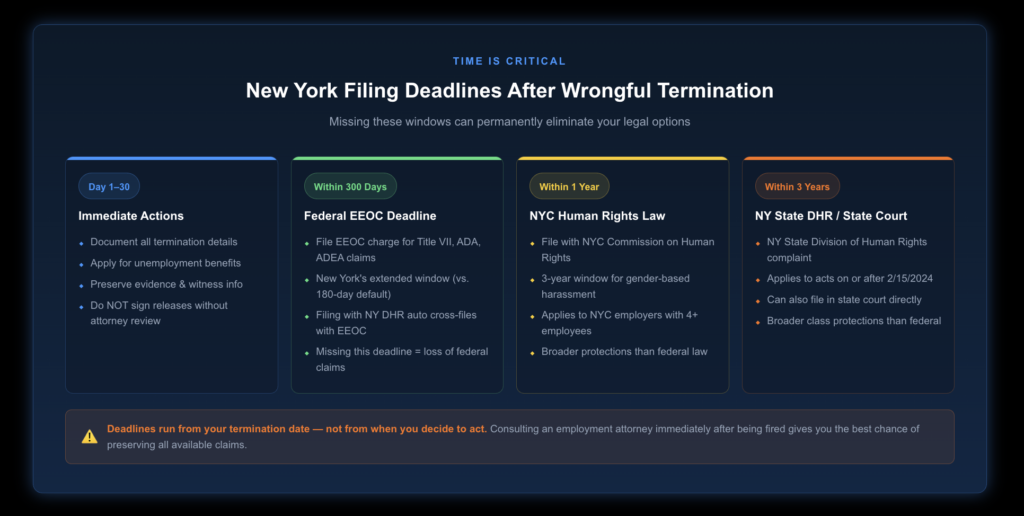
- Timing is critical: EEOC complaints must be filed within 300 days; NY State DHR complaints within 3 years (for acts after 2/15/2024)
- Documentation from day one dramatically strengthens your case
- You have a legal duty to mitigate damages by continuing your job search
Disclaimer: This article provides general information for informational purposes only and should not be considered a substitute for legal advice. It is essential to consult with an experienced employment lawyer at our law firm to discuss the specific facts of your case and understand your legal rights and options. This information does not create an attorney-client relationship.
What Are the Grounds for Wrongful Termination in New York?
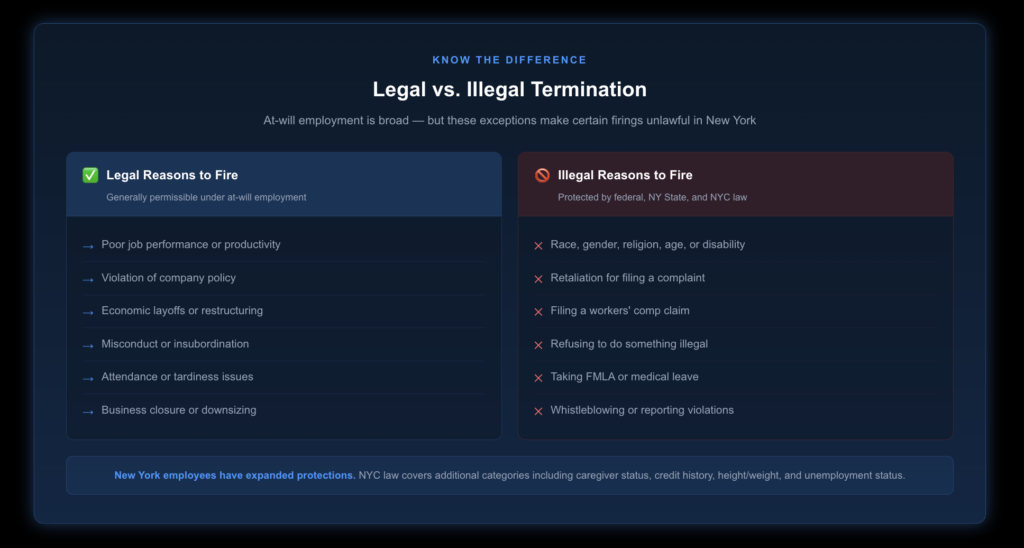
New York is an at-will employment state, meaning your employer can legally let you go for almost any reason — or no reason at all. That sounds stark, but it’s not the whole picture.
There are well-established legal exceptions that make certain firings illegal. Understanding those exceptions is the whole ballgame.
What Exceptions Protect New York Employees?
The Public Policy Exception prevents employers from firing you for exercising legal rights. That includes filing for workers’ compensation, reporting illegal activity, serving on jury duty, or voting. These are activities the law explicitly protects — your employer cannot punish you for them.
The Implied Contract Exception covers situations where your employer created a reasonable expectation of job security — through an employee handbook, verbal assurances, or consistent past practice. If the company said “we only fire for cause” and then fired you without cause, that promise may be legally enforceable.
The Covenant of Good Faith is recognized in some jurisdictions and requires that employers act in good faith when making termination decisions, particularly around commission payments or pension benefits that are close to vesting.
How Do New York's Protections Compare to Federal Law?
This is where New York employees have a real advantage. Federal law covers protected classes like race, sex, religion, national origin, age (over 40), and disability. But New York City’s Human Rights Law goes considerably further.
What Does the NYC Human Rights Law Cover That Federal Law Doesn’t?
The NYC Human Rights Law prohibits employment discrimination based on a much broader list — including caregiver status, credit history, unemployment status, salary history, height and weight, and sexual and reproductive health decisions. NYC employers with as few as 4 employees are covered, compared to the 15-employee federal threshold under Title VII.
At the state level, the New York State Division of Human Rights enforces the NY Human Rights Law, which similarly extends protections beyond federal minimums. A complaint filed with NY DHR is automatically cross-filed with the EEOC, so you protect your rights under both systems at once.
The practical takeaway: if you work in New York City and you were fired, your legal options are likely broader than you realize.
What Are Common Types of Wrongful Termination?
Can You Be Fired Based on Discrimination?
Discrimination-based termination is one of the most common forms of illegal firing. Federal law protects against termination based on race or national origin, gender, religion, age over 40, and disability. New York law adds sexual orientation, gender identity, marital status, and more.
Discrimination isn’t always explicit. It often looks like a pattern: suddenly getting negative performance reviews after years of stellar feedback, being excluded from meetings, or being held to standards your coworkers aren’t. The EEOC’s federal protections establish the baseline — New York builds well above that floor.
What Does Retaliation as Wrongful Termination Look Like?
Employer retaliation is one of the most frequently misunderstood types of wrongful termination. Your employer cannot fire you for engaging in legally protected activities — including filing a complaint with the EEOC, reporting safety violations to OSHA, requesting FMLA leave, reporting wage and hour violations, or requesting a reasonable accommodation.
The key legal element is proving a causal connection between the protected activity and the firing. Courts look at timing closely — a termination that comes days after a protected complaint is a significant red flag.
What Happens When an Employment Contract Is Breached?
Even in an at-will environment, a contract can change everything. Written employment agreements, offer letters specifying termination procedures, or employee handbook policies that promise progressive discipline all create enforceable expectations. If your employer bypassed their own stated procedures to fire you, that gap matters.
Verbal promises matter too. Statements like “we don’t fire people without cause” — especially when combined with a long employment history — can constitute an implied contract. Your breach of contract claim depends on showing that a reasonable person would have understood those words as a promise.
Can You Be Fired Without Warning in New York?
Technically, yes — at-will employment means no advance notice is required by default. But in practice, many employers create their own obligations through policies they don’t follow.
When Does No Warning Become Illegal?
If your company has a progressive discipline policy — written warnings, performance improvement plans, documented steps before termination — and they skipped all of it to fire you, that inconsistency is legally significant. Courts treat a company’s own policies as evidence of what the employment relationship actually was.
Similarly, if a suspicious pattern of circumstances surrounds your firing — you were let go days after raising a complaint, or right before a major pension vested — those facts don’t prove wrongful termination on their own, but they build a case.
How Do You Recognize Warning Signs of Wrongful Termination?
What Timing Red Flags Should You Watch For?
The timing of a termination is often the clearest signal that something is wrong. Watch for:
- Being fired shortly after filing a workers’ comp claim, EEOC complaint, or safety report
- Termination following a return from FMLA or pregnancy-related leave
- Being let go after refusing to participate in something illegal or unethical
- Dismissal that happens right before stock options vest or a pension benefit kicks in
What Changes in Treatment Signal a Problem?
Before a wrongful termination, there’s often a documented pattern. Sudden negative performance reviews after years of positive ones, exclusion from meetings you used to attend, unrealistic performance expectations that aren’t applied to colleagues, or sudden intensified scrutiny — these are patterns courts recognize as circumstantial evidence of discriminatory or retaliatory intent.
Pay particular attention to any comments linking your treatment to a protected characteristic — comments about age, race, or gender can become pivotal evidence. Even offhand remarks matter if they’re documented.
Why Does Documentation Matter So Much?
Start documenting the moment you sense something may be wrong — before you’re fired. Save emails, keep copies of performance reviews, write down the details of conversations while they’re fresh, and preserve the contact information of coworkers who witnessed relevant conduct.
Your former employer has a legal duty to preserve documents once they know litigation is possible, but your copies of critical evidence give you independence from their compliance.
What Happens If You Are Illegally Fired?
The legal process has a real structure, and navigating it correctly from the start determines how much ground you keep.
What Are the Administrative Requirements?
Most discrimination-based wrongful termination claims require filing with a government agency before you can sue in court. For federal claims, that means the EEOC — you typically have 300 days from the discriminatory act in New York (a state with its own civil rights agency). For state claims, the NY State Division of Human Rights accepts complaints within 3 years for acts occurring after February 15, 2024.
Missing these deadlines doesn’t just weaken your case — it can permanently destroy your right to sue. An employment attorney can help you identify which agencies apply to your specific claims and ensure you file correctly.
How Do You Build a Wrongful Termination Case?
Evidence is everything. Collect employment records, performance evaluations, emails, your written job description, and witness contact information. Document your financial losses — lost wages, lost benefits, job search expenses, and emotional distress impacts.
Identify who might serve as a witness. Coworkers who heard discriminatory comments or witnessed you being treated differently can provide testimony that’s difficult to explain away. Reach out to them before they change jobs or lose touch.
Is It Worth Suing for Wrongful Termination?
This is the practical question most people want answered. The honest answer: it depends on the strength of your case, the damages involved, and what you want from the outcome.
What Can You Recover in a Wrongful Termination Case?
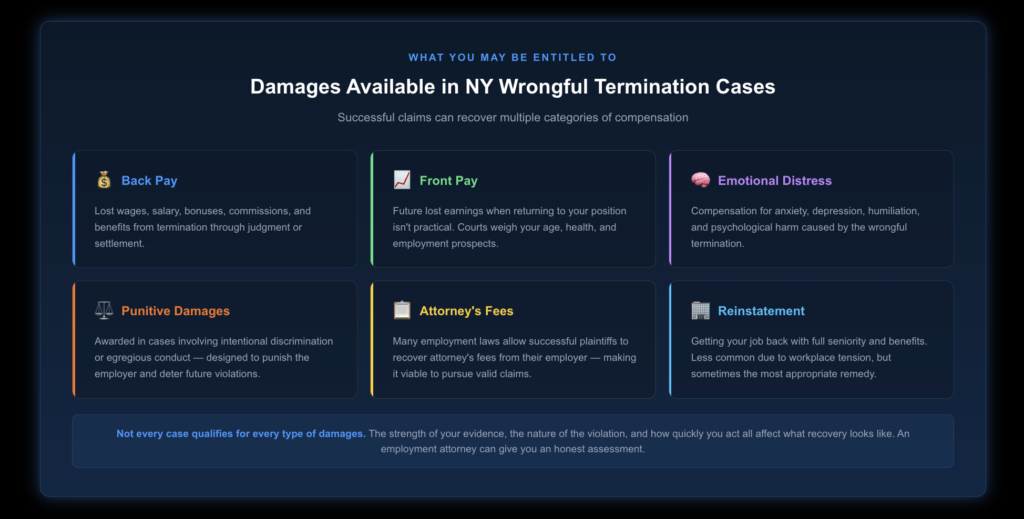
Back Pay covers wages and benefits from the date of termination through judgment or settlement — salary, bonuses, commissions, and the value of lost benefits like health insurance.
Front Pay addresses future lost earnings when returning to your job isn’t practical. Courts weigh factors like your age, health, work-life expectancy, and the likelihood of finding comparable employment.
Emotional Distress Damages compensate for the psychological harm caused by the wrongful termination — anxiety, depression, and the impact on your personal life.
Punitive Damages are available in cases involving intentional discrimination or especially egregious employer conduct. They’re designed to punish the employer and deter similar behavior.
Attorney’s Fees — many employment laws allow winning plaintiffs to recover attorney’s fees from their employer, which is a major factor in making these cases viable to pursue.
Reinstatement — getting your job back with full seniority. Not always practical given the working relationship, but sometimes the right remedy.
How Hard Is It to Win a Wrongful Termination Case?
Wrongful termination cases aren’t slam dunks — but strong cases with clear documentation and a provable connection between a protected characteristic or activity and the firing do win. The difficulty varies considerably based on the type of claim.
What Makes a Strong Case?
- A clear timeline showing protected activity followed quickly by adverse action
- Evidence of inconsistent treatment (you were disciplined; coworkers weren’t for the same thing)
- The employer’s stated reason doesn’t hold up to scrutiny — this is the pretextual termination argument
- Documented comments or conduct that reflect discriminatory intent
- Employer’s failure to follow their own stated policies before firing you
Cases that rest purely on gut feeling without documentation are harder to win. Cases with solid paper trails, credible witnesses, and inconsistencies in the employer’s explanation have genuine paths to recovery.
What Should You Do Immediately After Being Fired?
Time matters in two ways — legally and practically.
The First 30 Days After Termination
Document everything while it’s fresh. Write down exactly what was said, who was present, what led up to the firing, and anything that seemed unusual. Include dates, times, and direct quotes where possible.
File for unemployment benefits right away at NY.gov unemployment — you can pursue this even while challenging your termination. These are separate proceedings.
Don’t sign anything your former employer hands you without having an attorney review it. Severance agreements often include broad releases of legal claims. Once signed, those claims may be waived permanently. Understanding your post-termination rights before you sign anything is essential.
Consult an employment attorney — the sooner, the better. Deadlines run from the date of termination, not the date you decided to pursue a claim.
What About Your Job Search?
You have a legal duty to “mitigate damages” by actively looking for comparable work. Keep detailed records of applications, interviews, and any positions offered. Turning down a reasonable comparable offer can reduce the damages you recover.
This doesn’t mean taking any job that comes along — it means making a genuine, documented effort. Your job search records become evidence if your case goes to court.
Who Pays When You Sue an Employer for Wrongful Termination?
Your employer is the defendant and bears the financial liability for damages if you prevail. In most wrongful termination cases, the employer — not individual supervisors — is responsible for paying judgments or settlement amounts.
Does the Employer’s Insurance Cover This?
Many employers carry employment practices liability insurance (EPLI) that covers discrimination and wrongful termination claims. This often means there’s an insurer at the table during settlement negotiations, which can actually facilitate resolution.
If you prevail on certain federal claims, courts may also order your employer to pay your attorney’s fees and legal costs — a provision that exists specifically to make it financially viable for employees to pursue valid claims.
Ready to Protect Your Rights?
If you think your firing was illegal, the worst thing you can do is wait. Legal deadlines are real and unforgiving, and the quality of your case depends heavily on how quickly you start preserving evidence and getting proper advice.
Nisar Law Group represents employees across New York and New Jersey who have been subjected to discrimination, retaliation, and wrongful termination. Contact us today for a confidential consultation — we’ll review the facts of your situation and help you understand what options you actually have.
At Nisar Law Group, P.C., our New York lawyers are prepared to hold your employer accountable for illegal conduct directed at you. Contact us online or call us to discuss your case.
Frequently Asked Questions About Wrongful Termination in New York
Retaliation and wrongful termination often overlap, but they’re distinct legal theories. Wrongful termination is the broader category — it covers any firing that violates the law, whether that’s discrimination, contract breach, or public policy. Retaliation is a specific type of wrongful termination where the firing is punishment for something you did that the law protects, like filing an EEOC complaint, reporting safety violations, or requesting FMLA leave. You can have a retaliation claim without a separate discrimination claim — and in some cases, you can have both. The practical difference matters when deciding which agencies to file with and what legal theories to pursue.
A few concrete examples: an employee with 12 years of strong performance reviews is fired two weeks after filing an internal sexual harassment complaint — that’s retaliation. A 58-year-old manager is let go in a “restructuring” and replaced by a 32-year-old — that’s a potential age discrimination claim. An employee requests a reasonable accommodation for a disability and is terminated instead of accommodated — that implicates the ADA and New York disability protections. A worker reports wage theft to the Department of Labor and is fired the following month — that’s retaliation for protected whistleblowing activity. In each case, what matters legally is the connection between a protected characteristic or activity and the decision to fire.
The most powerful evidence tends to fall into a few categories. Comparative evidence — showing that employees outside your protected class were treated differently for the same conduct — is often decisive. Timing is critical: terminations that closely follow a protected activity carry a strong inference of retaliation. Written records like performance evaluations, emails, and HR documentation can contradict an employer’s stated reason for firing you. Witness testimony from coworkers who observed discriminatory comments or differential treatment adds independent credibility. And the employer’s own inconsistencies — changing explanations for the termination, or failing to follow their own disciplinary policies — often become some of the strongest evidence in a case.
Outcomes vary significantly depending on the strength of evidence, the legal theory, and whether the case settles or goes to trial. EEOC data consistently shows that a substantial portion of discrimination charges result in some form of resolution — mediation, settlement, or a finding of reasonable cause — before ever reaching a courtroom. Cases with clear documentation, credible witnesses, and a demonstrable inconsistency in the employer’s stated reason tend to settle favorably. Cases that go to trial are less predictable. The honest answer is that a qualified employment attorney can give you a realistic assessment of your specific facts — generic win rates don’t tell you much about your individual situation.
Retaliation doesn’t always mean getting fired immediately. Two common patterns: first, sudden negative performance reviews that appear only after you file a complaint or request an accommodation — especially when prior reviews were consistently positive. Second, being abruptly reassigned to less desirable duties, stripped of responsibilities, or excluded from meetings and projects you previously participated in. Both of these qualify as adverse employment actions under federal and New York law, even without a termination. Courts recognize that retaliation is often incremental — a pattern of increasingly negative treatment that eventually culminates in a firing or forces a resignation.
Under New York law, termination based on any protected characteristic is actionable. Common examples include: firing an employee after they reveal a pregnancy or request maternity leave; terminating someone after learning of a religious accommodation request; dismissing an older employee and citing “culture fit” without objective performance data; firing someone shortly after they disclose a disability or mental health condition; and terminating an employee of one race while keeping employees outside that protected class who engaged in similar conduct. NYC law adds additional protected categories — including caregiver status and unemployment status — that aren’t covered federally, so New York City employees have a broader range of potential claims than employees in most other states.
You can pursue claims through government agencies — EEOC for federal claims, NY State Division of Human Rights for state claims, or the NYC Commission on Human Rights for NYC-based violations. These agencies investigate and may facilitate resolution. If they issue a right-to-sue letter, you can file a lawsuit in court seeking back pay, front pay, emotional distress damages, punitive damages in egregious cases, and attorneys’ fees.
