

Wage theft occurs when employers fail to pay workers the full wages they’ve legally earned—whether through unpaid overtime, minimum wage violations, illegal deductions, or misclassification schemes. In New York, employees have powerful protections under both federal and state law, and as of September 2023, wage theft is classified as larceny under New York State Penal Law, meaning employers can face criminal prosecution for failing to pay wages. Understanding how to identify these schemes and take action is essential for protecting your hard-earned income.
Key Takeaways
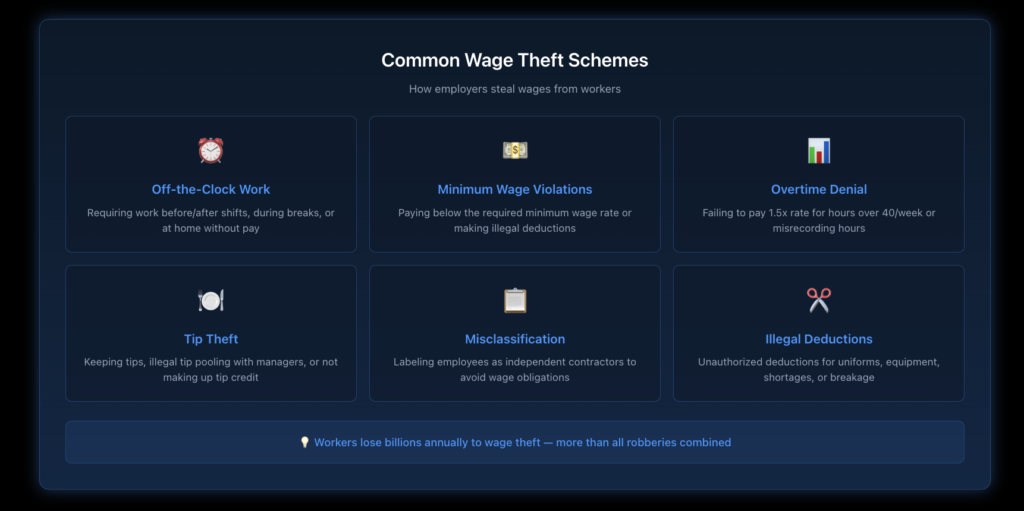
- Wage theft costs American workers billions annually, with common schemes including off-the-clock work, minimum wage violations, overtime denial, and employee misclassification.
- New York provides stronger protections than federal law, including criminal penalties for employers who steal wages.
- You can file claims with the New York State Department of Labor, the U.S. Department of Labor, or pursue private legal action.
- The statute of limitations for wage claims is six years in New York State courts.
- Employees are protected from retaliation for reporting wage violations.
- Liquidated damages (double damages) are available for willful violations.
Disclaimer: This article provides general information for informational purposes only and should not be considered a substitute for legal advice. It is essential to consult with an experienced employment lawyer at our law firm to discuss the specific facts of your case and understand your legal rights and options. This information does not create an attorney-client relationship.
What Are the Most Common Forms of Wage Theft?
Wage theft takes many forms, but certain schemes appear repeatedly across industries. Recognizing these tactics is the first step toward recovering your stolen wages.
How Does Off-the-Clock Work Violate Your Rights?
One of the most prevalent forms of wage theft involves employers requiring work before or after scheduled shifts without compensation. This includes mandatory pre-shift meetings, setting up workstations, cleaning after closing, responding to work emails from home, or donning required safety equipment. Under the Fair Labor Standards Act, all time spent performing work activities must be compensated—even if the employer didn’t explicitly authorize the extra time.
What Counts as Minimum Wage Violations?
Minimum wage violations occur when employers pay workers less than the legally required rate. In New York, the minimum wage varies by region and employer size, with New York City, Long Island, and Westchester having different rates than the rest of the state. Some employers attempt to circumvent these requirements by making illegal deductions for uniforms, equipment, or cash register shortages that push effective wages below minimum wage.
How Do Employers Deny Proper Overtime Pay?
Under the FLSA, non-exempt employees must receive overtime pay at 1.5 times their regular rate for hours worked over 40 in a workweek. Employers commit overtime theft through various methods: averaging hours across multiple weeks, paying straight time for overtime hours, or simply not recording all hours worked. Some employers instruct workers to clock out after 40 hours but continue working, a practice that directly violates federal and state law.
What Is Employee Misclassification?
Misclassifying employees as independent contractors is one of the most damaging forms of wage theft. When employers incorrectly classify workers as contractors, they avoid paying overtime, providing benefits, and contributing to unemployment insurance and workers’ compensation. New York uses the “ABC test” to determine worker classification, which presumes workers are employees unless the employer can prove otherwise.
How Does Tip Theft Happen?
For tipped workers, wage theft can involve employers keeping tips, implementing illegal tip pooling arrangements that include managers, or failing to make up the difference when tips plus the tipped minimum wage don’t equal the standard minimum wage. Under New York law, tips belong entirely to employees, and managers cannot participate in tip pools.
What Evidence Do You Need to Prove Wage Theft?
Building a strong wage theft case requires documentation. The burden often falls on employees to prove violations because employers are legally required to maintain accurate records—and those who commit wage theft rarely do so voluntarily.
What Records Should You Keep?
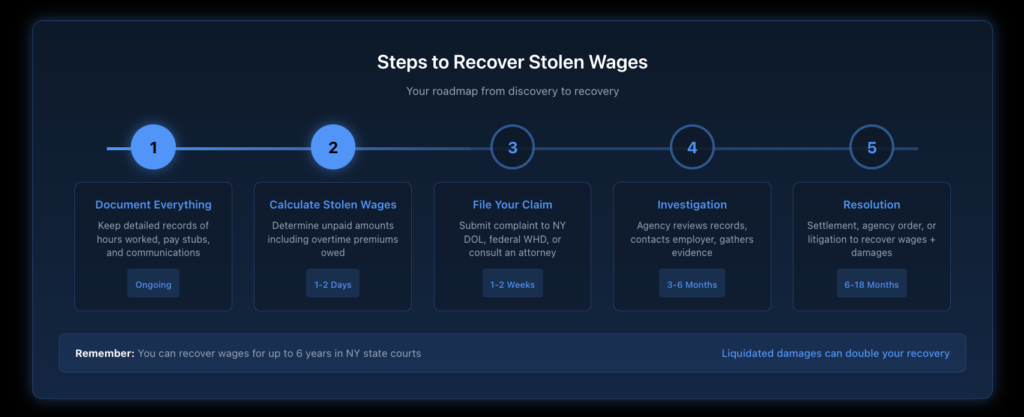
Start keeping your own detailed records immediately. This includes personal timesheets documenting actual hours worked, photographs of posted schedules, copies of pay stubs and wage notices, any written communications about pay rates or schedules, and witness contact information for coworkers who can corroborate your account. The Wage Theft Prevention Act requires New York employers to provide written wage notices and accurate pay stubs—if your employer isn’t providing these, that’s already a violation you can document.
How Do You Calculate Your Stolen Wages?
To calculate what you’re owed, multiply your unpaid hours by your regular hourly rate for non-overtime hours. For overtime hours, multiply by 1.5 times your regular rate. Remember to account for all time worked, including pre-shift and post-shift activities. If you were paid below minimum wage, calculate the difference between what you received and the applicable minimum wage rate for each hour worked.
Who Can You Report Wage Theft To?
New York workers have multiple avenues for recovering stolen wages, each with different advantages and limitations.
How Does the New York State Department of Labor Handle Claims?
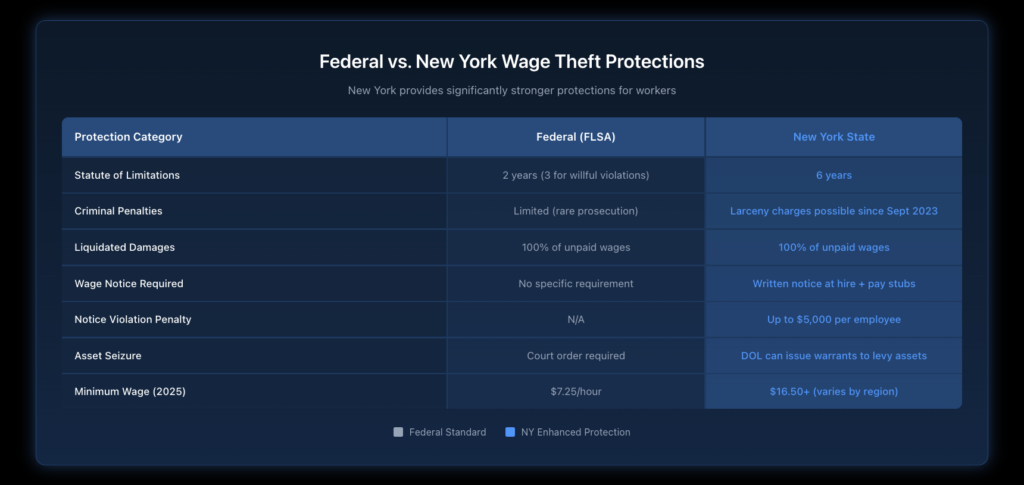
The NYS Department of Labor Division of Labor Standards investigates wage theft claims and can order employers to pay back wages plus penalties. Filing with the state is free and doesn’t require an attorney. The DOL can issue warrants to levy employer assets and refer cases to district attorneys for criminal prosecution. You can file a claim for unpaid wages going back six years through the Wage Theft Hub.
What About Federal Options?
The U.S. Department of Labor Wage and Hour Division enforces the FLSA and can investigate complaints. Federal claims have a two-year statute of limitations (three years for willful violations). The federal route may be preferable if you work for a multi-state employer or if state resources are overwhelmed. You can reach the WHD toll-free at 866-4US-WAGE.
When Should You Consider Private Legal Action?
Private lawsuits allow you to recover not just back wages but also liquidated damages (essentially doubling your recovery) and attorneys’ fees. Under the FLSA, you can bring a collective action on behalf of yourself and similarly situated coworkers, which can be powerful when an employer has systematically violated wage laws across their workforce.
What Makes New York's Wage Theft Protections Stronger?
New York provides significantly more protection than federal law alone, giving workers multiple advantages when pursuing wage claims.
How Does Criminal Liability Affect Employers?
As of September 2023, wage theft in New York is explicitly classified as larceny under Penal Law Section 155. This means employers who steal wages can face criminal prosecution, including potential jail time for significant violations. This criminal liability creates a powerful deterrent that federal law doesn’t provide.
What Damages Are Available Under State Law?
New York allows workers to recover liquidated damages equal to 100% of their unpaid wages for most violations. Combined with the six-year statute of limitations (compared to two years under federal law), this means workers can potentially recover substantial amounts. Employers who fail to provide required wage notices face additional penalties of up to $5,000 per employee.
How Are Workers Protected from Retaliation?
New York law prohibits employer retaliation against workers who report wage violations, file complaints, or cooperate with investigations. If you’re demoted, terminated, or otherwise punished for asserting your wage rights, you have a separate legal claim against your employer. This protection applies even if your underlying wage claim is ultimately unsuccessful—what matters is that you had a good faith belief that a violation occurred.
What Industries See the Most Wage Theft?
While wage theft can occur anywhere, certain industries have higher rates of violations. If you work in one of these sectors, extra vigilance about your pay is warranted.
Which Sectors Are Most Affected?
Construction, restaurants and food service, retail, home healthcare, janitorial services, and agriculture consistently show high rates of wage violations. These industries often rely on vulnerable workers, including immigrants and those paid in cash, who may be less likely to report violations. The Department of Labor prioritizes enforcement in these high-violation industries.
Why Are Low-Wage Workers Particularly Vulnerable?
Low-wage workers face the highest risk of wage theft partly because they often lack bargaining power and may fear retaliation. Workers in exempt classifications that don’t qualify for overtime sometimes accept the classification without questioning whether it’s legally correct. Many workers simply don’t know their rights or assume fighting back isn’t worth the effort—but wage claims can result in significant recoveries.
How Can You Detect Wage Theft in Your Paycheck?
Catching wage theft early requires understanding what should appear on your pay stub and recognizing common red flags.
What Should Your Pay Stub Include?
New York’s Wage Theft Prevention Act requires employers to provide detailed wage statements every pay period showing hours worked, rates of pay, deductions, and net wages. If your pay stub lacks this information—or if you don’t receive pay stubs at all—that’s a violation in itself. Compare your pay stub against your own records of hours worked to catch discrepancies.
What Are the Warning Signs?
Red flags include being asked to work “off the clock,” having your time records altered, receiving a salary when your job duties suggest you should be classified as non-exempt and eligible for overtime, unexplained deductions you didn’t authorize, being paid in cash without proper documentation, or being classified as an independent contractor when you work set hours with company equipment under direct supervision.
What Is the 7-Minute Rule and Does It Apply in New York?
The “7-minute rule” is a timekeeping practice where employers round employee time to the nearest quarter hour. If you clock in at 8:07, your time rounds down to 8:00; if you clock in at 8:08, it rounds up to 8:15.
Is Time Rounding Legal?
Time rounding is legal under the FLSA regulations only if it averages out fairly over time and doesn’t systematically favor the employer. If an employer always rounds down when employees clock in and always rounds up when they clock out, that’s illegal wage theft. The rounding must be neutral and applied consistently in both directions.
What About New York’s 4-Hour Rule?
New York has a separate “call-in pay” or “show-up pay” requirement. If you report to work as scheduled but are sent home early, you’re entitled to a minimum of four hours of pay (or the number of hours in your scheduled shift, whichever is less) at minimum wage. This protects workers from employers who schedule them and then send them home without meaningful compensation.
Ready to Take Action Against Wage Theft?
If you believe your employer has stolen your wages through any of the schemes described above, you have legal options. Nisar Law Group represents employees in wage theft cases throughout New York, helping workers recover unpaid wages, overtime, and damages. Our employment attorneys understand the tactics employers use and how to build strong cases for recovery. Contact us today to discuss your situation and learn what your wage claims may be worth.
Frequently Asked Questions About Wage Theft
A common example is requiring employees to work “off the clock”—such as asking workers to arrive 15 minutes early to set up their workstations or stay late to finish tasks without recording that time. Over weeks and months, these unpaid minutes add up to significant stolen wages. Other examples include paying below minimum wage, denying overtime to eligible workers, making illegal deductions from paychecks, or misclassifying employees as independent contractors to avoid paying benefits and overtime.
Yes. As of September 2023, wage theft is classified as larceny under New York State Penal Law Section 155. This means employers who fail to pay workers their earned wages can be referred to local district attorneys for criminal prosecution. The severity of criminal charges depends on the amount stolen, with larger theft amounts potentially resulting in felony charges. This criminal liability is a significant deterrent that goes beyond federal protections.
In New York State courts, you generally have six years to file a wage theft claim. This is significantly longer than the federal statute of limitations under the FLSA, which is two years for standard violations and three years for willful violations. The longer state deadline means you can potentially recover more stolen wages, making it important to file in the appropriate forum to maximize your recovery.
Useful evidence includes your own detailed records of hours worked, copies of pay stubs showing what you were paid, wage notices provided by your employer, photographs of work schedules, text messages or emails about working hours or pay, and testimony from coworkers who witnessed the violations. Keep in mind that employers are legally required to maintain payroll records, and their failure to do so can actually work in your favor since courts may accept your reasonable estimates when employer records are inadequate.
No. Both federal and New York law prohibit retaliation against employees who report wage violations, file complaints with government agencies, or participate in wage theft investigations. If your employer demotes, terminates, or otherwise punishes you for asserting your wage rights, you have a separate retaliation claim. This protection applies even if your wage claim is ultimately unsuccessful, as long as you had a good-faith belief that a violation occurred.
Off-the-clock work and overtime violations are among the most common forms of wage theft. Employers frequently require work before shifts officially begin, after shifts end, or during unpaid lunch breaks. Minimum wage violations also affect millions of workers, with studies showing that a significant percentage of low-wage workers are paid less than the applicable minimum wage. Employee misclassification—labeling employees as independent contractors to avoid wage and hour obligations—is another widespread practice.
You can recover your unpaid wages plus liquidated damages, which under New York law equal 100% of your unpaid wages for most violations. This effectively doubles your recovery. You may also be entitled to interest, attorney’s fees, and penalties for violations like failure to provide proper wage notices. In cases of willful violations, the damages and penalties increase further, making it financially worthwhile to pursue even seemingly small amounts of stolen wages.
Wage theft occurs across all industries, but certain sectors have higher violation rates. Construction, restaurants and food service, retail, home healthcare, janitorial services, agriculture, and warehouse work consistently show elevated rates of wage theft. These industries often employ vulnerable workers who may be less likely to report violations due to language barriers, immigration status concerns, or fear of job loss. However, wage theft also occurs in white-collar settings through misclassification and overtime violations.
