

Tipped employees in New York and across the country have specific legal protections governing how employers can handle their tips. The Fair Labor Standards Act (FLSA) sets federal baseline rules, while New York provides stronger protections with higher minimum wages and stricter requirements for employers who want to take a tip credit. Understanding these rules can help you identify when an employer is violating your rights—and what you can do about it.
Key Takeaways
- Employers must pay tipped employees at least $2.13 per hour under federal law (higher in New York), with tips making up the difference to minimum wage.
- Managers and supervisors cannot participate in tip pools under any circumstances.
- New York’s 80/20 rule restricts tip credits when employees spend more than 20% of their time on non-tipped work.
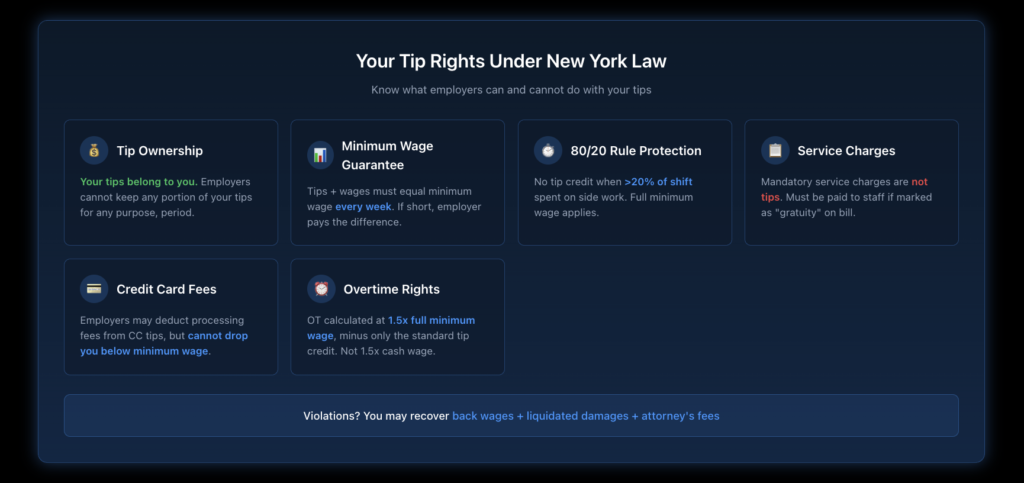
- Tips belong to employees—employers cannot keep any portion for any purpose.
- Employees can recover unpaid wages, liquidated damages, and attorney’s fees for tip violations.
Disclaimer: This article provides general information for informational purposes only and should not be considered a substitute for legal advice. It is essential to consult with an experienced employment lawyer at our law firm to discuss the specific facts of your case and understand your legal rights and options. This information does not create an attorney-client relationship.
What Is a Tip Credit and How Does It Work?
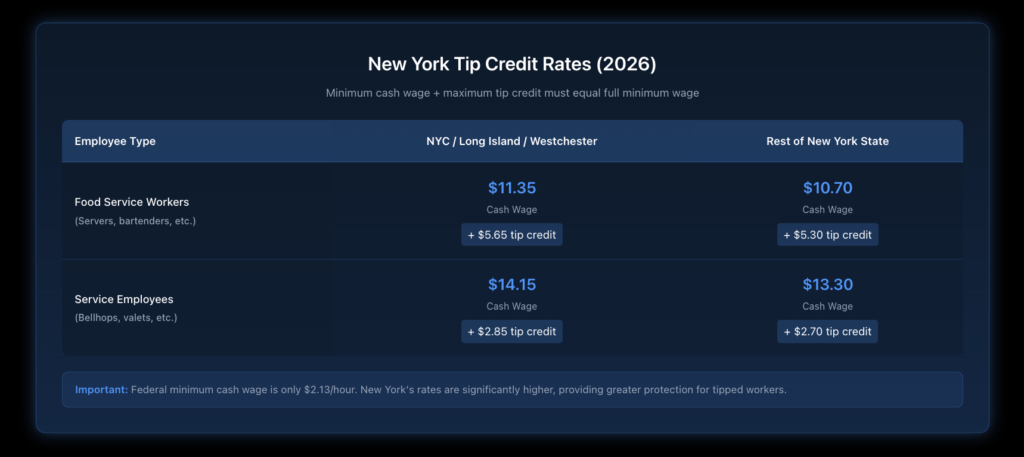
A tip credit allows employers to pay tipped employees a lower cash wage by counting tips toward their minimum wage obligation. Under federal regulations governing tipped employees, employers can pay as little as $2.13 per hour in direct wages if tips bring the employee’s total compensation to at least $7.25 per hour.
New York has significantly higher requirements. As of 2026, food service workers in New York City, Long Island, and Westchester County must receive at least $11.35 per hour in cash wages, with a maximum tip credit of $5.65 per hour. For service employees in these areas, the cash wage is $14.15 with a $2.85 tip credit.
What Must Employers Tell Employees About Tip Credits?
Before taking a tip credit, employers must provide written notice to employees explaining the cash wage they will receive, the amount of tip credit being claimed, that tips must equal at least the minimum wage when combined with wages, and that employees retain all tips except for valid tip pool contributions. An employer who fails to provide this required information cannot claim a tip credit at all.
What Happens When Tips Don’t Reach Minimum Wage?
When an employee’s tips combined with their cash wage don’t equal the minimum wage for any workweek, the employer must pay the difference. This calculation happens on a weekly basis—not daily or per shift. If you’re consistently making less than minimum wage after tips, your employer may be committing wage theft.
What Are the Rules for Tip Pooling?
Tip pooling arrangements must follow specific legal requirements depending on whether the employer takes a tip credit. The federal tip pooling regulations outline who can and cannot participate in these arrangements.
Who Can Participate in a Tip Pool?
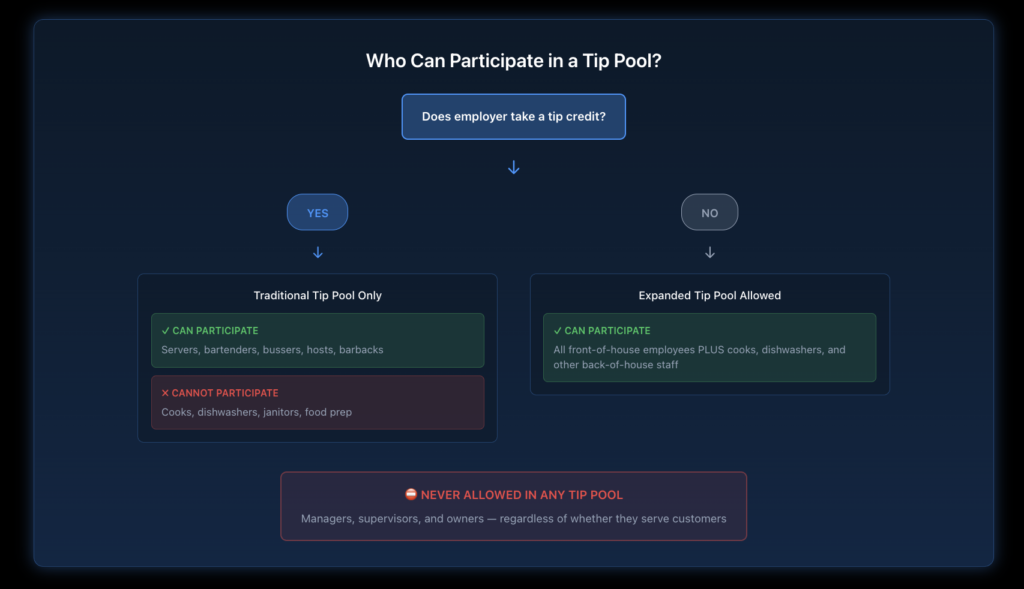
When an employer takes a tip credit, the tip pool can only include employees who “customarily and regularly receive tips”—servers, bartenders, bussers, and similar front-of-house staff. Back-of-house employees like cooks and dishwashers cannot participate in these traditional tip pools.
However, if an employer pays the full minimum wage without taking a tip credit, they may include back-of-house employees in the tip pool. This “nontraditional” tip pool allows tips to be shared with dishwashers, cooks, and other workers who don’t typically receive tips directly.
Can Managers or Supervisors Take Tips?
No. Under both federal law and New York law, managers and supervisors cannot receive any portion of employees’ tips—whether through a tip pool or otherwise. This prohibition applies regardless of whether the employer takes a tip credit. A manager may only keep tips they personally receive for service they directly and solely provided to customers.
The Department of Labor clarified in January 2025 that employees who meet the executive employee duties test under the FLSA cannot receive tips from employer-mandated tip pools. If your employer is requiring you to share tips with management, that’s a serious wage violation.
How Does the 80/20 Rule Protect Tipped Employees?
New York maintains strict rules about when employers can take a tip credit for work time. Employers in the hospitality industry cannot take tip credits for days when tipped workers spend more than two hours, or more than 20% of a shift, performing non-tipped duties.
What Counts as Non-Tipped Work?
Non-tipped work includes tasks that don’t directly generate tips—preparing food, cleaning, stocking, doing inventory, or other “side work” that doesn’t involve serving customers. While servers can perform some related duties like setting tables or making coffee, spending substantial time on these tasks triggers the 80/20 rule protection.
For example, if a server works an 8-hour shift but spends 2.5 hours rolling silverware, restocking stations, and cleaning the kitchen, their employer loses the tip credit for that entire day. The employer must pay the full minimum wage for those hours without any tip credit offset.
What Is the Dual Jobs Rule?
The dual jobs rule addresses employees who perform both tipped and non-tipped work. If you work as both a server (tipped) and a maintenance worker (non-tipped) for the same employer, the tip credit can only apply to your hours as a server. Your maintenance hours must be compensated at the full minimum wage. This distinction matters for workers whose employers try to pay them tipped wages for off-the-clock work or non-tipped responsibilities.
What's the Difference Between Tips and Service Charges?
Understanding the distinction between tips and mandatory service charges is critical because they’re treated completely differently under the law.
Are Service Charges Considered Tips?
No. A compulsory service charge—like an automatic 18% gratuity for large parties—is not legally a tip. It belongs to the employer as part of gross receipts. While employers can distribute service charge money to employees, it doesn’t count as a tip for tip credit purposes and must be included in calculating overtime pay.
The New York Department of Labor requires that if a service charge is distributed to employees, the customer must be clearly informed that the charge is a gratuity for the staff. Otherwise, the employer keeps the service charge.
Can Employers Deduct Credit Card Fees from Tips?
Under New York law, employers may deduct a pro-rated portion of the credit card processing fee from tips paid by credit card. However, this deduction cannot reduce the employee’s wages below minimum wage. Starting in 2025, employers must provide detailed monthly statements showing all deductions, including credit card fees.
How Are Overtime Pay Rules Different for Tipped Employees?
Tipped employees are entitled to overtime pay just like other non-exempt workers, but the calculation differs. For overtime hours, employers must pay time-and-a-half the minimum wage rate, minus the applicable tip credit.
How Is Overtime Calculated for Tipped Workers?
Under federal overtime regulations for tipped employees, the regular rate of pay includes the tip credit amount, cash wages, and any bonuses. For example, if minimum wage is $17.00 per hour in NYC and the tip credit is $5.65, overtime for a food service worker would be calculated on the $17.00 base—not just the $11.35 cash wage.
When a tipped employee works over 40 hours in a week, they must receive 1.5 times the minimum wage minus only the standard tip credit amount. The employer cannot take a larger tip credit for overtime hours.
What Can You Do If Your Employer Violates Tip Laws?
Employers who violate tip laws face significant consequences. You have the right to recover unpaid wages, liquidated damages (often equal to the unpaid wages), and attorney’s fees.
What Damages Are Available?
Under both the FLSA and New York Labor Law, employees can recover back wages for the full amount of tips improperly taken or tip credits improperly claimed, liquidated damages equal to the unpaid wages (effectively doubling your recovery), interest on unpaid wages, and attorney’s fees and costs.
The Department of Labor can also assess civil monetary penalties against employers who violate tip laws—up to $1,100 per violation for first-time offenses involving tip theft.
How Do Collective Actions Work for Tip Violations?
Tip violations often affect multiple employees at the same workplace. Collective actions for wage violations allow workers to join together in a single lawsuit against the employer. This approach can be more efficient than individual claims and sends a stronger message to employers who systematically violate tip laws.
If you believe your employer is violating tip laws, document everything—your hours worked, tips received, any tips shared with management, and communications about tip policies. This documentation becomes critical evidence if you need to pursue a claim.
What Protections Does New York Offer Beyond Federal Law?
New York provides substantially stronger protections for tipped employees than federal law requires. The state’s higher minimum wage means tipped employees keep more of their earnings, and the stricter 80/20 rule limits when employers can reduce wages through tip credits.
Additionally, New York employers face longer statutes of limitations for wage claims (six years under state law versus three years under the FLSA) and cannot use mandatory arbitration agreements to prevent employees from bringing tip theft claims in court in many circumstances.
Employees who face retaliation for reporting tip violations are also protected under both federal and state law. If your employer fires you, cuts your hours, or takes other adverse action after you complained about tip violations, you may have a separate retaliation claim.
Ready to Protect Your Rights?
If you believe your employer is violating tip pooling or tip credit rules, Nisar Law Group can help. Our employment law attorneys have extensive experience protecting the rights of tipped employees throughout New York and New Jersey. Contact us today for a consultation to discuss your situation and explore your options for recovering wages you’re owed.
Frequently Asked Questions About Tip Pooling and Tip Credit Rules
The 80/20 rule prevents employers from taking a tip credit when employees spend more than 20% of their work time on non-tipped duties like cleaning, stocking, or food prep. In New York, employers cannot claim the tip credit for any day on which a tipped worker spends more than two hours or 20% of their shift on such tasks. This rule ensures employers can’t use tipped wage rates while having employees perform primarily non-service work.
It depends on whether your employer takes a tip credit. If your employer takes a tip credit and pays you less than minimum wage in direct wages, they can only require tip sharing with employees who customarily receive tips—servers, bartenders, bussers, and similar positions. Kitchen staff, like cooks and dishwashers, cannot participate. However, if your employer pays the full minimum wage without taking a tip credit, they may require tip sharing with back-of-house employees.
No. Under both federal and New York law, managers and supervisors are prohibited from receiving any portion of employees’ tips, whether directly or through a tip pool. This rule applies regardless of whether the employer takes a tip credit. A manager can only keep the tips they receive directly from customers for the service they personally and solely provided.
Your employer must pay the difference if your tips combined with your cash wage don’t equal at least the minimum wage for any workweek. This calculation is done on a weekly basis. If your employer fails to make up this shortfall, they’re violating wage laws, and you can recover the unpaid wages plus additional damages.
In New York, employers may deduct a proportionate share of credit card processing fees from tips charged on credit cards. However, this deduction cannot reduce your total compensation below minimum wage. Employers must also pay credit card tips by the next regular payday and provide detailed statements showing all deductions.
The tip credit in New York varies by location and job type. As of 2026, in NYC, Long Island, and Westchester County, food service workers have a maximum tip credit of $5.65 per hour (with a cash wage of $11.35), while service employees have a tip credit of $2.85 per hour (with a cash wage of $14.15). The rest of New York State has slightly different rates. These amounts represent the maximum employers can credit against minimum wage obligations.
Under New York Labor Law, you generally have six years to file a claim for tip violations. Under the federal FLSA, the statute of limitations is typically two years, or three years if the violation was willful. Because New York’s timeframe is longer and often provides better remedies, many employees pursue claims under state law.
No. Both federal and New York law protect employees from retaliation for reporting wage violations, including tip law violations. If your employer fires you, reduces your hours, or takes other adverse action after you complained about tip practices, you may have a retaliation claim in addition to your wage claim.
