

Employee classification isn’t just paperwork—it determines whether you’re entitled to overtime pay for every hour you work beyond 40 in a week. If your employer has classified you as “exempt” when you should be “non-exempt,” you could be losing thousands of dollars annually in overtime compensation. Understanding the difference between these two categories—and recognizing when your employer may have gotten it wrong—is essential to protecting your right to fair wages.
Key Takeaways
- Exempt employees must meet both a salary threshold test AND a duties test to be excluded from overtime pay.
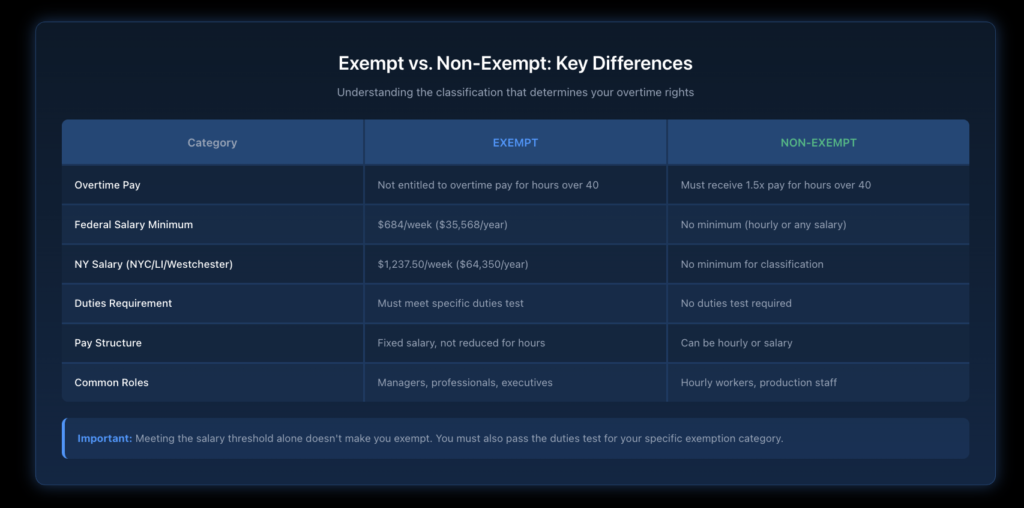
- The federal minimum salary for most exemptions is currently $684 per week ($35,568 annually), though New York has significantly higher thresholds.
- In New York City, Long Island, and Westchester, the 2025 salary threshold for executive and administrative exemptions is $1,237.50 per week ($64,350 annually).
- Job titles don’t determine exempt status—actual job duties and pay structure are what matter.
- Misclassification is common and may entitle you to back pay for unpaid overtime.
Disclaimer: This article provides general information for informational purposes only and should not be considered a substitute for legal advice. It is essential to consult with an experienced employment lawyer at our law firm to discuss the specific facts of your case and understand your legal rights and options. This information does not create an attorney-client relationship.
What Exactly Does "Exempt" vs. "Non-Exempt" Mean?
The Fair Labor Standards Act (FLSA) requires employers to pay most employees at least minimum wage for all hours worked and overtime pay—time and a half—for hours exceeding 40 in a workweek. Employees entitled to these protections are called “non-exempt.”
“Exempt” employees, by contrast, are excluded from overtime requirements. But here’s what many workers don’t realize: being paid a salary doesn’t automatically make you exempt. Your employer must satisfy specific legal tests to lawfully classify you as exempt from overtime.
Why Does This Classification Matter So Much?
If you work 50 hours a week and earn $60,000 annually, proper classification could mean the difference between:
- Exempt: You receive your $60,000 salary regardless of overtime worked
- Non-exempt: You’d be entitled to approximately $14,423 in additional overtime pay annually
That’s real money being left on the table when employers misclassify workers.
What Are the Three Tests for Exempt Status?
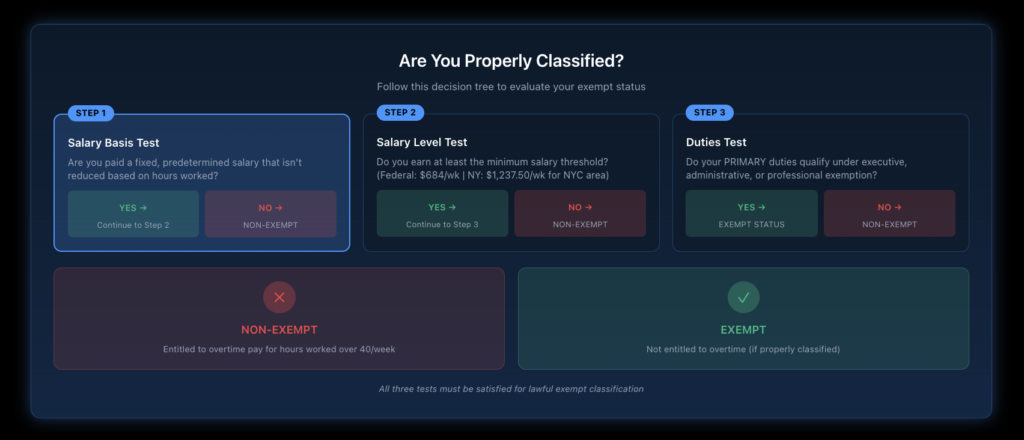
To be lawfully classified as exempt from overtime, employees must generally pass three tests under federal law. Failing any one of these tests means you should be classified as non-exempt and entitled to overtime calculation benefits.
What Is the Salary Basis Test?
The salary basis test requires that you receive a predetermined, fixed amount of compensation each pay period. This amount cannot be reduced based on the quality or quantity of work you perform.
If your employer docks your pay for working a partial day or reduces your paycheck because you didn’t meet productivity quotas, you may not actually be paid on a salary basis—regardless of what your offer letter says.
What Is the Salary Level Test?
Under current federal regulations, most exempt employees must be paid at least $684 per week ($35,568 annually). However, the Department of Labor’s attempt to raise this threshold to $1,128 per week was struck down by a federal court in November 2024, keeping the 2019 salary level in effect.
What Are New York’s Salary Requirements?
New York State maintains significantly higher salary thresholds for the executive and administrative exemptions. For 2025, the thresholds are:
Location | Weekly Salary | Annual Equivalent |
NYC, Long Island, Westchester | $1,237.50 | $64,350 |
Rest of New York State | $1,161.65 | $60,405.80 |
Importantly, New York does not have its own elevated threshold for the professional exemption, so the federal minimum of $684 per week applies to professional employees in New York.
What Is the Duties Test?
Meeting the salary requirements alone isn’t enough. Your actual job duties must fall within one of several recognized exemption categories defined by the Department of Labor.
What Are the Main Categories of Exempt Employees?
The most common exemptions are the so-called “white collar” exemptions: executive, administrative, and professional. Each has specific duties and requirements that go far beyond job titles.
What Qualifies as an Executive Exemption?
To qualify for the executive exemption, your primary duty must be managing the enterprise or a recognized department. Additionally, you must:
- Customarily and regularly direct the work of at least two full-time employees
- Have the authority to hire or fire, or have your recommendations on personnel matters given significant weight
Simply having “manager” or “supervisor” in your title doesn’t satisfy this test. If you spend most of your time performing non-managerial tasks alongside the workers you supposedly supervise, you may not qualify as an exempt executive.
What Qualifies as an Administrative Exemption?
The administrative exemption is perhaps the most frequently abused category. To qualify, your primary duty must involve:
- Office or non-manual work directly related to management or general business operations
- The exercise of discretion and independent judgment on matters of significance
Administrative work means “running the business” functions—think HR, finance, marketing, or IT strategy. Production workers, even those with significant responsibility, typically don’t qualify because their work relates to producing the employer’s product or service rather than running the business itself.
What Qualifies as a Professional Exemption?
The professional exemption applies to two types of workers:
Learned professionals must perform work requiring advanced knowledge in a field of science or learning, customarily acquired through prolonged specialized intellectual instruction. Think doctors, lawyers, engineers, and accountants.
Creative professionals must perform work requiring invention, imagination, or talent in recognized artistic fields.
What About Computer Employees?
Computer systems analysts, programmers, and software engineers may qualify for exemption if their primary duties consist of:
- Systems analysis and design
- Development, documentation, and testing of computer systems
- Creation or modification of programs
Importantly, computer employees can alternatively be paid on an hourly basis at a rate of at least $27.63 per hour and still qualify for exemption, one of the few exceptions to the salary requirement.
How Common Is Employee Misclassification?
Misclassification is pervasive across industries. Common scenarios where employers incorrectly classify workers as exempt include:
- Retail “assistant managers” who primarily stock shelves and operate cash registers
- Administrative assistants who follow established procedures without exercising independent judgment
- Inside salespeople who lack the authority to negotiate prices or terms
- IT help desk workers who troubleshoot using standard procedures
The consequences of contractor misclassification can be equally severe, where employers mislabel employees as independent contractors to avoid overtime and other protections entirely.
What Are the Consequences of Misclassification?
When employers misclassify non-exempt employees as exempt, those workers may be entitled to recover:
- Unpaid overtime for all hours worked over 40 per week
- Liquidated damages equal to the unpaid overtime (essentially doubling the recovery)
- Interest on unpaid wages
- Attorney’s fees and costs
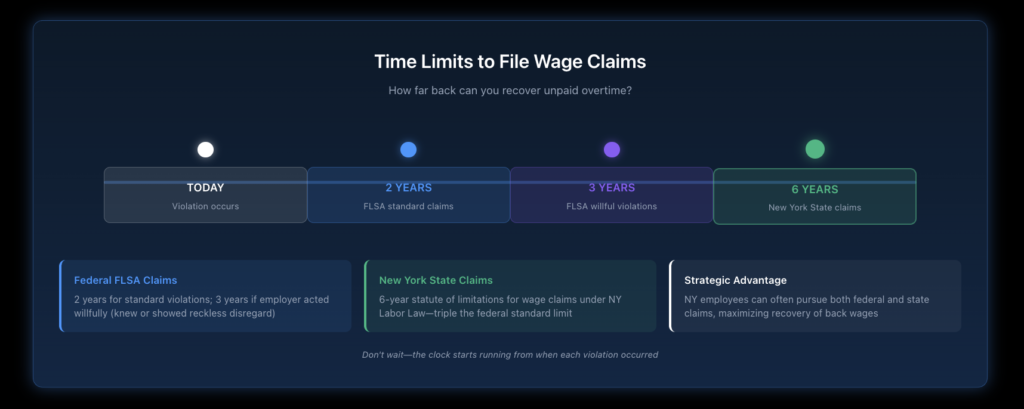
Under the FLSA, employees can recover unpaid wages going back two years, or three years if the violation was willful. New York’s statute of limitations for wage theft claims extends to six years under certain circumstances.
How Do You Know If You've Been Misclassified?
Ask yourself these questions about your job:
Does Your Salary Meet the Threshold?
If you earn less than $35,568 annually (federal) or the applicable New York threshold based on your work location, you should almost certainly be classified as non-exempt—regardless of your duties.
What Do You Actually Do Every Day?
Look beyond your job title and description. What tasks consume most of your work time? If you spend more than half your time performing non-exempt duties (like manual work, production tasks, or routine procedures), you may not actually qualify as exempt.
Do You Exercise Real Independent Judgment?
The administrative exemption requires discretion and independent judgment on “matters of significance.” Following established procedures, referring decisions to supervisors, or choosing between pre-approved options generally doesn’t meet this standard.
Do You Actually Manage People?
For the executive exemption, you must genuinely direct the work of at least two full-time employees. Occasionally, assigning tasks or providing guidance to coworkers isn’t the same as management responsibility.
What Should You Do If You Suspect Misclassification?
If you believe you’ve been improperly classified as exempt, consider taking these steps:
Document Your Work
Keep records of your actual job duties, hours worked, and any instances where your salary was improperly docked. This effective documentation can be crucial evidence in any wage claim.
Review Your Pay Stubs
Look for deductions that may indicate you’re not actually being paid on a true salary basis. Also, note any discrepancies between your stated salary and what you actually receive.
Understand Your Rights Under Multiple Laws
Federal FLSA claims can be pursued alongside state law claims. In many cases, the broader protections under New York law—including longer statutes of limitations and potentially more serious damages—make state claims particularly valuable.
Consider Collective Action
Wage and hour violations rarely affect just one person. Collective actions for wage violations allow similarly situated employees to join together in pursuing claims against employers with widespread classification problems.
What Protections Exist Against Retaliation?
Many workers hesitate to challenge their classification out of fear of retaliation. But both federal and state law prohibit employers from retaliating against employees who assert their wage rights.
Retaliation protections cover activities like:
- Filing wage complaints with government agencies
- Participating in investigations
- Discussing wages with coworkers
- Consulting with attorneys about potential claims
If your employer takes adverse action against you for raising wage concerns, you may have a separate retaliation claim in addition to your underlying wage dispute.
How Do FLSA Rules Apply to Your Situation?
Understanding FLSA coverage is essential because exemptions only apply to employees who are otherwise covered by the Act. The FLSA covers employees who either:
- Work for enterprises with annual gross sales of at least $500,000
- Engage in interstate commerce or produce goods for interstate commerce
In practice, most employees in New York are covered by the FLSA and can pursue both federal and state claims for overtime violations.
What About Minimum Wage Concerns?
While this article focuses on overtime exemptions, it’s worth noting that minimum wage violations and overtime misclassification often go hand in hand. If your employer is cutting corners on classification, they may also be violating minimum wage requirements through practices like:
- Improper tip pooling arrangements
- Unauthorized deductions
- Failure to pay for all hours worked
What Are Common Off-the-Clock Issues?
Even properly classified non-exempt employees sometimes don’t receive all the overtime pay they’re owed because of off-the-clock work. This includes:
- Pre-shift preparation time
- Post-shift cleanup or administrative tasks
- Work performed during unpaid meal breaks
- After-hours emails and phone calls
All compensable work time must be counted toward your 40-hour overtime threshold.
What Resources Are Available?
Several government resources can help you understand your rights:
- The Department of Labor Wage and Hour Division enforces federal wage laws
- The New York State Department of Labor handles state wage claims
- The Department of Labor’s compliance assistance materials provide helpful explanations of exemption requirements
These agencies can investigate complaints and pursue enforcement actions against employers who violate wage laws.
Ready to Take Action?
If you believe you’ve been misclassified as an exempt employee and denied overtime pay you’ve earned, Nisar Law Group can help. Our employment law attorneys have extensive experience handling wage and hour claims for workers throughout New York and New Jersey. Contact us today for a consultation to discuss your situation and explore your options for recovering the compensation you deserve.
Frequently Asked Questions About Exempt vs. Non-Exempt Classification
No. Being paid a salary is only one of three requirements for exempt status. You must also meet the minimum salary threshold and perform exempt job duties under the duties test. Many salaried employees are actually non-exempt and entitled to overtime pay because their actual job duties don’t qualify for any exemption category.
If you genuinely qualify as exempt under all three tests, your employer isn’t required to pay overtime regardless of how many hours you work. However, if your employer has misclassified you, you may be entitled to recover back pay for unpaid overtime plus liquidated damages. Review the duties test requirements carefully to determine whether your classification is correct.
Job titles are not determinative of exempt status. What matters is your actual compensation structure and the duties you perform, not what your employer calls your position. An employee titled “Manager” who primarily performs non-managerial tasks would likely not qualify for the executive exemption regardless of the title.
New York has significantly higher salary thresholds than federal law for the executive and administrative exemptions. Additionally, New York’s statute of limitations for wage claims is longer, and the state may provide additional remedies. Employees in New York should evaluate their classification under both federal and state standards to ensure compliance.
No. Overtime rights under the FLSA and New York Labor Law cannot be waived by contract or agreement between employer and employee. Even if you signed an agreement accepting exempt status or agreeing to work overtime without additional pay, such provisions are unenforceable if you don’t actually qualify for an exemption under the law.
These are separate classification issues. Exempt employees are employees who meet specific tests for exemption from overtime requirements. Independent contractors are not employees at all and therefore have different rights and protections. Employers sometimes misclassify workers as independent contractors to avoid overtime obligations entirely, which is a separate violation from exempt employee misclassification.
