

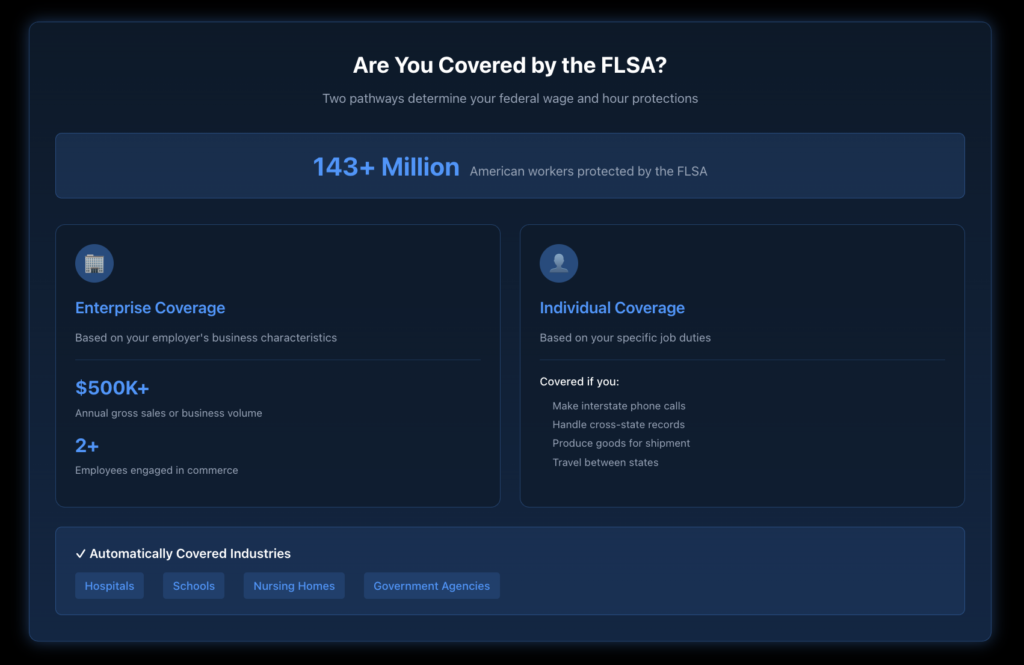
The Fair Labor Standards Act (FLSA) protects over 143 million American workers with minimum wage, overtime pay, and other fundamental workplace rights—but not every employee qualifies for these protections. Whether you’re covered depends on two key tests: enterprise coverage (based on your employer’s business) and individual coverage (based on your specific job duties). If your employer has at least $500,000 in annual business volume or operates a hospital, school, or government agency, you’re likely protected. Even without enterprise coverage, you may still qualify if your work involves interstate commerce.
Key Takeaways
- The FLSA establishes federal minimum wage, overtime requirements, and child labor standards.
- Enterprise coverage applies to businesses with $500,000+ annual revenue and at least two employees.
- Individual coverage protects workers whose duties involve interstate commerce.
- Hospitals, schools, nursing homes, and government agencies are automatically covered.
- New York provides additional protections through state wage and hour laws that often exceed federal standards.
- Certain employees are exempt from FLSA protections based on salary level and job duties.
Disclaimer: This article provides general information for informational purposes only and should not be considered a substitute for legal advice. It is essential to consult with an experienced employment lawyer at our law firm to discuss the specific facts of your case and understand your legal rights and options. This information does not create an attorney-client relationship.
What Is the Fair Labor Standards Act and Why Does It Matter?
The Fair Labor Standards Act is the primary federal law governing wages, hours, and working conditions in the United States. Enacted in 1938 as part of the New Deal, the FLSA established fundamental workplace protections that millions of workers rely on today.
What Protections Does the FLSA Provide?
The FLSA guarantees four core protections for covered, non-exempt employees:
Minimum Wage Requirements. The federal minimum wage is currently $7.25 per hour. However, many states, including New York, have higher rates—New York’s minimum wage ranges from $16.00 to $17.00 per hour depending on location as of 2026.
Overtime Pay. Covered employees must receive time-and-a-half pay for hours worked beyond 40 in a workweek. This means if you normally earn $20 per hour, you’re entitled to $30 per hour for overtime work.
Child Labor Restrictions. The law limits the types of work minors can perform and restricts their working hours to protect educational opportunities.
Recordkeeping Requirements. Employers must maintain accurate records of hours worked and wages paid.
How Does the FLSA Interact with State Laws?
Understanding the relationship between federal and state wage laws is essential for New York workers. When state law provides greater protections than federal law, the more protective standard applies. This is why New York employees often have stronger protections than the federal minimum—state law requires higher minimum wages and provides additional rights.
What Is Enterprise Coverage Under the FLSA?
Enterprise coverage is the most common way employees gain FLSA protection. Under this approach, the law applies to entire businesses that meet specific criteria, covering all employees who work for that enterprise.
Which Employers Meet the Enterprise Coverage Test?
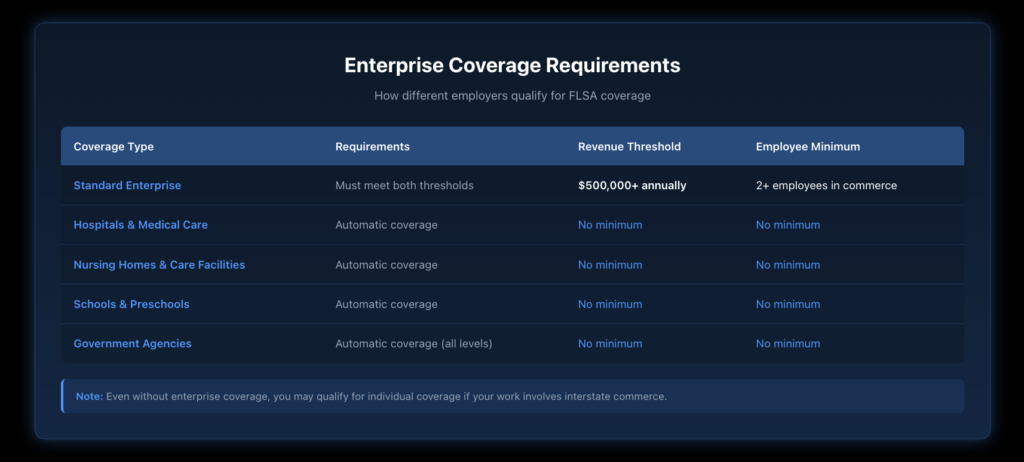
An employer qualifies for enterprise coverage if it meets two requirements:
The Revenue Threshold. The business must have at least $500,000 in annual gross sales or business volume. This includes all revenue from regular business operations—not just profit, but total income.
The Employee Requirement. The enterprise must have at least two employees engaged in commerce or producing goods for commerce.
Which Industries Are Automatically Covered?
Certain employers are automatically covered regardless of their revenue:
- Hospitals and medical care facilities
- Nursing homes and residential care facilities
- Schools and preschools (public and private)
- Federal, state, and local government agencies
If you work for any of these employers, you’re covered by the FLSA regardless of the organization’s size or revenue.
What Counts Toward the $500,000 Threshold?
The annual business volume calculation includes all activities that can be measured in dollar terms. For retailers, this means total sales. For landlords, it includes total rent collected. For service businesses, it encompasses all fees and charges.
The calculation looks at gross volume—not net profit. A business that brings in $600,000 in revenue but operates at a loss still meets the threshold.
What Is Individual Coverage Under the FLSA?
Even if your employer doesn’t meet the enterprise coverage test, you may still be protected through individual coverage. This applies to workers whose specific job duties involve interstate commerce.
Which Job Duties Qualify for Individual Coverage?
The FLSA covers individual workers who are “engaged in commerce or in the production of goods for commerce.” Practically, this includes employees who:
- Produce goods that will be shipped to other states
- Regularly make phone calls to people in other states
- Handle records of transactions crossing state lines
- Travel to other states for work
- Process orders involving interstate commerce
- Work in buildings where goods are produced for shipment outside the state
Are Domestic Workers Covered?
Domestic service workers receive special attention under the FLSA. Housekeepers, full-time babysitters, cooks, and other household employees are generally covered by the law. This protection ensures that even workers in private homes have access to minimum wage and overtime rights.
How Do Courts Determine Individual Coverage?
Courts examine the actual duties employees perform rather than job titles. A worker who spends even a portion of their time on interstate activities may qualify for individual coverage. The key question is whether the employee’s work has a substantial connection to commerce across state lines.
Who Is Exempt from FLSA Coverage?
Not all employees receive FLSA protections. The law excludes certain workers based on their job duties, compensation level, or the nature of their employment.
What Are the White-Collar Exemptions?
The most significant exemptions apply to executive, administrative, and professional employees—commonly called the “white-collar” exemptions. To qualify for exemption, an employee must meet three tests:
Salary Basis Test. The employee must receive a guaranteed salary regardless of hours worked or work quality.
Salary Level Test. The employee must earn at least $684 per week ($35,568 annually) under current federal standards. Note that New York’s salary thresholds for exempt employees are higher.
Duties Test. The employee’s primary duties must involve executive, administrative, or professional responsibilities as defined by federal regulations.
How Have Salary Threshold Rules Changed Recently?
The Department of Labor attempted to significantly increase salary thresholds in 2024, but a federal court struck down those changes. Currently, the 2019 thresholds remain in effect:
- Standard exemption: $684 per week ($35,568 annually)
- Highly compensated employees: $107,432 annually
However, New York State maintains its own higher thresholds. In New York City, Long Island, and Westchester, employees must earn at least $1,287.50 per week ($66,950 annually) to qualify for the executive or administrative exemption as of 2026.
Which Other Exemptions Exist?
Beyond white-collar exemptions, the FLSA excludes various other worker categories:
- Independent contractors (genuinely self-employed individuals)
- Outside salespeople
- Certain computer professionals
- Agricultural workers in some circumstances
- Seasonal amusement park employees
- Small newspaper delivery workers
How Does FLSA Coverage Work in New York?
New York workers benefit from some of the strongest wage and hour protections in the country. Understanding how state law interacts with federal requirements helps employees maximize their rights.
What Additional Protections Does New York Provide?
New York law extends beyond federal requirements in several important ways:
Higher Minimum Wage. While the federal minimum is $7.25 per hour, New York’s rates range from $16.00 to $17.00 per hour, depending on location.
Stricter Exemption Standards. New York’s salary thresholds for exempt employees exceed federal requirements, meaning more workers qualify for overtime protection.
Additional Employer Obligations. The Wage Theft Prevention Act requires employers to provide written notice of pay rates and maintain detailed wage records.
Stronger Enforcement. The New York State Department of Labor actively investigates wage violations and can impose penalties up to 200% of unpaid wages.
Can NYC Workers Receive Even Greater Protections?
New York City has additional worker protections beyond state law. The city’s laws cover issues like paid sick leave, fair workweek scheduling, and predictable scheduling requirements for certain industries. These local protections layer on top of state and federal requirements.
What Should You Do If You Think You're Not Covered?
If your employer claims you’re not covered by the FLSA or that you’re exempt from overtime, it’s worth examining those claims carefully. Misclassification is common, and many workers who believe they’re exempt actually qualify for overtime pay protection.
How Can You Verify Your Coverage Status?
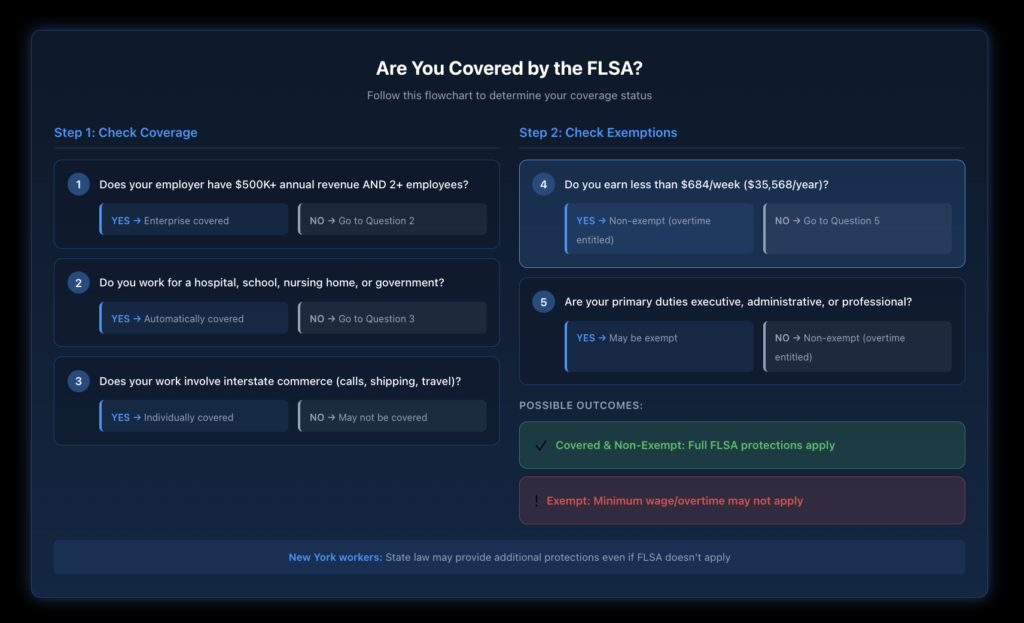
Start by examining your employer’s business:
- Does your company have annual sales exceeding $500,000?
- Does your employer operate a hospital, school, nursing home, or government agency?
- Do you work for an enterprise with at least two employees involved in interstate commerce?
If you answered yes to any of these questions, enterprise coverage likely applies.
Next, consider your individual duties:
- Do you make phone calls to other states?
- Do you handle interstate orders or shipments?
- Do you produce goods that cross state lines?
Even occasional involvement in interstate activities can establish individual coverage.
What If Your Employer Says You’re Exempt?
If your employer classifies you as exempt, scrutinize both your salary and your actual duties. Many employees are incorrectly classified as exempt because they hold “manager” titles but don’t actually perform exempt duties. If you spend most of your time on non-managerial work, you may qualify for overtime regardless of your title.
How Can Employees Protect Their Wage and Hour Rights?
Taking proactive steps helps ensure you receive all compensation you’re legally owed.
What Records Should You Keep?
Maintain personal records of:
- Hours worked each day and week
- Pay stubs and wage statements
- Any communications about your classification status
- Evidence of off-the-clock work you’ve performed
These records become crucial evidence if you need to pursue a wage theft claim.
What Deadlines Apply to Wage Claims?
Time limits restrict how far back you can recover unpaid wages. Under federal law, the statute of limitations is:
- Two years for standard violations
- Three years for willful violations
New York state law may provide additional time in some circumstances. Acting promptly preserves your ability to recover maximum compensation.
When Should You Consult an Employment Attorney?
Consider legal consultation if you experience any of these situations:
- Your employer misclassifies you as exempt when you don’t meet the exemption requirements
- You work over 40 hours but don’t receive overtime pay
- Your employer pays below the minimum wage requirements
- Your employer retaliates after you complain about wage violations
- You believe you’ve experienced independent contractor misclassification
An experienced attorney can evaluate your specific situation and help you understand your options.
Ready to Protect Your Wage and Hour Rights?
If you’re facing wage violations or have questions about your FLSA coverage, Nisar Law Group can help. Our employment law attorneys have extensive experience protecting workers’ rights throughout New York and New Jersey. We understand the complex interplay between federal and state wage laws, and we’re committed to ensuring every employee receives fair compensation. Contact us today for a consultation to discuss your situation.
Frequently Asked Questions About FLSA Coverage
The current federal minimum salary threshold for exempt employees is $684 per week, or $35,568 annually. Employees earning below this amount are automatically entitled to overtime pay regardless of their job duties. New York has higher thresholds—as of 2026, exempt employees in NYC, Long Island, and Westchester must earn at least $1,287.50 per week ($66,950 annually), while those elsewhere in New York State must earn at least $1,199.10 per week ($62,353.20 annually).
Exempt employees are workers who don’t qualify for minimum wage or overtime protections under the FLSA. The most common exemptions are the “white-collar” exemptions for executive, administrative, and professional employees. To be exempt, an employee must meet three tests: be paid on a salary basis, earn at least the minimum salary threshold, and perform primarily exempt duties as defined by federal regulations.
Common FLSA exemptions include executives who manage departments and supervise employees, administrative professionals who exercise independent judgment on significant business matters, learned professionals like doctors, lawyers, and engineers, outside salespeople who work away from the employer’s premises, and certain computer professionals. Other exemptions cover agricultural workers, seasonal amusement park employees, and small newspaper delivery workers.
Neither status is inherently “better”—it depends on your work situation. Non-exempt employees receive overtime pay for hours worked beyond 40 per week, which can significantly boost earnings if you regularly work long hours. Exempt employees typically have more predictable salaries and may have greater scheduling flexibility, but they receive no extra pay for overtime work. If you frequently work over 40 hours, non-exempt status usually provides better compensation.
The federal salary threshold remains $684 per week ($35,568 annually) after a court struck down the Department of Labor’s 2024 rule that would have raised it to $1,128 per week ($58,656 annually). However, New York State has its own higher thresholds that increased on January 1, 2025, and again on January 1, 2026. Always check both federal and state requirements, as the higher standard applies.
If you earn $20 per hour and are non-exempt, your overtime rate is $30 per hour (time-and-a-half). For a week where you work 50 hours, you’d earn $800 for the first 40 hours at regular pay, plus $300 for 10 overtime hours at $30 per hour, totaling $1,100 for the week. This calculation applies to covered, non-exempt employees under both federal and New York law.
The FLSA applies to businesses with at least $500,000 in annual gross sales and two or more employees involved in interstate commerce. However, employees can still be individually covered if their work involves interstate activities, even if their employer doesn’t meet the enterprise coverage threshold. Additionally, hospitals, schools, nursing homes, and government agencies are always covered regardless of size.
Genuine independent contractors are not covered by the FLSA. However, employers frequently misclassify employees as independent contractors to avoid paying minimum wage and overtime. If your employer controls how, when, and where you work, you may actually be an employee entitled to FLSA protections regardless of how you’re classified.
