

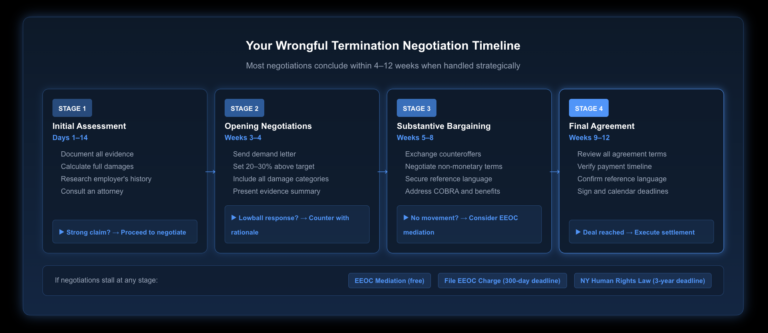
If you’ve been wrongfully terminated, your best settlement comes from negotiating strategically — ideally before filing any formal complaints — when your employer faces $75,000–$125,000 in potential litigation costs. Start by documenting everything, calculating your full damages (back pay, front pay, benefits, and emotional distress), and then present a demand 20–30% above your actual target. Most employers would rather negotiate than risk trial verdicts that average over $200,000 for discrimination cases. That leverage gives you a real shot at securing severance, COBRA subsidies, a neutral reference, and additional compensation — often totaling $30,000–$80,000 — within four to twelve weeks.
Key Takeaways
- Timing matters most: Negotiate within two to four weeks of termination, before filing EEOC charges, for maximum leverage.
- Realistic settlement ranges: Strong discrimination claims in New York typically settle between $30,000–$80,000; executive-level cases can exceed $200,000.
- Don’t stop at cash: Negotiate COBRA subsidies (saving $500–$2,000/month), neutral references, benefits continuation, and retirement vesting.
- Documentation changes everything: Written evidence of discrimination can increase settlement value by 40–60%.
- An attorney changes the math: Attorney involvement typically increases initial offers by 25–50%.
- Timeline: Most negotiations resolve within four to twelve weeks when handled systematically.
- Structure matters: How your settlement is structured affects what you actually keep after taxes.
Disclaimer: This article provides general information for informational purposes only and should not be considered a substitute for legal advice. It is essential to consult with an experienced employment lawyer at our law firm to discuss the specific facts of your case and understand your legal rights and options. This information does not create an attorney-client relationship.
What Determines Your Negotiating Power After an Illegal Firing?
Your leverage comes from two places: how strong your legal claims are, and how much your employer wants to avoid the consequences of litigation.
Wrongful termination claims are strongest when there’s a clear violation of law — being fired because of a protected characteristic like race, gender, age, or disability, or because you engaged in a protected activity like whistleblowing or filing a complaint. The stronger and more documented your claim, the more leverage you have at the negotiating table.
What Types of Evidence Strengthen Your Position?
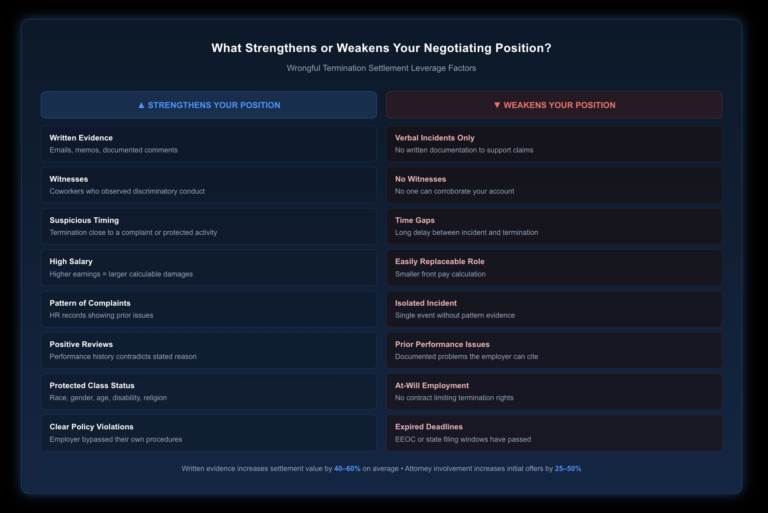
Documentary evidence is the most powerful tool you have. Emails containing discriminatory comments, performance reviews that contradict the stated reason for your termination, witness statements, and records showing a suspicious timeline all strengthen your position significantly. Written evidence of discrimination increases settlement values by 40–60% on average.
Your salary level matters too — courts calculate damages based on actual earnings, so higher earners have more to recover. Specialized skills and executive roles also increase leverage because they extend the projected job search period courts use to calculate front pay.
Why Do Employers Settle?
Employers settle to avoid:
- Litigation costs averaging $75,000–$125,000 before a single verdict
- Jury awards an average of over $200,000 in discrimination cases
- A discovery that exposes other workplace problems
- Negative publicity and reputational damage
Understanding these pressure points is what turns a difficult situation into a negotiable one.
When Should You Start Settlement Negotiations?
Timing is one of the most important strategic decisions you’ll make.
Why Is Negotiating Before Filing an EEOC Charge Usually Better?
Pre-complaint negotiations tend to produce larger settlements because employers can still control the narrative and avoid the certainty of formal legal proceedings. You’ll typically see faster resolution — weeks instead of months — along with more flexible settlement terms, lower legal costs for both sides, and easier confidentiality maintenance.
That said, you need enough evidence before approaching negotiations. Going in without proper preparation leads to lowball offers in the $5,000–$15,000 range — a fraction of what a documented claim is worth.
What Changes After Filing an EEOC Charge?
Once you file, the dynamic shifts. Employers may offer less because they’re already in reactive mode, but you gain formal discovery rights to strengthen your case and send a clear signal that you’re serious. Under New York law, you have 300 days to file an EEOC charge of discrimination and three years under the New York State Human Rights Law — giving you real flexibility to build your case before acting.
In New York City specifically, the NYC Human Rights Law provides some of the broadest employee protections in the country and gives employees even more time and options to pursue claims.
What Financial Components Should You Negotiate?
How Much Severance Can You Realistically Expect?
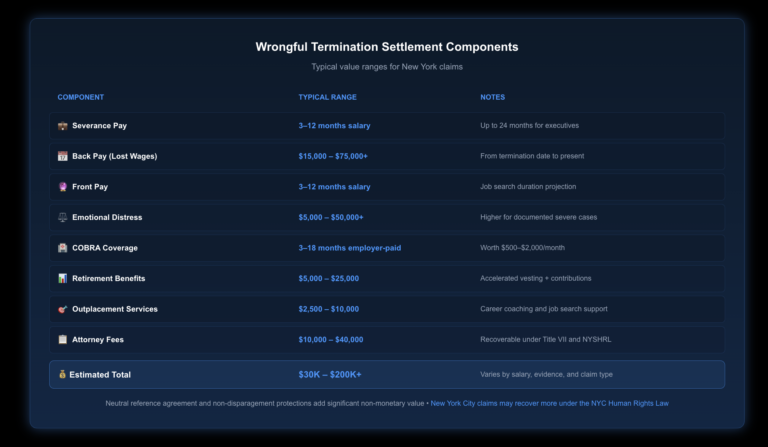
Standard severance is typically one to two weeks per year of service. But when you have a legitimate wrongful termination claim, that baseline is just your starting point. Strong discrimination or retaliation claims regularly push severance to three to twelve months of salary, and executives with clear evidence can negotiate twelve to twenty-four months.
Your severance demand should reflect both the industry standard and your specific legal exposure to the employer. Those are two different numbers, and combining both is how you justify a higher ask.
What Lost Wages Are You Entitled To?
You’re entitled to back pay — everything you would have earned from the date of termination to the present, including bonuses, commissions, and scheduled raises. Beyond that, courts award front pay for your expected job search period. For mid-level positions, that’s typically three to six months. Executive roles often justify six to twelve months, and in specialized fields with tight markets, courts have awarded up to two years of front pay.
Document your actual job search activity — applications, interviews, rejections — because front pay calculations depend on it. The more thorough your documentation, the harder it is for the employer to argue that you could have found work sooner.
How Do Benefits Factor Into Your Total Package?
Benefits are where a lot of people leave money on the table without realizing it.
COBRA continuation coverage for a family can run $500–$2,000 per month. Negotiating for employer-paid COBRA for six to eighteen months represents real, concrete value — often $6,000–$36,000 — that’s easy to quantify and harder for employers to refuse than straight cash.
Retirement account contributions are also worth pursuing: accelerated vesting, matching contributions, and deferred compensation you’ve earned are all negotiable. So is outplacement support, which can range from $2,500 to $10,000 in value and helps you explain the job transition to future employers.
What Non-Financial Terms Are Worth Fighting For?
Why Is a Neutral Reference Agreement So Valuable?
A strong neutral reference can be worth more than additional severance. Job offers get rescinded over bad references — and a documented history of discrimination or performance issues in your file is a liability you can negotiate away.
Specify exactly what HR will say: confirmation of your dates of employment, your job title, and that you’re eligible for rehire. Require all employment verification inquiries to go through HR only, with scripted responses that block former supervisors from commenting at all. If this isn’t in writing with specific language, it’s not enforceable — and employer conduct after termination can continue to harm you if you don’t address it explicitly.
What Should You Know About Non-Disparagement Clauses?
Mutual non-disparagement agreements should bind both parties equally — not just you. Push for language that covers all company representatives, including former supervisors who may have been involved in the termination. Include specific financial penalties for violations, typically $10,000–$25,000 per incident, to give the clause teeth.
Watch for one-sided non-disparagement provisions that restrict what you can say while leaving the employer free to make damaging comments. That’s a red flag — and a negotiating point.
How Do Confidentiality Provisions Work in Practice?
Most settlement agreements include confidentiality provisions, but not all of them are enforceable as written. Standard agreements allow you to disclose terms to your immediate family, attorneys, accountants, and government agencies — including the EEOC. Any confidentiality clause that prevents disclosure to your spouse or to government agencies may not hold up in court.
Beyond confidentiality, consider negotiating for file expungement — removing negative performance reviews or disciplinary records — and changing your separation status from “terminated” to “resigned.” The latter can affect your eligibility for unemployment benefits in New York, so weigh the tradeoff carefully before agreeing.
What Negotiation Strategies Actually Work?
Before you open negotiations, do your research. Find out who has actual settlement authority — HR may handle intake, but a general counsel or senior executive may need to sign off. Understand their primary concerns: Is it cost? Publicity? Precedent? Research whether the company has settled similar claims before, and calculate their realistic litigation cost exposure.
That information shapes your entire strategy and tells you exactly where to apply pressure.
How Should You Frame Your Demands?
Frame demands using objective criteria, not arbitrary numbers. Reference industry severance standards, comparable jury verdicts in New York (discrimination cases average over $200,000), your documented economic loss calculations, and actual benefit replacement costs. When your number comes with a rationale, it’s much harder to dismiss.
Look for solutions that genuinely address both sides’ interests. Structured payments over time may be easier for the employer to approve than a lump sum. Non-monetary benefits sometimes cost the employer far less than their value to you. Consulting agreements, extended transition periods, and accelerated vesting schedules are all worth exploring.
Can You Sue for Wrongful Termination If You Already Accepted Severance?
This is one of the most common questions — and the answer depends entirely on what you signed and when. If you’ve already accepted a severance package that included a release of claims, you may have waived your right to sue for wrongful termination. That’s exactly why you should never sign a severance agreement without first reviewing it carefully, ideally with an attorney.
However, if you’ve only received an offer — and haven’t signed a release — you can still negotiate, counter, or pursue legal action while those negotiations continue. The New York State Human Rights Law and federal employment statutes provide separate rights that a severance offer doesn’t automatically extinguish.
What Mistakes Should You Avoid?
Why Shouldn’t You Accept the First Offer?
Initial offers typically represent 30–40% of what employers will ultimately pay. That gap exists because employers expect negotiation and build room into the first number. Counter with specific, reasoned justifications: the strength of your legal claims, comprehensive economic loss calculations, comparable settlements in your industry, and the litigation risk you’re creating for the employer.
Silence or delay after a lowball offer is not the same as acceptance — take your time, respond in writing, and document every exchange.
What Do People Miss Besides the Dollar Amount?
The settlement amount is only one piece of the package. Extended benefits continuation saves thousands in COBRA costs alone. A strong neutral reference enables future employment, which is worth far more over time than a few extra weeks of severance. Stock option vesting preserves compensation you’ve already earned. Outplacement support helps you land faster.
Focusing exclusively on the check is how people leave significant value unclaimed.
What Happens If You Make Threats You Don’t Mean?
Only threaten actions you’re genuinely prepared to take. Empty threats to sue, go to the press, or file agency complaints destroy credibility the moment the employer calls your bluff. Your willingness to actually walk away from inadequate offers — and follow through on stated next steps — is your ultimate leverage. If you say you’ll file an EEOC complaint, be ready to do it.
When Does It Make Sense to Get an Employment Attorney?
An experienced employment attorney adds value in multiple ways: evaluating claim strength realistically, calculating comprehensive damages including emotional distress and punitive damages, and negotiating from a position that employers take seriously.
Attorney involvement signals that litigation is a real possibility — not just a threat. Employers frequently increase their offers by 25–50% when an attorney enters the picture, because the cost calculus changes immediately. The EEOC achieved favorable outcomes in over 90% of its resolved discrimination suits in FY 2023 — a track record employers are well aware of. Attorneys also ensure you’re claiming every available category of damages: back pay with interest, front pay projections, benefit losses, emotional distress damages under federal employment law, and attorney fee recovery under statutes like Title VII.
What Does Attorney Fee Recovery Mean for You?
Under statutes like Title VII and the New York State Human Rights Law, if you prevail in a discrimination claim, the court can require your employer to pay your attorney’s fees separately — meaning you could keep your entire settlement while the employer covers your legal costs. This makes litigation significantly more viable than many employees realize.
What Red Flags Should You Watch for in Settlement Offers?
Not all settlement offers are fair — some contain provisions designed to benefit the employer at your expense. Watch for:
- Overly broad releases that waive unknown claims or unrelated matters — you should only release employment-related claims you’re specifically aware of
- Impossible confidentiality terms preventing disclosure to spouses, attorneys, or government agencies like the EEOC
- One-sided non-disparagement clauses restricting only you, while allowing the employer free rein
- Delayed or conditional payments beyond 30 days or contingent on undefined “cooperation.”
- Vague reference language without specifying who responds and exactly what they’ll say
- Non-compete clauses that weren’t in your original employment agreement
If you’re over 40, the Older Workers Benefit Protection Act requires your employer to give you 21 days to consider a severance agreement and seven days to revoke after signing. Any agreement that shortens these periods may be unenforceable. Employees who were pushed out gradually rather than fired outright should also review whether constructive discharge applies to their situation.
How Do You Finalize and Protect Your Settlement?
Once you reach an agreement, get everything in writing with specific deadlines. Tax treatment matters: severance payments and emotional distress damages are taxed differently, so structuring the settlement wisely can meaningfully affect your take-home amount. Specify dispute resolution procedures in case of breach, and include clear payment timelines — typically 14–30 days from signing.
After signing, calendar all deadlines, confirm payment receipt, monitor compliance with the reference agreement, and maintain settlement documents indefinitely. If your employer breaches any term, you’ll want a complete paper trail.
What Alternatives Exist If Direct Negotiations Stall?
If direct negotiations hit a wall, EEOC mediation is available at no cost and often breaks deadlocks. A neutral mediator helps both sides find common ground, and mediated settlements average around $40,000, with resolution typically within 60–90 days.
Other options include structured settlements — spreading payments over time to increase total compensation while easing the employer’s cash flow — and consulting arrangements that provide income continuity while preserving flexibility. In some cases, non-monetary resolutions like training funds, policy changes, or record expungement provide more practical value than a cash payment alone.
What Are Your Filing Deadlines Under New York Law?
New York employees have some of the strongest legal protections in the country — and some of the most favorable filing deadlines.
- EEOC charge: 300 days from the discriminatory act
- New York State Human Rights Law: Three years (extended as of February 2024)
- NYC Human Rights Law: Three years, with the broadest protections of any jurisdiction
The New York Attorney General’s office provides resources on illegal termination and your rights under state law, and the New York State Division of Human Rights enforces protections that go beyond federal standards. If your termination involved any discriminatory motive — even if other reasons were also given — you may have viable claims under multiple laws simultaneously.
Don’t let these deadlines pass while waiting to see if things resolve on their own. The New York State Attorney General recommends consulting an attorney as soon as possible after a termination you believe was unlawful.
Ready to Fight for What You're Owed?
Being wrongfully terminated is one of the most disorienting professional experiences you can face. But effective negotiation can turn that legal violation into fair compensation and a real fresh start.
If you’ve been illegally fired in New York or New Jersey, Nisar Law Group can help you evaluate your claims, calculate your full damages, and develop a negotiation strategy designed around your specific situation. Don’t accept the first offer. Don’t let filing deadlines expire. And don’t navigate this alone.
Contact Nisar Law Group today for a consultation. Time limits apply to wrongful termination and discrimination claims — the sooner you act, the stronger your position.
Frequently Asked Questions About Negotiating After Wrongful Termination
The odds depend heavily on the strength of your evidence and the type of claim. EEOC data shows the agency achieved favorable outcomes in over 90% of its resolved discrimination suits in FY 2023. For private claims, cases with documented evidence — written communications, performance records contradicting the termination reason, and witness support — settle favorably far more often than those relying solely on verbal accounts. The goal for most employees is a negotiated settlement, not a trial, and well-documented claims give you strong leverage to achieve one.
An acceptable offer covers your documented economic losses — back pay, front pay, lost benefits — plus reasonable compensation for emotional distress and legal costs. For strong New York discrimination claims, settlements in the $30,000–$80,000 range are common at the pre-litigation stage, but the right number depends entirely on your salary, claim type, evidence quality, and the employer’s litigation exposure. A first offer below 40–50% of your calculated damages is generally too low and should be countered with a reasoned response.
Most wrongful termination settlements in New York range from $30,000 to $80,000 for strong claims, though executive-level cases regularly exceed $200,000. EEOC mediated settlements average around $40,000 and are resolved within 60–90 days. Cases involving documented discrimination, clear retaliation, or a pattern of employer misconduct typically settle higher than cases relying primarily on circumstantial evidence. Settlement amounts also depend on your annual salary, since damages are calculated based on what you would have earned.
Employment attorneys calculate settlement value by adding up every recoverable category of damages: back pay from the termination date to present, front pay based on your job search duration, the replacement cost of lost benefits (especially health insurance), emotional distress damages, and potential attorney fee recovery. They then weigh that number against the strength of your evidence, the employer’s litigation cost exposure, and comparable verdicts in similar New York cases. The result is a realistic range — a floor that reflects the minimum likely recovery and a ceiling that reflects the risk to the employer of going to trial.
Avoid threatening actions you’re not prepared to take — empty litigation threats destroy credibility. Don’t disclose your bottom line or indicate you’re under financial pressure to settle quickly. Avoid emotional or personal attacks on your former employer, which shift the conversation away from legal claims and weaken your professional position. Don’t agree to verbal terms without written confirmation, and never sign anything — including a severance offer — without first reviewing it carefully. Everything you say during negotiations can affect the final outcome.
No. First offers typically represent 30–40% of what an employer is ultimately willing to pay. Initial offers are designed to test whether you’ll settle cheaply before consulting an attorney or understanding your full legal rights. Counter with a detailed, reasoned response that references your documented damages, comparable settlements, and the employer’s litigation cost exposure. Most settlements require multiple exchanges before reaching a fair number.
It depends on what you signed. If you accepted severance and signed a release of claims, you likely waived your right to sue — which is exactly why you should never sign without carefully reviewing the release language first. If you’ve received a severance offer but haven’t yet signed, your legal rights remain fully intact. You can negotiate the terms, counter with additional demands, or consult an attorney before making any decision. Once you sign a properly executed release, your ability to pursue legal action is generally gone.
A good offer covers your core economic damages, provides a neutral reference with specific written language, includes mutual non-disparagement protections, and gives you COBRA continuation or benefit replacement. Payment timing is clear — typically within 14–30 days of signing — and the release of claims is limited to employment-related matters you’re specifically aware of. If an offer addresses all major financial and non-financial components, uses specific rather than vague language, and leaves you financially whole relative to your damages, it’s worth serious consideration.
