

You’ve been offered a leadership position — congratulations. But before you sign anything, understand this: the executive employment agreement sitting in front of you was drafted by the company’s legal team to protect the company, not you. Every clause, every definition, every payment trigger was written with the employer’s interests in mind. Your job, before signing, is to make sure your interests are in there, too.
An executive employment agreement is one of the most consequential contracts you’ll ever sign. It governs your compensation, your role, your exit rights, and the restrictions that follow you after you leave. Getting it right takes preparation, legal knowledge, and a clear-eyed understanding of where your leverage actually lies.
Key Takeaways
- Executive employment agreements cover compensation, role definition, termination rights, restrictive covenants, and dispute resolution — each of which needs careful review.
- Your negotiating leverage is highest before you sign — once you’re in the role, it diminishes significantly.
- New York provides specific legal standards for enforcing non-compete clauses and other restrictive covenants that may limit what an employer can impose.
- “Good reason” resignation provisions, severance triggers, and indemnification protections are often negotiable — but only if you ask.
- Working with an employment attorney before signing gives you the clearest picture of what you’re agreeing to and where you have room to push back.
Disclaimer: This article provides general information for informational purposes only and should not be considered a substitute for legal advice. It is essential to consult with an experienced employment lawyer at our law firm to discuss the specific facts of your case and understand your legal rights and options. This information does not create an attorney-client relationship.
What Does an Executive Employment Agreement Actually Cover?
An executive employment agreement is a formal contract between you and your employer that defines the terms of your leadership role. Unlike offer letters, which tend to be informal and easily changed, a properly negotiated executive contract creates enforceable obligations on both sides.
What Are the Key Components of an Executive Contract?
These agreements typically cover:
- Compensation structure: Base salary, target bonus, signing bonus, and the metrics or conditions tied to each
- Equity and long-term incentives: Stock options, restricted stock units, performance shares, and vesting timelines
- Benefits and perquisites: Health coverage, retirement contributions, expense accounts, and other executive-level benefits
- Role and reporting structure: Your title, responsibilities, and who you report to
- Term and renewal: Whether your employment has a defined duration or is at-will
- Termination provisions: What happens if the company ends your employment, under what circumstances, and with what notice
- Restrictive covenants: Non-compete clauses, non-solicitation agreements, and confidentiality obligations that survive your employment
- Dispute resolution: How and where employment disputes get resolved — arbitration, litigation, choice of law
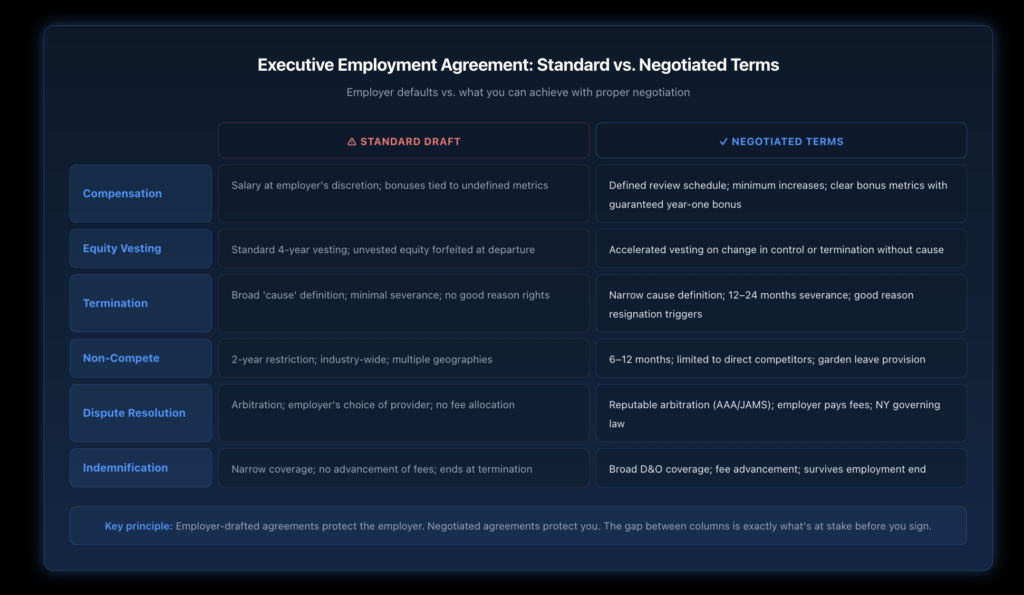
Each of these sections represents a negotiable opportunity. The question is knowing which ones matter most and where you have realistic room to push.
Why Is Negotiating Before You Sign So Important?
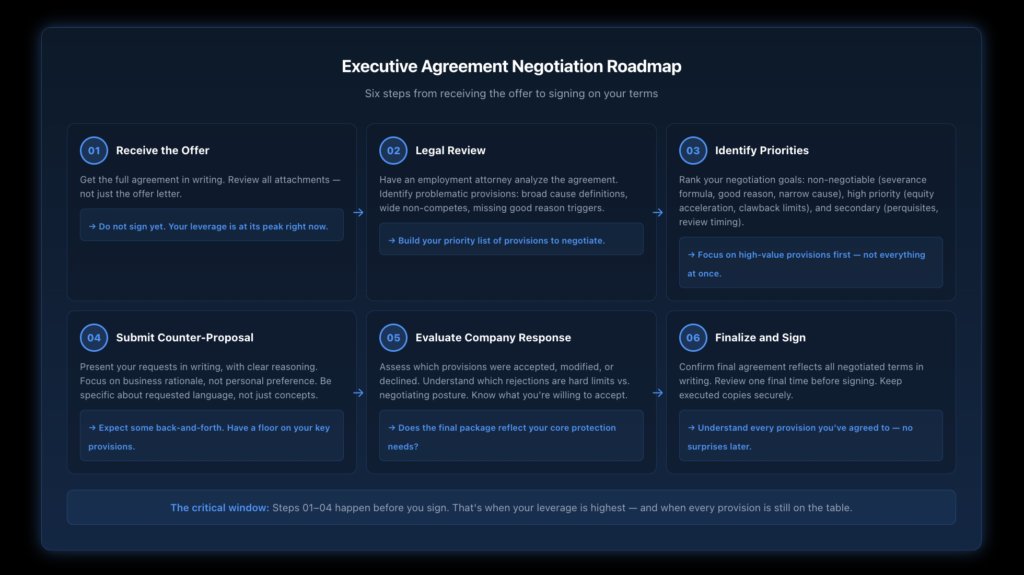
The moment you sign an executive employment agreement, your leverage drops dramatically. Companies that were willing to negotiate terms to attract you have much less incentive to revisit those same terms once you’re in the role and invested in the work.
When Does Your Negotiating Power Peak?
Your leverage is highest during the offer stage — specifically after you’ve received an offer and before you’ve accepted. At that moment, the company has committed to wanting you. They’ve made a decision. Reopening the search is expensive, time-consuming, and embarrassing. That’s your window.
This doesn’t mean being aggressive or unreasonable. Most executive negotiations are collaborative. The goal isn’t to “win” against the employer — it’s to arrive at terms that are fair, clear, and reflective of what you’re actually worth to the organization.
What Happens If You Don’t Negotiate?
If you sign without negotiating, you’re accepting the employer’s default terms — which, again, were written with the employer’s interests at the forefront. This often means:
- Severance that’s less than your real exit value
- Non-compete restrictions that are broader than legally necessary
- Bonus targets you have limited control over hitting
- No “good reason” resignation rights if the company restructures your role
These gaps can cost you significantly at departure, which — for executives — often comes sooner and under more complicated circumstances than either party expects at hire. Understanding executive compensation governance from the outset is essential.
What Compensation Terms Can You Negotiate in an Executive Agreement?
Compensation is the most visible part of any executive contract, but it’s also where some of the most important details can get buried in definitions and conditions.
How Should You Approach Base Salary Negotiations?
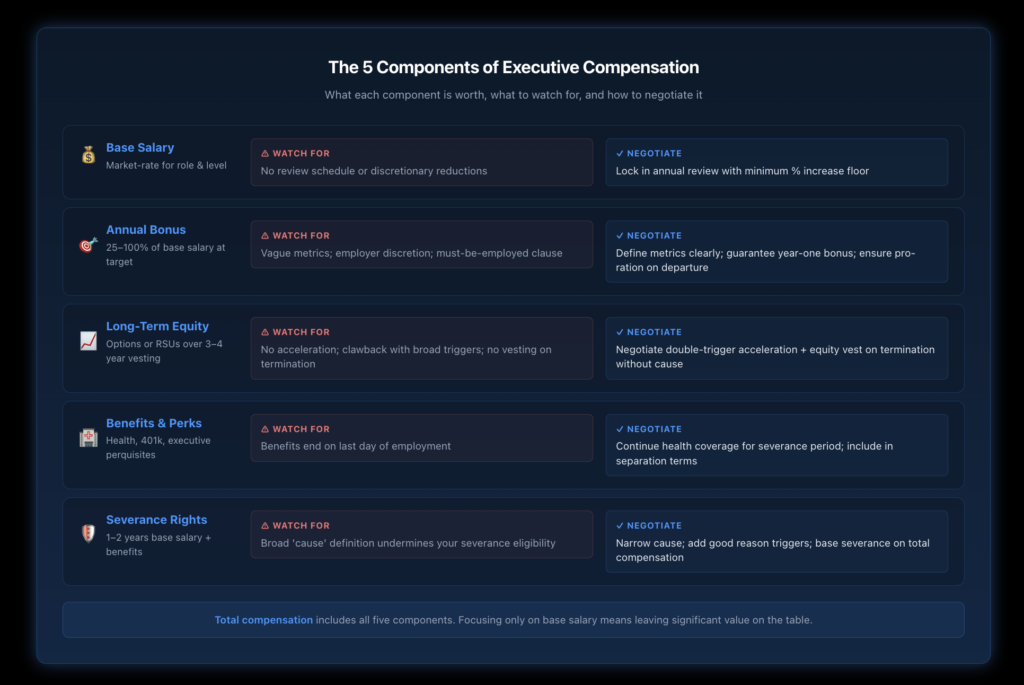
Base salary is typically the most straightforward element — you either accept the offer, counter, or negotiate until you reach a number both sides can live with. But don’t stop there. Make sure the contract specifies:
- How and when your salary gets reviewed
- Whether performance reviews come with guaranteed minimum increases or are purely discretionary
- The precise definition of “cause” is that your salary can be reduced
A salary that sounds good at hire can feel very different two years in if the company has broad discretion to restructure it.
What Should You Know About Bonus and Incentive Compensation?
Bonuses deserve close attention. A contract that promises a target bonus of 50% of base salary sounds valuable — until you realize the metrics are entirely within the board’s discretion, the payment requires you to still be employed on the payment date, and the company can unilaterally change the targets each year.
When reviewing bonus provisions, focus on:
- Whether target metrics are clearly defined or left to the company’s discretion
- Whether bonuses are guaranteed for year one (common in recruitment packages)
- What happens to unpaid bonuses if you leave before a payment date, especially if you leave for a good reason
- Whether performance-based compensation structures are tied to individual performance, company performance, or both
The SEC’s executive compensation disclosure framework gives you insight into how public companies structure and disclose executive pay — useful context when benchmarking what you’re being offered.
How Do Equity and Long-Term Incentives Factor In?
For many executives, equity compensation represents the most significant portion of total compensation. Negotiating vesting schedules, acceleration triggers, and the treatment of unvested equity at separation can be worth far more than negotiating base salary.
Key questions to address:
- What is the vesting schedule? Four-year vesting with a one-year cliff is standard but not universal.
- Does the equity accelerate on a change in control? Single-trigger, double-trigger, or something in between?
- What happens to unvested equity if you’re terminated without cause?
- Are there any clawback provisions that could require you to return compensation already paid?
The IRS governs golden parachute excise taxes under IRC Section 280G — these tax rules become relevant if change-in-control payments exceed three times your base compensation, and are worth understanding before you negotiate those provisions.
What Are the Most Critical Termination and Severance Provisions?
For executives, termination provisions are often more important than compensation provisions. The circumstances under which you can be fired, what you’re owed when you are, and whether you have the right to resign for “good reason” can define your financial outcome in a major way.
What Does “Termination Without Cause” Mean for You?
Most executive agreements distinguish between termination “for cause” and termination “without cause.” Termination without cause typically triggers severance payments. Termination for cause typically does not.
The definition of “cause” matters enormously. Employers often draft broad cause definitions that include things like:
- Failure to meet performance targets (even if targets weren’t reasonable)
- Conduct that “reflects negatively” on the company
- Any breach of company policy
Negotiate to narrow the cause definition. Cause should be limited to serious misconduct — criminal acts, fraud, gross negligence, willful failure to perform duties. The broader the cause definition, the easier it becomes for the company to terminate you without paying severance.
What Is a “Good Reason” Resignation and Why Does It Matter?
A “good reason” resignation clause is one of the most important protections you can negotiate. It allows you to resign and still receive severance if the company makes material, adverse changes to your situation — without your consent.
Common good reason triggers include:
- A significant reduction in your base salary
- A material diminution in your duties or responsibilities
- Relocation to a different geographic area without your agreement
- The company’s failure to pay you compensation owed
Without a good reason provision, if the company demotes you, strips your responsibilities, or restructures your role in a way that makes it untenable, your only option is to quit without severance — or stay in a situation that’s been fundamentally changed. This issue frequently intersects with constructive discharge claims that arise when an executive’s working conditions become untenable.
How Much Severance Is Reasonable for an Executive?
Severance norms vary by role, industry, and company size. For mid-level executives, one to two years of base salary is common. For C-suite executives, two or more years plus continuation of benefits is not unusual.
When negotiating severance, consider:
- Whether severance is based on base salary only, or total compensation, including target bonus
- How long benefits continuation lasts
- Whether unvested equity accelerates or is forfeited
- Whether severance is paid in a lump sum or over time
- The post-separation conditions (signing a release, non-disparagement, cooperation requirements)
The executive severance and retirement planning framework outlines what components are typically negotiable and what departure packages typically include at the executive level.
What Do Restrictive Covenants Mean for Your Future Career?
Non-compete clauses and non-solicitation provisions can significantly restrict what you’re able to do after leaving an executive role. Understanding what’s enforceable — particularly in New York — is essential before you sign anything.
Are Non-Compete Agreements Enforceable in New York?
In New York, non-compete agreements are only enforceable under limited conditions. A court will look at whether the restriction:
- Is necessary to protect a legitimate employer interest (trade secrets, confidential information, or specialized skills)
- Is reasonable in duration and geographic scope
- Does not impose undue hardship on the employee
- Does not harm the public
New York courts apply real scrutiny to non-competes, particularly those with overly broad industry definitions or extended time periods. A two-year restriction on working for any competitor in an entire industry is very different from a one-year restriction on soliciting specific clients you worked with directly. The former is much more likely to face legal challenges.
The New York Attorney General’s office has actively pursued enforcement actions against companies using overbroad non-compete agreements — a clear signal that these restrictions have meaningful limits under state law.
What Should You Negotiate in Non-Compete and Non-Solicitation Clauses?
When you can’t eliminate these restrictions entirely, focus on narrowing them:
- Duration: Push for six months to one year rather than two or more
- Geographic scope: Limit restrictions to markets where you actually worked
- Scope of restricted activity: Restrict only roles where you’d be using the employer’s specific confidential information
- Garden leave: Some agreements require the company to pay your salary during the non-compete period — this is worth requesting
- Non-solicitation vs. non-compete: Non-solicitation of specific clients or employees is more enforceable and less damaging than a full non-compete
Clawback provisions and confidentiality obligations are related considerations — make sure that any compensation recovery triggers are clearly defined and tied to actual misconduct rather than competitive employment.
What Other Provisions Should You Review Carefully?
Beyond compensation and termination, several other contract provisions deserve attention before you sign.
What Does Indemnification Mean for an Executive?
When you act as an officer or director, you can be personally named in lawsuits arising from your business decisions. Indemnification provisions — and the company’s obligation to advance legal costs — protect you from having to fund your own defense out of pocket while still employed.
Make sure your agreement includes:
- Broad indemnification for actions taken in your official capacity
- The company’s obligation to advance legal fees and costs
- Confirmation that indemnification survives the termination of your employment
- Coverage under the company’s Directors & Officers (D&O) insurance policy
Understanding how board compensation committees function — and how compensation and indemnification decisions get made — is a useful context for knowing what to request.
How Does Dispute Resolution Affect Your Rights?
Many executive agreements require disputes to be resolved through binding arbitration rather than in court. Arbitration is generally faster and more private — but it also limits your discovery rights and eliminates jury trials.
If arbitration is required, negotiate for:
- Choice of a reputable arbitration provider (AAA or JAMS)
- Employer-paid filing fees
- The right to conduct meaningful discovery
- New York is the governing law if that’s where you work
The EEOC’s framework for equal employment opportunity laws applies regardless of arbitration provisions — your statutory rights under Title VII and other federal anti-discrimination statutes cannot be waived through contract. Similarly, the New York State Department of Labor’s worker protections apply independently of any forum selection clause.
How Does Deferred Compensation Affect Your Contract Terms?
Many executive agreements include deferred compensation arrangements that defer payment of a portion of your compensation to a future date. These arrangements are governed by Section 409A of the Internal Revenue Code, which imposes strict rules on when and how deferred compensation can be paid.
Non-compliance with Section 409A can result in immediate income recognition, a 20% excise tax, and interest charges — all borne by the employee, not the employer. When reviewing deferred compensation provisions, make sure the payment triggers are clearly defined and compliant with IRS requirements.
What Should New York-Based Executives Know Specifically?
If you’re negotiating an executive agreement under New York law — or for a role based in New York — there are specific legal standards that apply to your situation.
How Does New York Law Affect Non-Compete Enforcement?
New York applies a common law reasonableness test to non-compete agreements. Courts will assess duration, geographic scope, and whether the restriction is necessary to protect a legitimate business interest. Overly broad restrictions are subject to “blue penciling” — a court can narrow the restriction rather than void it entirely.
For executives specifically, courts have upheld non-competes when they protect genuine trade secrets or client relationships developed through the executive role. But they’ve struck down restrictions that amount to blanket prohibitions on an executive’s ability to work in their industry.
What Are the Filing Timelines If Your Rights Are Violated?
If your employer breaches your employment agreement, your legal options depend on which laws apply and where claims are filed. Contract claims in New York have a six-year statute of limitations. Claims under Title VII and other anti-discrimination statutes have shorter windows — typically 300 days to file with the EEOC in New York, one year under the New York State Human Rights Law, and three years under the NYC Human Rights Law.
If your executive agreement includes a forum selection clause requiring disputes to be resolved in a particular venue, that will govern where you must file. And if your contract dispute also involves claims of discriminatory treatment, wrongful termination protections may provide additional legal avenues worth exploring. For New York executives facing corporate governance disputes tied to compensation, corporate governance, and executive compensation, provide additional context.
Ready to Protect Your Rights in an Executive Role?
Reviewing and negotiating an executive employment contract is one of the highest-value investments you can make in your own financial security. The terms you negotiate — or fail to negotiate — will govern your situation for years, including at the moment you may be least prepared to fight for yourself: at separation.
Nisar Law Group works with executives in New York and New Jersey to review employment agreements, identify problematic provisions, and negotiate terms that reflect your actual market value and legal rights. If you’re reviewing an offer or have concerns about restrictions in an existing contract, contact us today for a consultation.
Frequently Asked Questions About Negotiating Executive Employment Agreements
An executive employment agreement is a formal contract between a company and a senior-level employee that defines the terms of employment. Unlike standard offer letters, these agreements create legally enforceable obligations on both sides and typically address compensation, benefits, equity, termination rights, restrictive covenants, and dispute resolution. They’re most common for C-suite executives, vice presidents, and other senior leaders who have significant leverage during the hiring process.
Three-year executive employment contracts are used in some industries, particularly in healthcare, education, and certain financial services roles. Whether that term is reasonable depends on the industry, the role, and what protections are included for both sides. Longer terms can benefit executives by providing income security, but may also limit flexibility to move on if the role changes. Most corporate executive agreements are either at-will or have shorter defined terms with renewal options.
Severance norms for executives typically range from six months to two or more years of base salary, depending on level, industry, and tenure. C-suite executives often receive severance packages that include base salary continuation, pro-rated bonuses, continued health benefits, and sometimes accelerated equity vesting. The specific terms are highly negotiable, and the definition of what triggers severance — particularly the distinction between termination for cause and without cause — significantly affects what you’ll actually receive.
Executive employment agreements typically provide benefits beyond base salary that can represent substantial value. These include annual bonus targets, equity compensation with defined vesting schedules, enhanced severance packages, Directors & Officers insurance coverage, indemnification for actions taken in your official capacity, post-employment consulting arrangements, and — depending on the company and industry — perquisites such as expense accounts, car allowances, or housing assistance. The total value of an executive package often significantly exceeds the stated salary figure.
Executive agreements generally fall into three broad categories: employment agreements (which define all terms of your ongoing employment), severance or separation agreements (which govern the terms of departure), and change-in-control agreements (which address compensation and rights triggered by a corporate transaction). Some executives have all three in place. The most comprehensive protections come from a well-negotiated employment agreement that includes change-in-control and severance provisions as integrated components rather than separate documents.
A well-negotiated executive employment agreement should include clear definitions of base salary and bonus targets, specific cause and good reason definitions, a reasonable severance formula, equity acceleration provisions, indemnification and D&O insurance coverage, limited and time-bound non-compete restrictions, mutual non-disparagement clauses, and clear dispute resolution procedures. Each of these provisions represents a protection that may not be in the employer’s initial draft, which is exactly why legal review before signing is important.
CEOs and other senior executives typically negotiate salary by establishing a clear understanding of market benchmarks for similar roles and then presenting a reasoned counter-proposal based on their specific background, the scope of the role, and the company’s performance trajectory. Many executives work with employment attorneys during this process to ensure they’re not overlooking non-monetary provisions — like equity treatment, severance structure, and restrictive covenant scope — that can be equally or more valuable than base salary.
