

On April 15, 2010, Mayor Michael Bloomberg, Schools Chancellor Joel Klein, and United Federation of Teachers President Michael Mulgrew announced an agreement that ended one of the most publicly criticized practices in NYC public education. The so-called “rubber rooms” — officially known as Temporary Reassignment Centers — had held hundreds of tenured teachers for months or years while misconduct and incompetence investigations crawled forward. The 2010 agreement closed the physical rooms, introduced hard-charging deadlines, expanded the arbitration roster, and redirected reassigned teachers to actual work. But understanding what changed — and what didn’t — matters enormously for educators facing teacher certification and licensing disputes or reassignment today.
Key Takeaways
- The April 2010 agreement eliminated physical Temporary Reassignment Centers, effective September 2010.
- The DOE was given 10 days to file incompetence charges or 60 days to file misconduct charges after reassignment — missing either deadline sends the teacher back to the classroom.
- Reassigned teachers are now assigned to administrative duties, not idle holding rooms.
- Arbitrators expanded from 23 to 39; hearings increased from 5 to 7 days per month.
- Teachers continue to receive full pay during reassignment in most cases.
- Section 3020-a — the statute governing tenured teacher discipline — was not rewritten by the 2010 agreement; additional statutory reforms followed in 2012 and 2015.
- In practice, timelines were frequently not enforced, and cases continued to take years.
Disclaimer: This article provides general information for informational purposes only and should not be considered a substitute for legal advice. It is essential to consult with an experienced employment lawyer at our law firm to discuss the specific facts of your case and understand your legal rights and options. This information does not create an attorney-client relationship.
What Were the Rubber Rooms and Why Did They Exist?
To understand what the 2010 agreement changed, you first need to understand the system it was responding to. By 2010, New York City had a well-documented and financially staggering problem: hundreds of tenured educators spending months or years doing nothing while their disciplinary cases inched forward.
What Was a Temporary Reassignment Center?
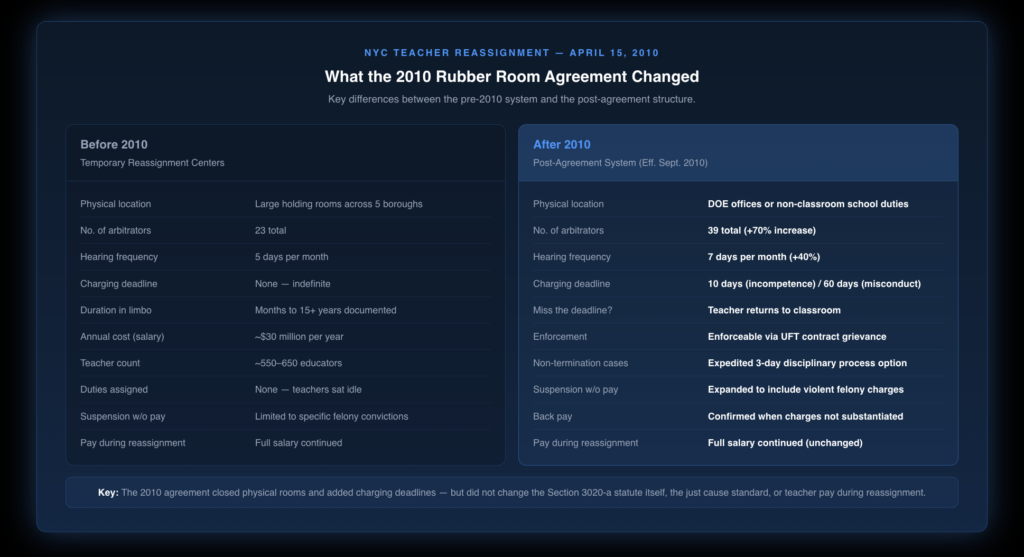
Temporary Reassignment Centers — universally called “rubber rooms” — were physical locations scattered across the five boroughs where teachers accused of misconduct or incompetence were sent while awaiting resolution of their Section 3020-a proceedings. At the time of the agreement, approximately 550 to 650 educators (more than 500 of them teachers) were assigned to these centers. The centers cost the city an estimated $30 million annually in salaries alone, with some estimates of total costs exceeding $65 million when administrative expenses are included.
Teachers in reassignment received full salaries — often $70,000 a year or more — while spending their days reading, playing games, or taking informal classes run by other reassigned educators. No instruction occurred. No productive work was assigned. The situation had become politically untenable for both the Bloomberg administration and the UFT.
Why Were So Many Teachers Sitting in Rubber Rooms?
The core problem was the absence of any firm timeline. Section 3020-a of the New York Education Law — the statute governing disciplinary proceedings for tenured teachers — established due process rights but imposed no hard deadlines on how quickly investigations had to conclude or charges had to be filed. Under the pre-2010 system, a teacher could be removed from the classroom and placed in a rubber room while an investigation remained open indefinitely. Some teachers sat for years. One teacher reportedly stayed for 15 years while earning a full salary throughout.
With only 23 arbitrators hearing cases just 5 days per month, the backlog was structural and self-reinforcing. Research tracking Section 3020-a decisions in New York City from 1997 to 2007 found only 208 formal decisions filed, averaging fewer than 21 per year out of a teaching workforce of approximately 78,000. The process was, by any measure, broken.
What Did the April 15, 2010, Agreement Specifically Change?
What Happened to the Physical Reassignment Centers?
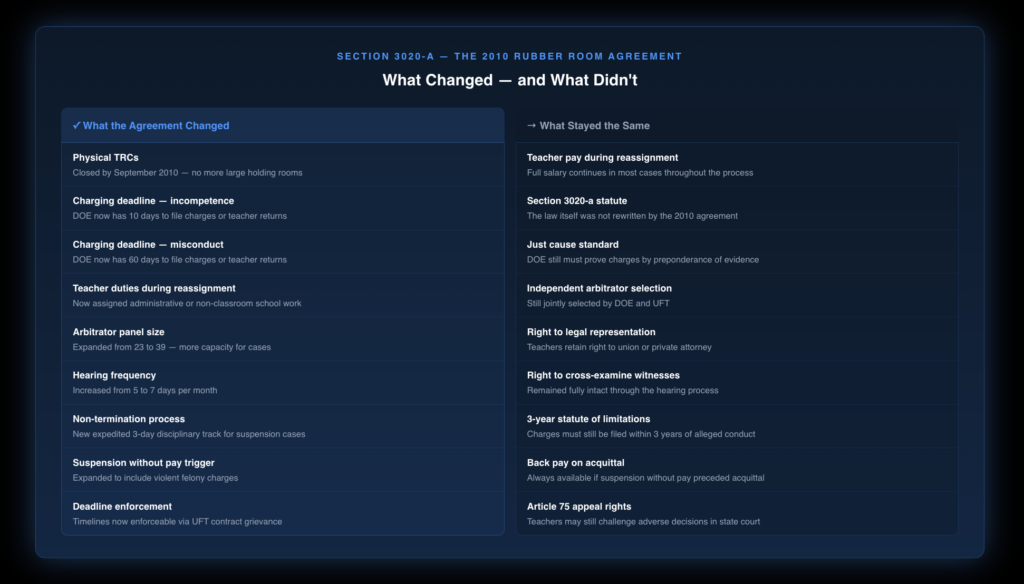
The agreement took effect at the start of the 2010-2011 school year, in September 2010. All teachers who had been assigned to rubber rooms prior to August 31, 2010, were reassigned to administrative offices within the Department of Education or given non-classroom duties in their schools. The physical holding rooms were shuttered. Teachers were now expected to do productive — if non-instructional — work while their cases were resolved, rather than sit idle in separate facilities.
This was the change most visible to the public. What the Queens Gazette reported at the time accurately captured the administration’s intent: cases that could have lasted years would be put on a schedule for resolution in months. Whether that promise was kept is a different question.
What New Deadlines Were Created for the DOE?
The most legally significant change wasn’t the closure of the rooms — it was the introduction of mandatory charging deadlines. Under the 2010 agreement:
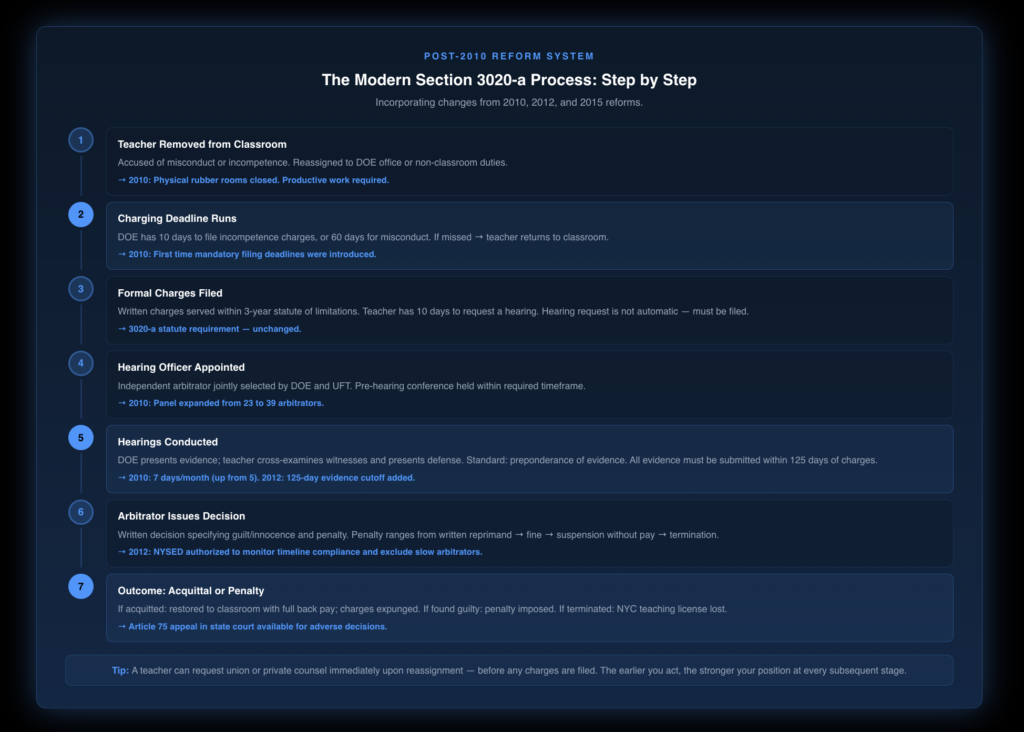
- If a teacher is reassigned based on allegations of incompetence, the DOE has 10 days to file formal charges — or the teacher returns to the classroom
- If a teacher is reassigned based on misconduct, the DOE has 60 days to file formal charges — or the teacher returns to the classroom.
These timelines were enforceable through the UFT contract’s grievance procedures, giving them contractual — not just administrative — weight. Investigations could continue after a teacher returned to the classroom if the DOE missed the deadline, but continued reassignment outside the classroom required that charges actually be filed.
How Did the 2010 Agreement Change the 3020-a Hearing Process?
What Is Section 3020-a of the New York Education Law?
Section 3020-a is the section of New York’s Education Law entitled “Disciplinary Procedures and Penalties.” It mandates that tenured teachers — those who have successfully completed a probationary period and earned tenure — can only be dismissed for “just cause” established through a formal administrative hearing. The statute creates a quasi-judicial process in which an independent arbitrator, jointly selected by the DOE and the UFT, hears evidence and issues a recommendation on guilt and penalty.
This core framework — due process before termination — was not eliminated or fundamentally altered by the 2010 agreement. What changed was the process surrounding it. Teachers in faculty rights disputes and disciplinary proceedings retain the same substantive protections under 3020-a that they always have.
What Changed Inside the Hearing Process Itself?
The 2010 agreement made several direct modifications to how 3020-a proceedings operated in New York City:
Arbitrator panel expanded: The number of arbitrators increased from 23 to 39, nearly doubling the capacity of the system to hear cases simultaneously.
Hearing frequency increased: Arbitrators went from hearing cases 5 days per month to 7 days per month — a 40% increase in scheduled hearing time.
Expedited process for non-termination cases: In cases where the DOE was seeking a suspension at reduced or no pay (rather than full termination), the agreement created an expedited 3-day disciplinary process as an alternative.
Expanded suspension without pay: The agreement expanded the list of charges that allowed the DOE to suspend a teacher without pay following a probable cause hearing. This list was extended to include violent felony crimes.
Back pay restoration: When charges were not substantiated against an educator, the agreement confirmed their entitlement to back pay for any period during which they were not receiving their full salary.
The NYSED page on teacher tenure hearings notes that the rules for terminating tenured educators have undergone significant changes since April 2012 — a second round of reforms that built on what the 2010 agreement started.
What Happened to Teachers' Pay and Benefits During Reassignment?
Were Teachers Still Paid After the Agreement?
Yes. One of the most persistent misconceptions about the 2010 agreement is that it stopped paying reassigned teachers. It did not. The fundamental economics of teacher reassignment didn’t change: a teacher removed from the classroom pending 3020-a proceedings continues to receive full salary and benefits during the investigation and hearing process in most circumstances.
This is by design. Due process — the constitutional and statutory guarantee that student disciplinary rights and educator rights alike rest on — requires that someone not be penalized before their case is actually decided. The 2010 agreement accepted this principle and focused instead on resolving cases faster, not on removing financial protection for teachers who hadn’t been found guilty of anything yet.
The goal was not to stop paying teachers while cases were pending. It was to make sure cases didn’t stay pending indefinitely.
When Could a Teacher Be Suspended Without Pay?
Before and after the 2010 agreement, suspension without pay is available in specific circumstances. When charges involve a probable cause finding for serious misconduct — particularly physical or sexual abuse of a student, or after the 2010 agreement’s expansion, violent felony crimes — the DOE can request a special hearing to determine whether the evidence supports suspension without pay. If that probable cause determination is made, the teacher can be suspended without pay for up to two or three months pending the outcome of the 3020-a proceeding.
This protection against arbitrary no-pay suspension is one of the most important rights tenured teachers retain under the system. Understanding these distinctions matters when educational malpractice claims intersect with educator employment.
Did the 2010 Agreement Actually Work?
This is the more honest question — and the answer is complicated.
Were the New Timelines Enforced?
In practice, the timelines introduced by the 2010 agreement were frequently not enforced with the rigor the agreement promised. Some hearings stretched to dozens of hearing dates spread across many months. Critics noted that the agreement created deadlines but didn’t create consequences severe enough to compel compliance. The UFT contract’s grievance procedures were the enforcement mechanism, but grieving a timeline violation doesn’t necessarily speed up the underlying case.
The physical rubber rooms closed. But as Gothamist reported in later coverage, the rubber rooms were said to have “gone underground” — teachers were now scattered across DOE offices and school building rooms rather than concentrated in large visible holding centers, but the same process of long-running reassignment continued in a less visible form.
What Happened to the Backlog of Cases?
The 2010 agreement set a goal of resolving all cases that existed at the time of closure by December 2010. That goal was not met across the board. More consequentially, in June 2012, it emerged that the New York State Education Department had failed to pay its 3020-a arbitrators for years, collectively owing them millions of dollars in back compensation. Ten of the 24 arbitrators on the New York City panel quit; the remaining 14 refused to hear testimony or issue decisions until their back wages were paid. This financial crisis — entirely separate from the 2010 agreement — created a new backlog at exactly the moment the system was supposed to be streamlining.
These persistent problems led directly to the more substantial legislative reforms that followed.
What Additional Reforms Followed the 2010 Agreement?
What Changed in 2012?
The 2012 legislative reforms to Section 3020-a were the most structurally significant changes since the 2010 agreement. The NYSED guidance on the 2012 changes outlined several major modifications that took effect for charges filed on or after April 1, 2012:
- 125-day evidence bar: Evidence could not be introduced more than 125 days after charges were filed, absent extraordinary circumstances, creating a genuine case-closure incentive
- NYSED hearing timeline monitoring: The Department was authorized to monitor arbitrator compliance with timelines and exclude those with a record of repeated failures
- Online case management: Implementation of the TEACH online system for case filing and tracking, replacing a manual paper process that contributed to delays
These changes addressed many of the enforcement weaknesses that had allowed the 2010 agreement’s timelines to be ignored in practice.
What Changed in 2015?
The 2015 Education Transformation Act added another layer of reform. Most significantly, it created Section 3020-b — an expedited hearing track for teachers rated “Ineffective” under the state’s Annual Professional Performance Review system. Teachers with two or three consecutive “Ineffective” ratings now face compressed timelines and a single hearing officer in all cases (replacing the option of a three-member panel that previously existed for some incompetence charges). Understanding this connection between performance evaluations and disciplinary proceedings is important for any educator consulting with an attorney about bullying and harassment in schools or facing an APPR-based disciplinary referral.
What Rights Do Charged Teachers Still Have Under 3020-a?
The 2010 agreement and subsequent reforms changed the timeline and structure of 3020-a proceedings. They did not strip tenured teachers of their core due process rights.
What Due Process Rights Survived the Agreement?
Under the teacher discipline framework maintained by NYSED, tenured teachers facing disciplinary charges retain the right to:
- A written specification of charges filed within three years of the alleged misconduct
- A hearing before an independent, impartial arbitrator
- Legal representation at the hearing (provided through NYSUT or retained privately)
- The opportunity to testify, call witnesses, and cross-examine the DOE’s witnesses
- The presumption of innocence — the DOE bears the burden of proof by a preponderance of the evidence
- Back pay if acquitted, covering any period of reduced or no pay
- An appeal of an adverse decision through an Article 75 proceeding in state court
These rights parallel, in important ways, the protections available to civil service employees in Section 75 hearings, though the mechanisms differ significantly. Understanding which framework applies to you — and who is protected under Section 75 — is an important first step.
What Should a Teacher Do If Reassigned Today?
Reassignment is not the end of a case — it’s the beginning. The steps a teacher takes immediately after being removed from the classroom can significantly affect the outcome of the subsequent 3020-a proceeding. Key actions include:
Contact your union immediately: NYSUT will typically provide free legal representation through the 3020-a process. Contact your UFT Borough Office and request legal counsel as soon as you are served with or anticipate charges.
Watch the charging deadlines: The 2010 agreement’s 10-day (incompetence) and 60-day (misconduct) charging windows are enforceable. If those deadlines pass without formal charges being served, you have a right to return to your classroom.
Begin building your defense record early: Witness statements, emails, lesson plans, evaluations, and any documentation of how charges arose can all be critical in the hearing. Pre-hearing suspensions — and how they’re handled — set the tone for the entire proceeding.
Consider private counsel: While union representation is available, tenured teachers facing serious charges sometimes retain private employment law counsel with specific 3020-a experience to supplement or replace union-provided representation.
The relationship between disciplinary proceedings and potential employer retaliation is also real. If you believe disciplinary charges are being pursued in retaliation for protected activity — reporting safety issues, advocating for students, or engaging in union activity — that context matters and should be preserved as evidence.
Facing 3020-a Charges or Reassignment? We Can Help.
The 2010 rubber room agreement changed the optics of NYC’s teacher discipline system. It changed some of the mechanics. But for educators facing reassignment today, the stakes remain exactly what they were before — your classroom, your certification, your career. Nisar Law Group represents educators in education law matters, 3020-a proceedings, certification disputes, and discrimination claims throughout New York and New Jersey. Contact us today to discuss your situation before the charging deadlines pass.
Frequently Asked Questions About the Rubber Room and 3020-a Hearings
The “rubber room” was the widely used nickname for Temporary Reassignment Centers — physical locations where tenured teachers accused of misconduct or incompetence were sent while their disciplinary cases were pending. Instead of teaching or performing any school-related work, teachers sat in these locations collecting full salaries for months or years. The April 2010 agreement between the Bloomberg administration and the UFT closed these physical centers, though the underlying reassignment process continued in a different form.
The nickname derives from the fact that the rooms were widely described as places where teachers could be expected to “bounce off the walls” from boredom — a reference to padded rooms in psychiatric facilities. The rooms were also sometimes compared to institutional holding spaces where nothing productive happened. The official name was Temporary Reassignment Center, but the informal “rubber room” stuck in media coverage, documentary films, and popular culture references, including Law & Order and the Netflix series Unbreakable Kimmy Schmidt.
The physical rooms, as they existed before 2010, no longer operate. However, the underlying practice of removing teachers from classrooms while disciplinary proceedings are pending continues. Critics have called the post-2010 arrangement a “hidden rubber room” — teachers are now scattered across DOE offices and school-based administrative assignments rather than concentrated in large visible holding centers, but the experience of extended reassignment pending a 3020-a hearing has not been eliminated for all teachers.
In the context of NYC education, “rubber room” refers to the practice of reassigning accused teachers to non-instructional holding assignments while their cases awaited resolution — effectively warehousing them at public expense. More broadly, the phrase came to symbolize institutional dysfunction: a process so slow and expensive that it cost taxpayers tens of millions of dollars per year without achieving the quick resolution of cases it was nominally designed to produce.
The formal name was Temporary Reassignment Center, or TRC. Some educators and advocates also refer to the broader category of extended administrative reassignment — including post-2010 assignments — as the “rubber room” in concept if not in physical form. The Absent Teacher Reserve (ATR) pool, created in 2005 for teachers excessed from closed or downsized schools, was sometimes called the “new rubber room” because it similarly warehoused educators in floating assignments without resolution.
Tenured teachers may be reassigned to administrative duties or non-classroom positions during the pendency of 3020-a proceedings — and that is exactly what the 2010 agreement formalized. However, this reassignment is not a punitive transfer without cause; it must follow the procedural requirements established by the agreement and the Education Law. Transfers of tenured teachers to positions with materially different duties or lower status can also raise legal questions, particularly if the transfer appears retaliatory or is used to avoid going through the 3020-a process altogether.

