

Veterans’ preference gives eligible veterans and certain family members an advantage when applying for federal government jobs and, in many cases, state and local positions. This preference system adds points to your examination scores, provides priority consideration during hiring, and offers protections during reductions in force. Understanding how to navigate veterans’ preference in federal employment can be the difference between landing a government job and being overlooked for candidates with less experience and dedication.
Key Takeaways
- Federal veterans’ preference adds 5 or 10 points to passing examination scores, depending on your service history and disability status.
- New York State provides additional civil service exam credits (5-10 points) and the 55-c program for disabled veterans.
- Federal contractors with $200,000+ contracts must take affirmative action to recruit and hire protected veterans under VEVRAA.
- You must file veterans’ preference complaints with the Department of Labor within 60 days of an alleged violation.
- Private employers in New York currently cannot offer veterans’ preference without state authorization, though legislation is pending.
Disclaimer: This article provides general information for informational purposes only and should not be considered a substitute for legal advice. It is essential to consult with an experienced employment lawyer at our law firm to discuss the specific facts of your case and understand your legal rights and options. This information does not create an attorney-client relationship.
Who Qualifies for Veterans' Preference?
Not every veteran automatically receives preference in federal hiring. Your eligibility depends on when you served, how long you served, and whether you have a service-connected disability. The Office of Personnel Management administers these requirements under federal law.
What Are the Basic Eligibility Requirements?
To qualify for any veterans’ preference, you must have served on active duty in the Armed Forces and been separated under honorable conditions. Active duty for training purposes alone doesn’t count. You’ll need your DD-214 (Certificate of Release or Discharge from Active Duty) to prove your eligibility when applying for federal positions.
What Is 5-Point Preference?
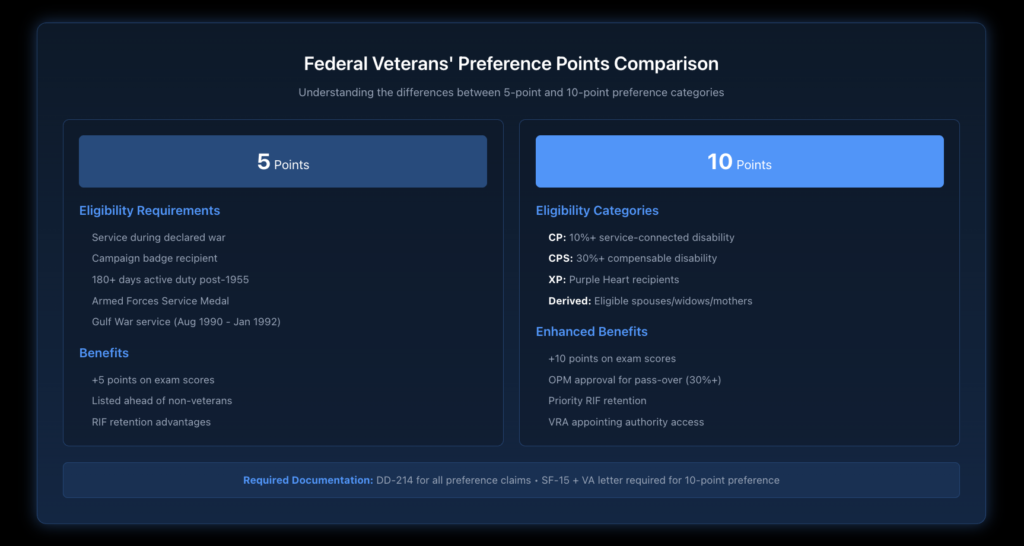
Five-point preference applies to veterans who served during a war declared by Congress, in a campaign or expedition for which a campaign badge was authorized, or for more than 180 consecutive days (other than for training) after January 31, 1955. You also qualify if you received an Armed Forces Service Medal for participation in a military operation. This preference adds 5 points to your passing examination score when competing for federal employment opportunities.
What Is 10-Point Preference?
Ten-point preference provides a greater advantage and applies to veterans with service-connected disabilities. The categories include:
CP (Compensable Disability): Veterans with a compensable service-connected disability rated at 10% or more by the VA qualify for 10 additional points.
CPS (30% or More Disability): Veterans with a 30% or more compensable service-connected disability receive 10 points plus additional protections, including OPM approval before an agency can pass over them for selection.
XP (Disability Under 10% or Purple Heart): Veterans with a service-connected disability rated less than 10%, or who received the Purple Heart, also receive a 10-point preference.
Veterans claiming 10-point preference must submit SF-15 (Application for 10-Point Veterans’ Preference) along with supporting documentation from the VA or their military branch.
How Does Veterans' Preference Work in Federal Hiring?
Understanding the mechanics of preference helps you know exactly what advantage you’re entitled to during the federal hiring process. These protections apply to competitive service positions and many excepted service positions.
What Is the Rule of Three?
Traditionally, when an agency filled a position through competitive examination, the selecting official could only choose from the top three eligible candidates. Veterans with preference who passed the examination would be listed ahead of non-veterans with the same score. A veteran with a 10-point preference who scored 80 would be rated as 90 and listed above a non-veteran who scored 89.
How Does Category Rating Affect Veterans’ Preference?
Many federal agencies now use category rating instead of numerical rankings. Under this system, candidates are placed into quality categories (such as “Best Qualified,” “Well Qualified,” and “Qualified”) rather than ranked by exact scores. Preference eligibles are listed ahead of non-preference eligibles within each category, and agencies must select from the highest quality category.
What Happens During Reductions in Force?
Veterans’ preference provides crucial protections during federal workforce reductions. When agencies must conduct a reduction in force (RIF), veterans receive retention preference over non-veterans at the same competitive level. Your preference status affects your position on the retention register, potentially allowing you to keep your job or bump into another position when layoffs occur.
What Veterans' Employment Protections Exist in New York?
New York provides robust employment protections for veterans at both the state and city levels. These benefits supplement federal protections and can provide additional advantages when seeking public sector employment. If you’re facing discrimination based on military service, understanding all available protections is essential.
How Does New York Civil Service Preference Work?
New York State awards additional credits on civil service examinations. Disabled veterans receive 10 points on open-competitive examinations and 5 points on promotion examinations. Non-disabled veterans receive 5 points on open-competitive examinations and 2.5 points on promotion examinations. You can only use these credits once for permanent employment in New York State civil service positions.
What Is the 55-c Program for Disabled Veterans?
Section 55-c of the New York Civil Service Law authorizes 500 entry-level positions specifically for qualified wartime veterans with disabilities. If you have a service-connected disability rating of at least 10% from the VA, you may be eligible to receive a state position without taking a competitive examination. Any veteran who received the Purple Heart is automatically eligible. The New York Department of Labor provides priority services to help veterans navigate these programs.
Do NYC Veterans Receive Additional Benefits?
New York City offers free civil service examination registration for veterans and veteran spouses, waiving the application fees that other applicants must pay. The NYC Department of Veterans’ Services connects veterans with employment resources and coordinates with city agencies on veteran hiring initiatives.
What Rights Do Veterans Have with Federal Contractors?
Federal contractors and subcontractors face specific obligations to recruit and hire veterans under the Vietnam Era Veterans’ Readjustment Assistance Act. These requirements apply to companies doing substantial business with the federal government and provide additional employment opportunities for protected veterans.
What Is VEVRAA and Who Does It Cover?
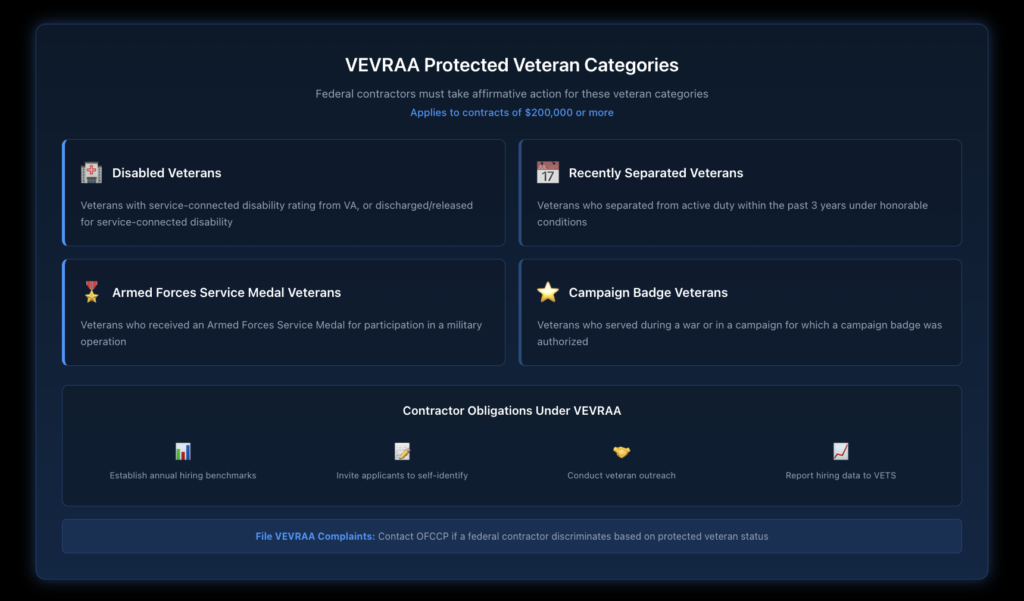
VEVRAA requires federal contractors with contracts of $200,000 or more to take affirmative action to recruit, hire, promote, and retain protected veterans. This isn’t just a preference—it’s a legal obligation that contractors must fulfill. The Office of Federal Contract Compliance Programs enforces these requirements and conducts focused reviews to ensure compliance.
Who Is a “Protected Veteran” Under VEVRAA?
VEVRAA covers four categories of protected veterans:
Disabled Veterans: Veterans with a disability rating from the VA or who were discharged for a service-connected disability.
Recently Separated Veterans: Veterans who separated from active duty within the past three years.
Armed Forces Service Medal Veterans: Veterans who received an Armed Forces Service Medal for participation in a military operation.
Active Duty Wartime or Campaign Badge Veterans: Veterans who served during a war or in a campaign for which a campaign badge was authorized.
What Is the VEVRAA Hiring Benchmark?
Federal contractors must establish an annual hiring benchmark for protected veterans. The current benchmark, based on Bureau of Labor Statistics data, helps contractors measure whether their outreach and recruitment efforts are effective. If a contractor’s protected veteran hiring consistently falls below the benchmark, it may indicate problems with their affirmative action program.
How Can You Enforce Your Veterans' Preference Rights?
When an employer violates your veterans’ preference rights, you have legal options to seek corrective action. Understanding the proper procedures for filing complaints helps protect your interests and ensures your claims receive proper attention.
How Do You File a Federal Veterans’ Preference Complaint?
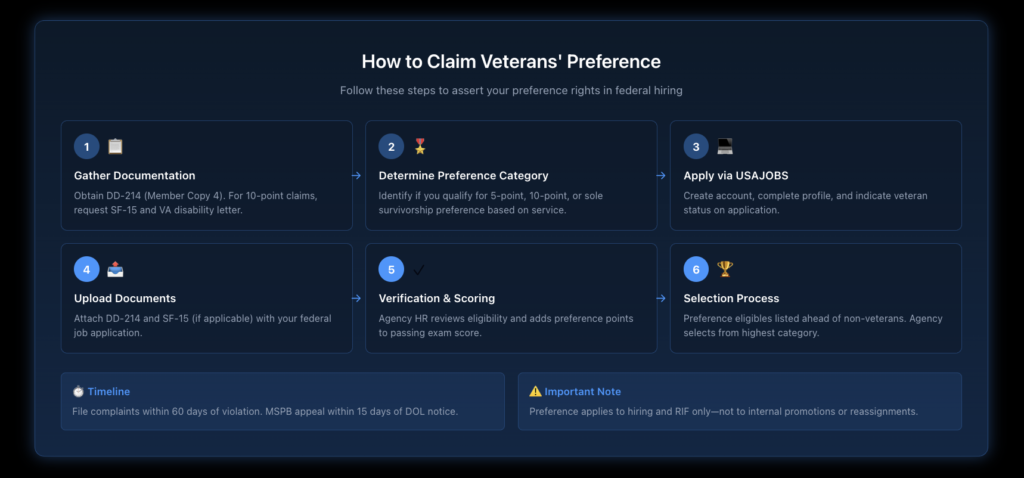
If a federal agency violates your veterans’ preference rights, you must file a complaint with the Department of Labor’s Veterans’ Employment and Training Service (VETS) within 60 days of the alleged violation. VETS will investigate your complaint and attempt to resolve it. You can file using Form 1010 online or by mail.
What Is the VEOA Appeals Process?
Under the Veterans Employment Opportunities Act, if VETS cannot resolve your complaint within 60 days, you can appeal to the Merit Systems Protection Board. You must file your MSPB appeal within 15 days after receiving notice that DOL couldn’t resolve your complaint. The MSPB can order the agency to comply with veterans’ preference requirements and award back pay and benefits.
What About VEVRAA Complaints Against Contractors?
If a federal contractor discriminates against you as a protected veteran, you can file a complaint with OFCCP. The agency will investigate whether the contractor is meeting its affirmative action obligations and can take enforcement action for violations. This is separate from any USERRA claims you might have against the same employer.
What Are Common Veterans' Preference Violations?
Understanding how employers violate veterans’ preference helps you recognize when your rights have been compromised. These violations can occur in federal hiring, during reductions in force, or in contractor employment situations.
What Happens When Agencies Improperly Calculate Preference?
Some federal agencies fail to add the correct number of points to veterans’ examination scores or improperly determine which preference category applies. Others may not list preference eligibles ahead of non-preference eligibles when using category rating. These calculation errors can result in qualified veterans being passed over for positions they should have received.
Can Agencies Pass Over Veterans for Selection?
Federal agencies can select a non-veteran over a preference-eligible only in limited circumstances. For veterans with 30% or more disability, the agency must obtain OPM approval before passing them over. The selecting official must provide legitimate, job-related reasons for the pass-over decision.
What Constitutes VEVRAA Noncompliance?
Federal contractors violate VEVRAA when they fail to invite applicants to self-identify as protected veterans, don’t establish annual hiring benchmarks, fail to conduct meaningful outreach to veteran organizations, or discriminate against veterans in hiring or employment decisions. Your rights as a military service member extend to employment with federal contractors.
Do Private Employers Have to Offer Veterans' Preference?
The rules for private employers differ significantly from public sector requirements. Currently, private sector veterans’ preference is limited in most jurisdictions, including New York.
What Is the Current Law in New York?
New York State currently doesn’t authorize private employers to voluntarily adopt veterans’ preference policies. Under Title VII of the Civil Rights Act, employers generally can’t give hiring preference based on veteran status unless state law specifically permits it. Pending legislation (Senate Bill S.3128) would allow private employers to voluntarily adopt veterans’ preference policies, but this hasn’t yet become law.
How Do Other States Handle Private Sector Preference?
Approximately 15 states currently permit private employers to offer veterans’ preference, while 40 states (including New York) offer preference only in public employment. The limitation exists because giving preference to veterans could potentially constitute discrimination against non-veterans unless authorized by state law.
What Can Private Employers Do Now?
While private employers can’t offer explicit hiring preference, they can and should recruit at veteran job fairs, partner with veteran service organizations, and ensure their hiring processes don’t discriminate against applicants based on military service or status. They can also highlight veteran-friendly workplace policies to attract veteran applicants.
How Do You Document Your Eligibility for Preference?
Having the right documentation ready streamlines your job applications and ensures you receive the preference you’ve earned. Missing or incomplete documents can delay your application or result in the denial of preference.
What Documents Do You Need for 5-Point Preference?
For a 5-point preference, your DD-214 (Member Copy 4) showing honorable discharge is typically sufficient. The DD-214 should clearly show your dates of service, character of discharge, and whether you served during a qualifying period or received a campaign badge or Armed Forces Service Medal.
What Additional Documents Does 10-Point Preference Require?
Ten-point preference requires SF-15 plus supporting documentation from the VA showing your disability rating. For disabled veterans, you’ll need a VA letter dated 1991 or later certifying your service-connected disability percentage. For veterans with service-connected disabilities, both USERRA and ADA protections may apply.
How Do You Verify Your Preference Is Properly Recorded?
After being hired by a federal agency, review your SF-50 (Notification of Personnel Action) to confirm your veterans’ preference is correctly noted in Block 23. For RIF purposes, preference should also appear in Block 26. If there are errors, contact your agency’s Human Resources office immediately to correct your personnel record.
Ready to Protect Your Veterans' Employment Rights?
Veterans who served their country deserve every employment advantage the law provides. Whether you’re claiming preference in federal hiring, seeking state civil service positions, or asserting your rights with federal contractors, knowing the rules gives you power.
If you believe your veterans’ preference rights have been violated or you’re facing wrongful termination as military personnel, Nisar Law Group can help. Our employment attorneys understand the complex intersection of veterans’ employment laws and can guide you through the complaint and appeals process. Contact us today for a consultation to discuss your situation.
Frequently Asked Questions About Veterans' Preference in Employment
Claiming veterans’ preference means you’re asserting your legal right to receive an advantage in federal hiring based on your military service. When you claim preference on a federal job application, you’re asking the agency to add points to your examination score and list you ahead of non-veterans with equal scores. You must provide documentation proving your eligibility, and the preference applies throughout the competitive hiring process, including any reductions in force.
The rule of three traditionally required federal agencies to select from only the top three eligible candidates on a hiring certificate. Veterans with preference who passed the examination would be ranked above non-veterans with the same score, potentially pushing them into the top three. While many agencies now use category rating instead, the principle remains similar—preference eligibles are listed ahead of non-preference eligibles within each quality category.
Veterans with a compensable service-connected disability rated at 30 percent or more receive special protections beyond the standard 10-point preference. Agencies must obtain approval from OPM before passing over these veterans for selection, providing an extra layer of protection in the hiring process. These veterans also receive additional retention rights during reductions in force.
For a 5-point preference, you need your DD-214 Member Copy 4 showing honorable discharge and qualifying service periods. For a 10-point preference, you must submit SF-15 along with supporting documents from the VA certifying your disability rating. The documentation must be current and clearly establish your eligibility for the specific preference category you’re claiming.
Veterans receive mandatory preference in federal hiring, and most state and local government positions, but private employers generally cannot offer preference unless state law permits it. Currently, 15 states allow private sector veterans’ preference. In New York, veterans receive civil service exam credits for public positions, but private employers cannot legally offer hiring preference to veterans without new legislation.
You must file a complaint with the Department of Labor’s Veterans’ Employment and Training Service within 60 days of the violation. VETS will investigate and attempt a resolution. If unsuccessful after 60 days, you can appeal to the Merit Systems Protection Board within 15 days. The MSPB can order the agency to comply and award compensation for lost wages and benefits.
USERRA protects your right to return to civilian employment after military service and prohibits discrimination based on military obligations. Veterans’ preference provides advantages in federal hiring and retention during reductions in force. They’re separate laws with different purposes—USERRA covers all service members’ reemployment rights while veterans’ preference specifically benefits qualifying veterans in the federal hiring process.
No. Federal contractors with contracts of $200,000 or more must take affirmative action to recruit and hire protected veterans under VEVRAA. They cannot discriminate against veterans in hiring, firing, pay, promotions, or other employment decisions. If you believe a federal contractor has discriminated against you based on your veteran status, you can file a complaint with the Office of Federal Contract Compliance Programs.
