

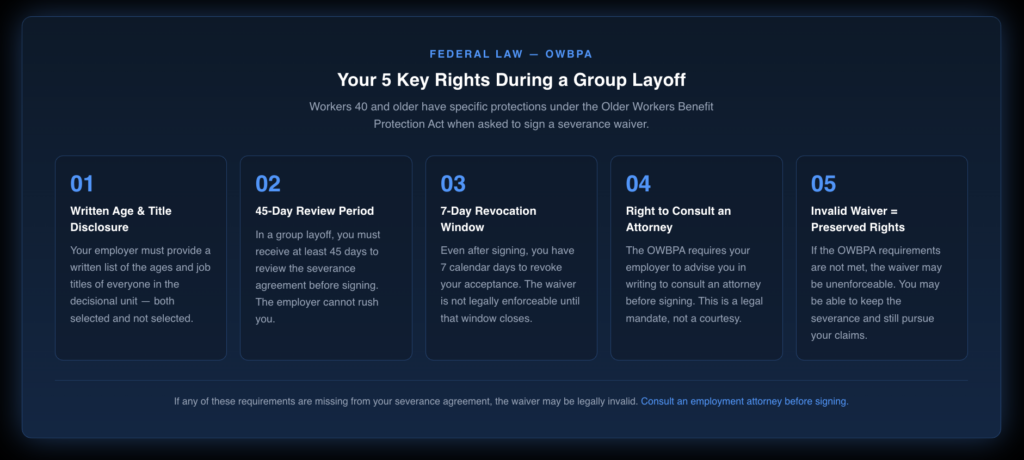
When your employer hands you a severance agreement during a layoff, you might notice an attachment listing other employees’ job titles and ages. That document isn’t an accident — it’s a federal legal requirement. Under the Older Workers Benefit Protection Act of 1990 (OWBPA), employers who ask workers 40 or older to sign a waiver of their age discrimination claims during a group layoff must provide a written disclosure of who else is being let go, their ages, their job titles, and who wasn’t selected. If your employer skipped that step, the waiver you signed may not be worth the paper it’s printed on.
Key Takeaways
- The OWBPA requires employers to disclose the ages and job titles of everyone in the “decisional unit” when layoffs involve a waiver of age discrimination claims.
- This applies when two or more employees 40 and older are being laid off and offered severance in exchange for releasing ADEA claims.
- You have 45 days to review the agreement and 7 days to revoke it after signing.
- An employer’s failure to comply can invalidate your waiver and preserve your legal claims.
- New York workers have additional protections that extend beyond federal law.
- You can still file an EEOC charge even after signing a waiver that fails OWBPA requirements.
Disclaimer: This article provides general information for informational purposes only and should not be considered a substitute for legal advice. It is essential to consult with an experienced employment lawyer at our law firm to discuss the specific facts of your case and understand your legal rights and options. This information does not create an attorney-client relationship.
What Is the OWBPA and Why Does It Matter in Layoffs?
The Age Discrimination in Employment Act (ADEA) protects employees 40 and older from workplace discrimination, including layoffs that target older workers. But employers found a workaround: offer severance money in exchange for signing away your right to sue. Congress responded by passing the OWBPA to set strict requirements for when those waivers are actually valid.
The core idea is straightforward. If you’re going to give up a legal right, you need enough information to make an informed decision. That’s where the age disclosure requirement comes in. Without knowing who else was laid off and how old they were, you can’t tell whether the company targeted older workers, which is the information you’d need to evaluate whether you even have a claim worth giving up.
Why the Age Disclosure Requirement Exists
Think about it from a practical standpoint. Your company just laid off 20 people. Were most of them over 50? Did the company keep younger employees in nearly identical roles? That pattern is exactly what age discrimination looks like. The EEOC’s guidance on understanding waivers makes this point explicitly: the disclosure exists so you can make a genuinely informed choice before signing anything.
Who Is Covered by the OWBPA?
The OWBPA applies to all employees 40 and older — the same group protected by the ADEA. The ADEA covers employers with 20 or more employees, including federal, state, and local governments. When workers over 40 have specific legal protections under the ADEA, those protections attach the moment an employer seeks a waiver of any age-related claim. A company cannot offer severance to a single employee over 40 and expect to avoid OWBPA compliance, though the more robust disclosure rules kick in with group programs.
What Exactly Must Your Employer Disclose?
This is where a lot of employees get surprised. The OWBPA disclosure is more detailed than most people expect — and that level of detail is intentional.
What Is a “Decisional Unit”?
The disclosure must cover everyone in the “decisional unit” — not just the people who were laid off. A decisional unit is the pool of employees from which the company selected who would and wouldn’t be let go. Under 29 C.F.R. § 1625.22, the scope of the decisional unit depends on the actual decision-making process. If the company eliminated 10% of all staff at a single facility, the whole facility is likely the decisional unit. If it were only considered employees in the accounting department, just that department would count.
This matters because the wider the decisional unit, the more age data you receive — and the better your ability to spot a pattern of targeting older workers in the selection process.
What Information Must Appear in the Disclosure?
Under the OWBPA, your employer must provide in writing:
- The job titles and ages of all employees selected for the layoff program
- The job titles and ages of all employees in the decisional unit who were not selected
- The eligibility factors used to determine who was selected
- The time limits of the program, including when the offer expires
- A clear description of the class, unit, or group of employees covered
Everything must be written in plain language. If the disclosure is buried in legalese or uses generic categories that obscure the age data, that can be grounds to challenge the waiver. The EEOC fact sheet on age discrimination is clear that the goal is to give you real, usable information — not a compliance formality your employer can check off and move on.

When Does the OWBPA Disclosure Requirement Apply?
Not every layoff triggers the full OWBPA disclosure. There are specific conditions that need to be met — but they come up more often than most employees realize.
What Counts as a “Group Layoff”?
The OWBPA’s detailed disclosure requirements kick in when:
- Two or more employees are being offered severance in exchange for signing a waiver
- At least some of those employees are 40 or older
- The employer is seeking a release of claims under the ADEA
Even a small layoff can qualify as a “group program” if multiple employees receive the same standardized severance offer. The ADEA waiver regulations are clear that the label your employer puts on the layoff doesn’t matter — what matters is whether the practical structure fits the definition of a group exit incentive or termination program.
What If No Waiver Is Involved?
The disclosure requirement only applies when the employer is asking you to waive your ADEA rights. If you’re simply laid off with no severance agreement, the OWBPA disclosure requirement technically doesn’t apply — though the ADEA still protects you from discriminatory selection. In New York, the New York State Human Rights Law provides an additional layer of protection that doesn’t require any waiver to be in play. Even without a disclosure document, if the layoff disproportionately targeted older workers, you may still have a viable age discrimination claim.
How Long Do You Have to Review the Disclosure?
The OWBPA isn’t just about what information you receive — it’s also about when you receive it and how long you have to act on it.
What Are the Review Period Requirements?
For group layoffs, you must be given at least 45 days to consider the severance agreement before signing it. This is longer than the 21-day period that applies to individual terminations — the extra time reflects the complexity of evaluating whether a group layoff discriminated based on age. During those 45 days, the offer cannot legally be withdrawn.
The 45-day clock starts when you receive the full OWBPA disclosure — not when you first hear about the layoff. If your employer hands you the severance paperwork without the required age and title data, that clock hasn’t actually started yet.
Can You Revoke After Signing?
Yes — and this surprises many employees. Even after you sign, you have 7 calendar days to revoke your acceptance. The agreement doesn’t become legally enforceable until that revocation period expires. If you sign on Monday and consult an attorney who raises red flags on Wednesday, you can still pull back your signature. The EEOC enforcement statistics show that age discrimination charges reached 16,223 in fiscal year 2024 — many of those cases involve workers who didn’t realize they could challenge a flawed waiver even after they’d signed.

What Happens If Your Employer Doesn't Comply?
If your employer skips the disclosure, shortens your review period, or provides data that doesn’t meet OWBPA standards, the waiver is invalid. That isn’t a technicality — it’s the entire mechanism Congress built into the law.
Can You Challenge a Defective Waiver?
Yes. If the OWBPA requirements weren’t met, you can challenge the waiver’s validity and still pursue your age discrimination claims — potentially without returning the severance money first. Courts have generally held that an employer cannot require you to tender back your severance payment just to challenge a legally defective waiver.
When it comes to proving age discrimination in a reduction-in-force context, the disclosure itself often becomes critical evidence. A skewed age distribution — many older workers selected, mostly younger workers retained — can be a compelling piece of a discrimination case even when direct evidence of discriminatory intent is hard to find.
Can You Still File with the EEOC?
Absolutely. No waiver, including a fully OWBPA-compliant one, can prevent you from filing a charge of discrimination with the EEOC. The agency can still investigate and proceed with its own enforcement even if you’ve signed. If a court or the EEOC finds the waiver is invalid, you retain full rights to pursue all available remedies — including back pay, liquidated damages, and reinstatement.
What Extra Protections Do New York Workers Have?
Federal law sets the floor. In New York, the protections go considerably further.
New York State Human Rights Law Protections
The New York State Human Rights Law (NYSHRL) covers employers with as few as four employees, compared to the ADEA’s threshold of 20. That means a larger share of New York workers are protected from age discrimination in layoffs than federal law alone would reach. The New York Department of Labor’s guidance on ageism confirms that age discrimination — including in the context of layoffs — is illegal at every stage of employment in New York.
The NYSHRL also carries a more favorable statute of limitations. You have one year to file a complaint with the New York State Division of Human Rights, versus 300 days to file an EEOC charge. If you’re pursuing litigation directly, NYC employees have three years under the NYC Human Rights Law.
What About NYC-Specific Protections?
New York City workers get an even broader safety net under the New York City Human Rights Law. It applies to employers with four or more employees and has been consistently interpreted more favorably for employees than either federal or state law. If you’re a New York City worker concerned about age discrimination during the hiring process or facing a questionable layoff, NYC law may give you stronger tools and a longer window to pursue your claims.
What Steps Should You Take After Receiving an OWBPA Disclosure?
If you’ve received a disclosure packet as part of a group layoff, the next moves matter.
Review the age data carefully. Look at who was selected and who wasn’t. Are the laid-off employees disproportionately older? Are the retained employees concentrated in younger age groups? This is the central question.
Don’t sign under pressure. You have 45 days. Your employer cannot legally pressure you to sign sooner or threaten consequences for waiting. Signing early is a choice — never a requirement.
Get legal advice before signing. The OWBPA actually requires your employer to advise you in writing to consult an attorney before signing. Take that advice seriously.
Save the disclosure. Email it to yourself, print it, or store it somewhere your employer can’t access. That document becomes critical if you later pursue a claim.
Understanding your options for filing an age discrimination claim is an important next step if you believe the layoff targeted older workers. Patterns from landmark age discrimination cases show that employees who documented age patterns and acted promptly consistently built stronger cases than those who waited.
If the layoff situation amounts to pressure resembling forced retirement, or if you’ve experienced employer retaliation for raising age discrimination concerns, those are separate legal issues worth evaluating alongside your OWBPA rights. And if severance negotiation is still on the table, an attorney can help you assess what leverage you have before giving anything up.
Need Help Understanding Your OWBPA Rights?
If you received a severance agreement as part of a group layoff — or you’re unsure whether the disclosure you received meets legal standards — Nisar Law Group can help. Our employment law attorneys represent employees exclusively, and we have extensive experience navigating age discrimination claims across New York and New Jersey. Contact us today to discuss your situation before your 45-day review period runs out.
Frequently Asked Questions About OWBPA Layoff Disclosures
The OWBPA disclosure requirement is triggered when an employer offers a standardized severance package to two or more employees aged 40 or older in exchange for signing a waiver of age discrimination claims under the ADEA. The moment that exchange is part of a group termination or exit incentive program — voluntary or involuntary — the disclosure rules apply. A single-employee termination only requires a 21-day review period and does not trigger the group disclosure.
Being laid off based on your age is illegal under the ADEA and, in New York, under the New York State Human Rights Law. An employer cannot use age as a selection criterion in a reduction-in-force. If an employer uses neutral-sounding criteria that disproportionately affect workers over 40, that may also constitute unlawful disparate impact discrimination. The OWBPA disclosure exists precisely to help you see whether age played a role in how selection decisions were made.
Research and EEOC charge data suggest that workers over 40 face an elevated risk during reductions-in-force. The EEOC received 16,223 age discrimination charges in fiscal year 2024, many connected to layoffs and restructuring events. While statistical patterns alone aren’t legal proof, an age distribution visible through the OWBPA disclosure — lots of older workers selected, younger workers retained — can be compelling evidence in an age discrimination claim.
The biggest mistake is signing a severance agreement before reviewing it carefully or consulting an attorney. Other common errors include failing to analyze the OWBPA disclosure for age patterns, not knowing you have the full 45 days to consider the agreement, and assuming that signing permanently ends all your legal rights. A waiver that doesn’t meet OWBPA’s requirements can be challenged even after you’ve signed it.
Whether to accept a severance agreement depends on your financial situation, the strength of any potential age discrimination claim, and what the waiver requires you to give up. An important factor is whether the OWBPA disclosure reveals a suspicious age pattern in how people were selected. In most cases, consulting with an employment attorney before signing — not after — gives you the clearest picture of your options and the most leverage.
It can be. Courts have recognized that “overqualified” is sometimes used as a proxy for age, particularly when the employer’s real concern is replacing a higher-paid, experienced older worker with someone younger and less expensive. If overqualification is cited as a layoff reason that disproportionately affects workers over 40, that reasoning may not hold up to legal scrutiny — especially when combined with other indicators of age bias.
The ADEA actually permits employers to favor older workers based on age, even when doing so disadvantages younger workers who are also 40 or older. What the law prohibits is favoring younger workers over older ones. The ADEA is specifically designed to protect workers on the older end of the age spectrum — not to enforce strict age-neutral treatment in every employment decision.

