

If your employer controls when you work, how you do your job, and provides your tools and equipment, you may be an employee entitled to minimum wage, overtime pay, and other workplace protections—regardless of what they call you on paper. Independent contractor misclassification occurs when employers wrongly classify workers as contractors instead of employees to avoid paying benefits, taxes, and legal protections required under federal and New York law. This practice costs workers thousands of dollars annually and strips them of fundamental workplace rights.
Key Takeaways
- You may be misclassified if your employer controls your schedule, methods, and tools while calling you an independent contractor.
- Misclassified workers lose an average of $10,000-$20,000 per year in wages and benefits compared to properly classified employees.
- New York applies stricter tests than federal law, including the ABC test for construction workers, making it easier to prove employee status.
- You can file complaints with both the U.S. Department of Labor and the New York State Department of Labor to recover unpaid wages.
- The statute of limitations is six years under New York law, compared to just two to three years under federal law.
- Employers face penalties up to $5,000 per misclassified worker in New York, plus back wages and liquidated damages.
Disclaimer: This article provides general information for informational purposes only and should not be considered a substitute for legal advice. It is essential to consult with an experienced employment lawyer at our law firm to discuss the specific facts of your case and understand your legal rights and options. This information does not create an attorney-client relationship.
What Is Independent Contractor Misclassification?
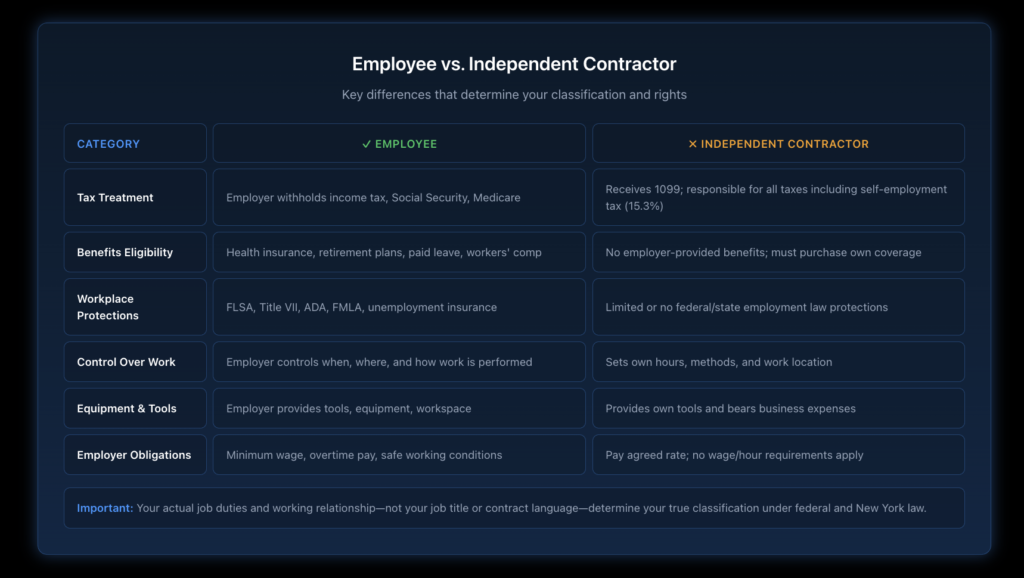
Independent contractor misclassification happens when an employer treats a worker as a self-employed contractor when the working relationship actually meets the legal definition of employment. This distinction matters because employees receive protections that contractors don’t, including minimum wage guarantees, overtime pay, unemployment insurance, workers’ compensation, and anti-discrimination protections.
How Does Federal Law Define the Difference?
Under the Fair Labor Standards Act, the Department of Labor uses an “economic realities” test examining six factors to determine worker classification. According to the DOL’s 2024 final rule, no single factor is determinative—the totality of circumstances controls.
The six factors include your opportunity for profit or loss, the investments you and the employer make, the permanence of the working relationship, the degree of control exercised over your work, whether your work is integral to the employer’s business, and whether you use specialized skills and business initiative.
How Does the IRS Classify Workers?
The IRS uses three categories to evaluate worker status: behavioral control (does the employer direct how you do your work?), financial control (who controls the business aspects like expenses and equipment?), and the type of relationship (are there written contracts or employee-type benefits?).
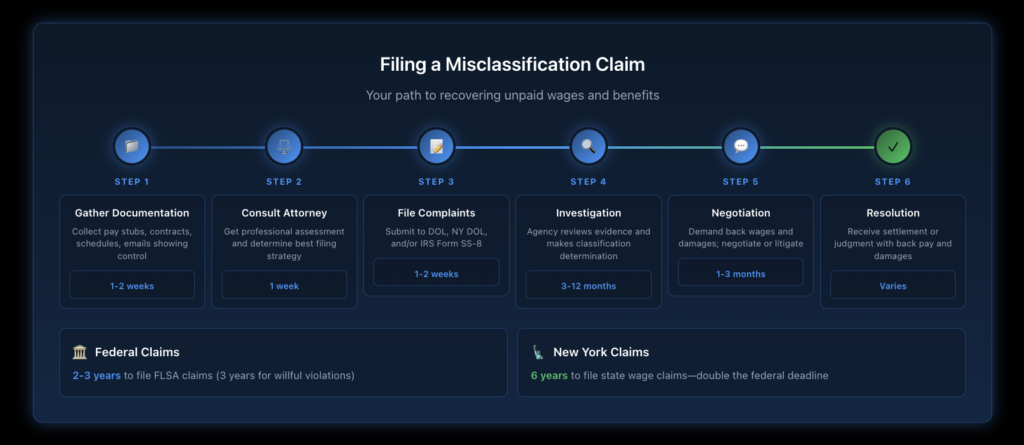
If you’re unsure about your status, you or your employer can file IRS Form SS-8 requesting an official determination. Be aware that this process takes at least six months, and the IRS maintains a searchable database of past determinations that can help you understand how similar situations were resolved.
Why Do Employers Misclassify Workers?
The financial incentives for misclassification are substantial. When employers classify workers as independent contractors, they avoid paying their share of Social Security and Medicare taxes (7.65% of wages), unemployment insurance contributions, workers’ compensation premiums, and employee benefits like health insurance and retirement plans.
What Does Misclassification Cost Workers?
Research from the Economic Policy Institute shows misclassified workers lose significant income and benefits annually. A typical construction worker loses up to $19,526 per year when misclassified, while truck drivers lose approximately $21,532, and home health aides lose around $10,214. These losses come from unpaid overtime, missing benefits, and bearing the full 15.3% self-employment tax burden instead of splitting FICA taxes with an employer.
Which Industries Have the Highest Misclassification Rates?
Wage theft through misclassification is particularly prevalent in construction, trucking and delivery, home healthcare, janitorial services, landscaping, nail salon,s and personal care, and the gig economy. New York’s Joint Enforcement Task Force estimates that 15-25% of construction workers in the state are misclassified.
What Are the Warning Signs of Misclassification?
You may be misclassified as an independent contractor if certain aspects of your working relationship suggest employee status. Consider these warning signs carefully.
Does Your Employer Control How You Work?
If your employer dictates your schedule, requires you to work at specific locations, mandates particular methods for completing tasks, or provides detailed instructions on how to perform your duties, these are strong indicators of an employment relationship. True independent contractors generally control when, where, and how they complete their work.
Does Your Employer Provide Your Tools and Equipment?
Employees typically use company-provided equipment, uniforms, vehicles, and supplies. If your employer provides these items rather than expecting you to invest in your own business equipment, you’re likely functioning as an employee regardless of your classification on paper.
Do You Work Exclusively for One Company?
Independent contractors typically market their services to multiple clients and have the freedom to accept or reject work. If you work primarily or exclusively for one company, receive regular payments rather than project-based fees, and cannot take on competing work, the relationship resembles employment.

How Does New York Law Protect Workers
New York provides stronger protections against misclassification than federal law through multiple testing standards and enhanced penalties.
What Is the ABC Test Under the Fair Play Act?
The New York Construction Industry Fair Play Act applies a strict ABC test to construction workers. Under this standard, a worker is presumed to be an employee unless the employer proves all three conditions: the worker is free from control and direction in performing the job, the work is performed outside the usual course of the employer’s business, and the worker has an independently established trade or business.
This presumption of employee status makes it significantly easier for construction workers to challenge misclassification in New York compared to other states or under federal law.
What Penalties Do New York Employers Face?
Employers who willfully misclassify workers under the Fair Play Act face civil penalties of up to $2,500 for the first violation per misclassified employee and up to $5,000 for subsequent violations within five years. Criminal prosecution can result in fines up to $25,000, jail time of 30-60 days, and debarment from public works contracts.
Beyond statutory penalties, employers must pay back wages, liquidated damages equal to the unpaid wages, and may face liability for unpaid taxes, unemployment insurance contributions, and workers’ compensation premiums.
How Can You File a Misclassification Complaint?
Multiple agencies enforce worker classification laws, and you can file complaints with federal or state authorities—or both.
Where Do You Report Federal Violations?
You can file a complaint with the U.S. Department of Labor’s Wage and Hour Division online, by phone at 1-866-487-9243, or in person at your nearest WHD office. The DOL investigates violations of the Fair Labor Standards Act, including misclassification that results in unpaid minimum wage or overtime violations.
How Do You Report Violations to New York State?
New York’s Joint Enforcement Task Force accepts misclassification complaints through the Department of Labor’s Employer Fraud Unit. You can report anonymously 24 hours a day by calling (866) 435-1499 or filing online. The Task Force coordinates enforcement among the Department of Labor, Workers’ Compensation Board, Department of Taxation and Finance, and the Attorney General’s office.
What Compensation Can You Recover?
Successfully challenging misclassification can result in substantial financial recovery covering multiple categories of damages.
What Back Wages Are Available?
You can recover unpaid minimum wages for all hours worked below the applicable minimum wage rate, unpaid overtime at time-and-a-half for hours exceeding 40 per week, and any improper deductions from your pay. Under federal law, the statute of limitations is two years (three years for willful violations), but New York allows claims going back six years.
Can You Receive Additional Damages?
Yes. Both federal and New York law provide for liquidated damages—typically equal to the amount of unpaid wages—effectively doubling your recovery. You may also recover attorney’s fees and costs, making it economically feasible to pursue even moderate claims.
Can You Join with Other Misclassified Workers?
If multiple workers at the same company have been misclassified, you may be able to pursue a collective action under the FLSA or a class action under New York law. These group actions increase efficiency, share litigation costs, and often result in larger settlements that deter future violations.
What Protections Exist Against Retaliation?
Employers cannot legally retaliate against workers who report misclassification or file wage complaints. Retaliation protections cover adverse actions like termination, demotion, reduced hours, or unfavorable schedule changes. If you experience retaliation, you may have additional legal claims and remedies beyond your original misclassification complaint.
What Should You Do If You've Been Misclassified?
If you suspect you’ve been misclassified as an independent contractor, start by documenting your working conditions. Keep records of your schedule, who controls your work methods, what equipment you use and who provides it, communications with your employer, and all pay records.
How Does an Employment Attorney Help?
An experienced employment attorney can evaluate whether you meet the legal definition of an employee under federal and New York law, calculate your potential recovery, including back wages and liquidated damages, navigate the complaint process with appropriate agencies, and represent you in settlement negotiations or litigation if necessary.
When Should You Act?
Don’t wait to address suspected misclassification. While New York’s six-year statute of limitations provides more time than federal law, starting early preserves evidence, maximizes your potential recovery, and may help other workers in similar situations. The longer misclassification continues, the more wages and benefits you lose.
Ready to Take Action?
If you believe you’ve been misclassified as an independent contractor and denied wages, overtime, or benefits you’re entitled to, Nisar Law Group can help. Our employment law attorneys have extensive experience holding employers accountable for misclassification and wage violations throughout New York. Contact us today for a consultation to discuss your situation and explore your legal options.
Frequently Asked Questions About Independent Contractor Misclassification
Under New York’s Fair Play Act, willful misclassification carries civil penalties up to $2,500 per worker for first violations and $5,000 for subsequent violations within five years. Criminal penalties can include fines up to $25,000 and 30-60 days in jail, plus debarment from public works projects. Federal penalties include liability for unpaid employment taxes plus interest and potential criminal charges for tax evasion in egregious cases.
The key indicators are workplace control and economic dependence. If your employer controls your schedule, dictates how you perform your work, provides your equipment and supplies, requires you to work exclusively for them, and pays you regularly rather than per project, you’re likely an employee regardless of what your contract says. True independent contractors run their own businesses, serve multiple clients, and control their own work methods.
The Department of Labor issued a final rule effective March 2024 that applies a totality-of-circumstances “economic realities” test using six factors to determine worker status under the Fair Labor Standards Act. However, as of May 2025, the DOL announced it will not enforce this rule and instead applies older guidance during investigations, though the 2024 rule remains in effect for private litigation purposes.
Misclassified workers lose minimum wage and overtime protections, eligibility for unemployment insurance and workers’ compensation, employer contributions to Social Security and Medicare, access to employer-provided health insurance and retirement plans, and protection under anti-discrimination laws. The financial loss averages $10,000-$20,000 annually, depending on occupation and location.
Yes. If you were misclassified as an independent contractor but performed work that would qualify you for unemployment insurance as an employee, you can apply for benefits. The unemployment agency will investigate your classification, and if they determine you were actually an employee, you may qualify for benefits. Report the misclassification to New York’s Joint Enforcement Task Force at (866) 435-1499.
New York’s statute of limitations for wage claims is six years, significantly longer than the federal two-year limit (three years for willful violations). This extended timeframe allows workers to recover more back wages, but you should still act promptly to preserve evidence and maximize your recovery. The sooner you file, the easier it is to document your working conditions and gather supporting evidence.
