

New York employees have strong legal protections when it comes to workplace breaks—stronger than federal law provides. If you work more than six hours in New York, you’re entitled to at least a 30-minute unpaid meal break, and factory workers receive even more generous protections. Understanding these rights helps you recognize when your employer may be violating the law and what you can do about it.
Key Takeaways
- New York requires meal breaks for shifts over six hours, while federal law has no such requirement.
- Non-factory workers get 30-minute breaks; factory workers get 60-minute breaks.
- Short rest breaks (5-20 minutes) must be paid if your employer offers them.
- You can file a complaint with the New York State Department of Labor if your employer denies required breaks.
- Working through a meal break without being relieved of duties means you must be compensated for that time.
Disclaimer: This article provides general information for informational purposes only and should not be considered a substitute for legal advice. It is essential to consult with an experienced employment lawyer at our law firm to discuss the specific facts of your case and understand your legal rights and options. This information does not create an attorney-client relationship.
What Does New York Law Require for Meal Breaks?
New York Labor Law Section 162 establishes specific meal period requirements that differ from federal wage and hour laws. Unlike the Fair Labor Standards Act, which doesn’t mandate any meal or rest breaks, New York law requires employers to provide meal periods based on shift length and timing.
What Are the Requirements for Non-Factory Workers?
Most New York employees fall into the non-factory worker category. If you work in an office, retail store, restaurant, or any other non-manufacturing environment, here’s what you’re entitled to:
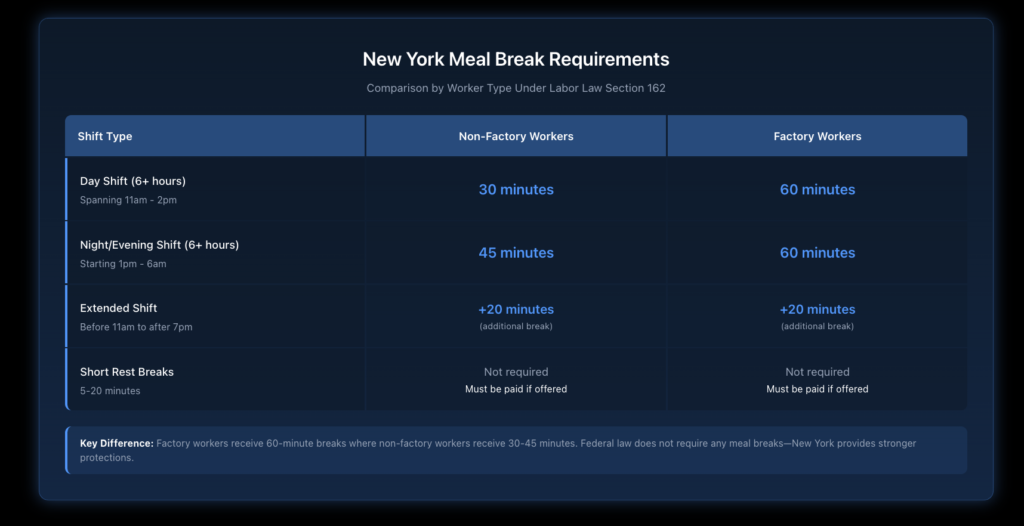
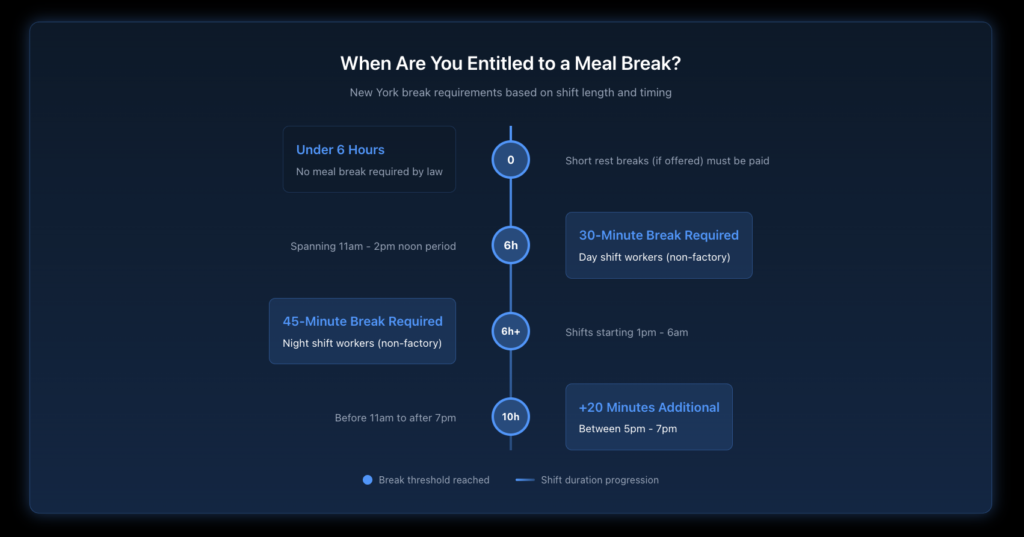
A 30-minute lunch break is required if your shift exceeds six hours and extends over the noon meal period (11:00 a.m. to 2:00 p.m.). This break must occur somewhere within that window.
For overnight shifts starting between 1:00 p.m. and 6:00 a.m. that last more than six hours, you’re entitled to a 45-minute meal break at the midpoint of your shift.
If your workday starts before 11:00 a.m. and continues past 7:00 p.m., you qualify for an additional 20-minute meal break between 5:00 p.m. and 7:00 p.m.
What Are Factory Workers Entitled To?
Factory workers receive enhanced meal break protections under New York law. If you work in manufacturing, a mill, workshop, or similar industrial setting, your employer must provide a 60-minute lunch break between 11:00 a.m. and 2:00 p.m.
For factory shifts starting between 1:00 p.m. and 6:00 a.m. that last more than six hours, you’re entitled to a 60-minute meal break at the midpoint of your shift—double what non-factory workers receive.
How Do New York Break Laws Compare to Federal Requirements?
The U.S. Department of Labor makes clear that federal law does not require employers to provide meal or rest breaks. This is where New York’s stronger state protections become significant for employees.
What Does Federal Law Actually Require?
Federal law under the FLSA doesn’t mandate any breaks whatsoever. However, if employers choose to offer short breaks of 5 to 20 minutes, federal regulations require those breaks to be paid as working time.
Meal periods of 30 minutes or longer can be unpaid under federal law, but only if the employee is completely relieved of all duties. If you’re required to monitor phones, watch equipment, or remain ready to work during your “meal break,” that time must be compensated.
Why Do New York Employees Have Better Protections?
New York’s Labor Law provides mandatory meal breaks that federal law simply doesn’t require. This means New York employers cannot simply decide not to offer any breaks—they must comply with state requirements regardless of what federal law permits.
When state and federal laws differ, the rule that’s more favorable to employees applies. For break requirements, that’s clearly New York law. If you’re dealing with off-the-clock work issues or believe your employer is misclassifying break time, understanding this distinction matters for your potential claims.
Are Short Rest Breaks Required in New York?
New York law does not require employers to provide short rest breaks. However, if your employer offers rest breaks of 5 to 20 minutes, they must be paid as working time—this is where federal law applies.
What Happens If My Employer Offers Rest Breaks?
Any short breaks your employer provides must be counted toward your hours worked and factored into overtime calculations. You cannot be required to clock out for a 10-minute coffee break or bathroom break.
These short breaks promote employee efficiency and are customarily paid across industries. Employers cannot offset this compensable rest time against waiting time, on-call time, or other working periods.
Can My Employer Control What I Do During Breaks?
During unpaid meal breaks, employers cannot require you to perform any work duties. However, they can require you to remain on the premises if you’re completely freed from all work responsibilities.
For paid rest breaks, employers have somewhat more flexibility in setting reasonable rules, though they cannot impose restrictions that effectively require you to work during break time. If you believe your employer is violating your rights regarding workplace breaks, an employment law attorney can evaluate your specific situation.
What Is the 7-Minute Rule in New York?
The “7-minute rule” refers to a federal rounding practice that New York follows, though it’s often misunderstood. Under 29 CFR §785.48(b), employers can round employee time to the nearest increment (typically 5, 10, or 15 minutes) for payroll purposes.
How Does Time Rounding Work?
If your employer uses 15-minute rounding, arriving at 8:07 a.m. could be rounded to 8:00 a.m. (working in your favor) or to 8:15 a.m. (working against you). The key legal requirement is that rounding practices must be neutral over time—they cannot systematically favor the employer.
This rounding principle also applies to meal period calculations. However, if rounding consistently results in employees receiving shorter breaks than legally required, it becomes a violation. Employers who misuse rounding practices to shortchange workers on break time or pay may face liability for wage theft.
Can You Work 8 Hours Straight Without a Break?
No. Under New York law, if your 8-hour shift spans the noon meal period (11:00 a.m. to 2:00 p.m.), you must receive at least a 30-minute meal break. Working straight through without a break violates Labor Law Section 162.
What If Your Shift Doesn’t Cover the Noon Period?
For shifts that don’t extend over the traditional lunch hours—say, 3:00 p.m. to 11:00 p.m.—you’re still entitled to a break. Shifts of more than six hours starting between 1:00 p.m. and 6:00 a.m. require a 45-minute meal break (or 60 minutes for factory workers) at the midpoint.
The only scenario where no break is required is a shift of six hours or less that doesn’t extend over any required meal period windows.
What About the One-Employee Shift Exception?
If you’re the only employee on duty, your employer may ask you to eat while working. This “one-employee shift” exception requires your voluntary written consent and acknowledgment that meal breaks may be interrupted. Importantly, if you work through a meal period under this arrangement, you must be paid for that time.
What Are the Consequences When Employers Violate Break Laws?
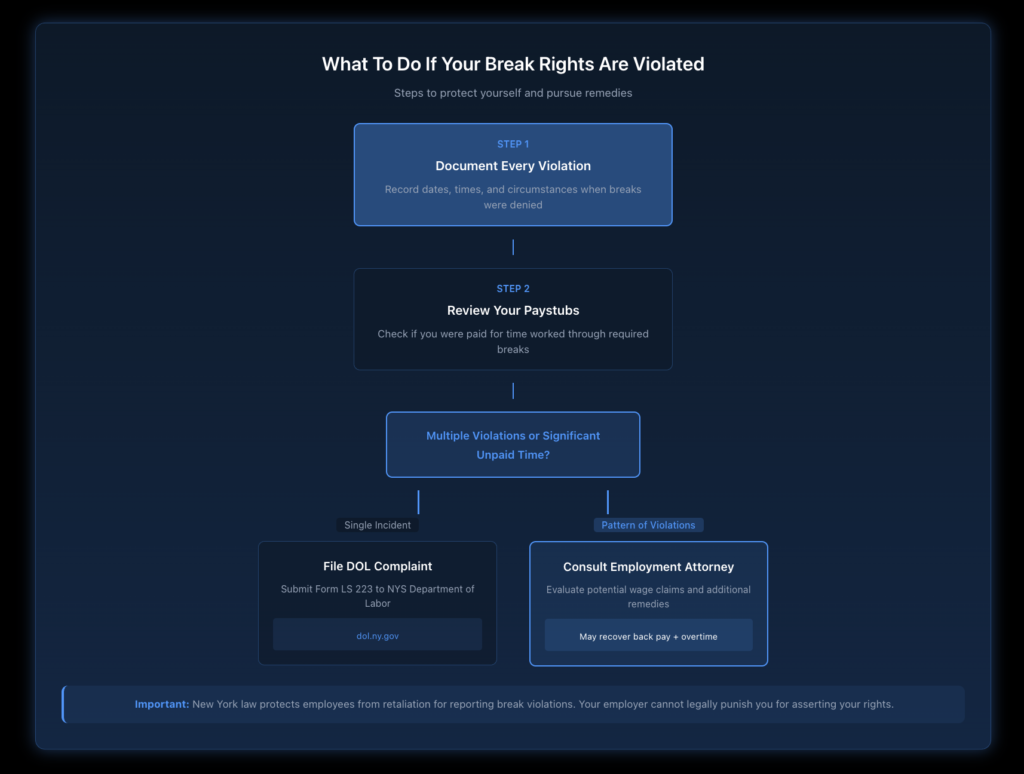
Employers who fail to provide required meal breaks face several consequences. Employees must be compensated for the time they should have been on break but were required to work. If those extra hours push your weekly total over 40, overtime pay becomes due.
How Can You File a Complaint?
You can file a complaint with the NYS Department of Labor Division of Labor Standards using Form LS 223. The Department investigates meal period violations and can order employers to compensate affected employees.
New York law also protects employees from retaliation for reporting broken laws. If your employer takes adverse action against you for asserting your break rights, you may have additional legal claims. Understanding how employer classification affects your break rights is essential, as employers sometimes misclassify workers to avoid providing required breaks.
Are 15-Minute Breaks Paid in New York?
Yes, if your employer provides 15-minute breaks, they must be paid. New York follows federal regulations requiring that short rest breaks of 5 to 20 minutes be compensated as working time. These breaks are considered beneficial to workplace efficiency and cannot be deducted from your hours worked.
The distinction is between short rest breaks (always paid if offered) and bona fide meal periods of 30 minutes or longer (can be unpaid if you’re completely relieved of duties). Employers who deduct pay for short breaks or require employees to clock out for bathroom breaks are violating wage and hour laws.
Can Employers Require You to Work Through Lunch?
Generally, no. New York law requires employers to provide meal breaks, and employees must be completely relieved of all duties during that time. However, there are limited exceptions.
What About Collective Bargaining Agreements?
The New York Court of Appeals has ruled that employees covered by union contracts may waive meal period rights if the collective bargaining agreement provides alternative benefits in exchange. Such waivers must be obtained through good-faith negotiations without coercion, and operational needs must make strict compliance impractical.
Individual employees without union representation generally cannot waive their meal break rights on a regular, ongoing basis. While you might occasionally agree to work through lunch to leave early on a particular day, this cannot become a standard arrangement.
If your employer regularly pressures you to skip breaks or creates conditions that effectively prevent you from taking breaks, documenting these violations becomes important. Consider consulting with an attorney who handles collective actions for wage violations to understand your options.
Need Help Protecting Your Workplace Rights?
If your employer denies required meal breaks, forces you to work during break time, or retaliates against you for asserting your rights, Nisar Law Group can help. Our employment law attorneys have extensive experience protecting New York employees facing wage and hour violations. Contact us today for a consultation to discuss your case.
Frequently Asked Questions About Meal and Rest Breaks
For an 8-hour shift that spans the noon meal period, you’re entitled to at least one 30-minute unpaid meal break. If your shift runs from before 11:00 a.m. to after 7:00 p.m., you qualify for an additional 20-minute break between 5:00 p.m. and 7:00 p.m. Factory workers receive 60-minute breaks instead of 30 minutes. Short rest breaks are not required by law, but must be paid if offered.
New York law does not require a meal break for shifts of 4 hours or less. The meal period requirement kicks in when your shift exceeds 6 hours. However, if your employer chooses to provide rest breaks during a 4-hour shift, those breaks must be paid as working time.
An unpaid 30-minute lunch break is typically not included in your 8-hour workday. If you’re scheduled to work 8 hours with a 30-minute unpaid lunch, you’ll be at the workplace for 8.5 hours total. However, if your lunch break is paid or if you’re required to perform any duties during that time, it counts as hours worked.
No, bathroom breaks are not considered meal periods. Reasonable bathroom breaks are generally permitted during working hours and should not be deducted from your pay. If your employer restricts bathroom access or counts restroom time as your official break, this raises potential legal concerns.
During unpaid meal periods, you must be completely relieved of all duties, though your employer can require you to stay on premises. Your employer cannot require you to perform work tasks, monitor equipment, or remain ready to work during an unpaid meal break. For paid short breaks, employers have somewhat more flexibility but cannot assign work duties.
The 8 and 80 rule is a federal overtime calculation method used primarily in healthcare settings, allowing hospitals to use 14-day pay periods with overtime owed for hours over 8 per day or 80 per two-week period. This rule does not affect meal break requirements—New York’s meal period laws apply regardless of which overtime calculation method your employer uses.
Not on a regular, ongoing basis. New York courts have ruled that simply trading your lunch break for leaving early doesn’t constitute a sufficient benefit to justify a meal period waiver. You might occasionally agree to work through lunch on a specific day, but your employer cannot establish this as a permanent arrangement unless you’re covered by a collective bargaining agreement with specific waiver provisions.
Standard meal breaks of 30 minutes or longer are typically unpaid, provided you’re completely relieved of all work duties. However, if your employer requires you to remain available for work, answer phones, or perform any duties during your meal period, that time must be paid. Short rest breaks of 5-20 minutes are always paid if your employer offers them.
