
Why Do You Need Pre-Termination Counseling Before Getting Fired?
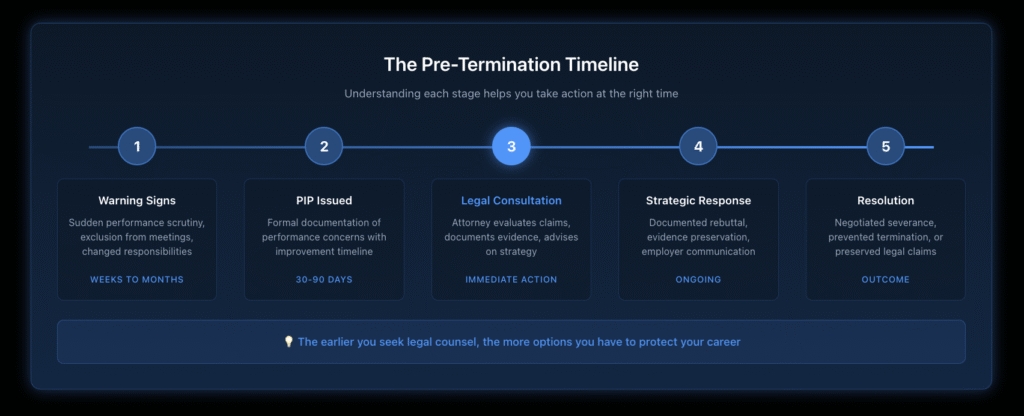
Pre-termination counseling is specialized legal guidance for employees who sense their job is at risk—whether they’ve been placed on a performance improvement plan (PIP), are under workplace investigation, or are experiencing warning signs that termination may be coming. This proactive approach helps you understand your rights, document potential violations, and position yourself for the best possible outcome before any final employment decision is made.
Contact us today for a confidential consultation about your whistleblower case.
Why Should You Seek Legal Counsel Before You're Terminated?
Most employees wait until after they’ve been fired to consult an employment attorney. By then, critical opportunities may have passed. Early legal intervention during the pre-termination phase can fundamentally change your situation.
When you’re still employed, you have access to company systems, documents, and communications that become much harder to obtain after termination. You can still influence the narrative of your departure. An attorney can help you document potential violations and identify whether your employer’s actions violate federal or state employment laws.
What Are the Benefits of Acting Early?
Seeking legal counsel before termination provides several advantages that simply aren’t available after you’ve been let go.
Your attorney can help evaluate whether the performance issues your employer cites are legitimate or whether they represent pretextual reasons for termination—manufactured justifications covering discriminatory or retaliatory motives. This analysis is more effective while you’re still employed and can observe workplace dynamics firsthand.
Early intervention also opens the door to negotiating your departure terms before any termination occurs. Many employers prefer to avoid the risk and cost of litigation, making pre-termination the optimal time to negotiate a favorable severance package.
According to the EEOC’s guidance on retaliation, retaliation claims have become the most frequently alleged basis of discrimination in the federal sector. If you’ve engaged in protected activity—like reporting harassment or requesting accommodations—and now face performance scrutiny, an attorney can help connect these events.
If you believe an AI system was used to discriminate against you, discipline you, or terminate your employment, contact us. You may have significant legal claims even when the decision came from an algorithm.
What Does a Performance Improvement Plan Really Mean?
A performance improvement plan—commonly called a PIP—is a formal document outlining specific performance concerns and setting expectations for improvement within a defined timeframe. On paper, PIPs are designed to help struggling employees get back on track. In practice, they often serve a different purpose.
Is a PIP Just a Precursor to Termination?
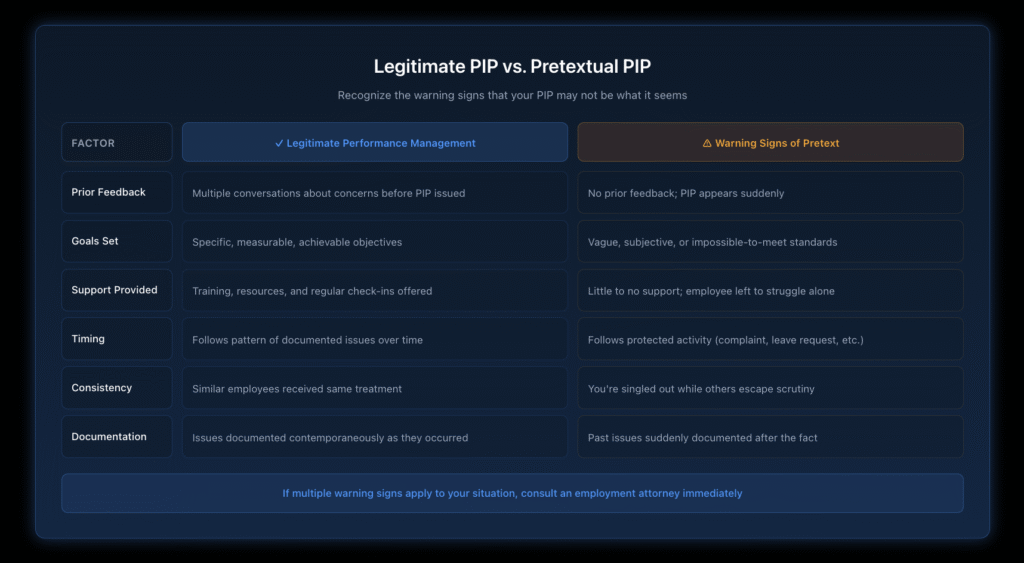
The uncomfortable truth is that many PIPs are documentation exercises rather than genuine improvement opportunities. Employers use them to create a paper trail justifying eventual termination—particularly when the real reason for wanting to end the employment relationship might be legally problematic.
When a PIP arrives out of nowhere with little prior feedback, sets unrealistic or subjective goals, follows closely after you’ve complained about workplace issues, or coincides with requests for medical leave or accommodations, these patterns suggest the PIP may be serving a different purpose than stated.
This doesn’t mean every PIP signals bad faith. Some employers genuinely want to retain employees and use PIPs appropriately. The critical question is whether your situation involves legitimate performance management or whether you’re being set up for termination.
How Should You Respond to a Performance Improvement Plan?
Receiving a PIP triggers a series of decisions that can significantly impact your legal position. Your response matters.
First, don’t sign immediately. Request time to review the document—24 to 48 hours is reasonable. When you do sign, you’re typically acknowledging receipt, not agreeing with the contents. If the signature line implies agreement, add a notation that your signature acknowledges receipt only.
Second, document everything. Keep copies of the PIP, your response, all communications with your supervisor, and any evidence that contradicts the performance concerns raised. Under New York Department of Labor retaliation protections, employers cannot punish you for exercising your rights under labor law.
Third, respond in writing. Prepare a professional response addressing each concern raised, providing context or contrary evidence where appropriate. This creates a record of your perspective that becomes part of any future legal proceeding.
Contact us at (212) 600-9534 to schedule a confidential consultation.
What Warning Signs Suggest Illegal Discrimination or Retaliation?
Not every termination—or PIP leading to termination—is illegal. New York is an at-will employment state, meaning employers can generally terminate employees for any reason or no reason at all. However, as the New York Attorney General’s office explains, employers cannot fire you for an illegal reason.
What Makes a Termination Illegal Under New York Law?
Under the New York State Human Rights Law, employers cannot terminate you based on race, religion, sex, national origin, age, sexual orientation, marital status, military status, disability, or other protected characteristics. The NYC Human Rights Law provides even broader protections for workers in New York City.
Retaliation also makes terminations illegal. If you complained about workplace discrimination, participated in an investigation, requested accommodations, filed a workers’ compensation claim, or engaged in other protected activity, and your employer responds with adverse action, that’s unlawful regardless of your performance.
The EEOC defines retaliation broadly—it includes not just termination but also demotion, unjustified negative evaluations, transfer to less desirable positions, and any action likely to deter reasonable employees from exercising their rights.
What Are Common Forms of Pre-Termination Retaliation?
Employer retaliation takes many forms, and recognizing these patterns early is crucial. Some common pre-termination retaliatory behaviors include:
Sudden performance scrutiny following protected activity—when an employee who previously received positive reviews suddenly faces criticism and documentation of alleged deficiencies.
Exclusion from meetings and communications that were previously part of your normal responsibilities.
Transfer of accounts, clients, or key responsibilities without legitimate business justification.
Denial of previously approved requests for time off, schedule flexibility, or other workplace accommodations.
Increased surveillance or micromanagement applied selectively to you but not similarly situated colleagues.
Changes to performance metrics or job expectations made retroactively or without notice.
Each of these actions, viewed in isolation, might seem like ordinary management. But when they cluster together following your engagement in protected activity, they may constitute illegal retaliation warranting legal intervention.
How Can Pre-Termination Legal Counsel Help You?
An employment attorney working with you during the pre-termination phase can provide several forms of critical support that simply aren’t available if you wait until after you’ve lost your job.
What Does a Pre-Termination Consultation Include?
During pre-termination counseling, your attorney will typically evaluate whether your employer’s stated reasons for performance concerns align with your actual performance history and whether protected characteristics or activities might be motivating factors in your treatment.
Your attorney will analyze documents, timelines, and communications to identify patterns suggesting discrimination or retaliation. They’ll help you understand your at-will employment exceptions and whether your situation falls within them.
If appropriate, your attorney may communicate with your employer on your behalf—sometimes this alone changes the dynamic significantly. Employers who know an employee has legal representation often approach the situation more carefully.
Can an Attorney Actually Prevent Your Termination?
Sometimes. When an employer realizes that terminating an employee will likely result in litigation—and that the employee has documented evidence supporting their claims—the calculation changes. The cost of defending a lawsuit, both in dollars and reputation, may exceed the perceived benefit of removing you.
More commonly, pre-termination legal involvement shifts the focus to negotiating a separation that works for both parties. This might mean an enhanced severance package, extended benefits, neutral references, or the removal of non-compete restrictions in exchange for a mutual release of claims.
What Steps Should You Take If You Suspect Termination Is Coming?
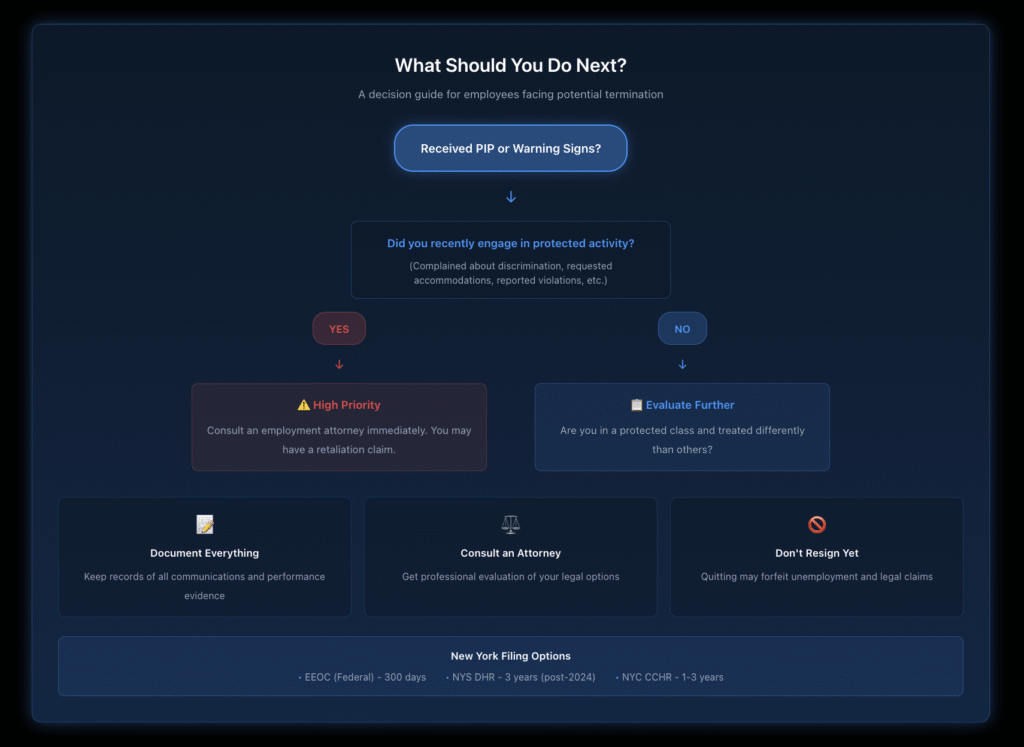
If you believe your job is at risk—whether from a PIP, investigation, or other warning signs—taking proactive steps now can significantly improve your position.
How Should You Document Your Situation?
Start keeping a contemporaneous record of events. Note dates, times, witnesses, and the substance of conversations related to your performance or treatment. Save relevant emails to personal storage (making sure not to violate any confidentiality obligations), and keep copies of performance reviews, commendations, and other documents supporting your work history.
If you’ve experienced discrimination or harassment, reporting through proper channels creates a protected record. Under federal law and New York’s whistleblower protections, employers cannot retaliate against employees who report violations in good faith.
When Should You Contact an Employment Attorney?
The optimal time to consult an attorney is before significant decisions are made—ideally when you first receive a PIP or sense that your position has become precarious. However, it’s never too late to get help.
Many employment attorneys offer initial consultations at no cost. Use this opportunity to describe your situation, understand your options, and determine whether legal representation makes sense for your circumstances.
Under EEOC filing requirements, you typically have 300 days from the date of discrimination to file a charge in New York. But the clock starts running from each discriminatory act, so earlier action preserves more options.
If you believe you’re facing constructive discharge—where your working conditions have become so intolerable that resignation is effectively forced—an attorney can help you understand whether quitting would preserve or forfeit your legal claims.
Contact us today for a confidential consultation about your whistleblower case.
Why Does Timing Matter in Employment Cases?
The pre-termination window represents your greatest leverage. Once you’ve been terminated, you’re in a reactive position—trying to recover what was lost rather than preventing harm in the first place.
What Do You Lose by Waiting?
After termination, you lose access to workplace evidence, your ability to observe ongoing conduct, and your platform to influence outcomes before they’re finalized. You may also face accelerating financial pressure as unemployment benefits and savings run their course.
Progressive discipline violations—where employers bypass their own policies in terminating you—are easier to document while you’re still employed. The same applies to identifying comparators: similarly situated employees who engaged in similar conduct but weren’t disciplined.
What Happens If You Simply Accept the PIP?
Some employees who receive PIPs focus exclusively on meeting the stated goals, hoping that compliance will resolve their situation. While genuine performance improvement is always valuable, proceeding as if the PIP is purely about performance when evidence suggests otherwise can leave you unprepared if termination follows regardless.
The better approach balances working toward improvement with protecting your legal interests—documenting your efforts, preserving evidence of discriminatory patterns, and keeping an attorney informed of developments. You don’t have to choose between fighting and complying; strategic employees do both.
Ready to Protect Your Career and Your Rights?
If you’re facing a performance improvement plan, workplace investigation, or other signs that your job may be at risk, early legal intervention can make a significant difference in your outcome. Nisar Law Group’s employment attorneys have extensive experience representing New York employees through the pre-termination process, helping them understand their rights, document violations, and negotiate favorable resolutions.
Don’t wait until you’ve lost your job to explore your options. Contact Nisar Law Group today for a consultation to discuss your situation and learn how pre-termination counseling can protect your interests.
Types of AI Discrimination Cases We Handle?
Why We're the Right Choice
- Experienced Federal Employment Attorneys
- Personalized Service and Client-Focused Approach
- Proven Track Record of Success
- Nationwide Representation for Federal Employees
- In-depth Knowledge of Federal Agency Procedures
Frequently Asked Questions About Pre-Termination Counseling
Being placed on a PIP means your employer has formally documented concerns about your work performance and created a structured plan for improvement, typically with a 30 to 90-day timeframe. While PIPs can represent genuine efforts to help struggling employees, they frequently serve as documentation to justify eventual termination—creating a paper trail that makes it harder to challenge your discharge later. The key is evaluating whether the concerns are legitimate or whether the PIP follows suspicious patterns like sudden scrutiny after protected activity.
Not automatically, but statistically most employees placed on PIPs are eventually terminated or resign. The outcome depends significantly on whether the PIP reflects genuine performance issues or serves as pretext for a decision already made. If your employer has set unrealistic goals, provided inadequate support, or issued the PIP following protected activity like discrimination complaints, the PIP may be designed to fail you. Consulting an attorney early helps you understand which scenario applies to your situation.
Legally, yes—employers generally aren’t required to provide warnings before issuing PIPs in at-will employment states like New York. However, a PIP appearing without prior feedback when you’ve consistently received positive reviews raises questions about the employer’s true motivation. Many companies have progressive discipline policies requiring verbal and written warnings before formal PIPs. If your employer bypassed its own procedures, this inconsistency can support claims that the PIP serves an improper purpose.
Resigning during a PIP is generally not advisable without first consulting an employment attorney. Voluntary resignation typically disqualifies you from unemployment benefits and makes it significantly harder to pursue wrongful termination or discrimination claims. Staying through the PIP process—while documenting everything and seeking legal guidance—preserves your options. If termination becomes inevitable, negotiating your departure often produces better outcomes than simply quitting.
You cannot sue simply because your employer issued a PIP—performance management is generally within employer discretion. However, you may have legal claims if the PIP constitutes retaliation for protected activity, targets you based on protected characteristics like age or disability, or applies inconsistently compared to similarly situated employees outside your protected class. An employment attorney can evaluate whether your specific circumstances support legal action.
Request time to review before signing, and add a notation that your signature acknowledges receipt only—not agreement with the contents. Prepare a written response addressing each concern with specific counter-evidence where available. Document all interactions with your supervisor, keep copies of communications and performance records, and begin consulting with an employment attorney immediately. Continue performing your job professionally while simultaneously protecting your legal interests.
Yes, HR typically participates in creating and administering PIPs—reviewing documentation, ensuring procedural compliance, and sometimes mediating between managers and employees. However, HR works for the company, not for you. While HR involvement adds process formality, it doesn’t guarantee fair treatment. Any statements you make to HR can be used to support the company’s position if disputes arise later, so approach HR interactions thoughtfully and consider having legal counsel advise you beforehand.
Absolutely. Employers can terminate employees during a PIP, even before the improvement period ends. At-will employment allows termination at any time for lawful reasons. If you’re fired mid-PIP, the relevant question becomes whether the termination was for legitimate performance reasons or whether it violated anti-discrimination or anti-retaliation laws. Employers sometimes accelerate terminations when they learn an employee has retained legal counsel or filed discrimination complaints—which itself may constitute unlawful retaliation.