

New York Labor Law § 215 is the state’s core anti-retaliation statute for wage complaints. It makes it illegal for an employer to fire, penalize, or discriminate against any employee who complains about wage violations — whether that complaint goes to a supervisor, to the New York State Department of Labor, or to another agency. Understanding this law matters because it covers virtually every private employer in New York, regardless of size; it carries criminal consequences for violators, and it gives employees multiple ways to fight back without first having to go through a government agency. Whether you work for a small restaurant or a major corporation, New York Labor Law § 215 protects your right to speak up about wage theft, minimum wage violations, and unpaid overtime without fearing for your job.
Key Takeaways
- Section 215 prohibits employers from retaliating against employees who complain about any violation of the New York Labor Law.
- Protected activities include informal complaints to supervisors, formal complaints to the NYDOL, and testifying in proceedings — even if the employee doesn’t cite a specific statute.
- Applies to virtually all private employers in New York — no minimum employee count.
- Remedies include reinstatement, back pay, liquidated damages up to $20,000, and attorney’s fees.
- Criminal penalty: Violating employers face a Class B misdemeanor charge.
- Statute of limitations: 2 years for a private civil lawsuit (tolled while NYDOL investigates).
- Immigration threats used as retaliation are explicitly prohibited under the statute.
- You do not need to file with the NYDOL before suing in court.
Disclaimer: This article provides general information for informational purposes only and should not be considered a substitute for legal advice. It is essential to consult with an experienced employment lawyer at our law firm to discuss the specific facts of your case and understand your legal rights and options. This information does not create an attorney-client relationship.
What Does Section 215 of the New York Labor Law Actually Say?
The full title of the statute is “Penalties and civil action; prohibited retaliation.” That title captures exactly what the law does: it creates both civil and criminal penalties for employer retaliation against employees who assert their rights under the Labor Law.
What Activities Does Section 215 Protect?
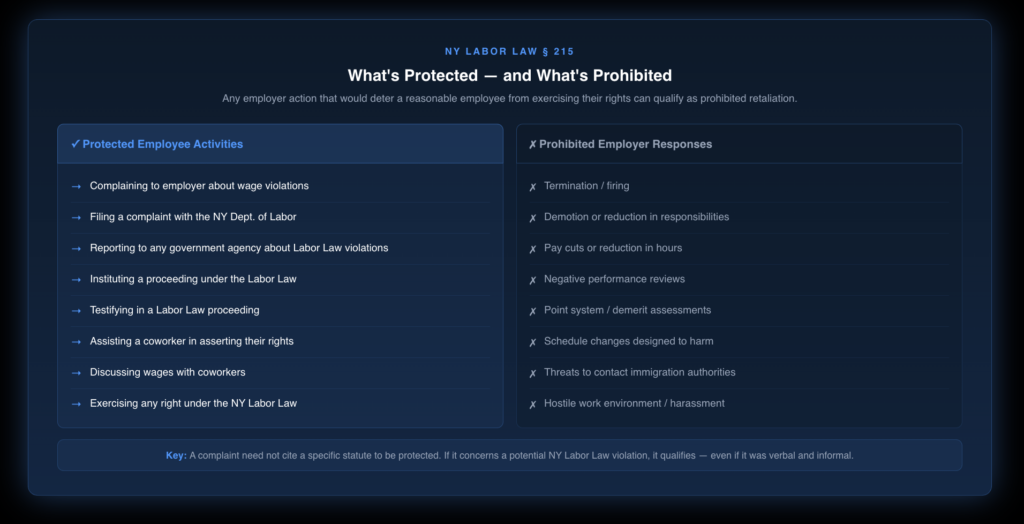
Section 215 protects employees who take any of the following steps:
- Make a complaint about a potential violation of the New York Labor Law to an employer, to the NYDOL, or to any other government agency
- Institute a proceeding under the Labor Law, or cause such a proceeding to be instituted
- Testify in any proceeding under the Labor Law
- Exercise any right protected by the Labor Law
- Assist another employee in asserting rights under the Labor Law
One of the most important features of the law is that the complaint doesn’t need to be formal or legally precise. The current text of Section 215 explicitly states that an employee complaint “need not make explicit reference to any section or provision of this chapter to trigger the protections.” If you tell your manager your paycheck is wrong, that’s protected. If you ask a coworker whether they’re also being paid below minimum wage, that can be protected, too. The complaint just needs to relate to a potential Labor Law violation.
This breadth is intentional. The law covers protected activities that range from a verbal dispute with a shift supervisor about tip allocation to a formal NYDOL complaint about systematic wage theft. The threshold for triggering protection is low by design.
Who Is Covered by Section 215?
Section 215 covers virtually every private-sector employee in New York — from full-time salaried workers to part-time hourly workers, domestic workers, and employees who may be misclassified as independent contractors. There is no minimum employer size. A five-person restaurant and a 5,000-person corporation are equally bound by this law.
State and municipal government employees are not covered by Section 215, though they may have separate protections under civil service law and other statutes. For private-sector workers, though, the reach is sweeping. The NYDOL’s retaliation page confirms that any employer covered by the Labor Law is subject to § 215, and virtually all private employers fall within that scope.
What Counts as Retaliation Under Section 215?
What Actions Qualify as Prohibited Retaliation?
The statute prohibits any employer from discharging, penalizing, or “in any other manner discriminating or retaliating” against an employee for engaging in protected activity. Courts interpret this language broadly. Prohibited retaliation includes:
- Termination or constructive discharge
- Demotion or reduction in hours
- Cuts to pay or benefits
- Schedule changes designed to harm the employee
- Exclusion from training or advancement opportunities
- Threats, harassment, or hostile work environment tactics
- Threats to report immigration status to federal authorities
- Negative performance reviews issued in retaliation
The forms of retaliation covered by § 215 are not limited to termination. Any adverse action — no matter how subtle — can qualify if it’s connected to the employee’s protected complaint.
Does a Point System or Demerit Count as Retaliation?
Yes — and this is one of the most important expansions in the modern version of the statute. New York lawmakers explicitly added language addressing employer point systems, occurrence tracking, and demerit banks. Under the current statute, it is prohibited for an employer to assess “any demerit, occurrence, any other point, or deductions from an allotted bank of time, which subjects or could subject an employee to disciplinary action, which may include but not be limited to failure to receive a promotion or loss of pay.”
This matters enormously in industries like retail, warehousing, and food service, where employers often use automated attendance point systems. If you complain about an unpaid wage violation and your employer adds an occurrence to your attendance record the following week, that can be a retaliation claim even if you haven’t been fired. The law is explicit that it doesn’t take a termination to qualify.
How Does Section 215 Compare to Other Retaliation Laws?
How Does Section 215 Differ from Federal Retaliation Law?
Federal law protects employees who complain about wage violations under the Fair Labor Standards Act, but federal retaliation claims are more limited in scope and come with stricter employer size thresholds. Under the FLSA, employers with fewer employees may have reduced liability exposure, and the damages available differ meaningfully. Section 215 was designed to fill that gap and go further.
Under § 215, you don’t need to prove the underlying wage violation was real — you only need to have made a good-faith complaint about a potential violation. That’s a critical distinction from some other retaliation frameworks. Courts have recognized that requiring an employee to first “win” the underlying wage claim before being protected would undermine the entire purpose of anti-retaliation law.
Section 215 also specifically addresses wage and hour violations — minimum wage, overtime, tip theft, and wage theft broadly — while federal retaliation protections tend to be statute-specific. If your employer retaliates against you for complaining about a wide range of Labor Law violations, § 215 gives you one strong state-law vehicle to pursue all of them.
How Does Section 215 Relate to New York Labor Law § 740?
New York Labor Law § 740 is New York’s general whistleblower anti-retaliation statute, which protects employees who report illegal conduct more broadly — beyond just wage violations. Section 215 is narrower but more powerful for wage claims specifically: it has mandatory liquidated damages, criminal exposure for the employer, and does not require the employee to have first reported internally before going to a government agency.
The two statutes can sometimes both apply, but § 215 is the more direct and more favorable vehicle when the underlying complaint involves minimum wage, overtime, earned wages, or any other provision of the New York Labor Law. Understanding which statute fits your situation matters for calculating damages and determining strategy. The legitimate discipline defense that employers raise in § 740 cases is also available under § 215 — but it’s harder to sustain when the protected complaint and the adverse action are closely connected in time.
What Remedies Are Available Under Section 215?
What Can You Recover in a Civil Lawsuit?
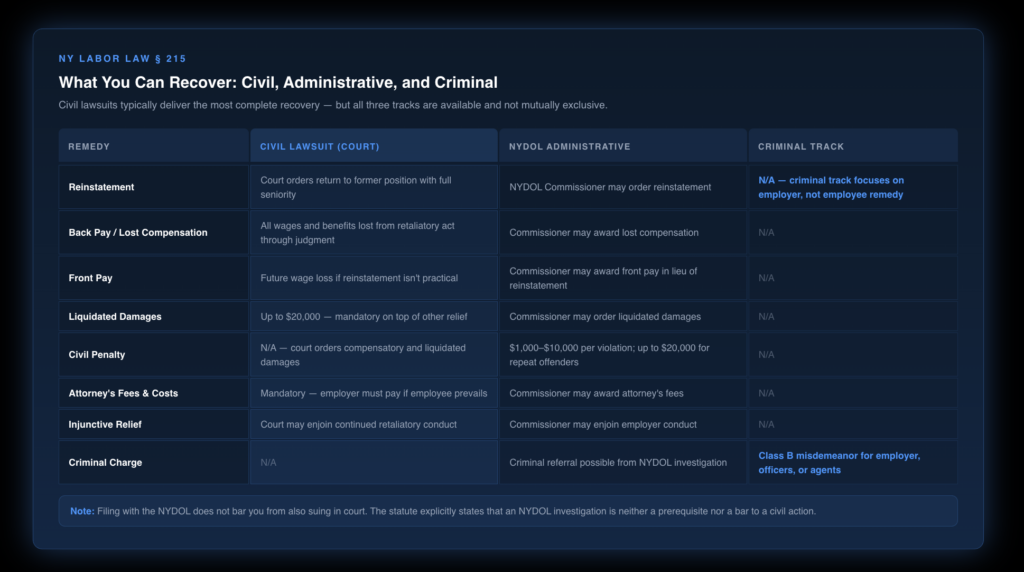
A successful Section 215 claim entitles you to a significant package of remedies. Courts may order:
Reinstatement: Your employer can be ordered to restore you to your former position with full seniority rights. If reinstatement is not practical — because the working relationship has become untenable — the court can order front pay instead.
Lost compensation and back pay: All wages, benefits, and other compensation you lost as a result of the retaliation are recoverable. This includes the period from the retaliatory action through the date of judgment.
Liquidated damages: Section 215 requires courts to award liquidated damages in addition to other relief. Liquidated damages under § 215 can be up to $20,000 — this is a penalty on top of your actual losses, not a substitute for them.
Attorney’s fees and costs: The employer must pay your reasonable attorney’s fees and litigation costs if you prevail. This provision is critical — it means you can pursue a legitimate § 215 claim even without significant upfront resources.
Injunctive relief: Courts can issue injunctions preventing the employer from continuing the retaliatory conduct.
Understanding the full picture of available damages is important when evaluating whether to pursue a civil claim versus an administrative complaint — because the civil route typically delivers more comprehensive recovery.
What Criminal Penalties Can Employers Face?
Section 215 also has teeth on the criminal side. Any employer (or officer or agent of a corporation, partnership, or LLC) who retaliates against an employee in violation of § 215 is guilty of a Class B misdemeanor under New York law. This is separate from and in addition to civil liability.
On the administrative side, the NYDOL Commissioner has the authority to assess civil penalties against employers found to have violated § 215, between $1,000 and $10,000 per violation. If the employer has committed a prior violation within the past six years, that ceiling rises to $20,000.
How Do You File a Section 215 Retaliation Claim in New York?
Can You File Directly in Court Without Going to NYDOL First?
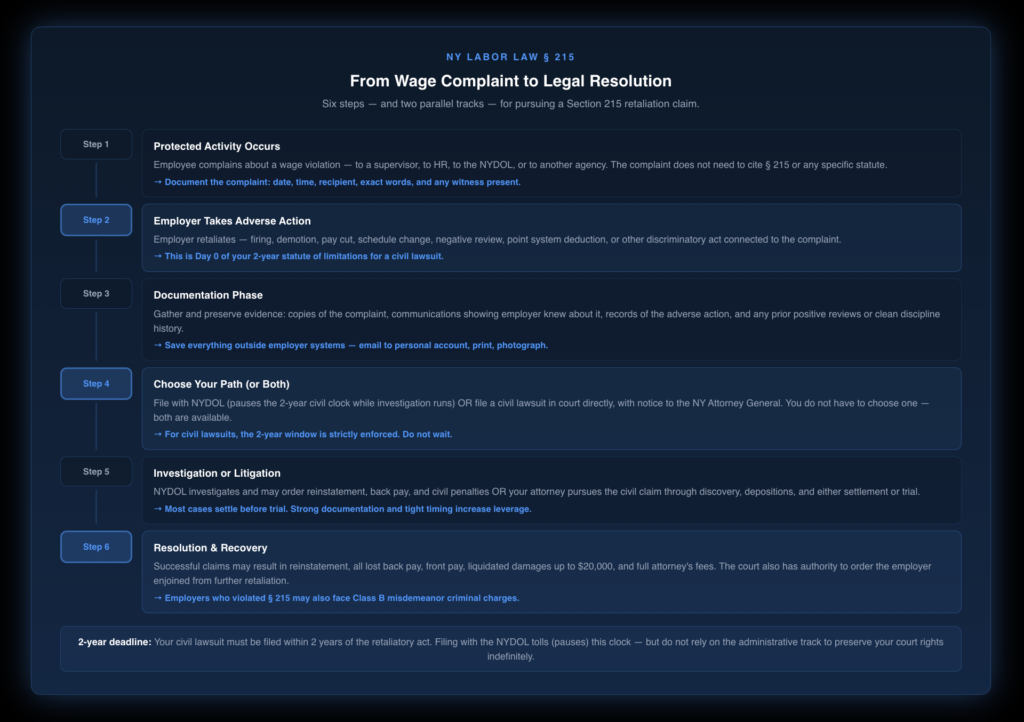
Yes. This is one of the most employee-friendly features of Section 215. The statute explicitly provides that an investigation by the Commissioner “shall not be a prerequisite to nor a bar against a person bringing a civil action under this section.” You can file a lawsuit in New York state or federal court within two years of the retaliatory act without first going through any administrative process.
There is one procedural requirement: before or at the time you file your civil action, you must serve notice on the New York Attorney General. This is a notice requirement, not a gatekeeping mechanism — failing to provide it can create problems, but it doesn’t mean you need the AG’s approval to sue.
The two-year statute of limitations is also tolled (paused) from the date you file a complaint with the NYDOL Commissioner, or the date the Commissioner initiates an investigation, until that process concludes. So if you file with the NYDOL and they investigate, your civil court window doesn’t keep running in the background.
What Is the Process for Filing with the NYDOL?
If you prefer to start with an administrative complaint — which can be useful if you want the state to investigate and build a case without immediate litigation costs — you can file through the NYDOL labor standards complaint process. The Division of Labor Standards investigates claims of wage theft, unpaid wages, and retaliation under § 215.
The Division of Labor Standards employs investigators who will contact your employer, request records, and issue findings. If the Commissioner determines a violation occurred, the NYDOL can order reinstatement, back pay, and civil penalties — and can pursue criminal charges in appropriate cases.
For reporting retaliation to government agencies, it’s worth knowing that you don’t have to choose between the NYDOL route and the civil court route. You can file with the NYDOL. If you’re not satisfied with the outcome or the investigation is taking too long, you can still bring a civil action.
What Makes a Strong Section 215 Retaliation Case?
What Evidence Do You Need to Prove Retaliation?
To prevail under Section 215, you generally need to establish three elements: (1) you engaged in protected activity, (2) your employer knew about it, and (3) your employer took an adverse action because of it. Building a strong case requires evidence at each step.
For the protected activity, preserve any records of complaints you made — emails, text messages, complaint forms, notes with dates. The statute doesn’t require a formal complaint, but a written record makes the protected activity easier to prove. If your complaint was verbal, create a contemporaneous note documenting what you said, to whom, and when.
For employer knowledge, look at who received your complaint. If you complained to a manager who was then involved in the adverse action, that creates a direct knowledge connection. The NYDOL wage theft resources page explains what documentation the Department looks for during investigations — which can also guide your own record-keeping.
For documenting retaliation, maintain detailed records of the adverse action itself: termination paperwork, performance reviews, schedule changes, texts or emails from supervisors, and payroll records showing changes. Save everything to a location outside of your employer’s control.
How Does Timing Factor Into a Section 215 Case?
Temporal proximity — the closeness in time between your complaint and the employer’s adverse action — is powerful circumstantial evidence of retaliation. Courts and investigators regularly look at whether a firing, demotion, or write-up came shortly after the complaint was made. If you complained about unpaid overtime on Monday and received a negative performance review for the first time on Wednesday, that timing creates a strong inference of retaliation.
Employers will often respond by claiming the adverse action was for legitimate reasons unrelated to the complaint. Recognizing how that defense works — and gathering evidence to counter it — is essential. The wrongful termination context often overlaps with § 215 claims, particularly when an employee is fired shortly after raising wage concerns. Treating those two potential claims as a package is often the strongest approach.
Facing Retaliation for a Wage Complaint? Let's Talk.
If your employer took action against you after you complained about unpaid wages, minimum wage violations, or overtime, New York Labor Law § 215 may give you significant legal recourse. Nisar Law Group represents employees exclusively — not employers — and we have extensive experience with retaliation claims throughout New York and New Jersey. Contact us today to discuss your situation.
Frequently Asked Questions About Labor Law Section 215 in New York
Section 215 of the New York Labor Law is the state’s primary anti-retaliation statute for wage complaints. It makes it illegal for employers to discharge, penalize, or discriminate against employees who complain about any violation of the New York Labor Law — including minimum wage violations, unpaid overtime, tip theft, and other wage-related issues. The statute provides civil remedies, including reinstatement, back pay, liquidated damages up to $20,000, and attorney’s fees, and makes retaliation a Class B misdemeanor.
Under New York Labor Law § 215, retaliation includes any adverse action an employer takes against an employee because the employee complained about a potential Labor Law violation. This covers termination, demotion, pay cuts, schedule changes, harassment, negative performance reviews, and even point system deductions in attendance tracking systems. The statute also expressly prohibits using immigration status threats as a retaliatory tool. The law is interpreted broadly — any employer action that would deter a reasonable employee from exercising Labor Law rights can qualify.
Proving retaliation under § 215 requires evidence of three things: that you engaged in protected activity (such as making a wage complaint), that your employer knew about it, and that the employer took an adverse action because of it. The most useful evidence includes written records of your complaint (emails, texts, complaint forms), documentation of the adverse action (termination paperwork, performance reviews), and evidence of timing (the shorter the gap between complaint and action, the stronger the inference). Witnesses who can confirm what was said and when are also valuable.
Under Section 215, the protected grounds for a retaliation claim are complaints or actions related to any provision of the New York Labor Law. Most commonly, these involve minimum wage violations, overtime violations, unpaid wages, improper deductions from pay, tip theft, and related wage-and-hour issues. The complaint doesn’t need to reference the specific statute or section number — it just needs to concern a potential Labor Law violation. Filing a complaint with the NYDOL, testifying in a Labor Law proceeding, or even helping a coworker assert their rights all qualify as protected grounds.
Strong Section 215 retaliation cases typically share several elements: a clear, documented complaint made close in time to the adverse action, an employer who knew about the complaint before taking action, an absence of legitimate, documented reasons for the adverse action before the complaint was made, and a pattern suggesting the reason given was pretextual. Cases are further strengthened when the employer cannot point to any prior written warnings, performance issues, or disciplinary history that would explain the adverse action, or when the employer treats similarly-situated employees who did not complain differently.
In New York, “wrongful termination” typically refers to a firing that violates a specific law, contract, or public policy. New York is an at-will employment state, meaning employers can generally fire employees for any reason or no reason at all — unless a specific legal protection applies. Terminations in violation of NY Labor Law § 215 (retaliation for wage complaints), anti-discrimination laws, whistleblower statutes, or contractual obligations all qualify as wrongful termination. If you were fired shortly after complaining about unpaid wages, your termination may violate § 215 regardless of the reason your employer gives.
In New York’s at-will employment system, employers generally can fire employees without warning, without cause, and without prior notice — unless a contract, union agreement, or specific statute says otherwise. However, that at-will doctrine does not override anti-retaliation protections. If an employer fires you without warning specifically because you complained about a wage violation, the lack of warning becomes evidence of retaliation rather than a shield against liability. Under § 215, the relevant question is not whether the employer gave a warning, but whether the termination was connected to your protected activity.
