

Yes — and in most cases, filing with one agency automatically takes care of both. The EEOC and the New York State Division of Human Rights (NYSDHR) operate under a worksharing agreement that cross-files your disability discrimination claims with both agencies the moment you submit to either one. That said, there are meaningful coverage differences, deadline distinctions, and strategic considerations that make understanding how both agencies work genuinely important — especially for New York employees pursuing ADA and state law claims simultaneously.
Key Takeaways
- Filing with either the EEOC or the NYSDHR automatically dual-files your charge with the other agency under their worksharing agreement.
- The ADA (EEOC) covers employers with 15 or more employees; the NY State Human Rights Law covers employers with 4 or more.
- EEOC deadline in New York: 300 days from the discriminatory act; NYSDHR: 3 years (for acts on or after February 15, 2024).
- The agency that takes your charge first typically handles the investigation.
- NYC employees face an election-of-remedies rule: filing with EEOC or NYSDHR may bar a separate NYC Commission on Human Rights complaint.
- You need an EEOC right-to-sue letter before filing a federal ADA lawsuit in court.
Disclaimer: This article provides general information for informational purposes only and should not be considered a substitute for legal advice. It is essential to consult with an experienced employment lawyer at our law firm to discuss the specific facts of your case and understand your legal rights and options. This information does not create an attorney-client relationship.
What Is Dual Filing and How Does It Work in New York?
When most New York employees think about filing a disability discrimination complaint, they assume they have to pick a lane — EEOC or state agency. That’s not actually how it works here. New York is what the EEOC calls a “deferral state,” meaning it has its own anti-discrimination agency enforcing parallel state law, and the two agencies have agreed to coordinate so employees don’t have to file twice.
What Is the Worksharing Agreement Between EEOC and NYSDHR?
The EEOC and NYSDHR have a formal worksharing agreement that makes each agency the other’s agent for receiving charges. Under the EEOC’s dual filing guidance, when you file with one agency, your charge is automatically filed with the other as well. This means your rights under both federal law (the ADA) and state law (the NY Human Rights Law) are preserved through a single filing.
The agency that receives your charge first typically handles the investigation. The other agency places its copy in a deferred status and generally doesn’t run a parallel investigation — that would duplicate effort and slow things down for everyone. This is good news for you as an employee: you file once and preserve both sets of rights.
What Happens When You File With One Agency?
If you file with the EEOC, your charge is cross-filed with the NYSDHR, and the EEOC typically takes the lead on processing. If you file with the NYSDHR, your charge is cross-filed with the EEOC, and the state agency takes the lead. Either way, you get workplace disability discrimination protections under both laws from a single intake.
You can also let the agency know you want to file directly with the other one — that option remains open. But for most employees, the automatic cross-filing is sufficient to preserve all your rights.
What Are the Coverage Differences Between EEOC and NYSDHR?
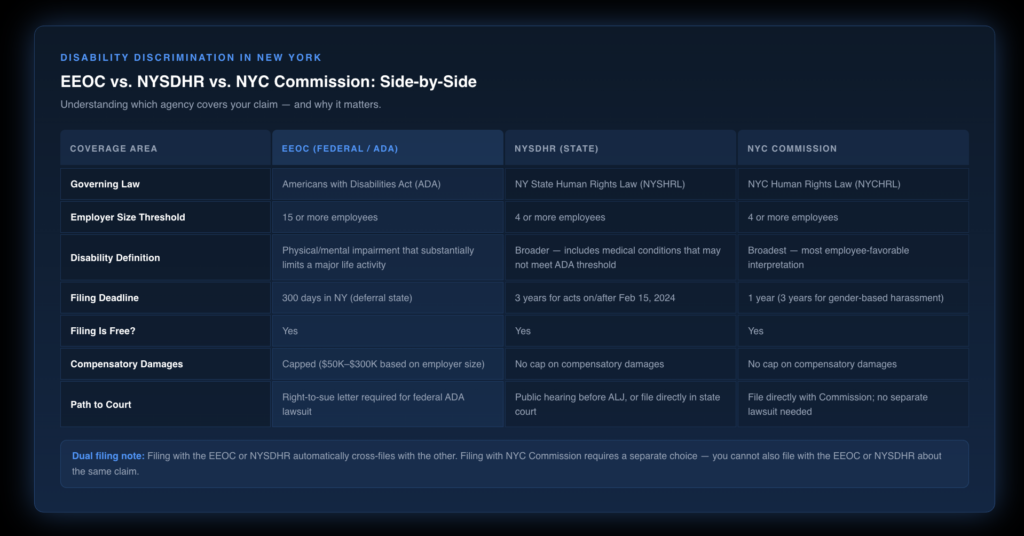
Even though dual filing makes the process seamless, the two agencies enforce different laws with different employer coverage thresholds. That difference matters more than most people realize.
What Employers Does Each Agency Cover?
The ADA — enforced by the EEOC — covers private employers with 15 or more employees. State and local governments are also covered regardless of size. The NY Human Rights Law — enforced by the NYSDHR — covers employers with 4 or more employees. That gap between 4 and 14 employees is significant. If you work at a company with 10 employees, the ADA doesn’t apply to you. The NYSHRL does.
Understanding small business requirements under these overlapping frameworks can make a real difference in whether you have a viable federal claim, a state claim, or both. If your employer has fewer than 15 employees, filing with NYSDHR may be your primary avenue, and the EEOC component of the dual filing may have limited practical value for your specific case.
Which Laws Apply to Your Disability Discrimination Claim?
The ADA and the NY Human Rights Law both prohibit disability discrimination in hiring, firing, compensation, and all other employment terms — but the NY law is interpreted more broadly in some areas. New York’s definition of “disability” under the Human Rights Law is wider than the ADA’s definition. Understanding what qualifies as a disability under the ADA is important, but you should know that a condition that doesn’t meet the ADA threshold may still qualify under state law.
The EEOC’s disability discrimination guidance makes clear that the ADA covers physical and mental impairments that substantially limit a major life activity. This includes mental health disabilities like depression, anxiety, and PTSD — conditions that employees sometimes assume won’t qualify. The NYSHRL goes further by covering conditions that are simply a “medical condition,” even if they don’t meet the ADA’s “substantially limits” threshold.
What Are the Filing Deadlines in New York?
Deadlines in discrimination cases are firm. Missing one can eliminate your right to pursue a claim regardless of how strong your case is.
How Long Do You Have to File With the EEOC?
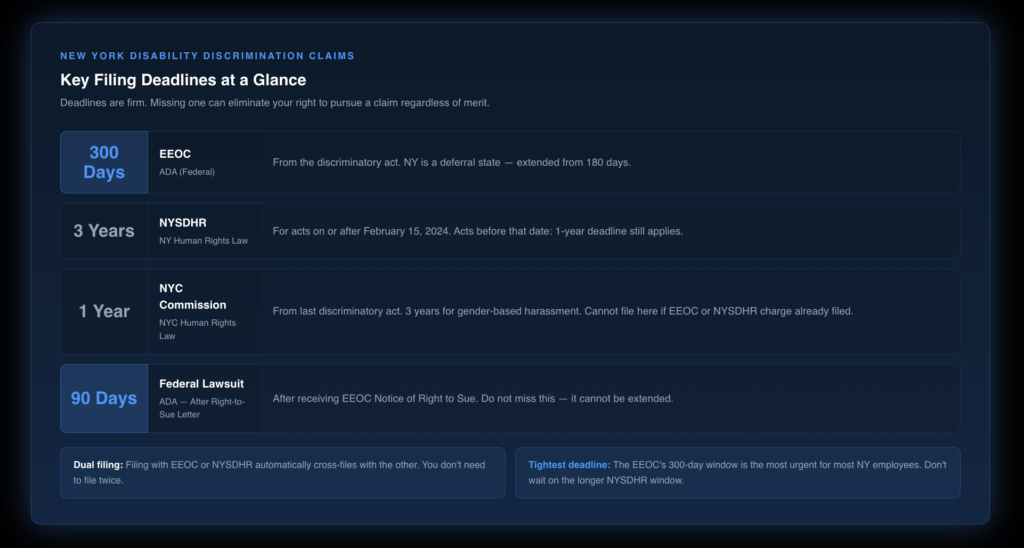
In New York, the standard 180-day EEOC deadline is extended to 300 days because New York has a state agency (the NYSDHR) that enforces a parallel law prohibiting the same discrimination. According to the EEOC, the time limits for filing a charge, the 300-day deadline applies in all deferral states, and New York qualifies. That means you have 300 calendar days from the date of the discriminatory act to file with the EEOC.
What Changed About the NYSDHR Deadline?
The NYSDHR deadline changed significantly and recently. In November 2023, Governor Hochul signed legislation extending the statute of limitations for NYSDHR complaints. According to NYSDHR’s legal updates, for any acts of discrimination occurring on or after February 15, 2024, you now have three years to file with the Division. For acts occurring before that date, the deadline was one year.
This extension is a major development for disability discrimination cases. It means New York employees now have considerably more time to evaluate their options, consult with an attorney, and file a state complaint — while the EEOC’s 300-day window remains unchanged. Practically speaking, the EEOC deadline is the tighter of the two for most employees, and it shouldn’t be treated as a backup if the federal deadline expires.
Which Agency Should You File With First?
For most New York employees, the choice of which agency to approach first is less important than people expect — because of dual filing. But there are some strategic considerations worth understanding.
What Are the Strategic Differences?
The EEOC tends to be more efficient for employees who need a right-to-sue letter to file a federal ADA lawsuit. The EEOC’s process ultimately leads to either a conciliation agreement, a right-to-sue letter, or EEOC-initiated litigation. If a federal court is a realistic goal, starting with — or ensuring coverage through — the EEOC is important.
The NYSDHR process can lead to a public hearing before an administrative law judge, which is a form of adjudication that doesn’t require going to federal court at all. If you want your case heard without filing a federal lawsuit, the NYSDHR route has advantages. The NYSDHR’s frequently asked questions explain that employees don’t even need an attorney to file a complaint — NYSDHR staff will help draft the formal complaint from your report.
The interactive accommodation process is also relevant here: if your disability discrimination claim arises from a failure to provide reasonable accommodations, the NYSDHR’s investigatory approach often examines the employer’s response to accommodation requests in detail. That can work in your favor when the paper trail shows a clear refusal.
Does It Matter Which Agency Investigates Your Charge?
It can. The agency that takes the lead on processing will shape the investigation, the timeline, and the eventual outcome. The EEOC tends to resolve charges more quickly on average, but outcomes vary by local office and case complexity. The NYSDHR process typically involves more communication with the complainant at each stage, which some employees find more informative.
In practice, if you file online through the EEOC’s Public Portal or visit an EEOC field office, the EEOC will process your charge. If you call the NYSDHR’s intake line or use their online reporting form, the state agency takes the lead. Either path preserves your rights under both laws.
What Happens After You File a Disability Discrimination Charge?
What Does the EEOC Investigation Process Look Like?
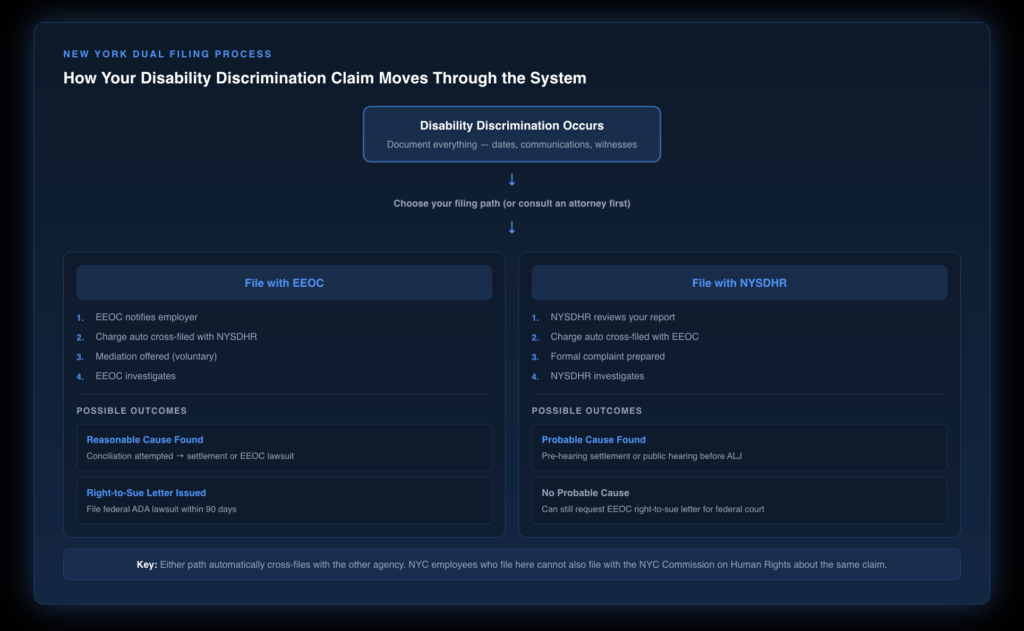
After you submit a charge by filing a charge of discrimination, the EEOC notifies your employer, who has an opportunity to respond. The EEOC may select your charge for mediation — a voluntary, confidential process that resolves many charges without a full investigation. If mediation doesn’t happen or fails, the EEOC investigates to determine whether there’s “reasonable cause” to believe discrimination occurred.
If reasonable cause is found, the EEOC attempts to resolve the matter through a conciliation agreement. If that fails, the EEOC can file suit in federal court or issue you a Notice of Right to Sue, which gives you 90 days to file your own ADA lawsuit in federal court.
What Does the NYSDHR Investigation Process Look Like?
The NYSDHR process differs in some meaningful ways. According to what to expect from the NYSDHR investigation process, after you report discrimination and the Division determines it’s covered under the Human Rights Law, a formal complaint is prepared on your behalf. Your employer — the respondent — is notified and asked to respond in writing.
An investigator then gathers facts, which may include interviews, document review, and site visits. If the Division finds probable cause, your case proceeds toward a public hearing before an administrative law judge. Many cases settle before reaching that stage — settlement opportunities exist throughout the NYSDHR process.
What About the NYC Commission on Human Rights?
New York City workers have a third option: the NYC Commission on Human Rights, which enforces the NYC Human Rights Law — generally considered the most protective anti-discrimination law in the country. But using it comes with an important constraint.
When Can You File With the NYC Commission on Human Rights?
The NYC Commission complaint process is free, handled through the Law Enforcement Bureau, and requires you to file within one year of the last discriminatory act (or three years for gender-based harassment). The NYC Human Rights Law protects employees at organizations with four or more workers, and it applies a broader, more employee-friendly standard than either the ADA or the NYSHRL. You can report discrimination to the NYSDHR regardless of city or location — but NYC workers have this additional avenue.
The NYC Commission on Human Rights complaint process is explicit that you cannot file a complaint there if you have already filed based on the same facts with the NYSDHR, the EEOC, or any federal or state court. This is the election-of-remedies rule in practice.
What Is the Election-of-Remedies Rule?
This rule means NYC employees must make a choice: file with the EEOC or NYSDHR (which triggers dual filing and preserves federal and state rights), or file with the NYC Commission — but not both, for the same underlying claim. This doesn’t mean you lose rights. Both paths offer meaningful remedies and investigation processes. But the choice is a one-way door, and it’s worth consulting an attorney before making it.
Employer retaliation is common after discrimination complaints, regardless of which agency you use. Filing with any of these agencies triggers anti-retaliation protections — any adverse action taken against you for filing a complaint can give rise to a separate retaliation claim.
What Remedies Are Available After Filing?
Whether your case resolves through the EEOC, the NYSDHR, or eventual litigation, the available remedies can include back pay for lost wages, front pay for future wage losses, compensatory damages for emotional distress, attorney’s fees, and equitable relief like reinstatement or a policy change at your employer. The NYSHRL and NYC HRL allow uncapped emotional distress damages in many cases — a significant advantage over the ADA’s damage caps for employers of different sizes.
If proving disability discrimination leads to a finding in your favor, you may also be entitled to reinstatement and reasonable accommodations going forward. Maintaining thorough disability documentation throughout your employment — records of accommodation requests, employer responses, and any changes in treatment — can significantly strengthen your damages claims. Employers who refuse to address undue hardship arguments in good faith often fare worse in EEOC and NYSDHR proceedings when that paper trail is clear.
Ready to File Your Disability Discrimination Complaint?
Understanding which agency to approach — and when — can shape the trajectory of your case from the start. Nisar Law Group represents employees exclusively, and our attorneys have handled disability discrimination cases under the ADA, the NY Human Rights Law, and the NYC Human Rights Law. If you’ve experienced disability discrimination at work and want to understand your filing options before any deadline passes, contact us today for a consultation.
Frequently Asked Questions About EEOC and NYSDHR Dual Filing
You can file through the EEOC’s online Public Portal at eeoc.gov, by calling 1-800-669-4000 to schedule an intake interview, or by visiting the nearest EEOC field office in person. New York has EEOC offices in New York City. After you submit an inquiry and complete an interview, the EEOC will prepare a formal charge for your signature. Remember that the 300-day deadline in New York is firm — starting the process sooner rather than later preserves your options.
No — retaliating against an employee for filing an EEOC complaint or participating in an investigation is illegal under both the ADA and the NY Human Rights Law. If your employer fires you, demotes you, cuts your hours, or makes your workplace intolerable after you file, those acts may give rise to a separate retaliation claim on top of your original discrimination complaint. Document any changes in treatment after filing and report them to the agency handling your charge.
The EEOC itself is not a court — it cannot issue binding judgments. However, if the EEOC finds reasonable cause and reaches a conciliation agreement with your employer, that agreement is legally enforceable. If your employer refuses to conciliate or violates a settlement, the EEOC can take the employer to federal court. If the EEOC issues you a right-to-sue letter, you can file your own federal lawsuit in which a judge’s eventual ruling is fully binding.
EEOC investigations vary considerably depending on complexity and caseload. Some charges are resolved through mediation within a few months. A full investigation, reasonable cause determination, and conciliation attempt can take anywhere from several months to well over a year. If the EEOC hasn’t resolved your charge within 180 days of filing, you can request a right-to-sue letter and proceed to federal court independently at that point.
Filing a charge can trigger a meaningful response from an employer, particularly if they want to avoid a protracted investigation or public finding of discrimination. Companies often engage in early settlement once a charge is filed, especially if the underlying facts are clear. An EEOC complaint is not public in the same way a court filing is, but a finding of reasonable cause or a lawsuit can become a matter of public record.
At the conclusion of its investigation, the EEOC will issue a determination. If it finds reasonable cause to believe discrimination occurred, it will attempt conciliation between you and your employer. If conciliation succeeds, the case resolves. If it fails, the EEOC may sue the employer in federal court or issue you a Notice of Right to Sue — giving you 90 days to file your own ADA lawsuit. If the EEOC finds no reasonable cause, it will still issue a right-to-sue letter, preserving your option to pursue the claim independently.
Remedies under the ADA are subject to compensatory and punitive damage caps that depend on employer size — ranging from $50,000 for employers with 15–100 employees up to $300,000 for employers with 500 or more employees. Back pay and front pay are not subject to these caps. Importantly, the NY Human Rights Law and the NYC Human Rights Law do not impose similar caps on compensatory damages, which is one reason state and city law claims can result in substantially larger recoveries than federal claims alone.
