

When your executive role comes to an end—whether by choice or necessity—the financial stakes are enormous. An executive severance package isn’t just about a few months of salary. It involves deferred compensation timing, retirement benefit protections, equity acceleration, Section 409A compliance, and age discrimination safeguards that most employees never encounter. Getting any of these wrong can cost you hundreds of thousands of dollars.
The good news is that executives have substantial legal protections—and significant negotiating power—that most departing employees don’t. Understanding how to use them is the difference between accepting a mediocre exit package and securing the financial security your career earned.
Key Takeaways
- OWBPA requires employers to give executives aged 40+ at least 21 days to review a severance agreement and 7 days to revoke after signing.
- Section 409A imposes a mandatory 6-month payment delay for “specified employees” (most public company executives) after separation.
- SERPs are not ERISA-protected—they’re unsecured obligations that become worthless if the company goes bankrupt.
- New York executives have a 3-year window to file age discrimination claims under the NYC Human Rights Law (vs. 300 days federally).
- Equity acceleration, salary continuation, and deferred compensation coordination are your highest-value negotiation targets.
Disclaimer: This article provides general information for informational purposes only and should not be considered a substitute for legal advice. It is essential to consult with an experienced employment lawyer at our law firm to discuss the specific facts of your case and understand your legal rights and options. This information does not create an attorney-client relationship.
What Are the Core Components of an Executive Severance Package?
Executive severance agreements are fundamentally different from standard employee separation agreements. The financial complexity—and the negotiating leverage—are on a different scale entirely.
What Does a Standard Executive Severance Package Include?
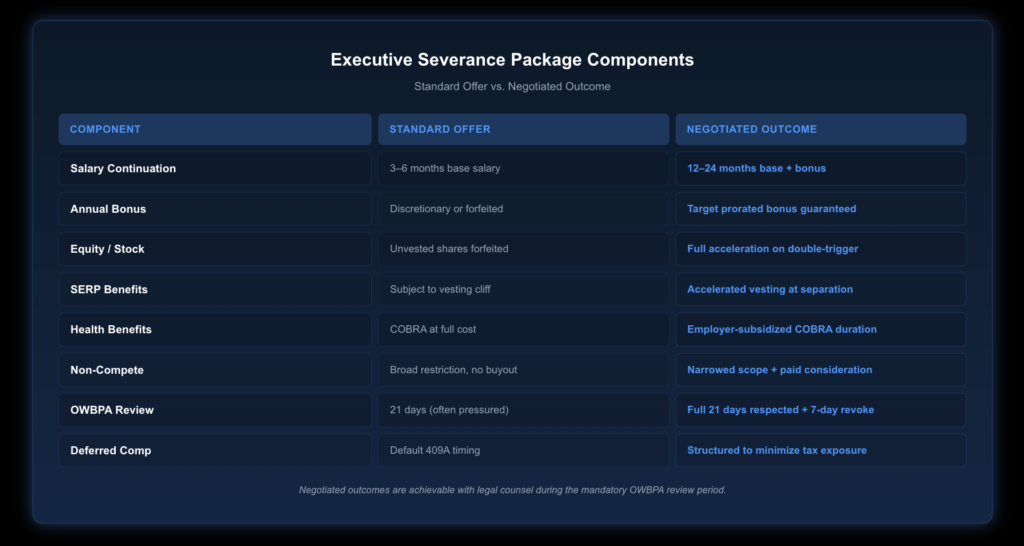
A baseline executive exit package typically includes salary continuation (ranging from 6 to 24 months depending on seniority), payment of earned but unpaid bonuses, continuation of benefits including health insurance, and outplacement services. Senior executives at the C-suite level can often negotiate 2 years of total compensation, while vice presidents typically receive 12 to 18 months.
What distinguishes executive packages is the additional layer of equity compensation treatment, deferred compensation coordination, retirement benefit continuation, and non-compete buyouts. These components—not the base salary continuation—are where the real negotiating value lives.
How Do Change-in-Control Provisions Affect Your Severance?
If your departure is triggered by a merger, acquisition, or major ownership change, change-in-control provisions can dramatically expand what you’re entitled to receive. A double-trigger provision requires both a change in control and an involuntary termination (or constructive dismissal) before benefits kick in—giving executives strong protection against being forced out post-acquisition.
Single-trigger provisions activate on the change-in-control event itself, regardless of whether you’re terminated. While less common, they provide maximum financial protection if a company is acquired and the new owners want to restructure leadership. Understanding which trigger applies to your agreement before any transaction occurs is critical—renegotiating after a deal is announced is far more difficult.
What OWBPA Protections Apply When Executives Sign Severance Agreements?
The Older Workers Benefit Protection Act (OWBPA) is arguably the most important federal protection for executives in their 40s, 50s, and 60s navigating a departure. It sets specific requirements that employers must follow before a valid age discrimination waiver can exist in your severance agreement.
What Are the OWBPA Requirements for Individual Separations?
For an individual executive separation (not a group layoff), a valid OWBPA waiver requires all of the following:
- The agreement must be written in a language you can understand
- The agreement must specifically name the Age Discrimination in Employment Act (ADEA) by title
- You must receive consideration beyond what you’re already entitled to
- You must be advised in writing to consult with an attorney before signing
- You must have at least 21 days to review the agreement
- You have 7 days after signing to revoke the agreement, no exceptions
If any of these requirements are missing, the waiver of your ADEA rights is invalid—even if you already signed. This is one of the most commonly overlooked protections in executive departures. Companies frequently present severance agreements with tight signing deadlines, hoping executives won’t realise that 21 days is legally required, not optional.
What Happens During a Group Layoff or Reduction in Force?
If your departure is part of a workforce reduction affecting multiple employees, the OWBPA requirements expand significantly. The employer must provide a 45-day review period (not 21 days), along with written disclosure of the job titles and ages of all employees selected and not selected for the program within the decisional unit. This disclosure requirement is critical—it allows you to determine whether older workers were disproportionately targeted.
Reviewing those disclosure lists with an attorney can reveal patterns of age discrimination under the ADEA that aren’t apparent from your individual termination alone. Executives who accept severance without reviewing these documents sometimes waive claims worth significantly more than the package offered.
How Does Section 409A Affect Deferred Compensation at Separation?
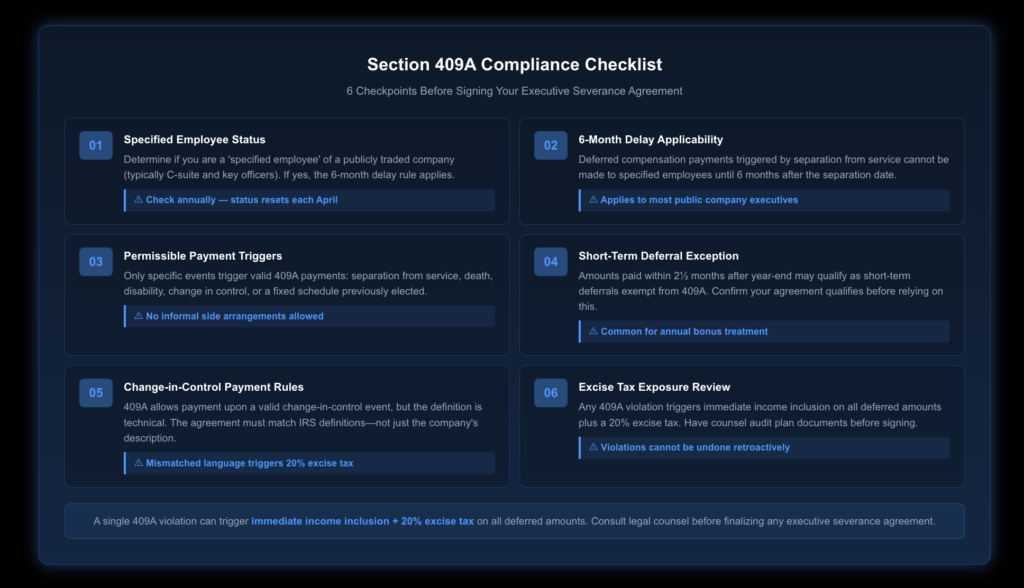
Section 409A deferred compensation rules create some of the most significant financial risks executives face at separation. A violation doesn’t just delay your payment—it triggers immediate income recognition on all deferred amounts, plus a 20% excise tax on top of ordinary income tax rates.
What Is the Six-Month Delay Rule for Specified Employees?
Under IRS Section 409A regulations, executives classified as “specified employees” of publicly traded companies face a mandatory 6-month delay before any deferred compensation payments can begin after separation. Most public company C-suite executives and many senior vice presidents meet the “specified employee” definition.
This means that if your separation agreement calls for deferred compensation payments to start immediately upon departure, those payment terms may violate Section 409A—exposing you to the 20% excise tax even if the violation isn’t your fault. Severance agreements for public company executives should always address the 6-month delay requirement explicitly.
What Are the SERP Risks Executives Often Miss?
Supplemental Executive Retirement Plans (SERPs) are company-funded retirement plans that sit outside the protections of ERISA-qualified plans. Unlike ERISA-qualified plans, SERPs are not held in trust for your benefit—they’re unsecured corporate obligations. If the company files for bankruptcy after your separation, your SERP benefits can be worth nothing.
Before relying on a SERP as a primary retirement asset, executives should understand:
- What the vesting schedule is and whether termination without cause triggers accelerated vesting
- Whether the plan is “funded” through a rabbi trust (which offers some protection) or is completely unfunded
- How ERISA’s lack of applicability affects your ability to sue for benefits
- Whether the SERP balance is portable or forfeitable in connection with non-compete clauses
SERPs also carry clawback provision risks—some plans allow employers to recoup SERP benefits if executives engage in competitive activities or cooperate with litigation adverse to the company.
What Are the New York-Specific Protections for Executives at Departure?
New York executives operate under a significantly more protective legal framework than federal law provides. Understanding the layered protections available under state and city law is essential for evaluating whether your departure terms reflect your full legal entitlement.
How Does the NYC Human Rights Law Expand Age Discrimination Protections?
The NYC Human Rights Law provides broader age discrimination coverage than either federal law or the New York State Human Rights Law. Unlike the ADEA, which only protects workers 40 and older, the NYCHRL prohibits age discrimination against workers of all ages. It applies to employers of any size and provides a generous 3-year statute of limitations for claims.
This matters for executives because pressure campaigns, “succession planning” conversations, and departures framed as voluntary can all constitute age discrimination if age was a motivating factor. The 300-day federal EEOC filing deadline can expire before executives even recognise what happened—but the 3-year NYCHRL window provides a meaningful opportunity to evaluate claims fully.
What Does the New York State Human Rights Law Add?
The New York State Human Rights Law (NYSHRL) protects employees aged 18 and older from age discrimination—not just those over 40. It applies to all New York employers regardless of size, eliminating the ADEA’s 20-employee threshold that can leave executives at smaller firms without federal protection.
The NYSHRL’s 3-year filing period at the state Division of Human Rights gives executives who suspect age was a factor in their departure meaningful time to investigate, consult legal counsel, and evaluate whether a claim makes financial sense given the value of claims released under a proposed severance agreement. Signing away those rights for inadequate consideration is a mistake many executives make under deadline pressure.
How Should Executives Approach the Severance Negotiation Process?
Understanding your legal rights is the foundation—but maximising your exit package requires strategic negotiation across multiple dimensions simultaneously.
What Are the Highest-Value Negotiation Targets for Senior Executives?
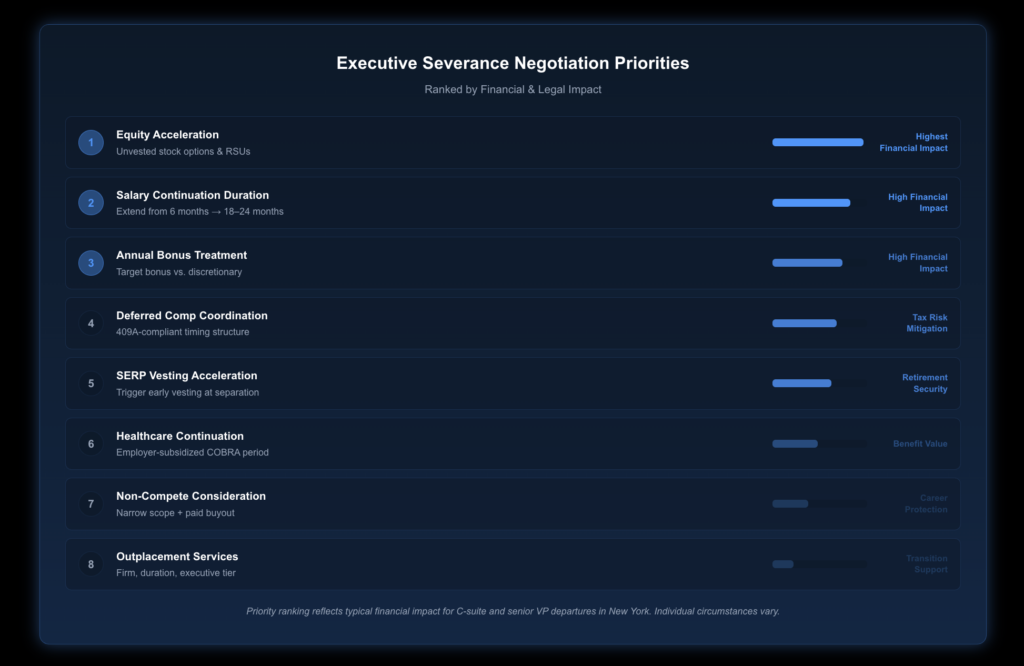
For most executives, the negotiating priorities in descending order of financial impact are:
Equity acceleration: Full or partial acceleration of unvested stock options and restricted stock units is often the single largest financial item in an executive departure. Agreements that allow “double-trigger” acceleration upon termination following a change in control protect equity value that can represent years of compensation.
Salary continuation duration: Extending salary continuation from 6 months to 12-24 months is standard negotiating terrain for C-suite departures and easier to obtain than most executives realise.
Annual bonus treatment: Your bonus for the year of departure—both prorated current-year and any deferred bonuses—should be specifically addressed. “Target bonus” or “target prorated bonus” language protects far more than “discretionary bonus” language.
Healthcare continuation: COBRA continuation runs for 18 months and is expensive. Negotiating employer-subsidised continuation for the duration of salary continuation is both achievable and significant.
Deferred compensation coordination: Ensuring that deferred compensation payments are structured to comply with Section 409A requirements and that payment timing is coordinated with other severance components prevents costly tax penalties.
Non-compete scope and consideration: Overbroad non-competes can render an executive unemployable. Negotiating geographic limitations, duration, and explicit consideration for restrictions—including non-compete carve-outs for equity held at departure—protects your ability to work.
What Red Flags Should Executives Watch for in Severance Agreements?
Certain provisions in executive severance agreements warrant immediate legal review before any signing deadline:
Broad release language that appears to release claims beyond employment discrimination (including ERISA or plan benefit claims) may be overreaching.
Non-disparagement provisions with asymmetric scope that restrict your speech while leaving the company free to discuss your departure undermine your professional reputation disproportionately.
Clawback triggers tied to cooperation that allow the company to recoup severance if you cooperate with any government investigation or proceeding are increasingly common and potentially illegal.
Missing OWBPA language in agreements presented to executives over 40 is a red flag that the employer may be attempting to obtain a waiver of age discrimination claims without complying with statutory requirements.
Do I Need Legal Representation for Executive Severance Negotiations?
The short answer is almost always yes. Executive departures involve legal documents that waive significant rights, financial instruments with tax consequences, and retirement benefits with complex vesting and compliance requirements. Having an employment attorney review the agreement before you sign—during the mandatory 21-day period—protects both your rights and your financial security.
The review period isn’t just a formality. It’s an opportunity to assess whether age discrimination played a role in your departure, whether the offered package reflects your full contractual entitlement under your employment agreement, and whether the Section 409A provisions in the agreement are structured correctly alongside valid ADEA waiver requirements.
Executives who negotiate with legal counsel consistently receive better outcomes than those who accept initial offers, even at companies with generally fair employment practices. The cost of legal counsel is almost always recoverable from a single negotiated improvement to package terms.
Ready to Protect Your Executive Exit?
If you’re navigating an executive departure in New York, the decisions you make in the first 21 days will define your financial outcome. From OWBPA compliance to SERP protection, Section 409A compliance, and equity negotiation, these issues require experienced employment counsel who understands both the legal framework and the negotiating dynamics of executive separations.
Nisar Law Group represents executives facing employment transitions throughout New York and New Jersey. Contact us today for a consultation to discuss your severance agreement, retirement benefits, and legal options before you sign anything.
Frequently Asked Questions About Executive Severance and Retirement Planning
Executive severance typically ranges from 6 months to 2 years of total compensation, depending on seniority and the circumstances of departure. C-suite executives (CEO, CFO, COO) generally receive 18 to 24 months of base salary plus target bonus. Vice presidents and senior directors typically receive 12 to 18 months. These figures represent negotiated outcomes rather than industry standards—initial offers are almost always lower, and most companies expect negotiation from senior-level departures.
An executive severance plan is a company-sponsored arrangement specifying the benefits an executive receives upon involuntary termination, termination without cause, or departure following a change in control. These plans typically go beyond standard employee separation packages to include equity acceleration, bonus treatment, extended benefits continuation, and deferred compensation provisions. Some executives have severance protections specified in their individual employment agreements rather than a company-wide plan, which often provides stronger protections.
Executives receive severance packages for several interrelated reasons: to induce talented leaders to accept roles knowing they have financial protection if business circumstances change; to honour contractual commitments made in employment agreements; to secure legally effective releases of employment claims; and to maintain goodwill during leadership transitions that can affect company culture and client relationships. From the company’s perspective, a well-structured severance agreement that obtains a valid legal release is often less expensive than the uncertainty of unresolved claims.
Red flags include missing OWBPA language (required for employees 40 and older waiving ADEA rights), release provisions that purport to cover ERISA or plan benefit claims, asymmetric non-disparagement provisions, clawback triggers tied to government cooperation, overly broad non-compete restrictions without adequate consideration, and time pressure designed to prevent meaningful review. Any agreement presented with a deadline shorter than 21 days to an employee over 40 violates federal law and renders the age discrimination waiver invalid.
Severance pay is taxed as ordinary income, not at a flat 40% rate. For executives in the highest federal income bracket, federal income tax reaches 37%, plus applicable state taxes (New YorkState’se top rate is approximately 10.9%, and New York City adds another roughly 3.88%). Total effective tax rates for high-income executives in New York City can approach 50% when all taxes are combined. Structuring large severance payments across tax years and coordinating deferred compensation payments can reduce the total tax burden—but must be done in compliance with Section 409A.
After 30 years of executive service, a reasonable severance package should reflect both tenure and seniority. Many executives in this situation are entitled to golden parachute protections, full SERP vesting, accelerated equity, and extended salary continuation of 2 or more years. The specific terms depend on what’s in your employment agreement, the company’s severance plan, and the circumstances of departure. Age discrimination laws also provide important leverage—pressure to retire or accept departure after decades of service often has legal dimensions worth evaluating with counsel.
The primary downside to accepting a severance agreement is that you’re typically releasing legal claims—including potential age discrimination, wrongful termination, and ERISA claims—in exchange for the offered benefits. If those claims have significant value, accepting an inadequate package means giving them up for less than they’re worth. Other downsides include non-compete restrictions that limit future employment, non-disparagement obligations that constrain your professional narrative, and potential conflicts between deferred compensation timing requirements and your new employer’s needs. Having an attorney evaluate the claims you’re releasing against the value offered is the most effective way to assess whether a package is actually reasonable.
