
Were You Arrested Without Probable Cause in New York?
We Can Help
If you were detained or arrested by police without a valid legal reason, your constitutional rights may have been violated — and you may have grounds for a civil rights lawsuit. A wrongful arrest isn’t just a bad experience. Under federal law, it’s a violation of your Fourth Amendment rights, and you may be entitled to compensation for the harm it caused.
At Nisar Law Group, we represent people in New York City and throughout New York State who have been wrongfully arrested or detained by government actors. We handle these cases exclusively on behalf of the people — not the police, not the government, not corporations. If you were arrested without probable cause, our team can review your situation and help you understand your options.
Contact Nisar Law Group, P.C. at (212) 600-9534 to learn how we can be of service.
What Does "Wrongful Arrest" Actually Mean Under the Law?
A wrongful arrest — also called a false arrest — happens when a police officer or other government actor detains or arrests you without probable cause. Probable cause is the legal threshold officers must meet before making an arrest. It means there must be enough facts and circumstances, known to the officer at the time, that a reasonable person would conclude you likely committed a crime.
When that threshold isn’t met, the arrest is unlawful — regardless of whether you were eventually charged, whether the officer believed they were doing the right thing, or whether charges were later dropped. The key question is always: what did the officer actually know at the moment they arrested you?
Under 42 U.S.C. § 1983, you have the right to sue a government official who violated your constitutional rights while acting under color of state law. A police officer making an arrest is always acting under color of state law, which means if they arrested you without legal justification, you can hold them accountable in federal court. This same federal statute is the foundation of our entire civil rights and constitutional litigation practice — covering not just wrongful arrest, but the full range of government abuses that violate your constitutional rights.
What’s the Difference Between a Wrongful Arrest and a Lawful Arrest That Went Wrong?
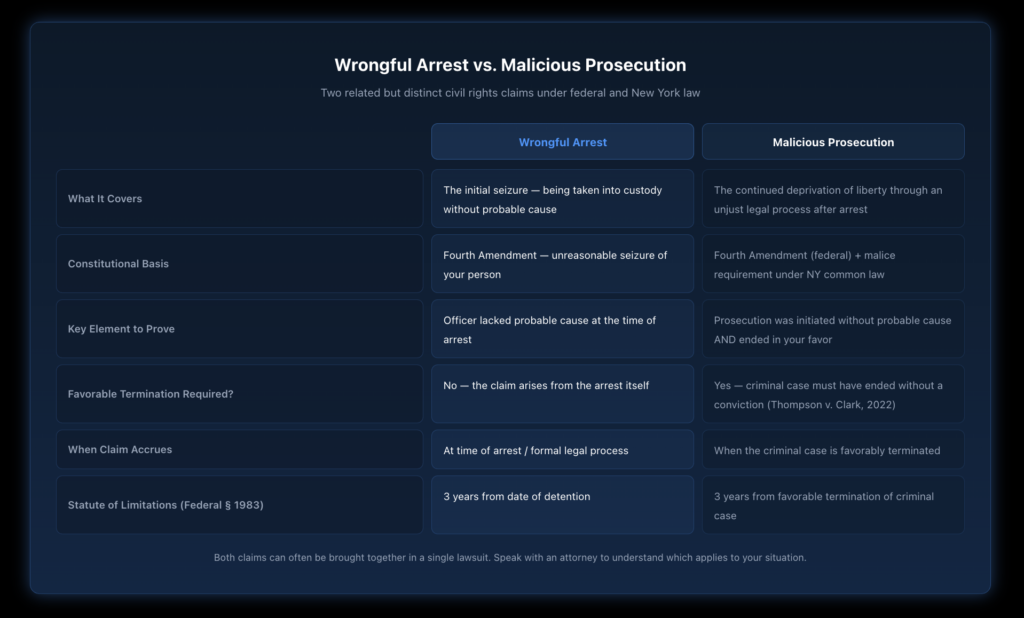
This distinction matters. An officer can lawfully arrest you based on probable cause even if you’re later found not guilty — probable cause is judged at the time of arrest, not by what happens afterward. However, if the officer lacked probable cause from the start — or acted based on racial profiling, fabricated evidence, mistaken identity, or an illegal tip — the arrest may have been unconstitutional even if the process technically continued.
A wrongful arrest claim focuses on that initial seizure. A related claim, malicious prosecution, covers what happens after — when police or prosecutors push forward with a case they know lacks legal basis, continuing to deprive you of your liberty through an unjust legal process.
How Do Wrongful Arrests Happen in New York City?
NYPD makes hundreds of thousands of arrests per year. Not all of them are lawful. Here are the most common situations where wrongful arrest claims arise in New York:
Mistaken identity. Officers arrest the wrong person based on a vague description, a name mix-up, or a faulty warrant. New York City has paid millions in settlements for this exact scenario — many of them tied to reversed convictions where the arrest record formed the foundation of an unjust prosecution.
Racial profiling. An officer stops and arrests someone based on race, ethnicity, or neighborhood rather than actual evidence of criminal activity. This is both a Fourth Amendment violation and, often, an Equal Protection violation under the Fourteenth Amendment. Racial profiling frequently intersects with police misconduct claims more broadly — pattern stops, unlawful frisks, and profiling-based arrests often form part of the same constitutional violation.
Illegal tips or informants. An arrest based solely on an uncorroborated tip from an anonymous informant — without independent corroboration — typically lacks probable cause. The tip alone doesn’t satisfy the constitutional standard.
Bad warrant applications. If a warrant was obtained using fabricated or misleading information in the officer’s affidavit, any arrest made pursuant to that warrant may still be unlawful. Officers who provide false statements to obtain warrants can be held personally liable.
Retaliatory arrests. Officers sometimes arrest people who challenge them verbally, film them, or assert their rights in public. These arrests often lack real probable cause and may also constitute First Amendment retaliation — a distinct civil rights claim when the arrest was triggered by protected speech or activity rather than any actual evidence of a crime.
Overlong detentions. Even a lawful stop can become an unlawful arrest if the officer continues to detain you far beyond what the situation justifies without ever establishing actual probable cause.
New York law, under CPL § 140.10, allows officers to arrest without a warrant only when they have “reasonable cause” — the state equivalent of federal probable cause. Critically, New York does not recognize the federal good-faith exception to the exclusionary rule, which means evidence obtained through an unlawful arrest in New York can still be suppressed in state court even when an officer acted in honest error.
What Rights Do You Have When You're Being Arrested?
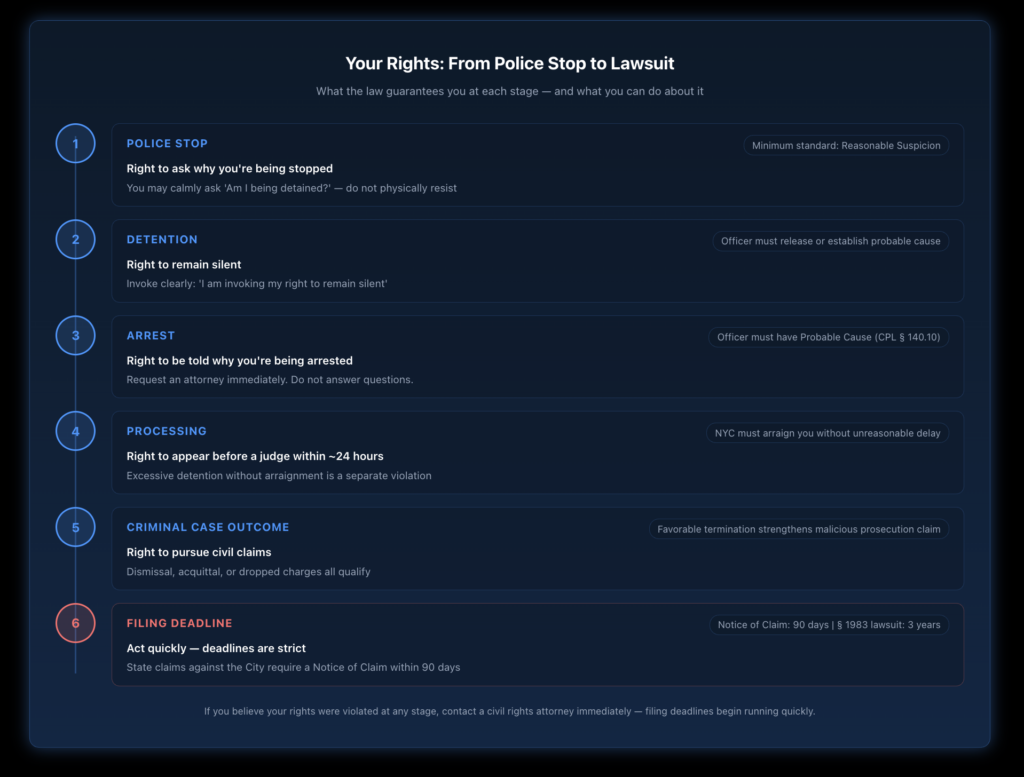
Under the Fourth Amendment, you have the right to be free from unreasonable seizures. An arrest without probable cause is exactly that. Understanding these rights matters both in the moment and when building your civil case afterward.
You have the right to ask why you’re being arrested. You do not have the right to physically resist, but you absolutely have the right to document, protest verbally, and later seek legal recourse. Preserving evidence of your encounter — anything you can gather at the time — is one of the most important steps you can take. Wrongful arrests by police frequently overlap with broader government misconduct and constitutional violations that our attorneys investigate as part of the same case.
You have the right to remain silent. Anything you say can be used against you, and nothing you say will un-arrest you. The safest course is to clearly invoke your right to remain silent and ask for an attorney.
You have the right to an attorney. Once you invoke this right, questioning must stop. This applies whether or not you can afford one.
Even after you’ve been arrested, you have rights. New York City must present you before a judge within a reasonable time — typically within 24 hours. Holding you without processing is itself a constitutional violation.
One practical note: the NYPD is not itself a suable legal entity. Under NYC Charter § 396, the proper defendant in most NYPD misconduct cases is the City of New York — and under GML § 50-k, the City typically indemnifies its officers, meaning it pays settlements and judgments on their behalf.
What Damages Can You Recover for a Wrongful Arrest?
There’s no standard number — every case turns on its specific facts. But here’s what you can potentially recover in a wrongful arrest lawsuit under § 1983:
Compensatory damages cover your actual losses: lost wages if you missed work, medical costs if you were injured, and the financial impact of an arrest record. They also include non-economic damages like emotional distress, humiliation, and the psychological harm from being wrongfully taken into custody. When an arrest also involved physical force, these damages can overlap significantly with excessive force claims — and both can be pursued in the same lawsuit.
Punitive damages are available against individual officers when the conduct was especially egregious or reckless, though not against the City itself.
Attorney’s fees — under 42 U.S.C. § 1988, if you prevail in a § 1983 case, the defendant may be required to pay your legal fees. This makes it financially viable to bring civil rights claims even when the monetary damages alone might be modest.
Injunctive relief — in some cases, a court can order policy changes or reforms, particularly in pattern-and-practice cases involving the same officers or precincts.
The scale of these claims in New York City is significant. According to the NYC Comptroller’s Annual Claims Report, wrongful conviction claims — many stemming directly from wrongful arrests — are among the single largest cost drivers in the City’s litigation budget. In FY 2023 alone, 13 reversed conviction settlements totaled more than $81.3 million, representing 30 percent of the City’s entire NYPD payout that year.
Filing Deadlines You Cannot Miss
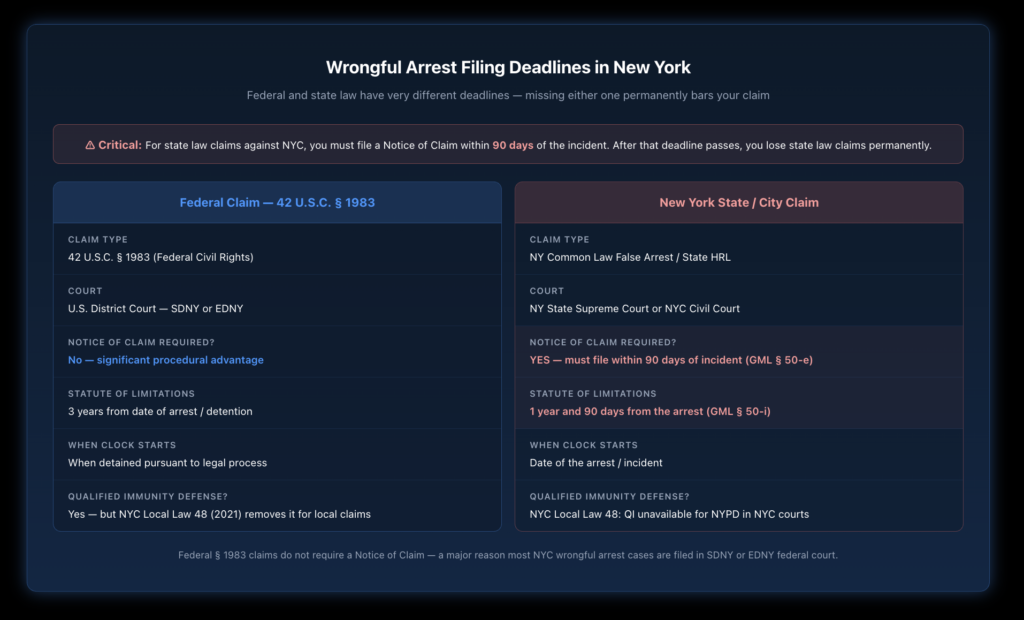
If you miss these deadlines, you lose the right to sue — permanently.
For a federal § 1983 claim, you have three years from the date of arrest to file in federal court.
For state law claims against the City of New York, the timeline is far more compressed. Under GML § 50-e, you must file a Notice of Claim within 90 days of the incident. Under GML § 50-i, you must then commence your lawsuit within 1 year and 90 days of the arrest.
Federal § 1983 claims do not require a Notice of Claim — a significant procedural advantage that makes federal court the preferred venue for most wrongful arrest cases in New York. Cases are typically filed in the Southern District of New York (SDNY) or the Eastern District of New York (EDNY). This is exactly why speaking with an attorney immediately after an incident matters: the 90-day state deadline begins running right away, and people who are held in custody following a wrongful arrest may also have prisoner rights claims arising from what happens after the arrest itself.
What Evidence Helps Prove a False Arrest in New York?
Strong civil rights cases are built on evidence gathered early. Since the 2020 repeal of Civil Rights Law § 50-a, NYPD disciplinary records that were previously shielded are now publicly accessible — which means prior complaints against the same officer can now be part of your case.
Body camera footage. NYPD officers are required to activate body cameras during arrests. This footage can corroborate or contradict the officer’s account. We routinely demand this footage early in litigation, before it’s overwritten.
Arrest report and charging documents. Inconsistencies between the arrest report, the criminal complaint, and the officer’s later testimony carry weight in civil proceedings.
Witness statements. Bystanders, store employees, neighbors — anyone who saw what happened. Cell phone video from bystanders has fundamentally changed police misconduct litigation.
Prior CCRB complaints against the officer. The NYC Civilian Complaint Review Board maintains records of past complaints against NYPD officers. Prior patterns of abuse of authority or false arrests are admissible to show a custom or practice — especially in Monell claims against the City. You can also file a complaint with the CCRB independently of any lawsuit, and the two processes are not mutually exclusive.
Medical records. If you were injured during or after the arrest, those records document harm. Physical injury during an arrest frequently gives rise to a parallel excessive force claim — both can be brought together in the same federal lawsuit under § 1983. In cases where the arrest targeted someone because of their religion, the claim may also intersect with religious discrimination by government entities.
Your criminal case outcome. A dismissal, acquittal, or favorable resolution of your criminal case strengthens a wrongful arrest claim. Under Thompson v. Clark (2022), a favorable termination for malicious prosecution purposes only requires that the prosecution ended without a conviction — no affirmative proof of innocence required.
Who Holds Police Officers Accountable in New York?
Several mechanisms exist, each with different powers and limitations. None of them replaces the right to bring your own civil lawsuit.
The NYC Civilian Complaint Review Board is an independent agency with authority to investigate complaints involving force, abuse of authority, discourtesy, and offensive language. Anyone — regardless of immigration status, age, or incarceration — can file a complaint. The CCRB’s core limitation is that its disciplinary recommendations are not binding on the Police Commissioner, who retains final authority over punishment. Budget constraints that took effect in 2024 further reduced the CCRB’s investigative capacity, making the civil lawsuit the primary route to actual accountability for many claimants.
The NY Attorney General’s Civil Rights Bureau and its Law Enforcement Misconduct Investigative Office pursue institutional reform and can investigate patterns of misconduct across New York’s 500+ law enforcement agencies — but they represent the People of the State, not individual claimants.
The NYC Commission on Human Rights handles discrimination complaints under the NYC Human Rights Law, including bias-based policing complaints. The Commission’s administrative process is separate from a § 1983 lawsuit, and you should confirm with counsel how pursuing both simultaneously affects your options and deadlines.
NYC Local Law 48 (2021) made New York City the first major city in the country to limit qualified immunity for local claims. NYPD officers cannot assert qualified immunity as a defense in lawsuits brought in NYC courts for unreasonable search and seizure and excessive force — a shift that makes local civil claims more viable than in nearly any other jurisdiction in the country.
Why Nisar Law Group?
Nisar Law Group is a boutique civil rights and employment litigation firm based in New York City. We represent employees and individuals — never corporations, never government agencies. Every case we take is on behalf of someone who has been wronged.
We bring the same commitment to wrongful arrest cases that defines all of our civil rights work: rigorous preparation, honest counsel, and unwavering advocacy for the people we represent. We know New York’s courts, we understand how NYPD accountability systems operate, and we know how to build the kind of record that produces results. We offer free initial consultations for wrongful arrest and civil rights cases. If we take your case, we work on a contingency basis — you pay nothing unless we win.
Contact us at (212) 600-9534 to schedule a confidential consultation.
Why We're the Right Choice
- Seasoned Litigators Who Have Handled Numerous Jury & Bench Trials
- Providing Representation with Clarity, Honesty & Integrity
- Building Long-Term Affiliations & Relationships
- Offering Consultations for All Case Types We Handle
Frequently Asked Questions About Wrongful Arrest
Yes. If a police officer or other government actor arrested you without probable cause, you can bring a civil rights lawsuit under 42 U.S.C. § 1983 in federal court — or under New York state law in state court. To win, you generally need to show the officer lacked a legal basis for the arrest at the time it happened. Successfully proving a wrongful arrest can result in compensation for your damages, including lost wages, emotional distress, and, in some cases, punitive damages against the individual officer.
It depends on the specific facts — there’s no fixed number. Damages in wrongful arrest cases can include lost wages, medical costs, emotional distress, and reputational harm. Cases involving prolonged detention, physical injury, serious emotional trauma, or an officer with a documented history of misconduct tend to result in larger recoveries. In New York City, wrongful conviction cases stemming from wrongful arrests have reached tens of millions of dollars in individual settlements — but the value of your case depends on what happened, the strength of the evidence, and the harm you suffered.
The legal term most commonly used is false arrest or false imprisonment. Under federal civil rights law, these claims are framed as Fourth Amendment violations — specifically, unreasonable seizure without probable cause. New York common law also recognizes false arrest as a distinct tort. If the wrongful arrest was followed by a criminal prosecution that lacked probable cause and eventually ended in your favor, that gives rise to the separate but related claim of malicious prosecution.
Technically, an arrest can be made without physical evidence as long as the officer has probable cause — a reasonable basis to believe you committed a crime. Probable cause can be based on eyewitness accounts, an officer’s direct observations, or reliable informant tips that have been independently corroborated. However, an arrest based solely on a hunch, an uncorroborated anonymous tip, or no real factual basis is not lawful, regardless of whether physical evidence later surfaces.
Suing the government for police misconduct is challenging, but far from impossible — especially in New York. Federal § 1983 claims in SDNY and EDNY have produced major verdicts and settlements. The key challenges are qualified immunity, strict notice of claim deadlines for state law claims, and the significant resources the City deploys to defend these cases. Having experienced civil rights counsel matters enormously. NYC’s Local Law 48 (2021) removed qualified immunity as a defense in local civil rights actions — making NYC claims more viable than in most other jurisdictions.
Yes, if the detention lacked a legal basis. Under the Fourth Amendment, any detention — not just a formal arrest — must be justified. An investigative stop requires at a minimum reasonable suspicion. If an officer detains you without even that, it’s an unlawful seizure. If the officer escalates a stop into an effective arrest — by handcuffing you, placing you in a patrol car, or holding you for an extended period — without establishing probable cause, that too may be actionable under § 1983.
Several mechanisms exist. The CCRB investigates civilian complaints, but its disciplinary recommendations are not binding on the Police Commissioner. The NY Attorney General’s Law Enforcement Misconduct Investigative Office investigates patterns across law enforcement agencies. The Internal Affairs Bureau handles misconduct reported from within the department. And critically, individuals can bring civil lawsuits under federal § 1983 or NYC Local Law 48 — this is often the most direct form of accountability because it creates financial consequences and a public court record. Filing a civil lawsuit and filing a CCRB complaint are not mutually exclusive.
