
Were Your Constitutional Rights Violated in a New York Jail or Prison?
We Can Help
Incarceration doesn’t erase your constitutional rights. When the government imprisons someone — whether in a state prison, a county jail, or Rikers Island — it takes on a legal obligation to protect that person from abuse, provide adequate medical care, and maintain conditions that meet constitutional standards. When those obligations are ignored, the law gives you a way to fight back.
At Nisar Law Group, we represent individuals in New York whose rights were violated while in government custody. These cases require a firm that understands the federal civil rights framework, New York’s significant state-level protections, and the procedural obstacles — like the Prison Litigation Reform Act — that can derail even strong claims if they aren’t navigated carefully.
If you or someone you love has experienced abuse, denial of medical care, or unconstitutional conditions in a New York jail or prison, contact us to discuss whether you have a claim.
Contact Nisar Law Group, P.C. at (212) 600-9534 to learn how we can be of service.
What Rights Do Incarcerated People Have?
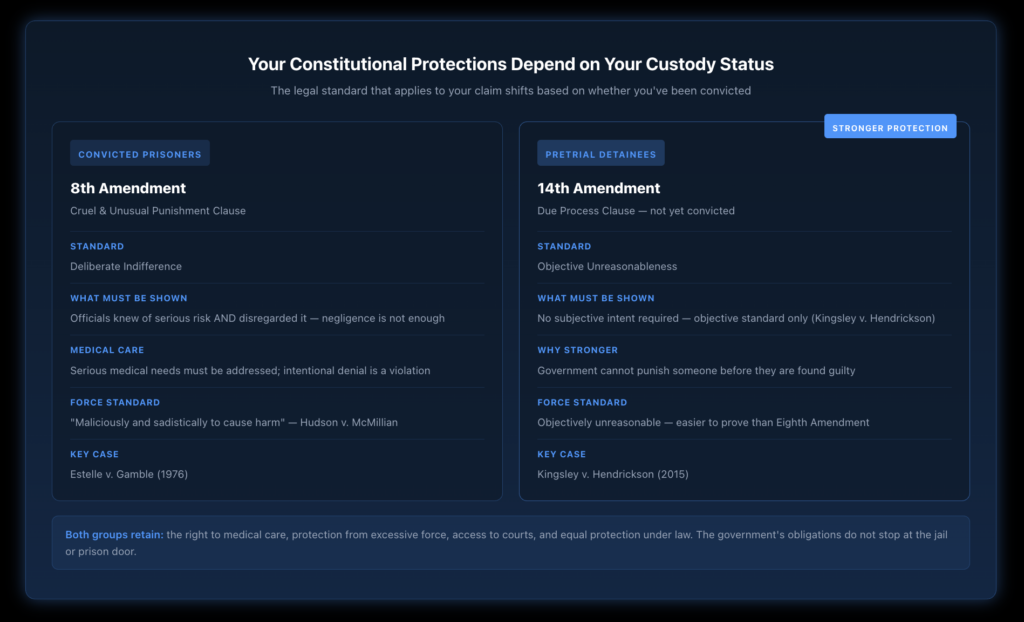
A conviction doesn’t strip a person of all constitutional protections. Under the Eighth Amendment, the government is prohibited from inflicting cruel and unusual punishment on people it incarcerates. That protection covers every person serving a sentence in a New York state prison or county jail.
For people who haven’t been convicted yet — pretrial detainees held in city jails like Rikers Island — the protections are actually stronger. Under the Fourteenth Amendment‘s Due Process Clause, the government cannot punish someone who hasn’t been found guilty. Courts have held that pretrial detainees are therefore entitled to at least as much protection as convicted prisoners, and in some contexts more.
The primary legal vehicle for pursuing these claims in federal court is 42 U.S.C. § 1983, the federal civil rights statute that allows individuals to sue government officials who deprive them of constitutional rights. Corrections officers, administrators, and — when systemic failures are at issue — the institution itself can face liability.
Common violations that form the basis of prisoner civil rights claims include:
- Denial of adequate medical or mental health care
- Excessive force by corrections officers
- Dangerous or inhumane conditions of confinement
- Illegal solitary confinement beyond New York’s legal limits
- Retaliation for filing grievances or cooperating with investigations
- Failure to protect from known threats or assaults by other incarcerated people
The Legal Standard: What Is "Deliberate Indifference"?
The controlling standard for most prisoner rights claims is deliberate indifference — a test first established by the Supreme Court in Estelle v. Gamble. The case established that prison officials who are deliberately indifferent to a prisoner’s serious medical needs violate the Eighth Amendment.
What does that mean in practice? Simple negligence or a medical mistake isn’t enough. The law requires proof that officials actually knew about a serious risk of harm — and chose to disregard it. This is a demanding standard, but it is met regularly in cases involving:
- Repeated denial or delay of medication for serious documented conditions
- Refusal to treat injuries that clearly required medical attention
- Ignoring known threats from other individuals in the facility
- The extended isolation that officials knew was causing serious psychological harm
It’s worth understanding how this standard shifts based on a person’s custody status. For convicted prisoners, the Eighth Amendment applies. For pretrial detainees, the Fourteenth Amendment’s objective reasonableness standard — established in Kingsley v. Hendrickson (2015) — applies, and it’s generally more plaintiff-friendly because it doesn’t require proof of subjective bad intent. The same principle applies in excessive force cases under our Excessive Force practice, where the constitutional standard also shifts based on custody status.
What New York Law Protects Incarcerated People?
The HALT Solitary Confinement Act
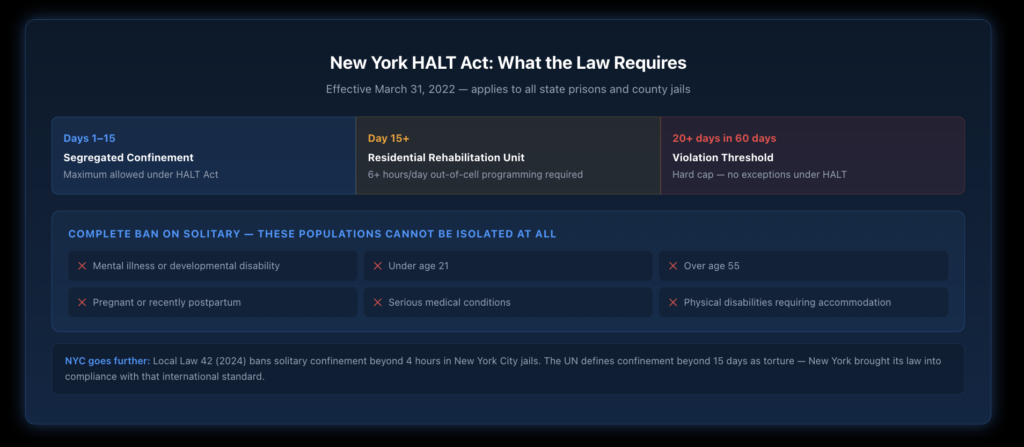
New York enacted one of the most significant prison reform laws in the country when it passed the Humane Alternatives to Long-Term Solitary Confinement Act (HALT Act) in 2021, effective March 31, 2022. The law transformed the legal landscape for solitary confinement claims in New York state prisons and county jails.
Key protections under the HALT Act:
- Maximum 15 consecutive days in segregated confinement — or 20 days in any 60-day period.
- People held beyond 15 days must be placed in a Residential Rehabilitation Unit providing at least 6 hours per day of out-of-cell programming.
- Complete ban on solitary confinement for people with mental illness or developmental disabilities, those under 21 or over 55, pregnant individuals, and others with serious medical conditions.
The United Nations defines segregated confinement beyond 15 days as torture. New York brought its law into compliance with that standard. New York City went even further — Local Law 42 (2024) bans solitary confinement beyond 4 hours in city jails.
If you or someone you know has been held in solitary confinement in New York in violation of these standards, that may support a civil rights claim.
The Prison Litigation Reform Act: The Obstacle You Need to Know
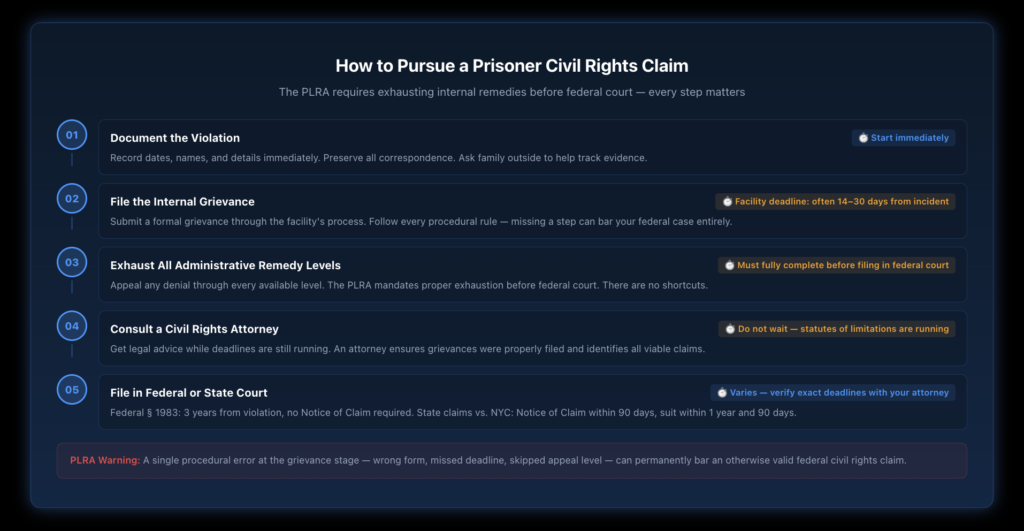
Federal law creates a significant procedural hurdle for prisoner civil rights cases. Under the Prison Litigation Reform Act (PLRA), incarcerated individuals must exhaust all available internal grievance procedures before filing a federal lawsuit. That means completing the prison’s internal process — correctly, on time, and at every appeal level — before any federal case can be filed.
A procedural misstep at the grievance stage can permanently bar an otherwise valid claim. This is one of the most critical reasons to involve an attorney as early as possible. The cases where the PLRA creates the most damage are the ones where someone tried to navigate the process alone and missed a step. When a facility retaliates against someone for filing grievances — reassigning them, placing them in isolation, or targeting them with discipline — that retaliation may itself be a separate First Amendment retaliation claim on top of the underlying rights violation.
Who Can Be Held Liable?
In prisoner rights cases, there may be more than one party responsible:
Individual corrections officers can be sued for personal acts of deliberate indifference or excessive force. They may assert qualified immunity in federal court — a doctrine that shields officials from liability unless they violated a clearly established right — but qualified immunity is not available for every claim, and it doesn’t eliminate cases that involve well-documented constitutional violations.
Prison administrators and supervisors face liability when they knew about a pattern of abuse or dangerous conditions and failed to act.
Municipalities and the City of New York can be held liable under the Monell doctrine when a constitutional violation resulted from official policy, a widespread custom, or a deliberate failure to train staff. The ongoing federal court oversight of Rikers Island under Nunez v. City of New York — which has resulted in civil contempt findings against the City and the appointment of a federal remediation manager — reflects exactly this kind of institutional accountability. Cases involving systemic failure often intersect with our Government Misconduct / Constitutional Violations practice.
Unlike individual officers, municipalities cannot assert qualified immunity.
What Evidence Matters in a Prisoner Rights Case?
Prisoner civil rights claims live and die on documentation. The evidence that carries the most weight:
- Written grievance records — including dates filed, content, and all responses received at each level
- Medical records documenting requests for care, denials, and the timeline of treatment
- Incident reports from the facility
- Witness statements from other incarcerated individuals, staff, or visitors
- Photographs of injuries or conditions
- Prior complaints or lawsuits involving the same facility, officers, or administrators
Family members on the outside play an important role in preserving evidence, tracking correspondence, and ensuring grievances are being filed and tracked properly. If there has also been excessive force during an incident, that claim can be pursued alongside the prisoner rights claim — see our Police Misconduct and Excessive Force pages for how those claims are evaluated.
Critical Deadlines You Cannot Miss
Prisoner civil rights cases have strict time limits. Missing a deadline can permanently bar your claim.
- Federal § 1983 claims — 3 years from the date of the violation in New York. Accrual is governed by federal law: the clock starts when the plaintiff knew or had reason to know of the injury.
- State law claims against New York City — a Notice of Claim must be filed within 90 days of the incident under GML § 50-e. Suit must be commenced within 1 year and 90 days under GML § 50-i.
- Federal § 1983 claims do not require a Notice of Claim — a significant procedural advantage over state court filing that makes federal court the preferred venue in most cases.
- PLRA exhaustion — grievances must be filed within the prison’s own internal deadlines before the federal court becomes available at all. These deadlines are set by the facility, not by statute, and can be as short as 14 days from an incident.
The interaction between the PLRA exhaustion requirement and the federal statute of limitations is one of the most technical areas in civil rights litigation. Don’t navigate it without counsel. If the underlying incident also involved an unlawful detention before being placed in custody, that may add a wrongful arrest claim with its own separate deadline clock running simultaneously.
What Can You Recover?
A successful prisoner rights claim can result in:
- Compensatory damages — covering medical expenses, lost wages, physical pain and suffering, and emotional distress
- Punitive damages — available against individual officers in cases of particularly egregious or reckless conduct (not against municipalities)
- Injunctive relief — a court order requiring a facility to change a specific practice or condition
- Attorney’s fees — under 42 U.S.C. § 1988, if you prevail on a federal civil rights claim, the defendant is typically required to pay your legal costs
The value of a case depends heavily on the nature of the violation, the severity of harm, and the specific defendants. We can give you a realistic assessment of what your situation may support.
Why Nisar Law Group?
Nisar Law Group is a boutique civil rights and employment litigation firm based in New York City. We represent individuals — not corporations, not government entities. Every case we take is on behalf of someone whose rights we believe in and whose situation we are committed to pursuing.
Prisoner rights cases are procedurally complex, institutionally resistant, and require attorneys who understand both the PLRA’s exhaustion requirements and the underlying constitutional claims. We know this terrain — the SDNY and EDNY dockets, the Second Circuit’s qualified immunity jurisprudence, and the New York-specific reforms that have shifted the landscape in recent years. Prisoner rights is one part of our broader Civil Rights & Constitutional Litigation practice — if your situation involves multiple constitutional violations from the same incident, we evaluate all of them together.
We handle civil rights cases on a contingency basis, which means you don’t pay legal fees unless we recover for you. Every case starts with a free consultation.
Contact us at (212) 600-9534 to schedule a confidential consultation.
Why We're the Right Choice
- Seasoned Litigators Who Have Handled Numerous Jury & Bench Trials
- Providing Representation with Clarity, Honesty & Integrity
- Building Long-Term Affiliations & Relationships
- Offering Consultations for All Case Types We Handle
Frequently Asked Questions About Prisoner Rights
Incarcerated people in New York retain several constitutional rights. At minimum: the right to be free from cruel and unusual punishment under the Eighth Amendment, the right to adequate medical care when they have a serious medical need, and the right to be protected from known threats to their safety. Pretrial detainees who have not been convicted retain even broader protections under the Fourteenth Amendment. These rights exist regardless of the nature of the underlying conviction or charge.
A conviction typically eliminates the right to vote during incarceration in most states, the right to possess firearms, and the practical freedom of movement and autonomy. However, incarcerated individuals do not lose constitutional protection against cruel and unusual punishment, the right to access courts, or the right to adequate medical care. The scope of retained rights depends on the specific constitutional provision and the restriction being challenged — courts apply different standards to different categories of rights.
Yes. Incarcerated individuals can file federal civil rights lawsuits under 42 U.S.C. § 1983 when government officials violate their constitutional rights. The Prison Litigation Reform Act requires that prisoners first exhaust all available administrative remedies — meaning they must complete the prison’s internal grievance process correctly and fully — before a federal lawsuit can be filed. Missing a procedural step at the grievance stage can bar an otherwise valid claim, which is why getting legal advice early matters.
This refers to an informal standard sometimes referenced in prison conditions litigation — not a formal statute — suggesting that when a significant number of incarcerated people are affected by a systemic deprivation, this increases the likelihood a court will find an official policy or widespread custom. That finding supports Monell’s liability against the institution itself rather than just individual officers. Its application varies by jurisdiction, and it is not itself a legal standard, but it reflects the general principle that systemic patterns carry more weight than isolated incidents.
Incarcerated individuals retain First Amendment rights to religion, speech, and court access — though these may be limited by legitimate penological interests. When a facility unlawfully restricts religious practice — denying access to religious texts, prohibiting prayer, or refusing religious dietary accommodations — that may support a claim under both the First Amendment and RLUIPA, a federal statute that provides strict scrutiny protection for religious exercise in custodial settings. For more on how those claims work, see our Religious Discrimination by Government Entities page. They retain Eighth Amendment protection from cruel and unusual punishment, including the right to adequate medical care and protection from violence. The Fourteenth Amendment’s Equal Protection Clause prohibits discrimination based on race and other protected characteristics. Pretrial detainees additionally have substantive due process rights against any punishment prior to conviction. The Americans with Disabilities Act also protects people with disabilities in prison from being excluded from programs and services.
Yes. New York’s HALT Act sets strict legal limits on segregated confinement, and violations of those limits may support a civil rights claim. If someone has been held in solitary confinement beyond 15 consecutive days, placed in isolation despite qualifying as a protected population under the HALT Act, or denied the out-of-cell programming required by law, those violations may be actionable under state law and potentially under federal constitutional law as well. Federal courts have recognized that prolonged solitary confinement, causing serious psychological harm, can independently violate the Eighth Amendment even without a HALT Act violation.
