
Were You Punished for Speaking Out Against the Government?
We Can Help
The First Amendment doesn’t just protect your right to speak — it protects you from being punished for speaking. When a government employer disciplines a public employee for blowing the whistle, when police arrest someone for filming them or challenging their authority, or when a government agency retaliates against a citizen for criticism or protest, that’s a constitutional violation. And it’s actionable.
At Nisar Law Group, we represent individuals in New York whose First Amendment rights have been violated by government actors — public employers, law enforcement, and government agencies. These cases require attorneys who understand both the protections that exist and the significant limitations courts have placed on them. Where your speech falls in that framework determines whether you have a claim.
If you believe the government retaliated against you for protected speech or activity, contact us to discuss what happened.
Contact Nisar Law Group, P.C. at (212) 600-9534 to learn how we can be of service.
What Is First Amendment Retaliation?
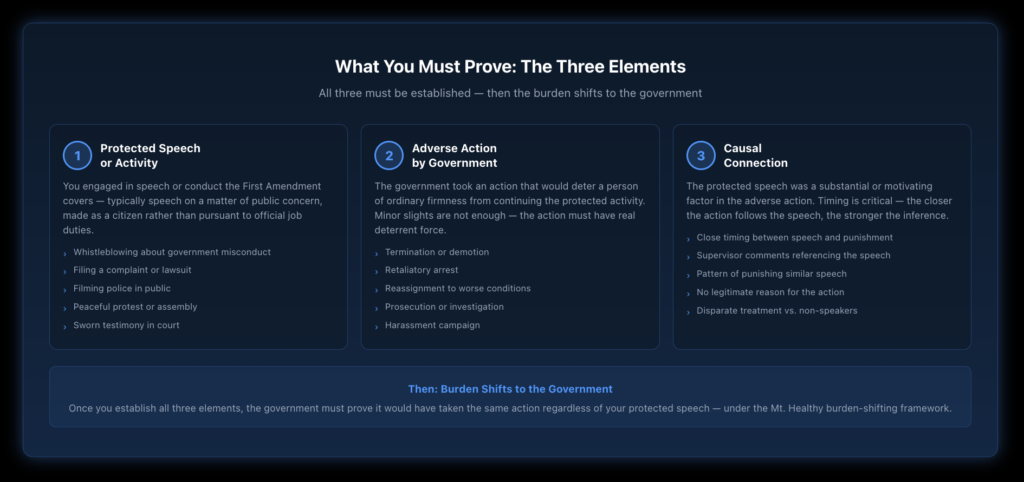
A First Amendment retaliation claim under 42 U.S.C. § 1983 requires three elements:
- Protected speech or activity — you engaged in speech or conduct that the First Amendment covers
- Adverse action by a government actor — conduct that would deter a person of ordinary firmness from continuing the protected activity
- Causal connection — your protected speech was a substantial or motivating factor in the adverse action.
If you establish all three, the burden shifts to the government to prove it would have taken the same action regardless of your speech. That burden-shifting framework comes from Mt. Healthy City School District v. Doyle, and it applies across virtually every First Amendment retaliation context.
What counts as protected speech is not limitless. The First Amendment protects speech on matters of public concern — corruption, government misconduct, safety issues, matters of community significance. It generally does not protect purely private workplace grievances. And for public employees specifically, there is a critical threshold question that must be answered before any protection applies.
The Garcetti Problem: Why Not Every Government Employee Speech Is Protected
This is the single most important — and most misunderstood — rule in First Amendment retaliation law for public employees.
In Garcetti v. Ceballos (2006), the Supreme Court held that when a public employee speaks pursuant to their official duties, the First Amendment provides no protection at all. The dispositive question isn’t what you said — it’s whether you said it as a citizen or as a government employee doing your job.
A deputy district attorney who writes a memo to his supervisor exposing misconduct is doing his job. If he’s punished for it, he has no First Amendment claim — because the memo was part of his official responsibilities. But if that same attorney writes a letter to the editor of a newspaper about the same misconduct, that speech is protected. The words are identical. The legal outcome is opposite.
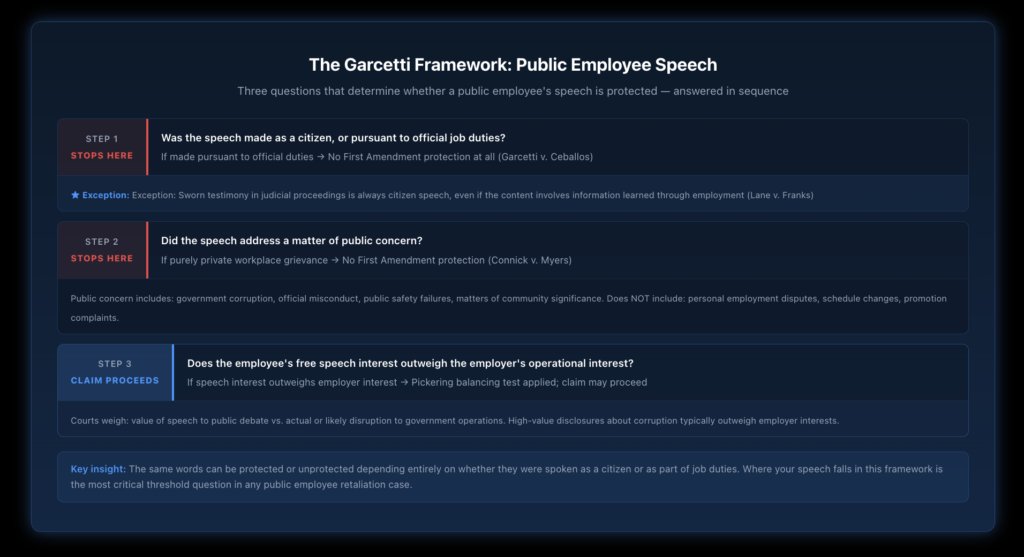
This creates a framework with three sequential questions for public employee cases:
Step 1 — Garcetti: Was the speech made as a citizen, or as part of official job duties? If official duties, the claim ends here.
Step 2 — Connick: Did the speech address a matter of public concern? Private workplace complaints — a dispute over a schedule change, dissatisfaction with a promotion — are generally not protected. Disclosures about government corruption, public safety failures, or official misconduct typically are.
Step 3 — Pickering balancing: Does the employee’s free speech interest outweigh the employer’s interest in efficient government operations? Courts weigh the value of the speech against the disruption or harm it caused.
There is an important exception to Garcetti. Under Lane v. Franks (2014), sworn testimony in judicial proceedings is protected speech by a citizen — even when the content involves information the employee learned in the course of employment. If you testified under oath about government misconduct and were punished for it, that retaliation is actionable.
Common Examples of First Amendment Retaliation in New York
Public Employee Whistleblowers
A city employee reports financial fraud to a supervisor and is transferred to a dead-end position. A public school teacher complains publicly about unsafe building conditions and finds themselves suddenly subject to disciplinary proceedings. A corrections officer reports excessive force by colleagues and is targeted with bogus performance reviews. In each case, the speech addressed a matter of public concern, the adverse action followed the speech, and the employer would struggle to explain the timing.
New York’s own whistleblower statutes provide additional protection on top of the First Amendment. NY Civil Service Law § 75-b protects public employees who report improper governmental action. NY Labor Law § 740, significantly strengthened in 2022, covers employees, former employees, and independent contractors who report violations of law or threats to public health and safety — with a right to jury trial, a 2-year statute of limitations, and expanded remedies including punitive damages. If your retaliation claim involves employment, our Police Misconduct and Government Misconduct / Constitutional Violations pages cover related accountability mechanisms.
Retaliatory Arrests — Filming Police, Protesting, and Asserting Rights
The First Amendment protects the right to film police officers in public, to verbally challenge an officer’s conduct, and to engage in peaceful protest. When police arrest someone not because of actual unlawful conduct but because of how they exercised those rights, that’s a retaliatory arrest claim. When that retaliatory arrest results in custody, conditions in detention may give rise to additional prisoner rights claims alongside the retaliation claim.
The complicating factor is Nieves v. Bartlett (2019). The Supreme Court held that when there is probable cause for an arrest, a retaliatory arrest claim generally fails — even if the officer’s actual motive was retaliation. The existence of probable cause acts as a presumptive bar. But there is a meaningful exception: if you can show with objective evidence that similarly situated individuals who were not engaged in the same protected speech were not arrested, your claim can proceed despite probable cause. The 2024 decision in Gonzalez v. Trevino clarified that this exception does not require specific named comparators — statistical or charging data can be enough.
This means that if you were arrested while filming police at a protest and others doing the same thing were not, that comparison matters. Documenting the pattern is essential. An attorney can help you identify what evidence exists and what discovery requests to make before it disappears.
Retaliation Against Civilians for Complaints or Lawsuits
A person files a CCRB complaint against an officer and starts getting stopped repeatedly in their neighborhood. A community advocate publicly criticizes a government agency and finds their business or organization suddenly subjected to inspections or permit delays. A litigant in a civil lawsuit against a government entity experiences adverse government action after filing. These are all potential First Amendment retaliation claims — though causation is always the hardest element to prove, and timing evidence is critical.
For claims where the retaliation also involved an unlawful stop or arrest, that dimension of the case may support a parallel wrongful arrest claim alongside the First Amendment retaliation claim.
Who Can Be Held Liable?
Individual government officials and officers can be sued personally under § 1983 for First Amendment violations. They may assert qualified immunity — but in the Second Circuit, the right to be free from retaliation for protected speech on matters of public concern has been clearly established for decades. Qualified immunity is harder to sustain in well-documented First Amendment retaliation cases than in many other civil rights contexts.
Government agencies and municipalities can face Monell liability when the retaliation reflects official policy, a widespread custom, or a failure to train or supervise. A government employer with a documented pattern of retaliating against whistleblowers or internal complainants can face institutional liability alongside individual liability. See our Government Misconduct / Constitutional Violations page for a full explanation of how Monell claims work.
Public employers — city agencies, school districts, police departments — are also subject to NY Civil Service Law § 75-b and NY Labor Law § 740 on top of constitutional claims, which can expand both the remedies available and the forum options.
Unlike individual officials, municipalities cannot assert qualified immunity.
What Evidence Matters in a First Amendment Retaliation Case?
The hardest element to prove is always causation — showing that the adverse action happened because of the protected speech, not for some other legitimate reason. Building a strong evidentiary record from the start is essential.
Key evidence includes:
- Timeline documentation — the closer in time the adverse action follows the protected speech, the stronger the inference of retaliation. Document every date precisely.
- Communications — emails, texts, memos, or recordings showing the decision-maker knew about the speech before taking adverse action.
- Pattern evidence — other employees who engaged in similar conduct without punishment; other employees who spoke out and were similarly punished.
- Statements by supervisors — any comment connecting the protected speech to the adverse action, even indirect ones.
- HR and personnel records — performance reviews, disciplinary records, and their timing relative to the protected speech.
- Prior complaints or grievances and the responses received.
For retaliatory arrest claims specifically, body camera footage, bystander video, arrest records, charging data showing how similar conduct was handled in other cases, and CCRB complaint records (now accessible after the 2020 repeal of Civil Rights Law § 50-a) all become critical. If excessive force occurred during a retaliatory arrest, those claims can be brought together — see our Excessive Force page.
Filing Deadlines
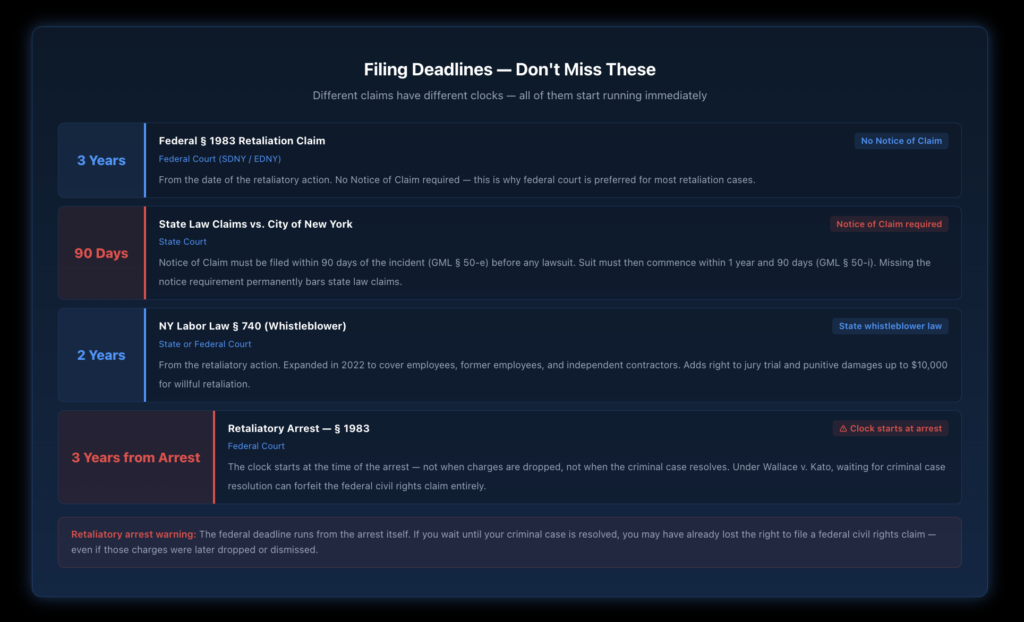
- Federal § 1983 claims — 3 years from the date of the retaliatory action in New York
- State law claims against New York City — a Notice of Claim must be filed within 90 days of the incident under GML § 50-e; suit must commence within 1 year and 90 days under GML § 50-i
- NY Labor Law § 740 claims — 2 years from the retaliatory action (expanded in the 2022 amendments)
- NY Civil Service Law § 75-b — coordinated with civil service and PERB proceedings; timeline varies
- Federal § 1983 claims do not require a Notice of Claim — a significant advantage that makes federal court the preferred venue for most retaliation cases.
One important note for retaliatory arrest claims: under Wallace v. Kato, the federal clock starts running at the time of the arrest, not when charges are dropped. Don’t wait for the criminal case to resolve before contacting an attorney.
What Can You Recover?
A successful First Amendment retaliation claim can result in:
- Compensatory damages — covering lost wages, lost benefits, emotional distress, harm to professional reputation, and any other actual losses flowing from the retaliation
- Back pay and reinstatement — if you were terminated or constructively forced out
- Punitive damages — available against individual government officials in appropriate cases; not available against municipalities
- Injunctive relief — a court order requiring the employer to stop a retaliatory practice or reinstate an employee
- Attorney’s fees — under 42 U.S.C. § 1988, if you prevail on a federal civil rights claim, the defendant is typically required to pay your legal costs
- NY Labor Law § 740 additionally provides civil penalties up to $10,000 for willful or malicious retaliation.
Why Nisar Law Group?
Nisar Law Group is a boutique civil rights and employment litigation firm based in New York City. We represent individuals — never corporations, never government entities. Every case we take on is on behalf of someone whose rights we believe in.
First Amendment retaliation cases sit at the intersection of constitutional law, employment law, and government accountability — three areas that require not just legal knowledge but strategic judgment about how to frame and sequence the claims. The Garcetti limitation alone derails claims that seem strong on the surface but fail at the threshold question. We know these cases from the ground up — the Second Circuit’s qualified immunity doctrine, the Nieves framework for retaliatory arrests, and New York’s layered whistleblower protections that can supplement or replace a constitutional claim depending on the facts. When the retaliation also involved religious expression — such as a government employee punished for faith-based speech — the case may also engage religious discrimination by government entities under the law. First Amendment retaliation is one component of our broader Civil Rights & Constitutional Litigation practice — if your situation involves multiple constitutional violations, we evaluate all of them together.
We handle civil rights cases on a contingency basis, which means you don’t pay legal fees unless we recover for you. Every case starts with a free consultation.
Contact us at (212) 600-9534 to schedule a confidential consultation.
Why We're the Right Choice
- Seasoned Litigators Who Have Handled Numerous Jury & Bench Trials
- Providing Representation with Clarity, Honesty & Integrity
- Building Long-Term Affiliations & Relationships
- Offering Consultations for All Case Types We Handle
Frequently Asked Questions About First Amendment Retaliation
Yes — but with important limits. The First Amendment prohibits government actors from retaliating against individuals for protected speech or expressive activity. For public employees, speech is only protected when made as a citizen on a matter of public concern, and not when made pursuant to official job duties under Garcetti v. Ceballos. For civilians — people filming police, peaceful protesters, citizens filing complaints — the protections are broader, though retaliatory arrest claims face the Nieves probable cause complication. The bottom line: the First Amendment protects against retaliation, but whether your specific speech qualifies depends heavily on the facts.
A First Amendment retaliation claim under Section 1983 requires: (1) the plaintiff engaged in protected speech or activity covered by the First Amendment; (2) the government actor took an adverse action that would deter a person of ordinary firmness from continuing that activity; and (3) a causal connection showing the protected speech was a substantial or motivating factor in the adverse action. Once those three elements are established, the burden shifts to the government to prove it would have taken the same action regardless of the speech.
The First Amendment does not protect speech made by public employees pursuant to their official duties (Garcetti), speech on purely private matters rather than matters of public concern (Connick v. Myers), or speech by an employee whose free speech interest is outweighed by the government employer’s legitimate interest in efficient operations (Pickering balancing). Beyond the employment context, the First Amendment also does not protect true threats, incitement to imminent lawless action, or obscenity — categories that have no civil rights retaliation application but are part of the broader First Amendment framework.
Yes. You can bring a federal civil rights lawsuit under 42 U.S.C. § 1983 against a government official or municipality that violated your First Amendment rights while acting under color of state law. For federal officials, a parallel mechanism called a Bivens action exists, though it faces significant procedural restrictions. A successful Section 1983 claim can result in compensatory damages, punitive damages against individual officials, injunctive relief, and attorneys’ fees paid by the losing party under 42 U.S.C. § 1988.
The most important evidence is anything that shows the decision-maker knew about the protected speech before taking the adverse action, and that the timing between the speech and the punishment was close enough to suggest a connection. Key evidence includes: communications showing awareness of the speech, a timeline establishing the sequence of events, comparator evidence showing other employees who did not speak out were treated differently, statements by supervisors linking the speech to the consequences, and personnel records showing a change in treatment after the protected activity. For retaliatory arrest cases, body camera footage, bystander video, and charging data showing how similar conduct was handled with other individuals are essential.
In the government retaliation context, protected activity includes: whistleblowing disclosures about government misconduct or illegal activity, testimony in judicial proceedings even when based on information learned through employment, public criticism of government officials or agencies, peaceful assembly and protest, filing complaints or lawsuits against government actors, and filming police officers in public spaces. The activity must address a matter of public concern rather than purely private disputes, and for public employees, it must be made as a citizen rather than pursuant to official duties.
In the government employer context, a First Amendment violation occurs when a government actor takes a materially adverse action — termination, demotion, transfer, arrest, prosecution — specifically because of an individual’s protected speech or expressive activity. The key is government action motivated by the content of protected speech. Retaliation for filing a grievance, for testifying truthfully in court, for reporting waste or corruption, for organizing with coworkers on matters of public concern, or for exercising the right to speak publicly about government conduct can all constitute First Amendment violations when the motivation is to punish or silence that speech.
