
Did a Police Officer Use More Force Than the Situation Required?
We Can Help
If you were injured by police in New York City or New York State, you may have a legal claim under federal civil rights law. Excessive force by law enforcement is a constitutional violation — and the attorneys at Nisar Law Group are here to help you understand your rights and fight for the compensation you deserve.
Contact Nisar Law Group, P.C. at (212) 600-9534 to learn how we can be of service.
What Is Excessive Force?
Excessive force happens when a law enforcement officer uses more physical force than is reasonably necessary to accomplish a legitimate law enforcement objective. The keyword is reasonable — not perfect, not minimal, but objectively reasonable given the specific circumstances the officer faced.
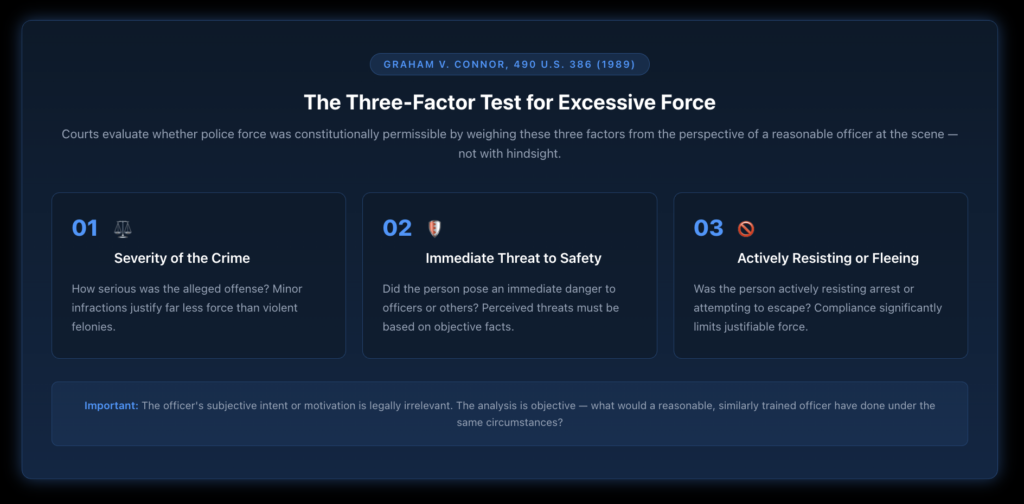
Under federal law, all excessive force claims brought against police during an arrest or investigative stop are evaluated under the Fourth Amendment’s objective reasonableness standard, a framework established by the U.S. Supreme Court in Graham v. Connor (1989). Courts look at three core factors when analyzing whether force was excessive:
- The severity of the crime being investigated
- Whether the suspect posed an immediate threat to officers or others
- Whether the suspect was actively resisting or attempting to flee
The officer’s subjective intent — what they believed or felt — is legally irrelevant. What matters is how a reasonable officer would have responded to the same facts and circumstances. This distinction is important because it means officers cannot justify excessive force by claiming they “felt” threatened without objective facts to back that up.
Understanding how courts apply this objective reasonableness standard is part of how we evaluate every civil rights and constitutional litigation claim we take on.
What Counts as Excessive Force?
Not every use of force by police is excessive. But many situations go far beyond what the law allows. Common examples of excessive force in New York include:
- Striking, kicking, or punching someone who is already restrained or not resisting
- Using a chokehold (now a felony in New York under the Eric Garner Anti-Chokehold Act)
- Deploying a taser, pepper spray, or other weapons against someone who poses no threat
- Shooting someone who is unarmed, fleeing, or not posing a significant threat of death or serious injury
- Slamming someone to the ground without justification
- Using force against someone during a mental health crisis who presents no danger
- Allowing a police dog to bite someone who has already surrendered
Excessive force during a stop or arrest can happen to anyone. It disproportionately impacts communities of color in New York City — and it often occurs alongside related violations like wrongful arrest or police misconduct that compound the harm.
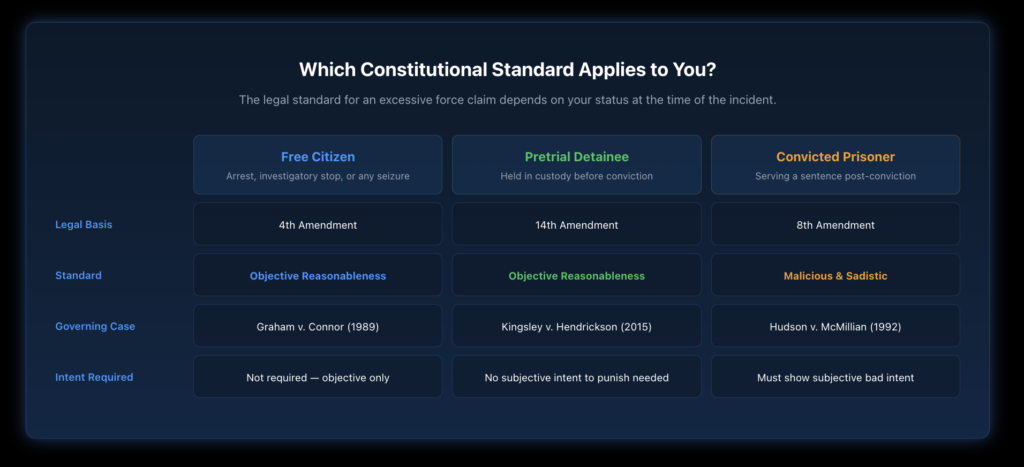
The standard changes depending on the person’s status at the time of the encounter. Free citizens being stopped or arrested are protected by the Fourth Amendment. Pretrial detainees are protected by the Fourteenth Amendment’s objective reasonableness standard under Kingsley v. Hendrickson (2015). Convicted prisoners fall under the Eighth Amendment’s prohibition on cruel and unusual punishment, which requires showing the force was used “maliciously and sadistically.”
What Are Your Rights Under New York Law?
New York has some of the strongest civil rights protections in the country. When it comes to police use of force, you are protected by multiple overlapping layers of law — federal, state, and city.
How the Federal Civil Rights Law (Section 1983) Protects You
The primary vehicle for most excessive force claims is 42 U.S.C. § 1983, the federal civil rights statute that allows individuals to sue government actors for constitutional violations. To bring a successful § 1983 excessive force claim in New York, you generally need to show:
- The officer was acting under color of state law (i.e., acting in their capacity as a police officer)
- Their actions deprived you of a right guaranteed by the U.S. Constitution
- You suffered actual harm as a result
Both the individual officer and, in some cases, the City of New York can be held responsible. Under the landmark Monell v. Department of Social Services decision, municipalities can face liability for government misconduct when a constitutional violation results from an official policy, a widespread practice, or a failure to train officers. The City of New York has paid nearly $800 million in NYPD misconduct settlements since 2019 alone — a figure that reflects both the scale of the problem and the viability of these claims.
New York City’s Qualified Immunity Reform
One of the most significant legal developments for New York victims of police violence is Local Law 48 (2021), which made NYC the first major city in the United States to limit qualified immunity for local civil rights claims. Under this law, NYPD officers cannot use qualified immunity as a defense in state court actions brought under the local cause of action for unreasonable searches and seizures and excessive force.
Qualified immunity has been one of the biggest barriers to justice in excessive force cases nationwide — it shields officers from personal liability unless their conduct violated “clearly established” law. NYC’s reform changes that calculus for claims brought in city courts, making it substantially easier to hold individual officers accountable.
The Eric Garner Anti-Chokehold Act
In 2020, New York enacted one of the toughest use-of-force statutes in the country. Under the Eric Garner Anti-Chokehold Act, a police officer who uses a chokehold causing serious physical injury or death can be charged with a Class C felony, carrying a sentence of up to 15 years. Even in the absence of serious injury, chokeholds constitute a Class A misdemeanor. This law has direct implications for civil claims — its existence establishes that such conduct is prohibited under New York law, which strengthens your case.
The Numbers Don't Lie: Excessive Force in NYC
The data on NYPD excessive force is striking. According to a NYC Comptroller report, CCRB excessive force complaints increased 49% between 2022 and 2023, reaching the highest level since 2013. In 2024, individual allegations of excessive or unnecessary force submitted to the CCRB rose again to 7,080 complaints.
In FY 2024, NYPD had more tort claims filed than any other City agency — 9,249 total filings, up nearly 32% from the prior year. These trends aren’t evenly distributed across the city. Sixteen precincts showed increases of more than 50% in annual CCRB force complaints, and the four precincts with the most complaints — the 75th, 40th, 73rd, and 44th — are in communities that are overwhelmingly Black or Hispanic/Latino.
This isn’t just a policy problem. It’s a pattern of harm that real people experience, and it creates real legal claims.
What Evidence Matters in an Excessive Force Case?
Strong excessive force cases are built on concrete evidence. The more you can document and preserve early, the stronger your case will be. Key evidence includes:
Body Camera Footage
Body-worn cameras are now standard issue across the NYPD. This footage can be decisive — studies show that CCRB cases relying on video evidence are substantiated at dramatically higher rates than those without it. If you were involved in an incident with police, request preservation of body camera footage immediately. This material can be lost or overwritten if not specifically preserved.
CCRB Complaints and Disciplinary Records
The 2020 repeal of Civil Rights Law § 50-a removed the decades-long shield on police disciplinary records in New York. CCRB complaints, hearing transcripts, and disciplinary history are now accessible under FOIL. Prior complaints against the same officer are directly relevant to your case — they can demonstrate a pattern of misconduct and support claims against the City under a Monell theory. You can file a complaint directly with the NYC Civilian Complaint Review Board, which investigates force, abuse of authority, discourtesy, and offensive language by NYPD officers.
Medical Records and Photographs
Document every injury — photographs, emergency room records, follow-up treatment, and any mental health impact from the encounter. Pain and suffering, emotional distress, and loss of enjoyment of life are all recoverable in a successful civil rights claim, alongside economic losses.
Witness Statements and Civilian Video
Bystander footage and eyewitness accounts can corroborate your account and fill gaps in official records. Civilian video captured on smartphones has been instrumental in major NYPD misconduct cases.
Prior Lawsuits and Settlement Data
The NYC Comptroller’s Claims Dashboard makes settlement and claim data publicly available by precinct and officer. A pattern of prior lawsuits against the same officer or unit is powerful evidence in both individual claims and broader Monell challenges.
What Can You Recover in an Excessive Force Case?
Victims of excessive force can pursue several categories of damages, depending on the facts of their case:
Compensatory Damages cover your actual losses — medical expenses, lost wages, diminished earning capacity, physical pain and suffering, and emotional distress. In serious cases involving serious injury, these figures can be substantial.
Punitive Damages can be assessed against individual officers (though not against the City itself) when the conduct was especially egregious or reckless. They are meant to punish and deter, not just compensate.
Attorney’s Fees are recoverable from defendants under 42 U.S.C. § 1988 if you prevail on a federal civil rights claim. This provision was designed to make civil rights litigation accessible regardless of a victim’s financial resources.
Injunctive Relief in some cases — particularly those involving systemic patterns — can require policy changes, additional training, or ongoing monitoring of a police unit.
How Long Do You Have to File?
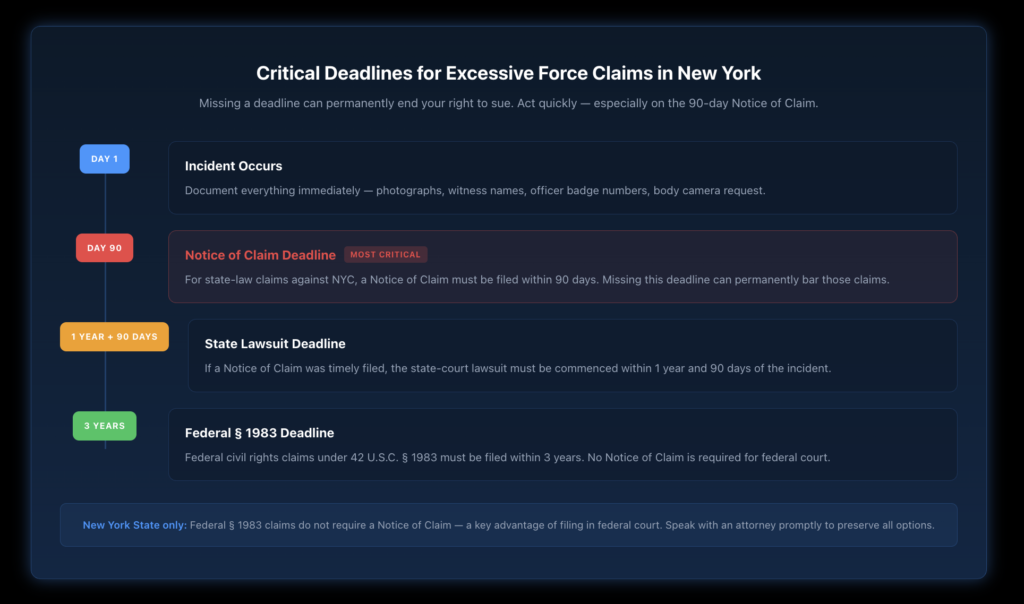
Timing is critical in excessive force cases. Missing a deadline can permanently bar your claim, no matter how strong the facts are.
For federal § 1983 claims in New York, the statute of limitations is three years from the date of the incident. For state-law claims against New York City, the requirements are more demanding:
- A Notice of Claim must be filed within 90 days of the incident (General Municipal Law § 50-e)
- The lawsuit must be commenced within 1 year and 90 days (General Municipal Law § 50-i)
The 90-day Notice of Claim requirement often catches people off guard. It applies to state-law claims against the City and must be filed before any lawsuit can proceed. Federal § 1983 claims do not require a Notice of Claim — one reason many attorneys prefer to file in federal court.
If you think your rights may have been violated, don’t wait. Contact Nisar Law Group as soon as possible so we can preserve evidence, meet all deadlines, and build the strongest possible case on your behalf.
Why Nisar Law Group?
Nisar Law Group is a New York-based employment and civil rights firm that exclusively represents individuals — never corporations, never government entities. When you come to us, we are always on your side.
Our attorneys understand the specific challenges of civil rights litigation in New York: the procedural complexity, the power imbalance between individuals and government, and the tactics used to minimize or defeat legitimate claims. We know the law, we know the courts, and we know how to fight effectively for our clients.
We handle the full spectrum of civil rights violations — police misconduct, wrongful arrest, First Amendment retaliation, prisoner rights, religious discrimination by government entities, and government misconduct. And we’re committed to making sure that the people who experience these violations have a voice in the legal system.
Contact us at (212) 600-9534 to schedule a confidential consultation.
Why We're the Right Choice
- Seasoned Litigators Who Have Handled Numerous Jury & Bench Trials
- Providing Representation with Clarity, Honesty & Integrity
- Building Long-Term Affiliations & Relationships
- Offering Consultations for All Case Types We Handle
Frequently Asked Questions About Excessive Force
Excessive force is any amount of physical force by a law enforcement officer that exceeds what a reasonable officer would use under the same facts and circumstances. The legal test, established by the Supreme Court in Graham v. Connor, is objective — it looks at what a trained officer would have done, not what this particular officer was thinking or feeling. Striking a non-resisting person, using a chokehold, deploying weapons against someone who poses no real threat, and shooting an unarmed person are all examples that courts have found to qualify.
Yes. Excessive force during an arrest or investigative stop violates the Fourth Amendment’s protection against unreasonable seizures. For pretrial detainees, the Fourteenth Amendment applies. For convicted prisoners, the Eighth Amendment governs. In each case, there is a constitutional violation when officers use force that goes beyond what the legal standard permits for that context.
In New York City, the City itself — not the individual officer — typically pays judgments and settlements. Under state indemnification law, NYC is required to defend and pay for its officers in most circumstances. This means that even when officers face no personal financial consequence, the City can still be held liable. NYC paid a record $1.94 billion in total settlements in FY 2024, with NYPD excessive force claims representing a significant portion of that amount.
Yes. Emotional distress is a recognized category of compensatory damages in civil rights claims. If you experienced anxiety, depression, PTSD, sleep disturbances, or other psychological harm as a result of an excessive force incident, those injuries can be included in your claim. You do not need to have suffered a physical injury to recover for emotional distress, though the presence of physical injuries typically strengthens the case.
For federal civil rights claims under § 1983, the statute of limitations is three years from the date of the incident. But for state-law claims against New York City, you must file a Notice of Claim within just 90 days of the incident — and the lawsuit must be started within one year and ninety days. The 90-day deadline is strict. Missing it can bar your state-law claims permanently, which is why speaking with an attorney quickly is so important.
Signs that force may have been excessive include: injuries that go beyond what the situation could justify; use of force against someone who was already restrained, compliant, or surrendering; deployment of weapons in situations where verbal commands would have sufficed; force used during a mental health crisis; and significant disparity between what the person was alleged to have done and how dramatically they were injured. Document your injuries with photos, seek medical attention, and speak with an attorney promptly.
A lack of resistance significantly limits the force police can legally use. The Supreme Court’s Graham test requires courts to assess, among other things, whether someone was actively resisting or attempting to flee. If you were not resisting, those facts work in your favor. Officers who continue to apply force after a person has stopped resisting — or who use force against someone who never resisted — are on legally precarious ground. Whether the specific use of force was excessive still depends on the full circumstances, which is why speaking with an attorney is important.
