

The intersection of religious freedom and LGBT workplace protections creates one of employment law’s most complex legal landscapes. While federal law now prohibits discrimination based on sexual orientation and gender identity, certain religious exemptions may allow some employers to make faith-based employment decisions. Understanding where your rights begin and where these exemptions end is critical for protecting yourself in the workplace.
Key Takeaways
- The Supreme Court’s 2020 Bostock decision established that Title VII protects LGBT employees from workplace discrimination.
- Religious organizations may qualify for statutory exemptions allowing them to make employment decisions based on religion.
- The ministerial exception bars discrimination claims by employees who perform vital religious duties.
- Most secular employers cannot use religious beliefs to justify LGBT discrimination.
- New York State provides additional protections through NYSHRL and GENDA that cover all employers regardless of size.
Disclaimer: This article provides general information for informational purposes only and should not be considered a substitute for legal advice. It is essential to consult with an experienced employment lawyer at our law firm to discuss the specific facts of your case and understand your legal rights and options. This information does not create an attorney-client relationship.
What Legal Protections Do LGBT Employees Have Under Federal Law?
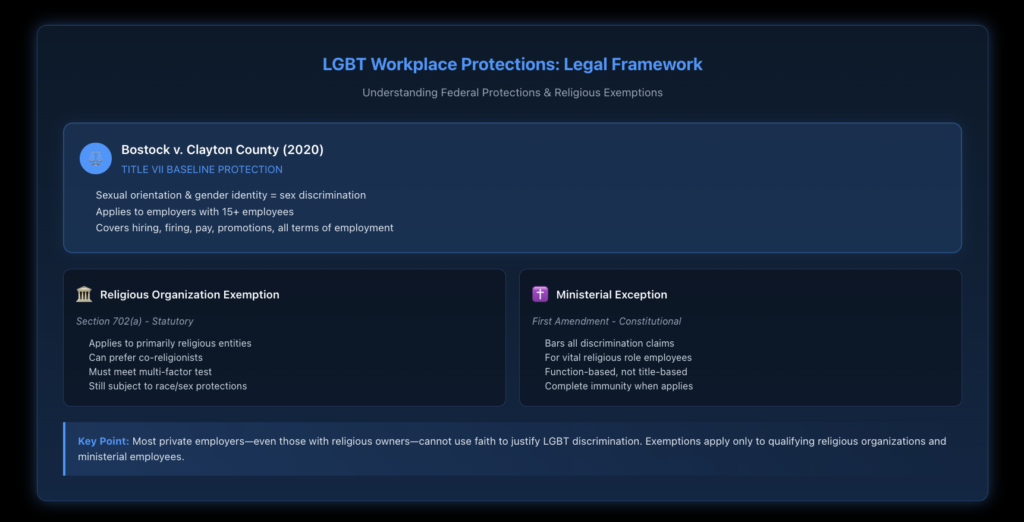
Federal workplace protections for LGBT employees stem primarily from Bostock v. Clayton County, a landmark 2020 Supreme Court decision. The Court held that firing someone simply for being homosexual or transgender violates Title VII’s prohibition on sex discrimination. Justice Gorsuch, writing for the 6-3 majority, explained that discrimination based on sexual orientation or gender identity necessarily involves treating employees differently because of their sex.
This ruling extended Title VII protections to LGBTQ employees nationwide, regardless of whether their state had existing protections. Before Bostock, employees in many states had no federal recourse when fired solely because of their sexual orientation or gender identity.
Title VII applies to employers with 15 or more employees, covering hiring, firing, pay, job assignments, promotions, layoffs, training, and any other term or condition of employment. The law also prohibits harassment that creates a hostile work environment based on sexual orientation or gender identity.
Can Religious Organizations Legally Discriminate Based on Sexual Orientation?
Religious organizations occupy a unique position under employment discrimination law. Two primary exemptions may allow qualifying religious employers to make employment decisions based on religion that would otherwise violate Title VII.
The religious organization exemption under Section 702(a) permits religious corporations, associations, educational institutions, and societies to prefer employees of a particular religion. Courts examine multiple factors to determine whether an employer qualifies, including whether the entity operates for profit, states a religious purpose in its governing documents, maintains affiliation with a formally religious entity, and regularly incorporates religious practices into its activities.
This exemption allows qualifying organizations to require employees to adhere to religious principles, which may include beliefs about marriage and sexuality. However, the exemption specifically addresses religious preference—it does not create blanket immunity from all discrimination claims. Religious employers remain subject to prohibitions against race, color, sex, and national origin discrimination, as well as related retaliation claims.

What Is the Ministerial Exception and How Does It Apply?
The ministerial exception represents a constitutionally-based doctrine that bars employment discrimination claims involving employees who perform vital religious duties at the core of a religious institution’s mission. Unlike the statutory religious organization exemption, the ministerial exception derives from First Amendment principles protecting religious organizations’ autonomy in selecting their spiritual leaders.
The Supreme Court established the modern ministerial exception framework in Hosanna-Tabor Evangelical Lutheran Church and School v. EEOC (2012) and expanded it in Our Lady of Guadalupe School v. Morrissey-Berru (2020). Courts consider all relevant circumstances, including the employee’s formal title, religious training, use of the title, and, importantly, the religious functions performed.
The exception applies beyond ordained ministers to lay employees who play substantial roles in conveying religious teachings. Teachers at religious schools who provide religious instruction, lead students in prayer, and guide them in living according to the faith may fall within the exception. However, an employee who merely describes religious beliefs without making efforts to inculcate those beliefs would not qualify.
When the ministerial exception applies, it provides complete immunity from employment discrimination claims, regardless of whether the challenged decision was motivated by religious reasons. This means affected employees cannot bring Title VII claims for any type of discrimination, including claims based on sexual orientation or gender identity.
How Does the Groff Decision Affect Religious Accommodation Requests?
The Supreme Court’s 2023 decision in Groff v. DeJoy significantly strengthened religious accommodation rights under Title VII. The Court clarified that employers cannot deny religious accommodations simply because they impose more than minimal costs. Instead, employers must demonstrate that granting the accommodation would result in substantial increased costs in relation to the conduct of their particular business.
This heightened standard affects workplaces where employees request accommodations based on religious beliefs about marriage, gender, or sexuality. For example, an employee who requests an accommodation from participating in workplace diversity training that conflicts with their religious beliefs is entitled to consideration of reasonable alternatives before denial.
However, the Groff standard also creates potential workplace tensions. An employee’s religious objection to using a transgender coworker’s preferred pronouns, for instance, must be balanced against the employer’s obligation to maintain a non-discriminatory workplace for all employees.
What Additional Protections Exist Under New York State Law?
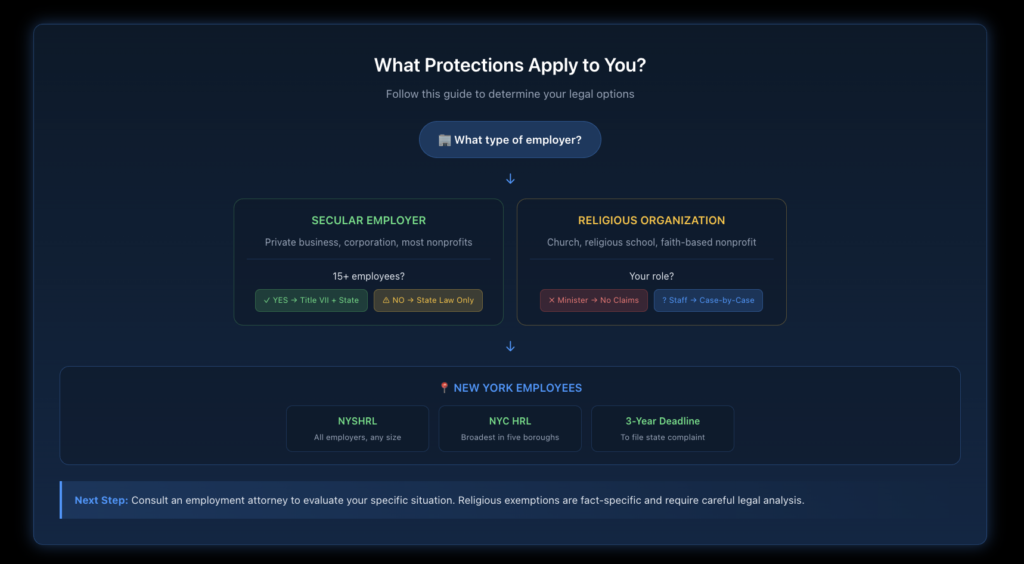
New York provides some of the nation’s strongest employment discrimination protections through the New York State Human Rights Law. The NYSHRL explicitly prohibits employment discrimination based on sexual orientation and gender identity, covering all employers regardless of size—a crucial difference from Title VII’s 15-employee threshold.
The Gender Expression Non-Discrimination Act, enacted in 2019, explicitly added gender identity and expression as protected characteristics under state law. This ensures comprehensive protections for transgender and gender non-conforming employees throughout New York State.
The New York City Human Rights Law extends even broader protections within the five boroughs. Employers must respect employees’ chosen names and pronouns and cannot enforce policies restricting restroom access based on biological sex. The NYC Commission on Human Rights actively enforces these provisions and can impose significant penalties for violations.
These state and local protections remain fully effective regardless of changes to federal enforcement priorities. Employees who believe they have experienced discrimination can file complaints with the New York State Division of Human Rights within three years of the alleged discriminatory act.
What Should You Do If You Face Religious-Based LGBT Discrimination?
Documenting discriminatory treatment thoroughly and contemporaneously provides the foundation for any potential legal claim. Save emails, text messages, and written communications that demonstrate discriminatory intent or treatment. Note the dates, times, locations, and witnesses to verbal statements or actions.
Review your employer’s policies on discrimination, harassment, and religious accommodations. Many employers have internal complaint procedures that you may need to follow before pursuing external remedies. Filing an internal complaint also creates a record and may trigger employer obligations to investigate and take corrective action.
Understanding whether your employer qualifies for any religious exemptions helps clarify your legal options. Most private employers—including those owned by religious individuals—do not qualify for the religious organization exemption unless the organization’s purpose and character are primarily religious.
Consulting with an experienced employment attorney before taking action ensures you understand your rights and the strength of your potential claims. Time limits for filing discrimination complaints are strict, and early legal guidance helps preserve your options.
Talk to a New York Employment Lawyer About Your Rights
Religious exemptions to employment discrimination laws are narrowly defined, and most employers cannot lawfully discriminate against LGBT employees based on religious beliefs. If you believe you have experienced workplace discrimination because of your sexual orientation or gender identity, you may have legal recourse under federal, state, and local law.
The employment attorneys at Nisar Law Group have extensive experience representing employees in discrimination cases involving complex legal issues. We can evaluate your situation, explain your rights, and help you determine the best path forward.
Contact Nisar Law Group today for a confidential consultation about your workplace discrimination concerns.
Frequently Asked Questions About Religious Exemptions and LGBT Discrimination
Under federal law established by the Bostock decision, most employers with 15 or more employees cannot fire you based on your sexual orientation or gender identity. This constitutes illegal sex discrimination under Title VII. New York State law extends this protection to all employers regardless of size, providing comprehensive coverage for LGBT employees throughout the state.
Courts examine multiple factors, including whether the organization states a religious purpose in its governing documents, maintains affiliation with a church or denomination, incorporates religious practices into its operations, and whether its mission is primarily religious rather than secular. Simply having religious owners or expressing religious values does not automatically qualify an employer for the exemption.
The answer depends on the specific facts. If the teacher qualifies as a ministerial employee who performs vital religious functions like teaching religion classes and leading students in religious activities, the ministerial exception may bar any discrimination claim. For non-ministerial employees, the religious organization exemption may allow the school to require adherence to religious principles, but this varies based on the circumstances.
For most private employers, the First Amendment does not provide protection against Title VII liability. The religious organization exemption and ministerial exception provide the primary avenues for faith-based employment decisions. Secular employers cannot invoke religious beliefs to justify discrimination against LGBT employees.
The Supreme Court’s June 2020 decision in Bostock v. Clayton County established that Title VII’s prohibition on sex discrimination includes discrimination based on sexual orientation and gender identity. However, New York State has prohibited sexual orientation discrimination since 2002 and added explicit gender identity protections in 2019 through GENDA.
Employees may request religious accommodations for conflicts with workplace requirements, but employers must balance accommodation requests against their obligation to maintain a non-discriminatory workplace. An accommodation that would constitute harassment of a coworker creates an undue hardship that employers need not provide. New York law specifically requires employers to respect employees’ chosen names and pronouns.

