

Yes, proselytizing at work is generally legal—but that right has limits. Title VII of the Civil Rights Act protects employees who wish to discuss their faith with coworkers, while simultaneously protecting other employees from unwanted religious pressure. The key distinction lies in whether your religious expression crosses the line from protected speech into harassment or workplace disruption. Under federal law, employers must accommodate sincerely held religious beliefs unless doing so creates an undue hardship, and this includes some forms of religious expression. However, when sharing your faith becomes persistent, unwelcome, or creates a hostile environment for others, the legal protections evaporate.
Key Takeaways
- Title VII protects religious expression at work, including discussing your faith with willing coworkers during non-work time.
- Employers cannot ban all religious discussion, but can restrict proselytizing that disrupts work or harasses others.
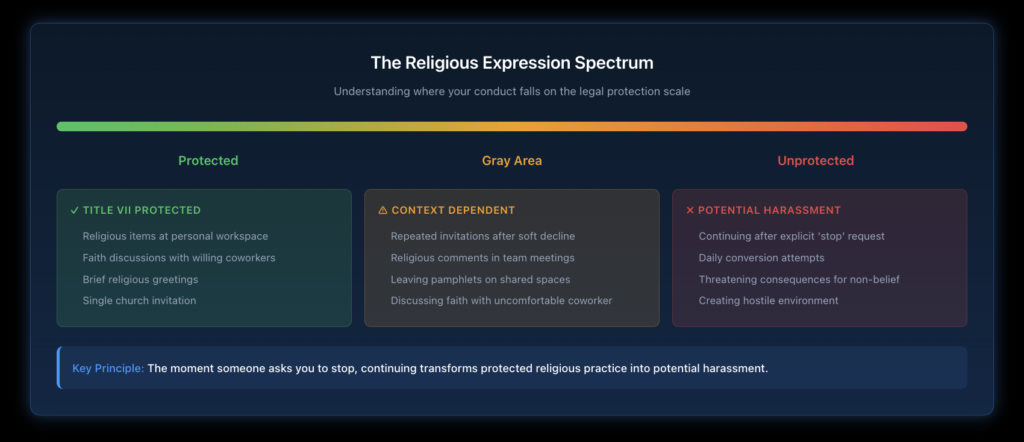
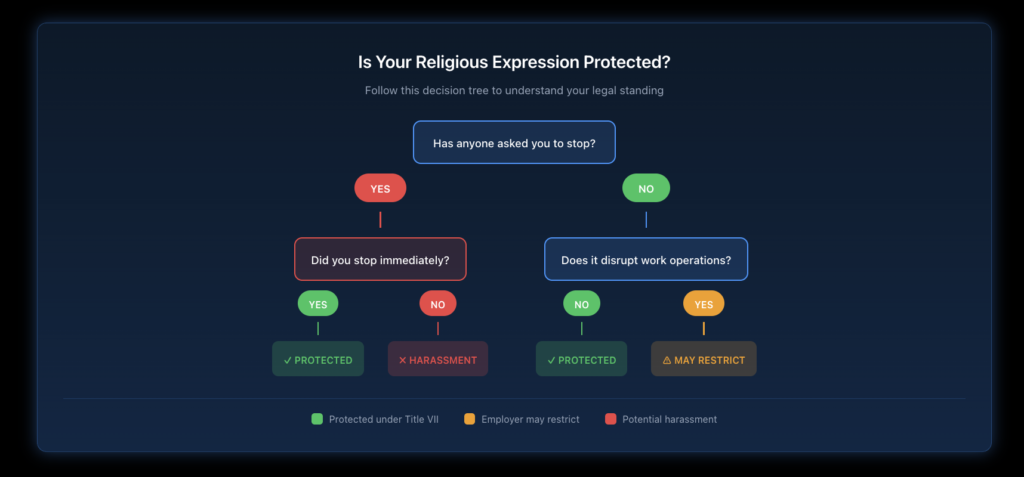
- Once a coworker asks you to stop discussing religion with them, continuing constitutes harassment.
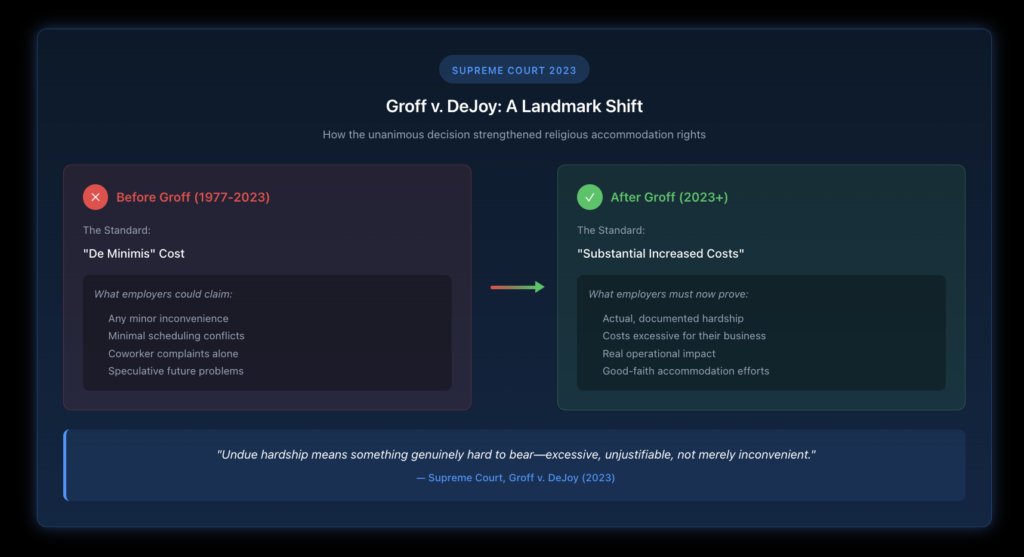
- The 2023 Supreme Court decision in Groff v. DeJoy strengthened religious accommodation rights.
- New York State and City laws provide broader protections than federal law.
- Employers must balance accommodating religious expression with preventing a hostile work environment.
Disclaimer: This article provides general information for informational purposes only and should not be considered a substitute for legal advice. It is essential to consult with an experienced employment lawyer at our law firm to discuss the specific facts of your case and understand your legal rights and options. This information does not create an attorney-client relationship.
What Does Proselytizing Actually Mean in Employment Law?
Proselytizing refers to the act of attempting to convert others to your religious beliefs. In the workplace context, this can range from casual conversations about faith to persistent attempts to persuade coworkers to adopt your religious views. The EEOC’s guidance on religious discrimination explicitly lists proselytizing as a form of religious observance or practice protected under Title VII—but with important qualifications.
What Forms Can Workplace Proselytizing Take?
Religious expression at work takes many forms beyond direct conversion attempts. Some employees use religious phrases when greeting others, like saying “God bless you” or “Have a blessed day.” Others may leave religious pamphlets on coworkers’ desks, invite colleagues to religious services, or engage in one-on-one discussions about salvation and spiritual beliefs.
According to the EEOC, whether a practice constitutes religious expression depends on the employee’s motivation, not the nature of the activity itself. An employee who invites a coworker to church as part of their faith practice receives different legal treatment than someone making the same invitation purely for social reasons.
Why Does This Matter for Your Employment Rights?
Understanding the legal boundaries around religious expression protects both your right to practice your faith and your right to work free from harassment. If you’re the employee who wants to share your beliefs, knowing the limits helps you avoid inadvertently creating legal liability for yourself or your employer. If you’re receiving unwanted religious pressure, understanding these boundaries empowers you to assert your rights effectively.
When Does Sharing Your Faith Cross the Line Into Harassment?
The line between protected religious expression and illegal harassment isn’t always clear, but certain factors consistently determine where courts draw it. Religious harassment occurs when employees are subjected to unwelcome conduct based on religion that is so severe or pervasive that it creates a hostile work environment.
What Makes Religious Expression “Unwelcome”?
Conduct becomes unwelcome when the recipient clearly indicates they don’t want it to continue. According to EEOC guidance, unwelcomeness is evident when an employee expressly objects to particular religious expression. The critical moment often occurs when someone asks the proselytizing employee to stop—continuing after that request transforms protected religious practice into potential harassment.
However, unwelcomeness isn’t always explicitly stated. Courts examine the totality of circumstances. An employee who is visibly uncomfortable, consistently avoids religious conversations, or changes their behavior to evade a proselytizing coworker may demonstrate that the conduct is unwelcome even without directly saying so.
How Do Courts Evaluate “Severe or Pervasive” Conduct?
For religious expression to constitute actionable harassment, it must be sufficiently severe or pervasive to alter the conditions of employment. Courts consider several factors: the frequency of the conduct, its severity, whether it’s physically threatening or merely annoying, and whether it interferes with work performance. A single comment about religion almost never rises to harassment, but daily attempts to convert a coworker who has asked to be left alone likely would.
The Supreme Court has noted that Title VII isn’t a “general civility code.” Isolated incidents, offhand comments, and simple teasing typically don’t constitute illegal harassment. But when religious expression becomes persistent, targeted, and unwelcome, the legal analysis shifts dramatically.
How Did Groff v. DeJoy Change Religious Accommodation Law?
The Supreme Court’s unanimous 2023 decision in Groff v. DeJoy fundamentally altered how courts evaluate employer defenses against religious accommodation claims. For nearly 50 years, employers could deny accommodations by showing merely a “de minimis” cost—essentially any minor inconvenience. Groff eliminated that standard.
What Is the New “Undue Hardship” Standard?
Under Groff, employers must now demonstrate that granting a religious accommodation would result in “substantial increased costs in relation to the conduct of its particular business.” This is a significantly higher bar than the previous de minimis standard. The Court emphasized that “undue hardship” means something genuinely hard to bear, excessive, or unjustifiable—not merely inconvenient.
This matters for proselytizing cases because employers can no longer reflexively deny accommodation requests related to religious expression by claiming minimal workplace friction. They must demonstrate actual, substantial hardship.
How Does This Affect Proselytizing Specifically?
The EEOC’s guidance acknowledges that some religious beliefs require proselytizing. Under the strengthened Groff standard, employers must work harder to accommodate employees whose faith mandates sharing their beliefs—but this doesn’t give employees carte blanche to harass coworkers. The EEOC explicitly states that employers need not accommodate religious expression that constitutes harassment or creates a hostile work environment.
The balance tips when proselytizing interferes with work or becomes unwelcome to specific individuals. An employer can require that proselytizing cease toward any coworker who objects, and can restrict religious expression that disrupts business operations or could reasonably be perceived as the employer’s own message.
What Rights Do Employees Have to Express Religion at Work?
Title VII requires employers to accommodate religious expression to the extent possible without undue hardship. This means employers generally cannot implement blanket bans on all religious discussion or expression.
Can You Display Religious Items at Your Workspace?
Employees typically have the right to display religious items at personal workspaces—Bibles, Qurans, religious symbols, or inspirational quotes. The EEOC specifically notes that employers engage in discrimination when they treat employees differently regarding such displays based on which religion the items represent.
However, employers can restrict displays that are visible to customers if they could reasonably be perceived as representing the employer’s views, or if displays create conflicts among employees.
Can You Discuss Your Faith During Breaks?
Employees generally have more latitude to discuss religion during non-work time, including breaks and lunch periods. Conversations in common areas like break rooms or cafeterias typically receive stronger protection than religious discussions during active work time or in customer-facing situations.
The key principle remains consent. Two employees voluntarily discussing their faith creates no legal issue. One employee persistently trying to convert another who has declined creates potential liability.
Can Your Employer Stop You From Using Religious Greetings?
Using religious phrases like “Have a blessed day” or “Peace be upon you” in ordinary workplace greetings generally receives protection. The EEOC notes that where religious expression is limited to brief phrases or greetings, employers have greater difficulty demonstrating that accommodation would pose undue hardship.
However, context matters. A customer service representative who insists on extensive religious commentary during every customer interaction presents a different situation than an employee who occasionally uses faith-based greetings with coworkers.
How Do New York Laws Differ From Federal Protections?
New York employees benefit from stronger religious discrimination protections than federal law provides. Both the New York State Human Rights Law and the New York City Human Rights Law extend protections beyond Title VII’s scope.
What Additional Protections Does New York State Provide?
The New York State Human Rights Law covers employers with four or more employees, compared to Title VII’s 15-employee threshold. This means smaller employers in New York face religious discrimination liability that wouldn’t exist under federal law alone.
New York law specifically protects religious observance, including Sabbath and holy day observance, wearing religious attire, clothing, or facial hair, and other practices in accordance with religion. The state’s Division of Human Rights enforces these protections, and complaints must be filed within three years of the discriminatory act for incidents occurring after February 15, 2024.
How Is New York City’s Law Even Broader?
The NYC Human Rights Law provides among the strongest religious protections in the country. It requires employers to accommodate religious needs unless doing so creates a “significant” hardship—arguably a higher standard than federal law’s “undue hardship.” The city law also protects employees from discrimination based on perceived religion, meaning an employer who discriminates against you because they incorrectly assume your religious beliefs violate the law.
NYC law extends protections to non-employees, including freelancers and independent contractors, broadening coverage substantially beyond federal protections.
What Should You Do If Your Religious Expression Causes Conflict?
Navigating religious expression at work requires awareness of both your rights and your responsibilities. The goal is practicing your faith while respecting others’ rights to be free from unwanted religious pressure.
How Can You Practice Your Faith Appropriately?
The EEOC recommends that employees who seek to proselytize should cease doing so with respect to any individual who indicates the communications are unwelcome. This doesn’t mean abandoning your faith at work—it means directing religious discussions toward willing participants.
Consider whether the person you’re speaking with has shown a genuine interest in religious conversations. Have they asked questions, continued the dialogue voluntarily, or expressed appreciation for your perspective? These are signs of welcome engagement. Conversely, short responses, subject changes, or visible discomfort suggest you should redirect your energy elsewhere.
What If Someone Won’t Stop Proselytizing to You?
If a coworker’s religious expression has become unwelcome, clearly communicate that you want it to stop. Documentation matters—note when you made the request and the coworker’s response. If the behavior continues, report it through your employer’s complaint procedures.
Your employer has a legal obligation to address religious harassment once they’re aware of it. An employer who knows about unwelcome proselytizing and fails to take appropriate corrective action faces liability for the resulting hostile work environment.
Can Your Employer Fire You for Religious Expression?
Yes and no. Employers cannot terminate employees simply for expressing religious beliefs. However, they can take action when religious expression crosses into harassment, disrupts business operations, or continues after accommodation discussions determine that the expression cannot be permitted without undue hardship.
What Constitutes a Legitimate Employer Response?
Employers can legitimately restrict religious expression that interferes with work performance, disrupts the workplace, or constitutes harassment. They can require that proselytizing cease toward coworkers who object. They can move employees to different work areas to prevent ongoing conflicts.
What employers cannot do is single out religious expression for restrictions that don’t apply to comparable secular expression. If an employer allows employees to discuss politics, sports, or personal interests but prohibits all religious discussion, that disparity likely violates Title VII.
When Might Termination Be Lawful?
Termination for religious expression is generally lawful only when the employer has exhausted accommodation possibilities and determined that the expression cannot continue without undue hardship, or when the expression constitutes harassment that the employee refuses to cease.
An employee who continues to proselytize after their employer has clearly explained that the behavior must stop—particularly if coworkers have complained—may face legitimate discipline. The employer’s documentation of complaints, accommodation efforts, and warnings becomes critical in these situations.
How Should Employers Balance Religious Freedom and Workplace Harmony?
Employers walk a difficult line. They must accommodate religious expression without creating a hostile environment for other employees. The EEOC explicitly warns that trying to suppress all religious expression violates Title VII, but tolerating harassment also violates the law.
What Are Employer Best Practices?
The EEOC recommends that employers train managers to gauge the actual disruption posed by religious expression rather than merely speculating about potential problems. Employers should identify alternative accommodations that might avoid actual disruption—for example, designating a private location where voluntary religious discussions or study groups can occur.
Employers should incorporate discussion of religious expression into their anti-harassment training, emphasizing that all employees must be sensitive to the beliefs or non-beliefs of others.
What Policies Should Be in Place?
Effective workplace policies acknowledge that religious expression is protected while establishing clear boundaries. Policies should specify that employees may discuss religion with willing participants but must stop if asked, that discriminatory harassment based on religion violates company policy, and that the company will investigate complaints about unwelcome religious conduct.
The key is consistent application. Policies that restrict religious expression more than comparable secular expression invite discrimination claims.
What If Your Employer Fails to Accommodate Your Religious Expression?
If your employer denies your request to engage in religious expression that you believe should be accommodated, or if they take adverse action against you for protected religious conduct, you may have a legal claim.
How Do You Document a Denial of Accommodation?
Preserve all communications with your employer about religious accommodation. Note when you made requests, who you spoke with, and what responses you received. If your employer claims undue hardship, document their stated reasons.
After Groff v. DeJoy, employers must demonstrate substantial increased costs, not mere inconvenience. If your employer’s stated hardship seems minimal or speculative, that strengthens your position.
What Remedies Are Available?
Employees who successfully prove religious discrimination can recover various remedies, including back pay, reinstatement, compensatory damages for emotional distress, and, in some cases, punitive damages. New York law may provide additional remedies, including uncapped damages under the New York City Human Rights Law.
Filing deadlines matter. You have 300 days to file with the EEOC in New York, three years to file with the New York State Division of Human Rights for recent claims, and one year to file with the New York City Commission on Human Rights.
Ready to Take Action?
If you’re facing discrimination because of your religious expression at work, or if unwanted proselytizing has created a hostile environment that your employer refuses to address, Nisar Law Group can help. Our employment law attorneys understand the nuanced balance between religious freedom and workplace protections under federal, New York State, and New York City law. Contact us today for a consultation to discuss your situation and understand your legal options.
Frequently Asked Questions About Proselytizing in the Workplace
No, employers cannot implement blanket bans on all religious discussion. Title VII protects religious expression as a form of religious observance. However, employers can reasonably restrict religious discussion that disrupts work, interferes with business operations, or becomes unwelcome harassment toward specific coworkers. The key distinction is between permissible limits on disruptive conduct versus impermissible suppression of religious expression generally.
Once a coworker clearly communicates that they don’t want religious discussions with you, continuing those conversations can constitute harassment. The EEOC specifically states that employees who proselytize should cease doing so with any individual who indicates the communications are unwelcome. Respecting that boundary protects both your coworker’s rights and your own job security.
Generally, yes, as long as you’re inviting willing participants and respecting those who decline. A single invitation to a coworker typically falls within protected religious expression. However, persistent invitations after someone declines, or invitations that come with implied workplace consequences, cross into problematic territory. Context and consent matter significantly.
No, you have the right to decline participation in religious discussions, and your employer cannot allow retaliation against you for doing so. If a coworker’s religious expression becomes unwelcome and your employer fails to address your complaints, you may have a harassment claim. Your employer has an obligation to maintain a workplace free from religious harassment.
Religious expression becomes harassment when it’s unwelcome, severe, or pervasive enough to alter working conditions and create a hostile environment that a reasonable person would find abusive. Casual conversation about faith between willing participants isn’t harassment. Persistent attempts to convert someone who has asked to be left alone are likely to fail. The recipient’s response and the frequency and intensity of the conduct determine the legal classification.
Document the differential treatment with specific examples, dates, and witnesses. If employees who express secular views receive different treatment than those expressing religious views, that disparity may constitute discrimination. File a complaint through your company’s internal procedures first, then consider filing with the EEOC, New York State Division of Human Rights, or New York City Commission on Human Rights if the situation doesn’t improve.

