

No, employers cannot legally fire you because of your military service. The Uniformed Services Employment and Reemployment Rights Act (USERRA) explicitly prohibits employers from terminating employees based on their past, present, or future military obligations. This federal law applies to all employers regardless of size—whether you work for a small business or a Fortune 500 company. If you’ve been fired after returning from deployment, denied reemployment after military leave, or terminated because your employer learned about your service obligations, you likely have a strong legal claim.
Key Takeaways
- USERRA protects all service members from wrongful termination based on military status or service obligations.
- Employers must reinstate you to your former position (or an equivalent role) after military leave.
- You have up to 5 years of cumulative military service protected under USERRA with the same employer.
- New York State and NYC human rights laws provide additional protections beyond federal law.
- Remedies include job reinstatement, back pay, lost benefits, and potentially double damages for willful violations.
- The 2025 Dole Act significantly strengthened USERRA protections with a $50,000 minimum damage floor.
Disclaimer: This article provides general information for informational purposes only and should not be considered a substitute for legal advice. It is essential to consult with an experienced employment lawyer at our law firm to discuss the specific facts of your case and understand your legal rights and options. This information does not create an attorney-client relationship.
What Does USERRA Actually Protect You From?
USERRA creates a comprehensive shield against military-based employment discrimination. But what specific actions does this protection cover?
What Types of Termination Does USERRA Prohibit?
The law prohibits termination based on your military status, whether you’re an active duty service member, reservist, National Guard member, or veteran. This protection extends to:
Direct termination — Your employer cannot fire you simply because you serve in the military. If your supervisor tells you, “We need people who are always available,” after learning about your Guard obligations, that’s a clear violation.
Constructive discharge — Some employers try to force service members out by making work conditions intolerable after they return from duty. Creating hostile work environments based on military status violates USERRA just as much as an outright firing.
Pretextual termination — Employers may claim they’re firing you for performance issues or policy violations when military service is the actual reason. Courts and investigators look at timing, documentation, and treatment of non-military employees to identify these pretextual terminations.
What Are the Eligibility Requirements for USERRA Protection?
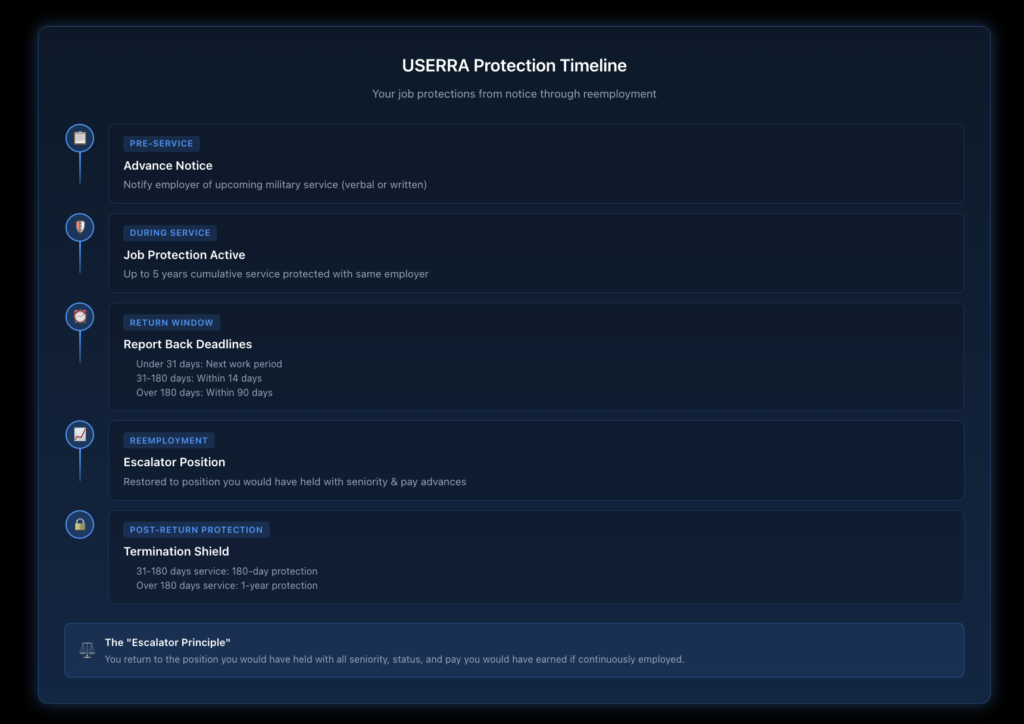
You must meet five basic criteria to qualify for reemployment rights under USERRA:
- You left a civilian job to perform military service
- You gave advance notice to your employer (verbal or written)
- Your cumulative military service with that employer doesn’t exceed five years
- You weren’t discharged under dishonorable conditions
- You reported back to work within the required timeframe
The timeframe for reporting back depends on your service length. For service under 31 days, you must report by the beginning of the next scheduled work period. For service between 31 and 180 days, you have 14 days. For service over 180 days, you have 90 days to apply for reemployment.
How Do You Prove Your Termination Was Based on Military Service?
Proving wrongful termination based on military service requires connecting your discharge to your military status or activities. The burden of proof works differently under USERRA than most employment laws—and often in your favor.
What Evidence Demonstrates Military-Based Discrimination?
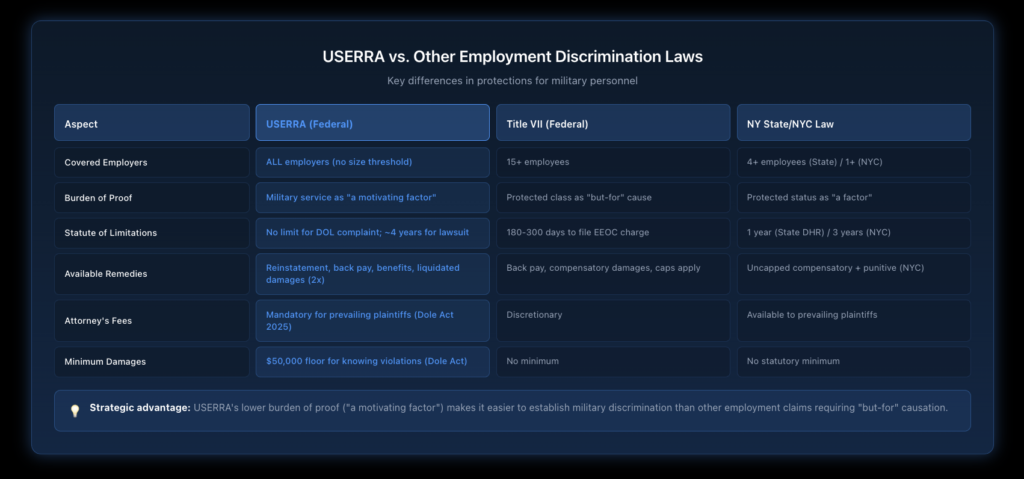
Under USERRA, you only need to show that your military service was “a motivating factor” in the employment decision—not necessarily the only factor. This is a lower bar than many discrimination laws require.
Strong evidence includes:
Timing — Termination shortly after returning from deployment or after requesting military leave creates strong circumstantial evidence. The concept of temporal proximity applies here just as it does in retaliation cases.
Statements — Comments from supervisors about your military obligations—”we can’t plan around your deployments” or “maybe you should choose between your career and the military”—provide direct evidence of discrimination.
Disparate treatment — If employees without military obligations received accommodations or opportunities that were denied to you, this pattern supports your claim.
Failure to reinstate — If your employer refused to restore you to your former position or an equivalent role after service, this alone may constitute a USERRA violation.
How Does the Burden-Shifting Work in USERRA Cases?
Once you establish that military service was a motivating factor, the burden shifts to your employer. They must prove they would have taken the same action regardless of their military service. According to Department of Labor regulations, this “same decision” defense requires concrete evidence that the termination was inevitable regardless of military status.
What Are Your Rights Under New York State and NYC Law?
While USERRA provides federal protection, New York offers additional safeguards that often exceed federal standards. Understanding these layered protections is crucial for service members working in New York.
How Does the New York State Human Rights Law Protect Military Personnel?
The New York State Human Rights Law explicitly prohibits discrimination based on military status in employment, housing, and public accommodations. This law protects:
- Current military service members
- Veterans of any uniformed service
- Members of the Reserves and National Guard
- New York Guard and Militia members
The New York State Division of Human Rights enforces these protections and provides an additional avenue for filing complaints. You have one year from the discriminatory act to file with the state—compared to federal options that may have different timelines.
What Additional Protections Does NYC Provide?
Starting in November 2017, the NYC Human Rights Law added explicit protections for veterans and active military personnel. This city law covers discrimination in employment, housing, and public accommodations based on military service status.
The NYC Commission on Human Rights accepts complaints within one year of the alleged discrimination (or three years for gender-based harassment claims). The act must have occurred within or have a sufficient connection to New York City.
Notably, NYC law often provides broader remedies and broader definitions of discrimination than federal law. For service members facing termination in New York City, this creates multiple enforcement options.
What Remedies Are Available If You Were Wrongfully Terminated?
USERRA provides substantial remedies designed to make you whole after illegal termination. The Senator Elizabeth Dole 21st Century Veterans Healthcare and Benefits Improvement Act, signed into law in January 2025, significantly strengthened these remedies.
What Can You Recover Under USERRA?
The law provides for “make-whole” relief, meaning you should be restored to the position you would have occupied had the violation never occurred. Available remedies include:
Reinstatement — Your employer must restore you to the position you would have held with appropriate seniority. This “escalator principle” means your career should have continued advancing even while you served.
Back pay and benefits — You’re entitled to wages, health insurance, retirement contributions, and other benefits you lost due to the unlawful termination.
Front pay — When reinstatement isn’t practical (perhaps because of employer hostility), courts may award future lost wages instead.
Liquidated damages — If your employer knowingly violated USERRA, courts can award additional damages equal to your lost compensation. Under the 2025 Dole Act amendments, there’s now a minimum $50,000 floor for liquidated damages even when lost wages are minimal.
Attorney’s fees — The Dole Act made attorney’s fees mandatory for prevailing USERRA plaintiffs against private and state or local government employers.
How Has the Dole Act Changed USERRA Remedies?
The 2025 amendments represent the most significant expansion of USERRA since its 1994 enactment. Key changes include:
- Explicit prohibition against “any form of retaliatory action”—eliminating debate about what qualifies as adverse action
- $50,000 minimum liquidated damages for knowing violations
- Mandatory attorney’s fees for successful plaintiffs
- 3% annual prejudgment interest rate on lost wages
- Expanded injunctive relief allowing early court intervention
These changes dramatically increase the financial consequences employers face for USERRA violations.
How Do You File a USERRA Complaint?
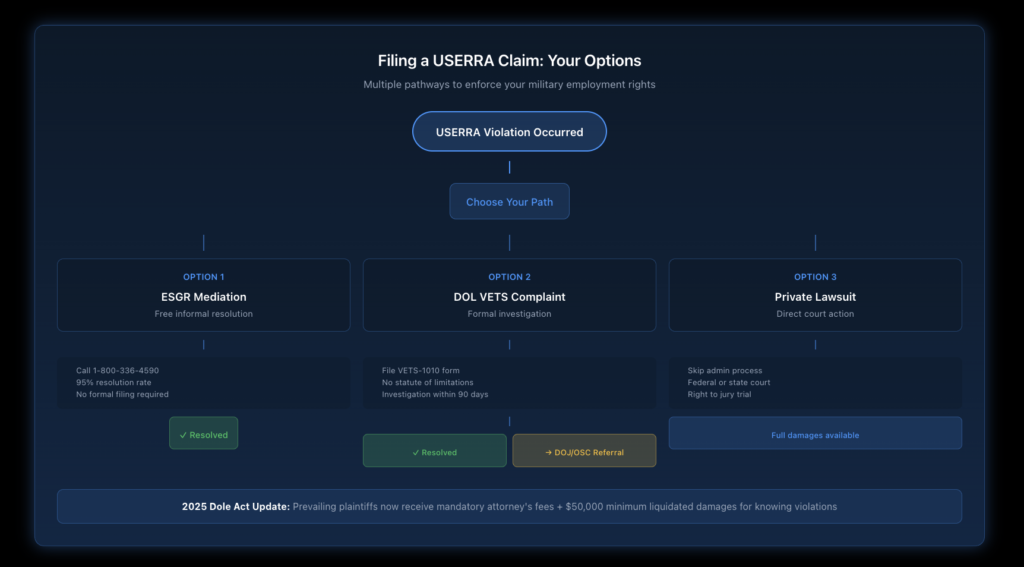
Multiple pathways exist for enforcing your USERRA rights. Understanding these options helps you choose the best approach for your situation.
What Is the ESGR Mediation Process?
Before filing a formal complaint, the Employer Support of the Guard and Reserve (ESGR) offers free mediation services. ESGR ombudsmen work with you and your employer to resolve disputes informally. According to ESGR, approximately 95% of assistance requests are resolved through this mediation process.
To start mediation, call 1-800-336-4590 (select option 1) between 8 a.m. and 6 p.m. Eastern Time, Monday through Friday.
How Do You File a Formal Complaint with DOL VETS?
If mediation fails, you can file a formal complaint with the Department of Labor’s Veterans’ Employment and Training Service (VETS). Unlike ESGR, VETS has investigation authority and will contact your employer as part of a formal inquiry.
USERRA has no statute of limitations for filing with VETS, though courts have applied a four-year limit to private lawsuits in some circumstances. File your complaint promptly to preserve your rights and ensure evidence remains available.
After investigation, if VETS cannot resolve your complaint, you can request a referral to the Department of Justice (for private or state/local employers) or the Office of Special Counsel (for federal employers).
Can You File a Private Lawsuit?
Yes. You can bypass the administrative process entirely and file a lawsuit directly in federal or state court. This option may make sense when:
- You need immediate injunctive relief
- Your employer is uncooperative
- You have a complex case involving significant damages
- The administrative process is moving too slowly
Private sector and state/local government employees file in the federal district court. State employees may file in state court. The EEOC resource guide for service members explains how USERRA intersects with other anti-discrimination protections.
What Protection Do You Have Against Immediate Termination After Reemployment?
USERRA doesn’t just guarantee reemployment—it provides enhanced job security once you return. These protections help prevent employers from reinstating service members only to manufacture reasons for termination shortly after.
How Long Are You Protected From Termination After Returning?
Your protection period depends on the length of your military service:
- Service of 31-180 days: You cannot be discharged except for cause for 180 days after reemployment
- Service of more than 180 days: You cannot be discharged except for cause for one year after reemployment
“Cause” means conduct or circumstances that would justify termination of a similarly situated employee without military obligations. Random performance concerns that weren’t documented before your service generally won’t qualify.
What Qualifies as “Cause” for Termination?
The standard mirrors what employers would apply to any employee. Legitimate grounds include:
- Serious misconduct (theft, violence, insubordination)
- Consistent failure to meet reasonable, documented performance standards
- Business closures or genuine reductions in force
Your employer cannot point to performance issues that developed during your absence or that weren’t documented through normal progressive discipline procedures.
What Should You Do If You've Been Wrongfully Terminated?
If you believe you were fired because of your military service, take these steps to protect your rights and build your case.
How Should You Document Your Situation?
Start documenting immediately. Keep records of:
- All communications about your military service and termination
- Your employer’s stated reasons for termination
- Names of witnesses to relevant conversations
- Your performance reviews and any disciplinary history
- How similarly situated non-military employees were treated
- Any evidence of statements about your military obligations
This documentation becomes essential whether you pursue administrative remedies or litigation.
When Should You Contact an Attorney?
Consider consulting with an employment attorney if:
- You’ve been denied reemployment or immediately terminated after returning from service
- Your employer claims “cause” for termination, but the evidence seems manufactured
- You’re facing complex benefit or pension issues
- You’ve experienced retaliation for asserting USERRA rights
- You want to pursue damages beyond simple reinstatement
An attorney can evaluate whether USERRA applies to your situation, identify additional claims under state or city law, and help you navigate the enforcement process.
Ready to Protect Your Rights?
If you’re a service member or veteran who has been wrongfully terminated, demoted, or denied reemployment because of your military service, Nisar Law Group can help. Our employment law attorneys understand the unique challenges military personnel face in the civilian workplace and have experience protecting the rights of those who serve. Contact us today for a consultation to discuss your situation.
Frequently Asked Questions About Wrongful Termination of Military Personnel
Yes, USERRA applies to every employer in the United States, regardless of the number of employees. Unlike Title VII and many other employment laws that only cover employers with 15 or more employees, USERRA has no size threshold. Whether you work for a small family business with five employees or a multinational corporation with thousands of workers, your employer must comply with USERRA’s requirements. This universal coverage reflects Congress’s intent to ensure that military service never costs someone their civilian career, no matter where they work.
No, your employer cannot terminate you simply because you are serving on active duty. USERRA protects your job while you perform military service and guarantees your right to reemployment when you return. Your employer must treat your position as though you were on a leave of absence. They may fill your position temporarily, but they cannot permanently terminate your employment due to your military obligations. Termination during active duty based on your service is a clear USERRA violation that can result in significant legal consequences for your employer.
Your employer must still reemploy you in a position with equivalent seniority, status, and pay. USERRA uses an “escalator principle,” which means you step back onto the career ladder at the point you would have reached had you never left. If your specific position was eliminated through a genuine reduction in force, your employer must place you in a comparable position. The only exception is if your employer can prove that reemployment is impossible or unreasonable due to changed circumstances—a defense that courts interpret narrowly.
The timeframe depends on your service length. For service under 31 days, you must report by the beginning of the next scheduled work period after time for safe travel home, plus eight hours of rest. For service between 31 and 180 days, you have 14 days to submit an application for reemployment. For service exceeding 180 days, you have 90 days to apply. These deadlines can be extended if meeting them is impossible or unreasonable through no fault of your own.
Generally, no. Performance issues that arose during your absence or that weren’t documented through normal processes before your service typically cannot justify termination during your protected period. You’re entitled to reasonable training and retraining to refresh skills that may have deteriorated during your absence. Your employer must make reasonable efforts to qualify you for your reemployment position before considering termination, and any performance concerns must be documented through the same procedures applied to employees without military obligations.
USERRA protects all service members and veterans from employment discrimination and guarantees reemployment rights after military service. It applies to all employers. VEVRAA specifically applies to federal contractors and subcontractors and protects “protected veterans,” including disabled veterans, recently separated veterans, and active duty wartime or campaign badge veterans. VEVRAA also requires federal contractors to take affirmative action to recruit, hire, and advance protected veterans—an obligation that doesn’t exist under USERRA.
No. USERRA explicitly prohibits retaliation against anyone who asserts their rights under the law or assists others in doing so. The 2025 Dole Act amendments strengthened this protection by prohibiting “any form of retaliatory action”—not just adverse employment actions. This means even subtle forms of reprisal that courts previously might not have addressed are now clearly prohibited. Retaliation can itself form the basis for a USERRA claim with the same remedies available as for the underlying discrimination.
You don’t need a lawyer to file with ESGR or DOL VETS, and the administrative process is designed to be accessible without legal representation. However, an attorney can be valuable for complex cases, when seeking significant damages, or if you want to file directly in court. The 2025 amendments now guarantee attorney’s fees for successful USERRA plaintiffs against private and state or local government employers, which makes it easier to obtain legal representation on a contingency basis.
