

Familial status discrimination happens when employers treat workers differently because they’re parents, caregivers, pregnant, or planning families. This includes being passed over for promotions because you have young children, facing negative comments about “commitment” after taking maternity leave, being excluded from projects after announcing pregnancy, or receiving discipline tied to elder care responsibilities.
New York employees facing this discrimination have strong legal protections. Federal laws like Title VII, the Pregnancy Discrimination Act, and the Family and Medical Leave Act provide foundational rights. New York State’s Human Rights Law extends these protections further, specifically prohibiting discrimination against anyone who is pregnant or has children under 18. The NYC Human Rights Law offers even broader coverage, making it one of the most protective frameworks in the country.
Key Takeaways
- Familial status discrimination includes bias against parents, caregivers, pregnant employees, and those with family responsibilities.
- Federal protections come through Title VII gender stereotyping theory, the Pregnancy Discrimination Act, and FMLA anti-retaliation provisions.
- New York State explicitly prohibits discrimination based on pregnancy and having children under 18.
- NYC’s Human Rights Law provides the nation’s strongest familial status protections.
- Common violations include “mommy track” demotions, elder care penalties, interview questions about childcare, and flexibility double standards.
- Documentation of discriminatory comments, differential treatment patterns, and performance changes is critical for building strong cases.
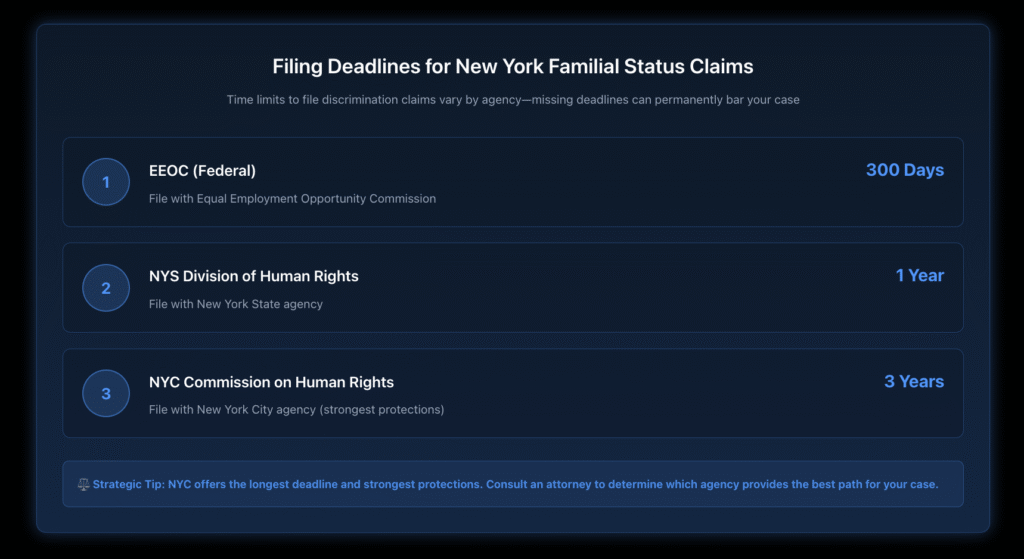
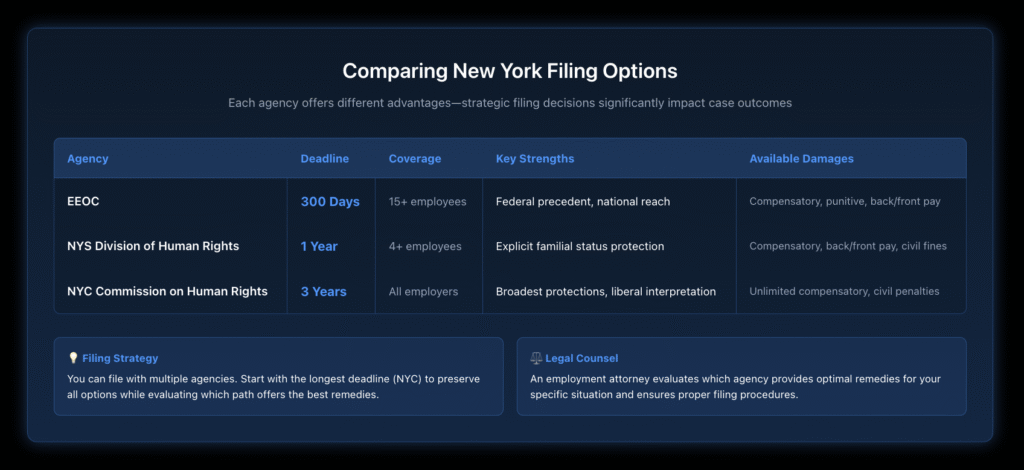
- New York employees can file with the EEOC (300 days), NYS Division of Human Rights (1 year), or NYC Commission on Human Rights (3 years).
Disclaimer: This article provides general information for informational purposes only and should not be considered a substitute for legal advice. It is essential to consult with an experienced employment lawyer at our law firm to discuss the specific facts of your case and understand your legal rights and options. This information does not create an attorney-client relationship.
What Exactly Is Familial Status Discrimination?
Familial status discrimination occurs when employers make employment decisions based on an employee’s family structure, parenting responsibilities, or caregiving duties. This form of workplace bias extends beyond just having children—it includes caring for elderly parents, disabled relatives, spouses, or any family member requiring assistance.
The discrimination frequently appears through seemingly innocent workplace observations. Comments like “She won’t be as committed now that she has kids” or “We need someone who can travel freely without family obligations” reveal bias that violates anti-discrimination laws. These statements reflect assumptions about capability and dedication based on family responsibilities rather than actual job performance.
In New York specifically, familial status discrimination takes on additional legal significance. The state recognizes that caregiving responsibilities shouldn’t limit career advancement opportunities. New York courts have increasingly acknowledged that stereotypes about working parents constitute a form of gender discrimination when they influence employment decisions.
What Are the Most Common Forms of Familial Status Discrimination?
How Does Pregnancy Discrimination Manifest in the Workplace?
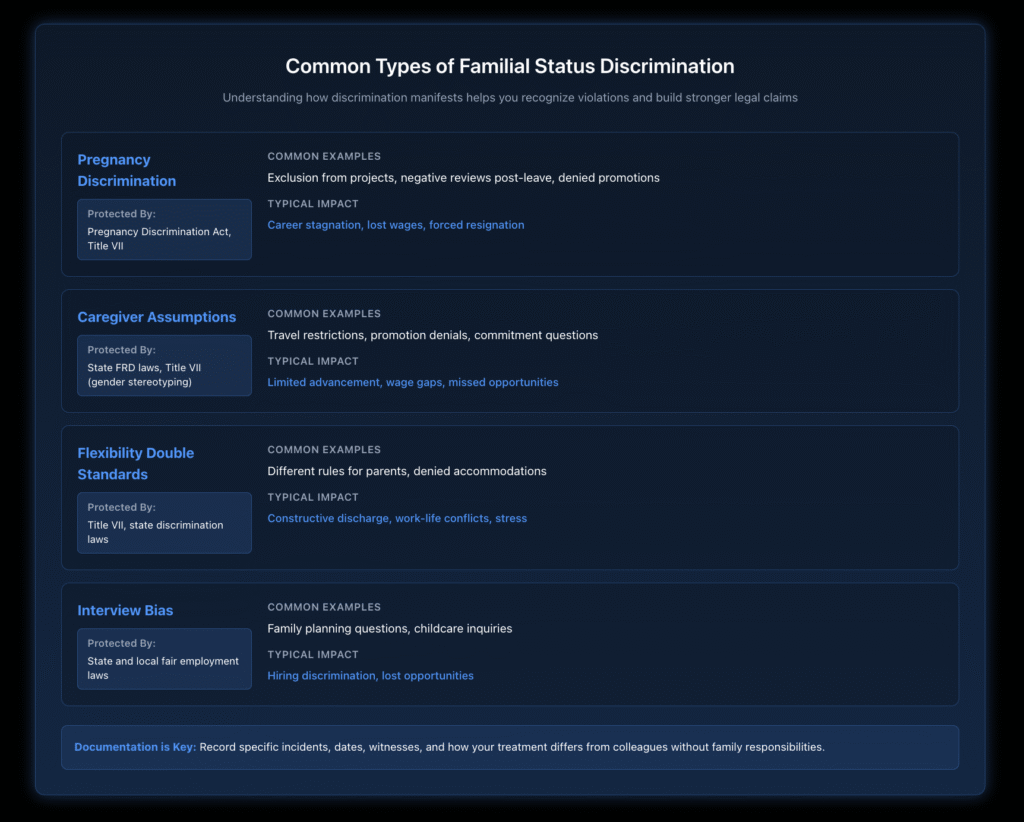
Pregnancy discrimination represents one of the most prevalent forms of familial status bias. Pregnant employees often experience exclusion from important projects after announcing their pregnancy, supposedly to “protect” them or reduce their workload without consent. This protective paternalism violates anti-discrimination laws by making assumptions about what pregnant employees can or want to handle.
Performance reviews tied to maternity leave create another common violation. Employees who receive strong reviews before pregnancy suddenly face criticism after returning from leave, with no legitimate performance-based explanation for the change. This pattern often indicates discriminatory intent.
Job interviews reveal pregnancy discrimination through prohibited questions about family planning, childcare arrangements, or future pregnancy intentions. New York law strictly prohibits these inquiries, yet they persist across industries.
What Is Caregiver Stereotyping and How Does It Affect Employment?
Caregiver stereotyping involves assumptions that parents, particularly mothers, can’t handle demanding roles or maintain the same level of commitment as childless colleagues. Employers make decisions based on these stereotypes rather than evaluating actual performance or discussing individual circumstances.
Being automatically overlooked for travel-required positions without discussion demonstrates this bias. Employers assume parents can’t or won’t travel, rather than offering the opportunity and allowing the employee to decide. This removes agency and limits career growth based on family status rather than ability.
Treatment changes after discussing elder care responsibilities signal another form of caregiver stereotyping. Employees who mention caring for aging parents may suddenly face questions about “reliability” or commitment, despite maintaining consistent performance records.
How Do Schedule Flexibility Policies Discriminate?
Flexibility bias creates double standards where parents face stricter rules than non-parent colleagues. When flexible arrangements are offered to some employees but denied to parents with the same job performance, discrimination occurs.
Punitive scheduling designed to force resignation represents an extreme form of flexibility discrimination. Employers may assign impossible schedules or frequently change shifts without notice, making it nearly impossible for parents to maintain childcare arrangements. This constructive discharge pushes employees out without formally terminating them.
Comments suggesting parents are inherently less dedicated workers demonstrate flexibility bias. These statements often accompany denials of reasonable schedule modifications, revealing that family status rather than business necessity drives the decision.
How Does Federal Law Protect Against Familial Status Discrimination?
Can Title VII Address Familial Status Discrimination?
Yes, Title VII of the Civil Rights Act protects against familial status discrimination through the gender stereotyping doctrine. While Title VII doesn’t explicitly mention family status, federal courts increasingly recognize that discrimination against caregivers often stems from illegal gender-based assumptions.
The landmark case Back v. Hastings on Hudson Union Free School District (2004) established critical precedent for these claims. The Second Circuit Court of Appeals, which covers New York, found that denying tenure to a pregnant teacher based on assumptions about her future commitment constituted gender stereotyping under Title VII. This decision empowers New York employees to challenge family-related bias as sex discrimination.
When employers assume women will be less committed after having children, or that men shouldn’t need significant family leave, they engage in sex-based discrimination. These stereotypes about traditional gender roles in caregiving violate Title VII regardless of whether the employer consciously intends to discriminate.
What Does the Pregnancy Discrimination Act Require?
The Pregnancy Discrimination Act (PDA) requires employers to treat pregnancy, childbirth, and related medical conditions the same as any other temporary medical condition. This means pregnant employees must receive equal treatment in all aspects of employment.
Equal treatment during pregnancy-related absences constitutes a core PDA requirement. If your employer allows other employees to take medical leave for temporary conditions, pregnant employees must receive the same accommodation. Denying this equal treatment violates federal law.
Jobs cannot exclude pregnant employees unless pregnancy genuinely prevents performing essential functions that can’t be reasonably accommodated. Blanket exclusions based on pregnancy status alone—such as removing pregnant employees from certain assignments without individual assessment—violate the PDA.
Benefits and leave policies must apply equally regardless of pregnancy status. If your employer provides disability leave or modified duties for other temporary conditions, pregnant employees must have access to the same benefits under the same terms.
How Does FMLA Protect Parents and Caregivers?
The Family and Medical Leave Act (FMLA) provides job-protected, unpaid leave for eligible employees to care for family members or address their own serious health conditions. Covered employers cannot deny this leave to qualifying employees, and critically, cannot retaliate against employees for taking or requesting FMLA leave.
FMLA covers leave for the birth or adoption of a child, allowing new parents time to bond with and care for their new family member. Care for a spouse, child, or parent with a serious health condition also qualifies for FMLA protection, as does the employee’s own serious health condition.
Retaliation protections represent a crucial aspect of FMLA. Employers cannot take negative actions against employees for exercising their FMLA rights. This includes subtle retaliation like exclusion from opportunities, increased scrutiny after returning from leave, or discipline related to leave-taking. These retaliation protections often provide stronger remedies than the underlying leave entitlement violations.
What Additional Protections Does New York Law Provide?
How Does New York State Human Rights Law Address Familial Status?
New York State’s Human Rights Law provides explicit protections against familial status discrimination. The law defines familial status as being pregnant or having children under 18 years of age. Employers cannot make employment decisions based on stereotyped beliefs or opinions about caregivers of children under 18.
This explicit protection goes beyond federal law by specifically naming familial status as a protected category. New York employers covered by the law—those with four or more employees—must ensure their employment decisions aren’t influenced by whether someone has children or is expecting a child.
The one-year filing deadline for New York State Human Rights Law claims gives employees more time than the federal EEOC’s 300-day deadline. This extended timeline can prove critical for employees who need time to understand their rights or gather documentation before filing.
What Makes NYC Human Rights Law Protections Even Stronger?
New York City’s Human Rights Law offers the broadest protections against familial status discrimination of any jurisdiction in the United States. The law covers all employers in NYC, regardless of size, and courts interpret its protections more liberally than federal or state law.
The three-year filing deadline for NYC Human Rights Law claims provides significantly more time than federal (300 days) or state (one year) options. This extended timeframe allows employees who experience ongoing discrimination to build comprehensive cases documenting patterns of bias.
NYC’s law explicitly prohibits discrimination based on caregiver status, covering a broader range of family caregiving situations than state or federal protections. This includes caring for elderly parents, disabled relatives, or other family members—not just minor children.
Recent New York legal developments have strengthened caregiver discrimination protections even further. Courts increasingly recognize that caregiving responsibilities intersect with other protected characteristics, particularly gender, creating stronger frameworks for challenging family-related workplace bias.
How Can You Recognize Familial Status Discrimination?
What Red Flag Comments Indicate Discrimination?
Discriminatory comments often reveal employer bias during interviews, performance discussions, or casual workplace conversations. Questions about family planning during job interviews directly violate anti-discrimination principles. Employers have no legitimate business reason to know whether you plan to have children.
Inquiries about childcare arrangements similarly expose discriminatory intent. Questions like “Who will watch your kids if you have to work late?” or “How will you handle school pickups?” suggest the employer is making decisions based on parental status rather than qualifications.
Comments about position “flexibility” requirements when discussing family responsibilities signal potential discrimination. When employers emphasize that a job requires flexibility only after learning about your family obligations, this pattern suggests bias. The same position descriptions rarely stress flexibility when interviewing or managing childless candidates.
What Behavioral Changes Signal Discrimination?
Sudden exclusion from client meetings or important projects following family changes indicates possible discrimination. If your responsibilities shift dramatically after having a child, getting married, or taking on elder care duties—without performance-based justification—this pattern suggests family status influenced the decision.
Comments about “divided loyalty” or lack of commitment appearing after family changes reveal discriminatory thinking. These statements directly connect your family responsibilities to assumed work commitment, which constitutes illegal stereotyping.
Differential treatment compared to colleagues without children provides strong discrimination evidence. When childless coworkers receive opportunities, flexibility, or treatment you’re denied despite similar performance and qualifications, your family status likely influenced the decision.
How Do Performance Issues Connect to Discrimination?
Performance problems coinciding with family responsibilities warrant scrutiny. If negative reviews or discipline appear immediately after taking parental leave, announcing a pregnancy, or discussing elder care needs—particularly when your actual work quality hasn’t changed—discrimination may explain the timing.
Being passed over for promotions with family-related justifications violates anti-discrimination laws. Explanations like “We need someone who can fully commit right now” or “This position requires someone without family distractions” constitute evidence of familial status discrimination.
Assignments seemingly designed to create work-life conflicts can evidence discrimination. When employers assign schedules, travel requirements, or work hours they know conflict with your family responsibilities—especially if the assignments differ from past practice or other employees’ assignments—this may indicate discriminatory intent.
How Should You Document Familial Status Discrimination?
What Information Should Your Records Include?
Documenting every discriminatory incident creates the foundation for strong legal claims. Record dates, times, locations, and everyone present during problematic interactions. Capture exact quotes of discriminatory comments as soon as possible after they occur. The more specific and detailed your documentation, the harder it becomes for employers to dispute your claims.
Email yourself summaries of discriminatory conversations immediately after they happen. This creates a contemporaneous record with an electronic timestamp that’s difficult to challenge. These immediate summaries often prove more credible than reconstructed timelines created months later when pursuing legal action.
Note your emotional reactions and any physical manifestations of stress tied to discrimination. While these details may not appear directly relevant to the legal claim, they support emotional distress damages claims and demonstrate the discrimination’s real-world impact on your life.
What Communications Should You Preserve?
Save all work emails containing discriminatory comments or revealing differential treatment patterns. Forward these emails to your personal account to ensure you maintain copies even if you lose access to work systems. Screenshot text messages or instant messages showing bias, as these formats can be easily deleted or lost.
Performance reviews become critical evidence, especially those that change after your family status changes. If your reviews were consistently positive before having a child but turn negative after returning from parental leave—without legitimate performance changes—this pattern strongly suggests discrimination.
Written communications denying accommodations or flexibility offered to others provide direct evidence of discrimination. When these denials reference your family responsibilities or parental status, they often constitute smoking-gun evidence that’s difficult for employers to explain away.
How Do You Track Pattern Evidence?
Comparing how similarly situated colleagues without family responsibilities are treated builds powerful discrimination cases. Document specific instances where childless coworkers receive opportunities, schedule flexibility, or assignments you’re denied despite equal or superior qualifications.
Note every opportunity you’re excluded from and who receives those opportunities instead. When patterns show you’re consistently bypassed in favor of childless employees for promotions, high-profile projects, or career development opportunities, this circumstantial evidence often proves discrimination more effectively than isolated incidents.
Track how employer responses to your needs differ from responses to similar requests from employees without family responsibilities. When others receive schedule modifications, remote work options, or deadline extensions, you’re denied. Document these disparities with as much detail as possible.
What Are Your Legal Rights in Common Scenarios?
How Should You Handle the “Mommy Track” Diversion?
When employers exclude you from high-profile projects and client presentations after returning from maternity leave under the guise of “being considerate of your new responsibilities,” this protective paternalism violates anti-discrimination laws. You have the legal right to the same opportunities as before your family status changed, unless you specifically request modifications.
Communicate clearly that you want to maintain your full responsibilities and career trajectory. Put this communication in writing to create a record. If exclusion continues despite your expressed preferences, you’re experiencing discrimination that may support legal claims.
Document every project or opportunity you’re excluded from after becoming a parent, noting who receives these assignments instead. This pattern of evidence often proves discrimination more effectively than arguing about any single assignment decision.
What Rights Do Elder Care Providers Have?
Requesting occasional schedule flexibility to help aging parents with medical appointments shouldn’t trigger “reliability” comments or promotion denials. While elder care isn’t protected under FMLA in all cases, New York State and NYC laws protect against caregiver discrimination broadly.
The ADA’s association provision may provide additional protection if your family member has a disability. This law prohibits discrimination based on your relationship with someone who has a disability, covering many elder care situations.
You should be able to request reasonable accommodations for caregiving without facing retaliation. When employers respond to accommodation requests with increased scrutiny, changed job duties, or passed-over promotions, document these actions carefully as evidence of discrimination.
How Should You Respond to Prohibited Interview Questions?
Questions during interviews about childcare arrangements, family planning intentions, or how you’ll handle business travel as a parent violate anti-discrimination principles in most jurisdictions. New York law strictly prohibits these inquiries because they reveal intent to make decisions based on family status.
You’re not legally required to answer family-related questions during interviews. You can politely redirect with responses like “I’m happy to discuss my qualifications and ability to meet the position’s requirements.” If interviewers persist with family-related questions despite redirection, this pattern strengthens discrimination claims if you’re not hired.
Document prohibited questions as soon as the interview ends. Note the specific questions asked, who asked them, and their apparent interest or concern. If you don’t get the position, these questions may evidence discriminatory intent, particularly if the employer hires a childless candidate with similar or lesser qualifications.
What Steps Should You Take When Facing Discrimination?
How Do You Document Discrimination Effectively?
Start keeping contemporaneous records immediately when you suspect discrimination. Don’t wait to see if the situation improves—early documentation provides the strongest evidence of discriminatory patterns and intent. Record incidents in a private journal or digital document that your employer cannot access.
Create detailed entries for each incident, including the date, time, location, people present, exactly what was said or done, and your response. Include context about your work performance and how the incident fits into broader patterns. The more thorough your documentation, the stronger your potential legal claims.
Preserve all physical and electronic evidence related to the discrimination. Make copies of relevant documents before they disappear. Forward important work emails to your personal account. Take screenshots of electronic communications that might be deleted.
When Should You Follow Company Procedures?
Report discrimination through your employer’s established complaint channels to create an official record. Most employee handbooks outline procedures for reporting discrimination—follow these procedures precisely and document each step. This creates a paper trail showing you raised concerns and gives your employer the opportunity to address them.
File written complaints rather than relying solely on verbal reports. Written complaints create indisputable records of what you reported and when. Keep copies of all complaint documentation for your personal records.
Note how your employer responds to discrimination reports. If they fail to investigate, retaliate for your complaint, or take inadequate corrective action, these failures strengthen legal claims. Document every interaction with HR, management, or compliance personnel regarding your complaints.
What Evidence Should You Preserve Before Filing Claims?
Save all relevant documents before they’re automatically deleted or become inaccessible. Many companies auto-delete emails after specific periods—don’t assume you’ll be able to retrieve evidence later. Forward critical emails to your personal account and download important documents while you have system access.
Identify potential witnesses to discriminatory conduct and keep track of their contact information. Witnesses can corroborate your accounts of discriminatory comments, differential treatment, or retaliation. Their testimony often proves crucial in discrimination cases.
Create a comprehensive timeline of events, including both discriminatory incidents and your positive work accomplishments. This timeline helps attorneys evaluate your case strength and becomes the foundation for complaints, demand letters, or lawsuits.
What Legal Remedies Are Available for Familial Status Discrimination?
What Financial Compensation Can You Recover?
Back pay and lost benefits compensate for wages, bonuses, and benefits you would have earned without the discrimination. This includes lost salary from wrongful termination, missed promotions, or being forced to accept lower-paying positions due to discrimination. Calculating back pay involves comparing your actual earnings to what you should have earned absent the discrimination.
Front pay compensates for future lost earnings when reinstatement isn’t appropriate or feasible. Courts award front pay when returning to your former employer would be uncomfortable, ineffective, or when the position no longer exists. Front pay calculations project lost earnings for a reasonable period until you can reasonably expect to find comparable employment.
Emotional distress damages address the psychological harm caused by discrimination. In New York, emotional distress damages can be substantial, particularly in cases involving egregious discrimination or retaliation. You don’t need to prove physical manifestations of emotional distress, though documented medical treatment for anxiety, depression, or stress strengthens these claims.
What Non-Monetary Remedies Can Courts Order?
Job reinstatement or promotion orders restore you to the position you should have held absent discrimination. Courts can order employers to reinstate wrongfully terminated employees, promote employees who were illegally denied advancement, or provide the positions employees should have received.
Policy changes often form part of discrimination settlements or court orders. Employers may be required to revise discriminatory policies, implement new anti-discrimination procedures, or enhance complaint investigation processes. These changes help prevent future discrimination against other employees.
Positive references may be required in settlement agreements to repair damage to your career prospects. When discrimination led to your departure or tarnished your professional reputation, requiring the employer to provide neutral or positive references helps restore your standing in your industry.
What Are Recent Legal Developments?
If you’re experiencing familial status discrimination, don’t wait to seek help. Early intervention often leads to better outcomes and can prevent discrimination from escalating.
Immediate Actions You Can Take
- Start documenting any differential treatment or discriminatory comments
- Review your employee handbook for anti-discrimination policies
- Save important emails and communications to a personal account
- Consider whether you have witnesses to discriminatory conduct
When to Contact Legal Counsel
- You’ve reported discrimination and faced retaliation
- You’re facing discipline that seems connected to your family status
- You’ve been passed over for opportunities with family-related explanations
- You’re experiencing a pattern of treatment different from childless colleagues
Understanding Your Options An employment attorney can help you understand which laws apply to your situation, evaluate the strength of your potential claims, and develop a strategy for addressing the discrimination while protecting your career.
At Nisar Law, we understand the unique challenges parents and caregivers face in the workplace. We’ve successfully represented employees across various industries who have experienced familial status discrimination, securing both monetary compensation and meaningful workplace changes.
Your family responsibilities should enhance your professional profile by demonstrating time management, prioritization, and leadership skills—not limit your career opportunities. If you’re facing discrimination because of your family status, contact us for a confidential consultation to discuss your rights and options.
Don’t let discriminatory attitudes derail your career. You have legal protections, and we’re here to help you enforce them.
How Can You Protect Your Career While Addressing Discrimination?
What Communication Strategies Work?
Be proactive about communicating your availability and work arrangements clearly. Don’t let supervisors make assumptions about your capabilities or commitment based on your family status. State explicitly what you can and want to handle professionally.
Put accommodation requests in writing to create records and ensure clear communication about your needs. Written requests eliminate ambiguity about what you asked for, when you asked, and how the employer responded.
Focus work conversations on your professional contributions and capabilities rather than family circumstances. While you shouldn’t have to hide your family life, emphasizing your work accomplishments helps counter stereotypes about parents’ dedication or competence.
How Do You Build Supporting Networks?
Connect with colleagues who can serve as witnesses to both your work performance and any discriminatory treatment. These relationships provide both support during difficult situations and potential testimony if you pursue legal claims.
Find mentors who are successful parents in your field to provide guidance on navigating workplace challenges. Their experiences and advice can help you develop strategies for addressing discrimination while protecting your career advancement.
Document professional achievements consistently to counter stereotypes about parents’ capabilities or commitment. Maintain records of successful projects, positive client feedback, awards, and other evidence of your contributions. This documentation becomes critical if your employer later attempts to justify adverse actions with pretextual performance concerns.
What Should You Do If You're Experiencing Discrimination?
What Actions Can You Take Immediately?
Start documenting any differential treatment or discriminatory comments today if you haven’t already. The sooner you begin creating records, the more complete and credible your evidence becomes. Don’t wait until you decide to pursue legal action—documentation should begin when discrimination starts.
Review your employee handbook for anti-discrimination policies, complaint procedures, and relevant HR contacts. Understanding these procedures helps you follow proper channels and strengthens your legal position. Employers often argue that employees didn’t exhaust internal remedies—following handbook procedures eliminates this defense.
Save important emails and communications to a personal account while you have access. Don’t assume you’ll be able to retrieve evidence later. Forward emails containing discriminatory comments, differential treatment patterns, or evidence of retaliation to an account your employer cannot access.
Consider whether you have witnesses to discriminatory conduct who might be willing to provide supporting statements. Witness corroboration significantly strengthens discrimination claims, particularly for verbal comments that might otherwise become “he said, she said” disputes.
When Should You Contact Legal Counsel?
Contact an employment attorney if you’ve reported discrimination internally and faced retaliation for raising concerns. Retaliation often provides stronger legal claims than the underlying discrimination, and early legal intervention can prevent escalating retaliation.
Seek legal guidance if you’re facing discipline that seems connected to your family status, particularly if the discipline appears after taking parental leave, announcing a pregnancy, or requesting family-related accommodations. Timing patterns often reveal discriminatory motivation.
Consult an attorney when you notice patterns of treatment different from childless colleagues despite similar or superior performance. Pattern evidence typically requires legal expertise to evaluate and present effectively in negotiations or litigation.
How Do You Understand Your Legal Options?
An employment attorney can help you understand which laws apply to your specific situation. New York employees may have claims under federal Title VII, the PDA, FMLA, the ADA, New York State Human Rights Law, and NYC Human Rights Law—each with different requirements, deadlines, and remedies.
Evaluating your case strength requires legal expertise. Attorneys assess your evidence, identify legal theories with the strongest support, and develop comprehensive strategies for addressing multiple forms of discrimination you may have experienced.
Understanding filing deadlines is critical—missing deadlines can permanently bar your claims. Federal EEOC complaints must be filed within 300 days in New York. New York State claims have a one-year deadline, while NYC claims allow three years. An attorney ensures you preserve all potential claims by meeting every applicable deadline.
Your family responsibilities should enhance your professional profile by demonstrating time management, prioritization, and leadership skills—not limit your career opportunities. If you’re facing discrimination because of your family status, contact Nisar Law Group for a confidential consultation to discuss your rights and options. Don’t let discriminatory attitudes derail your career—you have legal protections, and experienced employment attorneys can help you enforce them.
Frequently Asked Questions About Familial Status Discrimination
Examples include refusing to hire a qualified candidate because she has young children, passing over a father for promotion after he takes paternity leave, denying schedule flexibility to parents while granting it to childless employees, or terminating an employee who requests accommodation for elder care responsibilities. Any employment decision based on someone’s family responsibilities rather than job performance constitutes familial status discrimination.
Family status discrimination occurs when employers treat employees unfavorably based on their family situation—having children, being married, being single, being divorced, or having caregiving responsibilities for elderly parents or other family members. This discrimination stems from stereotypes and assumptions about how family obligations affect work performance rather than evaluating actual capabilities and contributions.
A clear example involves an employer telling a woman she won’t be considered for a management promotion because “mothers can’t handle the travel requirements,” while men with children face no such limitations. Another example includes automatically excluding a pregnant employee from important projects without discussing her preferences or abilities. Family discrimination also occurs when employers ask interview questions about childcare arrangements or family planning intentions.
Familial status is a federally protected class in housing under the Fair Housing Act, but federal employment law protection is more limited. Title VII of the Civil Rights Act doesn’t explicitly protect familial status, but courts have recognized that discrimination based on caregiver responsibilities often violates Title VII’s prohibition on sex discrimination through the gender stereotyping doctrine. The Pregnancy Discrimination Act explicitly protects pregnant employees. Many states, including New York, provide more direct familial status employment protections than federal law.
Familial status covers pregnancy, having children (particularly children under 18), being a parent or legal guardian, being in the process of adopting children, and providing care for family members, including elderly parents, disabled relatives, or spouses. The exact coverage varies by jurisdiction—New York State law specifically protects pregnancy and having children under 18, while NYC’s law extends to broader caregiver responsibilities regardless of the care recipient’s age or relationship.
Five common examples include: (1) refusing to hire pregnant candidates despite their qualifications, (2) demoting mothers to less responsible positions after maternity leave without performance justification, (3) denying flexible schedules to parents while allowing the same arrangements for childless employees, (4) making offensive comments about employees’ dedication after they become parents, and (5) retaliating against employees who take FMLA leave for family caregiving by excluding them from opportunities or increasing scrutiny upon their return.
Strong discrimination cases include direct evidence like discriminatory comments in emails, texts, or documented conversations. Circumstantial evidence includes patterns of differential treatment compared to similarly situated employees without family responsibilities, timing between protected activities (like pregnancy announcements or FMLA requests) and adverse actions, statistical evidence showing that parents face different treatment than childless employees, and documented changes in performance evaluations or job responsibilities coinciding with family status changes. Witness testimony corroborating discriminatory comments or treatment significantly strengthens cases.
The four primary categories of discriminatory acts are: (1) disparate treatment—treating employees differently because of their family status, (2) hostile environment—creating a workplace atmosphere hostile to parents or caregivers through comments, exclusion, or other conduct, (3) retaliation—punishing employees for asserting their rights related to family responsibilities or filing discrimination complaints, and (4) failure to accommodate—refusing to provide reasonable modifications for pregnancy-related conditions or family caregiving needs when such accommodations are provided for other similar situations.
Related Resources
- Federal and State Protections for Familial Status
- “Family Responsibilities Discrimination” Claims
- Caregiver Discrimination in the Workplace
- Stereotyping Parents in Employment Decisions
- Single Parents and Workplace Discrimination
- Pregnancy and Parenthood: Employment Protections
- Work-Life Balance Policies and Discrimination
- Housing Discrimination Based on Familial Status
- Case Studies: Successful Familial Status Claims
- Title IX Protections in Educational Institutions
- Discrimination in Higher Education Settings
- Faculty Rights and Academic Freedom
- Special Education Law: IEPs and 504 Plans
