
Did a Government Entity Discriminate Against You Because of Your Religion?
We Can Help
When a government entity — a public school, a city agency, a police department, or a state prison — denies a reasonable religious accommodation, retaliates against you for your beliefs, or treats you worse than other similarly situated people because of your faith, that’s not just a dispute. It may be a violation of the First Amendment, Title VII of the Civil Rights Act, and some of the strongest anti-discrimination laws in the country.
At Nisar Law Group, we represent public employees, students, and other individuals whose religious rights have been violated by government actors. Many of these cases sit at the intersection of constitutional law and employment law — and they require attorneys who understand both frameworks.
If you believe a government employer, a public school, a prison, or other government agency or representative discriminated against you based on your religion, contact us to discuss your situation.
Contact Nisar Law Group, P.C. at (212) 600-9534 to learn how we can be of service.
What Is Religious Discrimination by a Government Employer?
Religious discrimination by a government entity occurs when a government employer treats an employee or applicant unfavorably because of their religion — their beliefs, practices, or religious observances. This includes discrimination based on actual or perceived religion, which means you don’t have to belong to a formal religious institution to be protected.
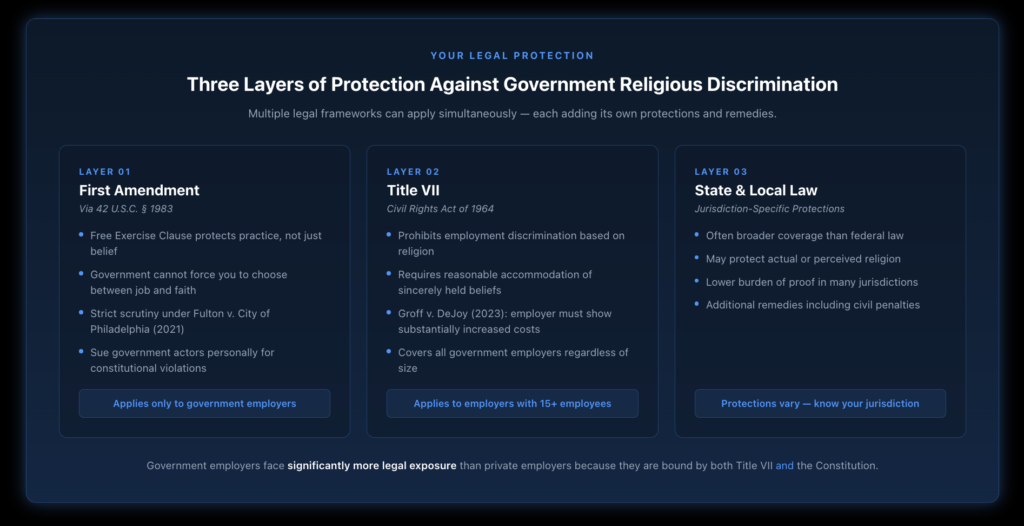
There are two distinct legal frameworks that apply to government employers specifically, and both can apply to the same situation:
The First Amendment protects religious freedom from government interference. Under 42 U.S.C. § 1983, you can sue a government employer that violated your First Amendment rights while acting under color of state law. The Free Exercise Clause protects religious practice, not just belief, meaning a government employer cannot force you to choose between your job and your faith.
Title VII of the Civil Rights Act prohibits employment discrimination based on religion and requires employers — including government employers — to provide reasonable accommodations for sincerely held religious beliefs unless doing so would impose an undue hardship. The Supreme Court’s 2023 decision in Groff v. DeJoy significantly strengthened these protections by replacing the old “more than de minimis cost” standard with a new, more demanding test: an employer must now show that the accommodation would result in substantially increased costs in relation to the conduct of its particular business.
Many states and cities layer additional protections on top of the federal baseline. New York is a strong example: the NYC Human Rights Law covers employers with four or more employees, protects against discrimination based on actual or perceived religion, and requires only that the plaintiff was treated “less well” than others. The NY State Human Rights Law goes further still, covering all employers regardless of size and explicitly protecting the wearing of religious attire, clothing, or facial hair. Understanding what protections exist in your jurisdiction is a critical part of building the strongest possible case.
Common Examples of Government Religious Discrimination
Not every workplace conflict involving religion rises to the level of a legal claim. But these situations frequently do — especially in the government employment context:
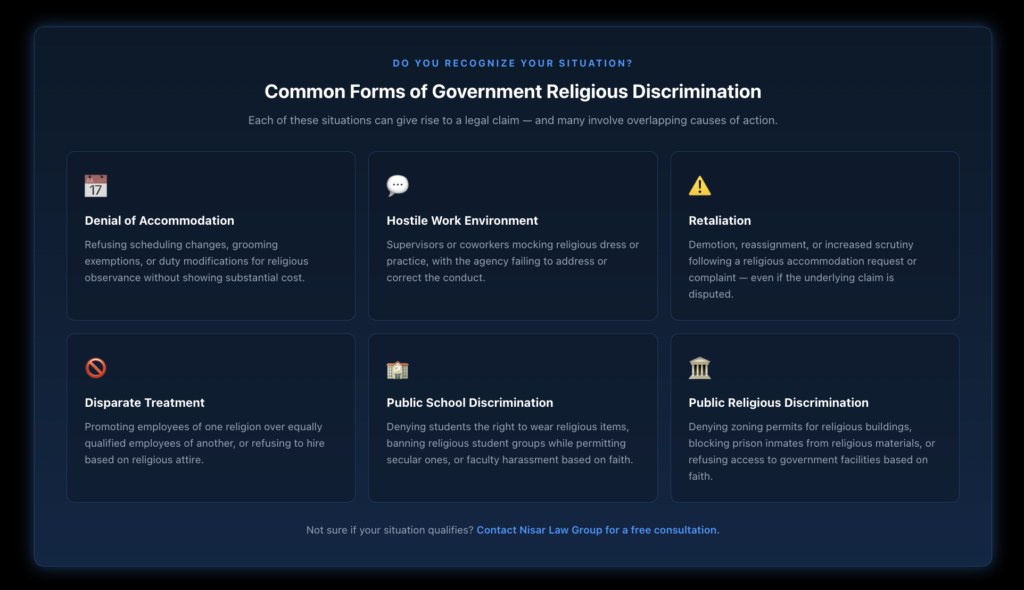
Denial of Religious Accommodation
The most common claim. A public employee asks for a scheduling accommodation to observe the Sabbath, requests an exemption from a grooming policy that conflicts with their religious practice, or asks not to be assigned to duties that violate their beliefs. The government employer refuses — or offers a token alternative that doesn’t actually resolve the conflict. Under Groff, employers now face a meaningfully higher burden to justify that refusal.
Common examples include:
- Muslim public employees denied Eid or Jumah prayer accommodations
- Jewish city or state employees denied accommodations for High Holy Days or Shabbat
- Sikh police officers or correction officers disciplined for wearing religious articles under or instead of standard-issue gear Employees of any faith are denied shift changes or schedule modifications for religious observances when accommodation would not substantially increase costs
Hostile Work Environment Based on Religion
A supervisor or coworkers regularly make comments mocking a public employee’s religious practice, religious dress, or beliefs — and the agency does nothing about it. Under Title VII, a hostile work environment based on religion is its own claim, separate from the failure to accommodate. The conduct must be severe or pervasive enough to alter the conditions of employment.
Retaliation for Requesting an Accommodation or Filing a Complaint
A public employee requests a religious accommodation and is suddenly passed over for promotion, reassigned to a less desirable position, or targeted for increased scrutiny. This is retaliation — and it’s independently actionable even if the underlying accommodation claim is disputed. Retaliation is one of the most frequently litigated issues in government religious discrimination cases because the timing is often hard for employers to explain. When the adverse action is taken specifically because of protected speech about religious rights, it may also support a separate First Amendment retaliation claim.
Disparate Treatment and Discriminatory Hiring
A government agency promotes employees of one religion while passing over equally qualified employees of another. Or a public employer refuses to hire someone because of religious attire visible during the interview. These claims are analyzed under the same burden-shifting framework as other employment discrimination claims — and the First Amendment adds an additional constitutional dimension when the employer is a government actor. In cases where a government employee’s religious identity played a role in a stop, arrest, or use of force, those facts can intersect with wrongful arrest and excessive force claims under the same civil rights lawsuit.
Public School Discrimination and Accommodations
A staff member at a publicly funded school, college, or university makes derogatory comments about a student’s hijab or prohibits a student from wearing an eagle feather or Native American regalia at graduation. Or a public school denies after-school meeting space to a Christian children’s club despite providing space for non-religious groups. These claims implicate a range of laws, including the First Amendment, Fourteenth Amendment, and Title VI of the Civil Rights Act of 1964. Generally, publicly funded institutions cannot deny services to a religious student or group that it provides to a different religion or non-religious group. Like government employers, schools must provide reasonable religious accommodations as long as they are not too disruptive of the learning environment. These cases often intersect with free speech and retaliation claims, too.
Public Religious Discrimination
A courthouse security guard denies entry to a person in religious dress. A town council denies a zoning permit for a Jewish synagogue but approves one for a Christian church in a similar area. A prison chaplain denies an Odinist inmate access to religious materials. Religious discrimination is not limited to government workplaces and schools. These claims can arise from the discriminatory acts of one government employee or the systemic exclusion of an entire community. Cases like these often overlap with First Amendment free speech and retaliation, and RLUIPA claims. When you feel you have been unfairly treated or made to feel like an outsider by a government agent, you need an attorney who can help you navigate potential claims and craft a cohesive strategy.
The Constitutional Framework: Recent Supreme Court Developments
The legal landscape for First Amendment religious freedom claims has shifted significantly in recent years, generally in ways that strengthen protections for employees.
Under Employment Division v. Smith (1990), a neutral law of general applicability that incidentally burdens religious practice could survive rational basis review. But in Fulton v. City of Philadelphia (2021), the Supreme Court held that any policy with a mechanism for case-by-case discretionary exceptions is not “generally applicable” under Smith — meaning it triggers strict scrutiny. This is significant for government employers because many agency policies include exception processes or waivers, which can now be challenged under heightened review.
Kennedy v. Bremerton School District (2022) rejected the old Lemon test for Establishment Clause analysis and confirmed that the government cannot suppress the private religious expression of its own employees. And in RLUIPA (42 U.S.C. § 2000cc), Congress provided strict scrutiny protection for religious exercise in both land use and institutional settings — which applies directly to claims involving religious practice in jails and prisons, a context our Prisoner Rights practice handles as well.
The combined effect of these decisions is that government entities have less room to deny religious accommodations or justify discrimination than they did a decade ago — and the legal tools available to plaintiffs have grown stronger.
How State and Local Law Can Strengthen Your Claim
One of the most important strategic decisions in a religious discrimination case is understanding what protections exist beyond the federal baseline — because state and local laws often go significantly further than Title VII and the First Amendment alone.
New York is a strong example of this layered protection approach. The NY State Human Rights Law (Executive Law § 296(10)) explicitly prohibits requiring any employee to violate sincerely held religious practices, including Sabbath or holy day observance and the wearing of any attire, clothing, or facial hair in accordance with religious requirements. Unlike Title VII, it applies to all employers regardless of size.
The NYC Human Rights Law covers any employer with four or more employees, protects against discrimination based on actual or perceived religion, extends protections to interns and independent contractors, and requires only that you were treated “less well” than others — a meaningfully lower standard than federal law. The NYC Commission on Human Rights can impose civil penalties up to $250,000 for willful violations and can require employers to update policies and provide training.
Depending on where your claim arose, comparable state and local protections may be available to you. An attorney familiar with the laws in your jurisdiction can identify which forums offer the strongest combination of coverage, remedies, and filing deadlines.
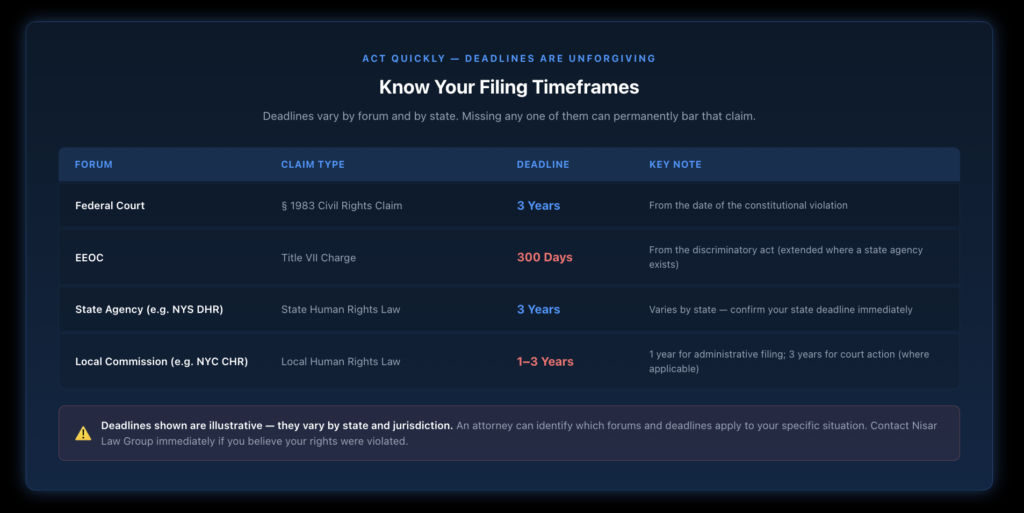
Filing deadlines vary by forum and by state. The following illustrates how deadlines can stack in a jurisdiction like New York:
- § 1983 claims (federal court) — 3 years from the date of the violation (generally matches the state’s tort claims statute of limitations)
- EEOC charge (Title VII) — 300 days from the discriminatory act (extended where a state agency exists)
- NYS Division of Human Rights — 3 years from the act (effective February 15, 2024)
- NYC Commission on Human Rights — 1 year (administrative); 3 years (court action)
Missing any of these deadlines can permanently bar certain claims. Timing must be assessed immediately.
Who Can Be Held Liable?
In government religious discrimination cases, the potential defendants depend on the nature of the claim:
Individual government supervisors or officials can be sued personally under § 1983 for First Amendment violations while acting under color of state law. They may raise qualified immunity, though the strengthened First Amendment framework under Fulton and related cases has narrowed that defense in certain contexts.
Government agencies and municipalities can be held liable under the Monell doctrine when the discrimination resulted from an official policy, a widespread custom, or a failure to train employees on religious accommodation obligations. Government entities across the country have paid significant sums in religious discrimination settlements involving agency employees. For a broader explanation of how Monell claims work against government entities, see our Government Misconduct / Constitutional Violations page.
Unlike individual officials, municipalities cannot assert qualified immunity.
What Evidence Matters in a Religious Discrimination Case?
Building a strong claim requires documentation from the start. The evidence that carries the most weight:
- The accommodation request itself — written requests are far stronger than verbal ones; if you made a verbal request, document it immediately in a follow-up email, along with every subsequent verbal exchange related to the request
- The employer’s written denial or non-response — including the stated reason and any alternative offered
- Communications showing a pattern of treatment — emails, messages, performance reviews, scheduling records
- Comparator evidence — how similarly situated employees of different religions or no religion were treated
- Witness statements from coworkers who observed the conduct or the employer’s response
- Prior complaints to HR or an agency EEO office, and the responses received
If the denial of accommodation was followed by adverse action — a demotion, reassignment, suspension, or termination — documenting the timeline becomes critical. Retaliation claims in government religious discrimination cases often turn on proximity: the closer in time the adverse action follows the protected request, the stronger the inference of retaliation.
What Can You Recover?
A successful religious discrimination claim against a government actor can result in:
- Compensatory damages — covering lost wages and benefits (in employment cases), emotional distress, and harm to professional reputation
- Back pay and reinstatement — if you were terminated or constructively discharged (in employment cases)
- Nominal damages — available against individual government officials when no specific economic losses can be compensated (often $1; triggers right to seek attorneys’ fees as prevailing party)
- Punitive damages — available against individual government officials in § 1983 claims in appropriate cases; not available against municipalities
- Injunctive relief — a court order requiring the agency to change its policies or practices (triggers right to seek attorneys’ fees as prevailing party)
- Attorneys’ fees — under 42 U.S.C. § 1988, if you prevail on a federal civil rights claim, the defendant is typically required to pay your legal costs
Where applicable, state and local human rights commissions may also impose civil penalties for willful violations, independent of what you personally recover.
Why Nisar Law Group?
Nisar Law Group is a boutique civil rights and employment litigation firm. We represent individuals — never corporations, never government entities. Every case we take is on behalf of someone whose rights we believe in.
Religious discrimination claims against government employers sit at the intersection of constitutional law, Title VII, and state and local statutes — three distinct bodies of law that require careful, coordinated strategy. And religious discrimination claims against schools, prisons, and others implicate constitutional law, Title VI, RLUIPA, and many other federal and local laws. We know the federal dockets, the relevant First Amendment jurisprudence, and the jurisdiction-specific protections that can make a significant difference in how your case is structured and what you can recover.
We handle civil rights and employment cases on a contingency basis, which means you don’t pay legal fees unless we recover for you. Every case starts with a free consultation.
Contact us at (212) 600-9534 to schedule a confidential consultation.
Why We're the Right Choice
- Seasoned Litigators Who Have Handled Numerous Jury & Bench Trials
- Providing Representation with Clarity, Honesty & Integrity
- Building Long-Term Affiliations & Relationships
- Offering Consultations for All Case Types We Handle
Frequently Asked Questions About Religious Discrimination by Government Entities
Title VII of the Civil Rights Act of 1964 is the primary federal statute prohibiting religious discrimination in employment. It requires employers, including government employers, to provide reasonable accommodations for sincerely held religious beliefs unless doing so would impose an undue hardship on the business. The Supreme Court’s 2023 decision in Groff v. DeJoy significantly strengthened these protections by replacing the old lenient standard with a requirement that employers show substantial increased costs before denying accommodation. Government employers are also bound by the First Amendment’s Free Exercise Clause, which provides an additional constitutional layer of protection that private employers do not face.
The two primary exceptions are the undue hardship defense and the bona fide occupational requirement (BFOQ). Undue hardship allows an employer to deny accommodation if granting it would impose a substantial increased cost on the business under Groff v. DeJoy — the burden is now genuinely on the employer to prove this. A BFOQ exists in narrow circumstances where a particular religion is a genuine job requirement, such as a position at a religious institution. For government employers, the BFOQ exception is extremely narrow and rarely applicable, and the First Amendment imposes additional constraints that do not apply to private employers.
It depends on the circumstances. Under Title VII, an employer must make a reasonable accommodation for Sabbath observance or holy day observation unless it would impose a substantial cost. After Groff v. DeJoy, the old standard that allowed employers to deny accommodation for any “more than de minimis” cost has been replaced with a meaningfully higher threshold. If you refused to work on a day your religion requires observance, made your beliefs known to your employer, and were terminated without the employer genuinely attempting to accommodate you, you may have a viable religious discrimination claim.
Religious discrimination occurs when a government entity treats you unfavorably because of your religion — your beliefs, observances, or practices. It includes refusing to hire or promote someone because of their faith, failing to provide reasonable accommodation for religious practices, creating or tolerating a hostile work or school environment based on religion, and retaliating against someone for requesting an accommodation or filing a complaint. Discrimination based on perceived religion is also covered, meaning you can have a valid claim even if the employer was wrong about what religion you practice or follow.
Willful deprivation of civil rights under color of law — including First Amendment violations — can be a federal crime, and the Department of Justice has authority to pursue criminal prosecution in serious cases. However, criminal prosecution is handled by the government, not by private attorneys. A civil rights attorney handles a separate civil lawsuit on your behalf, which can result in financial compensation, reinstatement, policy changes, and attorney’s fees regardless of whether criminal charges are ever filed.
There is no standard number — it depends on the nature of the violation, the damages you suffered, and which laws you bring claims under. Compensatory damages can include lost wages, lost benefits, emotional distress, and reputational harm. Attorneys’ fees are recoverable under § 1988 in successful federal civil rights claims, making these cases financially viable even when monetary damages alone are modest. Where state or local human rights commissions have jurisdiction, they may impose civil penalties for willful violations, independent of any individual recovery. Cases involving termination, prolonged denial of accommodation, or a documented pattern of discrimination tend to result in larger recoveries.
The government faces strict constitutional limits on how it can burden religious practice. Under the First Amendment’s Free Exercise Clause, a government employer cannot impose a policy that targets religious practice or forces employees to choose between their job and their faith. Under Fulton v. City of Philadelphia, any government policy with a mechanism for exceptions is subject to strict scrutiny if it burdens religion. Government employers must also comply with Title VII’s accommodation requirement. The combined effect of these protections means government employers face significantly more legal exposure for religious discrimination than private employers do.