

When you discover illegal activity, discrimination, or safety violations at work, where you report matters just as much as what you report. The choice between internal reporting (through your company’s channels) and external reporting (to government agencies) directly affects your legal protections, the investigation’s effectiveness, and your career security. Employees who understand these distinctions make stronger strategic decisions that protect both their rights and their ability to drive meaningful change.
This decision isn’t one-size-fits-all. Your specific situation, the type of violation involved, and your employer’s track record all factor into the best approach. Understanding each pathway—and when to use them—puts you in control of how your report moves forward.
Key Takeaways
- External reporting to government agencies typically provides stronger anti-retaliation protections under federal laws like Sarbanes-Oxley and Dodd-Frank.
- Internal reporting can resolve issues faster, but carries risks if management is complicit in the wrongdoing.
- Over 83% of whistleblowers first report internally, but this doesn’t always lead to corrective action.
- New York employees benefit from some of the strongest state-level whistleblower protections in the country.
- Documenting everything before reporting—through either channel—significantly strengthens your position.
- Consulting with an employment attorney before making disclosures helps protect your interests regardless of which path you choose.
Disclaimer: This article provides general information for informational purposes only and should not be considered a substitute for legal advice. It is essential to consult with an experienced employment lawyer at our law firm to discuss the specific facts of your case and understand your legal rights and options. This information does not create an attorney-client relationship.
What's the Difference Between Internal and External Whistleblowing?
The distinction is straightforward, but the implications run deep. Internal whistleblowing means reporting misconduct to someone within your own organization—a supervisor, HR department, compliance officer, or internal hotline. External whistleblowing involves taking that information outside the company to government agencies, regulatory bodies, or legal authorities.
Why Does Your Choice Matter?
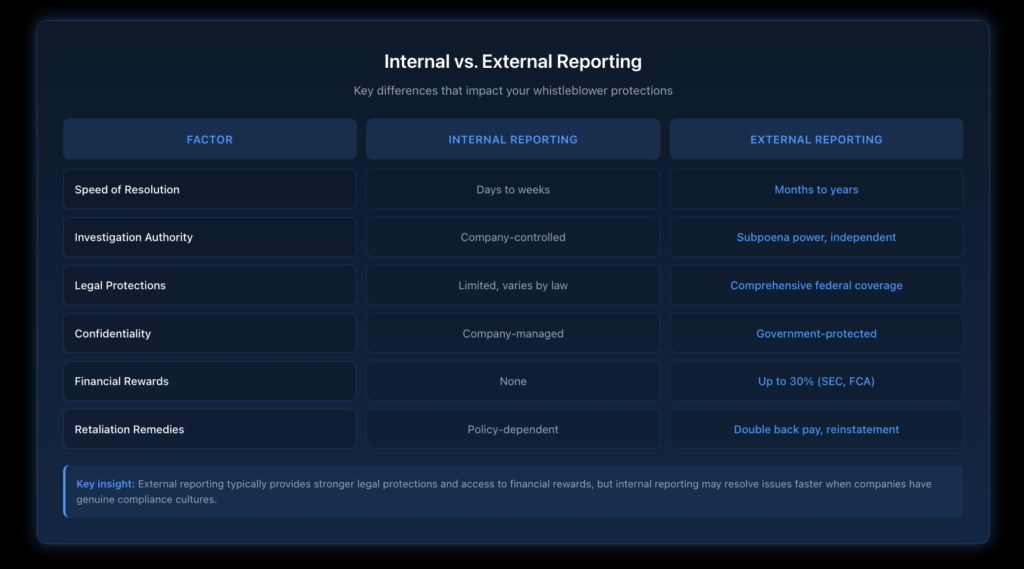
The pathway you select affects several critical factors. First, it determines which legal protections apply to you. Second, it shapes how the investigation will proceed. Third, it influences whether the underlying problem actually gets fixed. And fourth, it impacts what remedies you can access if your employer retaliates against you.
Who Investigates Under Each Approach?
Internal investigations are conducted by the company itself—typically compliance departments, internal auditors, or outside counsel hired by the company. This creates an inherent tension since the organization is essentially investigating itself.
External investigations are handled by government agencies with genuine enforcement authority. Agencies like OSHA, the SEC, or state labor departments can compel document production, conduct surprise inspections, and issue subpoenas. They operate independently of corporate interests and have the legal tools to uncover violations that internal investigations might miss or minimize.
When Should You Report Internally First?
Internal reporting can be appropriate—and even strategically valuable—under certain circumstances. Knowing when this pathway makes sense helps you make an informed choice.
Does Your Company Have Strong Compliance Systems?
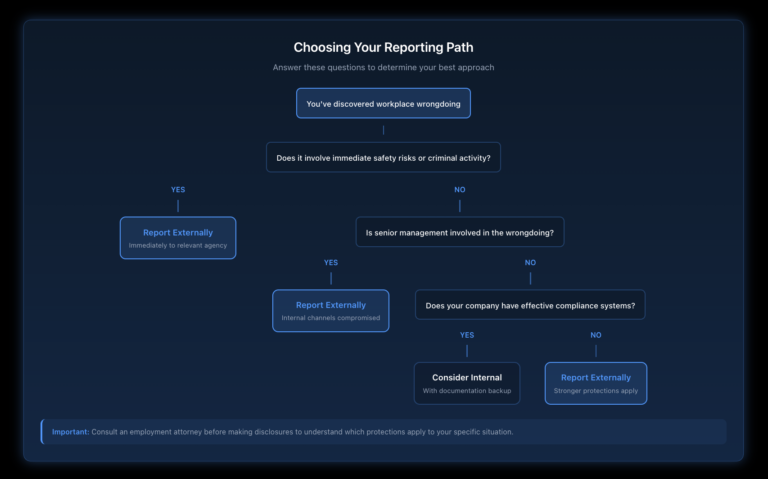
Companies with genuine compliance cultures often resolve problems quickly through internal channels. Look for indicators like regular training programs, anonymous reporting mechanisms that actually protect confidentiality, and a history of taking corrective action when issues surface.
If your employer has an independent ombudsman program or a board-level audit committee that takes compliance seriously, internal reporting may get results without the extended timeline of external agency involvement.
Is the Violation Relatively Contained?
Some issues stem from individual bad actors rather than systemic company policies. A single manager engaging in discrimination or a localized safety violation might be addressable through internal processes, particularly if senior leadership has demonstrated a genuine commitment to correcting problems.
Can You Document the Company’s Response?
One strategic approach involves reporting internally with clear documentation of your report, then monitoring how the company responds. This creates a paper trail showing you gave the organization a chance to address the issue. If internal processes fail, you’ve strengthened your position for subsequent external reporting by demonstrating the company’s inadequate response.
What Are the Risks of Going Internal First?
Internal reporting carries significant risks. Once you report, potentially culpable individuals may learn about your complaint and begin covering their tracks, destroying evidence, or building a case to discredit or retaliate against you. Companies investigating themselves face obvious conflicts of interest—their lawyers work for the company, not for you.
Some employers conduct superficial investigations designed primarily to create a record of “appropriate response” rather than genuinely addressing the underlying problem. This can actually make subsequent external reporting more difficult by allowing the company to claim it has already investigated and found no merit to your concerns.
When Should You Report Externally?
External reporting becomes essential—and often provides the strongest protections—in several common situations. Recognizing these scenarios helps you understand when bypassing internal channels makes sense.
Is Senior Management Involved in the Wrongdoing?
When the people responsible for addressing violations are the ones committing them, internal reporting is essentially futile. If executives, board members, or compliance officers are participants in or covering up misconduct, your internal report will likely be suppressed, and you’ll be exposed to significant retaliation risk with minimal chance of corrective action.
Does the Violation Pose Immediate Public Harm?
Ongoing criminal activity, imminent safety threats, or violations causing active harm to consumers, patients, or the public often warrant immediate external reporting. Government agencies have the authority to halt dangerous practices quickly through injunctions, stop-sale orders, or facility closures—powers that internal processes simply don’t possess.
Has Internal Reporting Already Failed?
If you’ve previously reported concerns internally without adequate response—or worse, if you faced retaliation for raising issues—external reporting becomes both practically necessary and legally protected. Many whistleblower statutes specifically protect employees who escalate to external agencies after internal channels prove ineffective.
What Agencies Handle External Reports?
The appropriate external agency depends on the type of violation you’re reporting. The EEOC handles workplace discrimination complaints. OSHA addresses safety violations and enforces whistleblower protections across multiple industries. The SEC investigates securities fraud and offers significant financial rewards for successful tips. State agencies—like the New York State Division of Human Rights—provide additional avenues with sometimes broader protections than federal counterparts.
What Legal Protections Exist for Internal Reporters?
Internal whistleblowers receive varying degrees of protection depending on what laws apply to their situation and whether their employer genuinely honors its own policies.
How Does Sarbanes-Oxley Protect Internal Reports?
The Sarbanes-Oxley Act specifically protects employees of publicly traded companies who report securities violations internally. This means you cannot be terminated, demoted, suspended, or harassed for reporting potential fraud through company channels—but you must work for a publicly traded company or its contractor for SOX protections to apply.
Do Company Policies Provide Real Protection?
Many employers have anti-retaliation policies in their handbooks. However, these policies are only as strong as the company’s willingness to enforce them. A handbook policy doesn’t create the same enforceable rights as federal or state law. If your employer retaliates despite its written policy, you’ll need external legal recourse to obtain meaningful relief.
What About State Law Protections?
New York offers particularly strong protections for whistleblowers reporting internally. New York Labor Law Section 740 protects employees who disclose violations to supervisors or public bodies, and the New York City Human Rights Law provides additional protections for city employees and workers at companies operating within the five boroughs.
What Legal Protections Exist for External Reporters?
External reporting generally triggers the strongest available whistleblower protections. Federal statutes provide robust remedies for employees who face retaliation after reporting to government agencies.
How Does Dodd-Frank Protect Securities Whistleblowers?
The Dodd-Frank Act provides comprehensive protections for individuals reporting securities violations to the SEC. If your employer retaliates, you can sue in federal court and potentially recover double back pay, reinstatement, and attorneys’ fees. Dodd-Frank also bars employers from contractual provisions that prevent you from reporting potential violations to the SEC.
What About the False Claims Act?
The False Claims Act offers powerful protections—and significant financial incentives—for reporting fraud against government programs. If your employer defrauds Medicare, Medicaid, defense contracts, or other federal programs, you can file a qui tam lawsuit on the government’s behalf and potentially receive 15-30% of any recovery. Anti-retaliation provisions protect you from termination, demotion, or harassment for filing such claims.
How Does OSHA Enforce Whistleblower Protections?
OSHA enforces anti-retaliation provisions under more than 20 federal statutes covering industries from airlines to nuclear energy. If you report safety violations, environmental hazards, or other protected concerns to OSHA and face retaliation, you can file a complaint seeking reinstatement, back pay, and compensatory damages.
Can You Pursue Both Internal and External Reporting?
You don’t necessarily have to choose one path exclusively. Strategic use of both channels can maximize your protections while giving your employer a fair opportunity to address problems.
What’s the Sequential Approach?
Some employees report internally first with a clear timeline for expecting resolution, then escalate externally if the company fails to act appropriately. This approach shows good faith—you tried to work within the system—while preserving your ability to access external protections when internal processes prove inadequate.
Does the Order of Reporting Matter Legally?
For some whistleblower laws, yes. Certain statutes require you to exhaust internal remedies before filing external complaints. Others specifically protect external reporting regardless of whether you reported internally first. Understanding the specific legal framework applicable to your situation is essential, which is why consulting with an employment attorney before making disclosures is so valuable.
What Are the Timing Considerations?
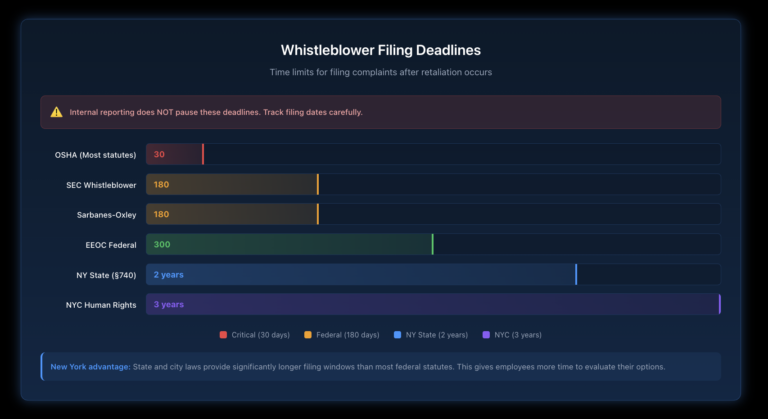
Filing deadlines don’t pause while you wait for internal processes to work. Federal whistleblower statutes impose strict time limits for filing retaliation complaints—sometimes as short as 30 days. Reporting internally doesn’t extend these deadlines, so you need to track applicable timelines carefully while monitoring your employer’s response to internal reports.
How Should You Document Your Concerns Before Reporting?
Regardless of which reporting path you choose, thorough documentation dramatically strengthens your position. Preserving evidence before anyone knows you’re concerned protects you if disputes arise later.
What Should You Preserve?
Document everything that relates to the violation you’re observing. Emails, policies, financial records, meeting notes, and witness contact information all matter. Create contemporaneous written records noting what you observed, when, and who was present. Store copies of documentation securely outside your workplace—on personal devices or cloud storage that your employer can’t access or delete.
How Do You Document Without Violating Confidentiality?
This is where many well-intentioned whistleblowers make costly mistakes. Taking trade secrets, attorney-client privileged materials, or classified information can expose you to legal liability even if your underlying concerns are legitimate. Focus on documenting what you personally observed and communications that came to you in the ordinary course of your work. When uncertain about what you can safely retain, consulting an attorney first provides crucial guidance.
Why Does Documentation Protect You?
Strong documentation prevents your employer from claiming you fabricated concerns after the fact or that you misunderstood what you observed. It also protects against pretextual terminations—situations where employers manufacture performance issues to justify firing whistleblowers. If you have documented stellar performance reviews before reporting and sudden negative evaluations after, that pattern speaks volumes about retaliation.
What Factors Should Guide Your Decision?
Answering several key questions honestly helps you evaluate which reporting approach best fits your situation.
Does Your Company Genuinely Address Violations?
Research your employer’s history. Have previous compliance issues been corrected? Have other employees who raised concerns been protected or pushed out? Company culture around compliance often reveals itself in how past situations were handled.
Can You Manage Potential Career Disruption?
Even illegal retaliation creates real-world consequences while you pursue legal remedies. Consider your financial reserves, your ability to find new employment if necessary, and your tolerance for the stress of potential workplace conflict. Having realistic expectations about the process helps you prepare effectively.
Do You Have Strong Evidence?
Weak or ambiguous evidence makes any reporting approach more challenging. If your concerns are based primarily on suspicions rather than documented facts, you may need to gather more information before moving forward. That said, the law protects good-faith reports even if subsequent investigation doesn’t confirm every detail of your concerns.
Have You Sought Legal Guidance?
An experienced whistleblower attorney can evaluate your specific situation, identify which laws protect your disclosures, and help you develop a strategy that maximizes both effectiveness and protection. The stakes are too high—and the legal landscape too complex—to navigate entirely on your own.
How Do New York Laws Strengthen Whistleblower Protections?
New York provides some of the nation’s strongest whistleblower protections, layering state and city laws on top of federal safeguards.
What Does New York Labor Law Section 740 Cover?
Section 740 protects employees who disclose or threaten to disclose employer activities that violate laws, creating a substantial and specific danger to public health or safety. Recent amendments significantly expanded this law, covering more types of disclosures and lengthening the time period for filing complaints.
How Does the NYC Human Rights Law Add Protection?
For employees working in New York City, the NYC Human Rights Law provides additional anti-retaliation protections with broader coverage and more accessible enforcement mechanisms than federal law. You can file retaliation complaints directly with the NYC Commission on Human Rights or pursue private lawsuits in state court with potentially greater damages than federal claims allow.
What Filing Deadlines Apply in New York?
New York generally allows longer filing periods than federal law. While OSHA retaliation complaints often have 30-day deadlines, New York State complaints typically allow up to two years. NYC complaints can be filed within three years of the retaliatory action. These extended deadlines provide crucial flexibility, but acting promptly whilethe evidence is fresh remains advisable.
Ready to Protect Your Rights?
Choosing between internal and external reporting requires careful analysis of your specific circumstances, the nature of the violation, and your employer’s track record. Neither path is inherently right or wrong—the best choice depends on factors unique to your situation.
What matters most is making an informed decision with a full understanding of your legal protections and strategic options. If you’re facing workplace wrongdoing and need guidance on the most effective reporting approach, Nisar Law Group can help you evaluate your options, understand your rights, and develop a strategy that serves both your interests and the broader goal of accountability.
Contact us today for a confidential consultation to discuss your situation and explore the reporting path that best protects your rights while maximizing the chance for meaningful change.
Frequently Asked Questions About Whistleblower Reporting Options
Internal whistleblowing involves reporting misconduct to someone within your organization, such as HR, a supervisor, a compliance officer, or an internal hotline. External whistleblowing means taking your concerns outside the company to government agencies like OSHA, the SEC, the EEOC, or state regulatory bodies. The key distinction is whether the report stays within company control or goes to authorities with independent investigative powers. External agencies can compel document production and witness testimony—authority that internal investigations lack.
Protection depends on the specific laws that apply to your situation and your employer type. The Sarbanes-Oxley Act protects employees of publicly traded companies who report securities violations internally. Some state laws, including New York Labor Law Section 740, protect internal disclosures to supervisors. However, internal reporters generally receive less comprehensive protection than those who report to government agencies. Company anti-retaliation policies provide only as much protection as the employer is willing to enforce.
Consider external reporting first when senior management participates in or covers up the wrongdoing, when the violation creates immediate public safety risks, when internal reporting has already failed to produce corrective action, or when your company has a pattern of retaliating against employees who raise concerns. External reporting also makes sense when you want access to whistleblower reward programs like those offered by the SEC or under the False Claims Act for government fraud.
Yes, you can pursue both approaches simultaneously or sequentially. Some employees report internally first to give their employer an opportunity to correct problems, then escalate externally if internal processes fail. Others go directly to external agencies when circumstances warrant. Be aware that filing deadlines for external complaints don’t pause while internal processes unfold, so you must track applicable time limits carefully. An attorney can help you coordinate both channels strategically.
Federal and state whistleblower laws provide remedies for retaliation following external reports. Depending on which laws apply, you may be entitled to reinstatement, back pay, compensatory damages for emotional distress, and attorneys’ fees. Some statutes provide double back pay. You can file retaliation complaints with agencies like OSHA or pursue private lawsuits in federal or state court. The specific process and deadlines vary by law, making prompt consultation with an employment attorney essential.
The appropriate agency depends on the type of violation. Report workplace discrimination to the EEOC or state human rights agencies. Report safety violations to OSHA. Report securities fraud to the SEC. Report fraud against government programs like Medicare or defense contracts to the Department of Justice using False Claims Act procedures. For environmental violations, the EPA is typically appropriate. Many situations involve overlapping agency jurisdiction, so consulting an attorney helps ensure your report reaches the agencies best positioned to address your concerns.
Several reporting mechanisms protect the whistleblower’s identity. The SEC whistleblower program allows anonymous tips through an attorney. OSHA permits confidential complaint filing. The False Claims Act initially keeps qui tam lawsuits under seal, protecting the relator’s identity during early investigation. However, complete anonymity throughout the entire process is often difficult to maintain, particularly if your information leads to enforcement action requiring your testimony. Some state programs offer varying degrees of identity protection as well.
While not legally required, consulting an attorney before reporting provides significant advantages. An attorney can identify which laws protect your specific disclosures, help you document concerns appropriately without violating confidentiality obligations, advise on the best reporting channel for your situation, and ensure you meet applicable filing deadlines. Many whistleblower attorneys offer free initial consultations and work on contingency for certain types of cases, making legal guidance accessible without upfront cost.

