

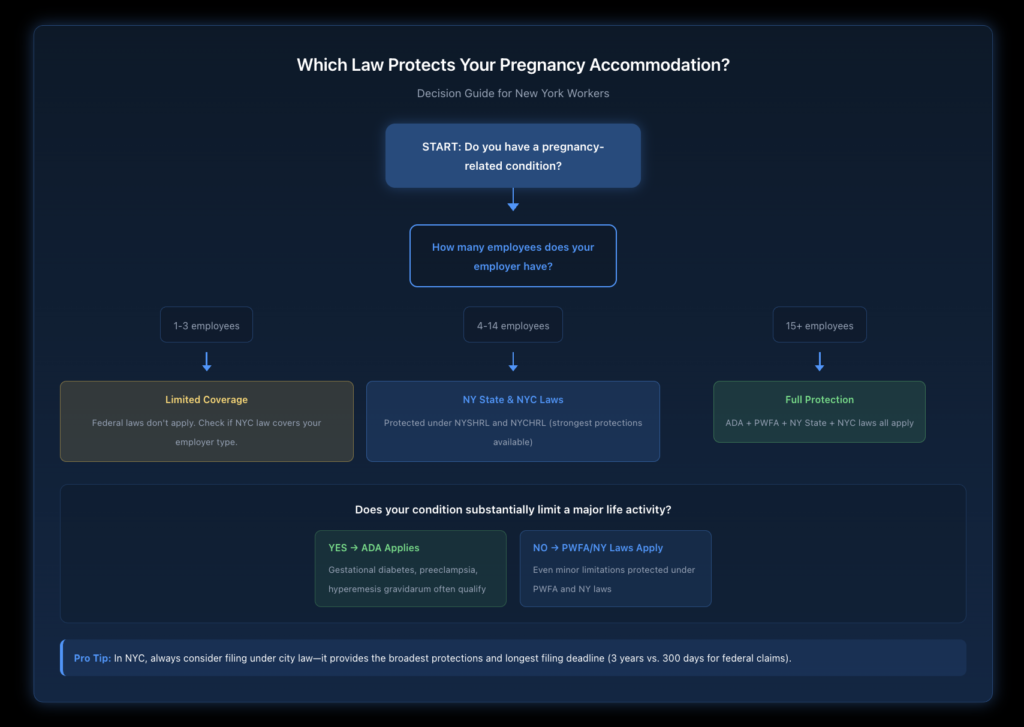
Yes, the Americans with Disabilities Act (ADA) can protect workers experiencing pregnancy-related medical conditions that substantially limit major life activities—even though pregnancy itself isn’t classified as a disability. Conditions like gestational diabetes, preeclampsia, hyperemesis gravidarum, and severe morning sickness often qualify for ADA protection, requiring employers to provide reasonable accommodations. When combined with the federal Pregnant Workers Fairness Act (PWFA) and New York’s stronger state and city laws, pregnant employees in New York have multiple legal pathways to secure workplace accommodations for pregnancy complications.
Key Takeaways
- Pregnancy itself isn’t a disability under the ADA, but pregnancy-related medical conditions that substantially limit major life activities often qualify for protection.
- Common qualifying conditions include gestational diabetes, preeclampsia, hyperemesis gravidarum, sciatica, anemia, and pregnancy-related depression.
- The ADA Amendments Act of 2008 significantly expanded protections, making it easier for pregnancy-related impairments to meet the disability definition.
- The federal PWFA (effective June 2023) provides additional accommodation rights that don’t require meeting the ADA’s disability threshold.
- New York State and NYC laws offer even broader protections, treating pregnancy-related conditions as disabilities requiring accommodation.
- Employers must engage in an interactive process to identify reasonable accommodations unless doing so creates undue hardship.
Disclaimer: This article provides general information for informational purposes only and should not be considered a substitute for legal advice. It is essential to consult with an experienced employment lawyer at our law firm to discuss the specific facts of your case and understand your legal rights and options. This information does not create an attorney-client relationship.
What Makes a Pregnancy-Related Condition Qualify as an ADA Disability?
Under the ADA, a pregnancy-related impairment qualifies as a disability when it substantially limits one or more major life activities, or substantially limited those activities in the past. This assessment considers how the condition affects activities like walking, standing, lifting, bending, concentrating, sleeping, or the normal functioning of bodily systems like digestive, cardiovascular, or neurological functions.
The key factor isn’t simply having a pregnancy complication. Rather, it’s whether that condition creates meaningful functional limitations. A pregnant worker with gestational diabetes that requires frequent monitoring, dietary restrictions, and affects her ability to concentrate may qualify for ADA protection. Someone experiencing routine pregnancy fatigue without significant functional limitations might not.
Which Pregnancy Conditions Most Commonly Qualify?
The EEOC’s guidance on pregnancy discrimination identifies several pregnancy-related conditions likely to meet the ADA’s disability definition. Gestational diabetes affects blood sugar regulation and can substantially limit eating, sleeping, and cardiovascular functions. Preeclampsia causes dangerous blood pressure elevation and can limit circulatory functions, requiring bed rest. Hyperemesis gravidarum involves severe, persistent nausea and vomiting that substantially limits digestive functions and the ability to eat.
Other commonly qualifying conditions include pregnancy-related anemia that causes fatigue limiting major life activities, sciatica and severe back pain that substantially limit standing, walking, or lifting, postpartum depression that affects concentration, sleeping, and daily functioning, and cervical insufficiency requiring significant activity restrictions.
How Did the ADA Amendments Act Expand Coverage?
Before 2008, courts often interpreted the ADA narrowly, finding that temporary pregnancy-related impairments didn’t qualify as disabilities. The ADA Amendments Act (ADAAA) specifically addressed this problem by broadening the definition of disability. Now, the focus is on whether discrimination occurred—not on whether someone is disabled enough to deserve protection.
The ADAAA clarified that conditions don’t need to be permanent to qualify. A temporary impairment that substantially limits major life activities—even for several months—can meet the disability threshold. The Job Accommodation Network notes that this change made it significantly easier for pregnant workers with pregnancy-related impairments to demonstrate they have disabilities warranting reasonable accommodations.
How Does the PWFA Differ from ADA Protection?
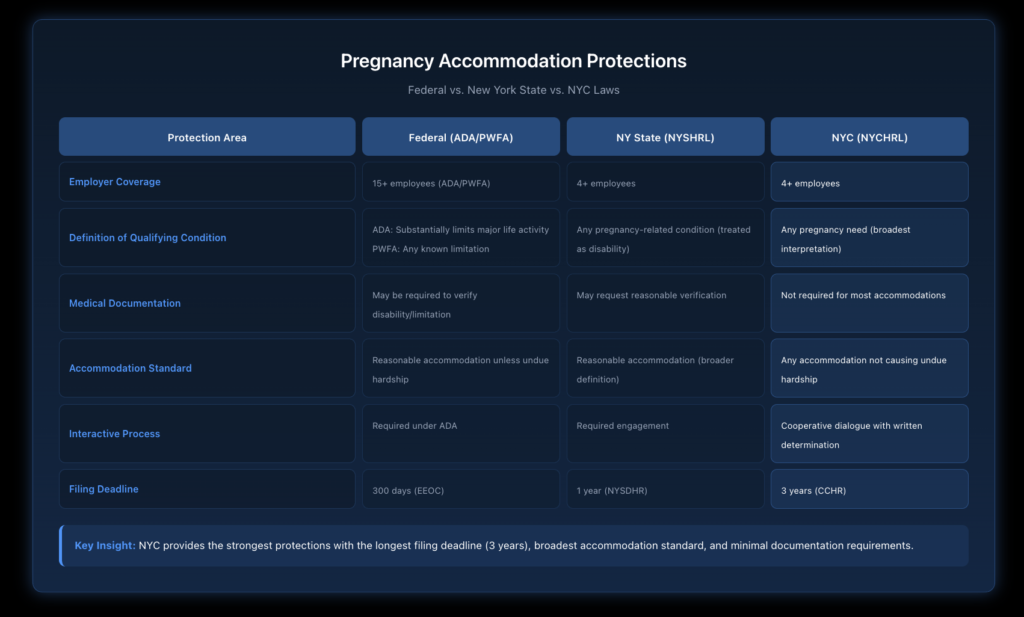
The Pregnant Workers Fairness Act, which took effect in June 2023, creates a separate legal pathway for pregnancy accommodations that doesn’t require meeting the ADA’s disability definition. Under the PWFA, any known limitation related to pregnancy, childbirth, or related medical conditions can trigger accommodation rights—even minor, modest, or episodic limitations.
This distinction matters significantly. Under the ADA, you must prove your condition substantially limits a major life activity. Under the PWFA, limitations like needing more frequent bathroom breaks, experiencing routine morning sickness, or requiring occasional rest periods can trigger accommodation requirements. The PWFA essentially fills the gaps where the ADA’s disability definition might not apply.
When Should You Rely on ADA vs. PWFA Protections?
For workers with serious pregnancy complications—gestational diabetes, preeclampsia, hyperemesis gravidarum—both laws may apply simultaneously. You can request accommodations under whichever law provides stronger protection for your specific situation. When conditions clearly meet the ADA’s disability threshold, ADA protection may offer certain advantages in terms of established case law and precedent.
For workers with limitations that fall short of the ADA’s substantial limitation requirement, the PWFA provides crucial backup protection. If your employer denies accommodations, arguing your condition isn’t a disability, you can pursue your claim under the PWFA’s broader framework instead.
What Accommodations Can Pregnant Workers Request Under the ADA?
When a pregnancy-related condition qualifies as an ADA disability, employers must provide reasonable accommodations unless doing so creates undue hardship. The range of potential accommodations mirrors those available for any disability—they’re limited only by what’s necessary to enable the worker to perform essential job functions.
Common ADA accommodations for pregnancy-related disabilities include modified work schedules to accommodate medical appointments or fatigue, permission to sit or stand as needed rather than maintaining one position, more frequent breaks for eating, drinking, resting, or using the restroom, temporary reassignment to less strenuous duties, ergonomic equipment like adjustable chairs or standing desks, permission to work from home during bed rest periods, and leave beyond standard FMLA entitlements when medically necessary.
What Does the Interactive Process Look Like?
Under the ADA, employers can’t simply deny accommodation requests. They must engage in an interactive process—a good-faith dialogue to identify effective accommodations. This process typically involves the employee describing functional limitations, the employer identifying essential job functions, both parties brainstorming potential accommodations, and arriving at a mutually acceptable solution.
Neither party can simply refuse to participate. If your employer ignores your accommodation request or refuses to discuss alternatives, that failure itself may constitute disability discrimination. Document all communications carefully and follow up in writing if verbal requests go unanswered.
Can Employers Require Medical Documentation?
Employers can request reasonable documentation to verify that you have a pregnancy-related condition requiring accommodation. However, they can’t demand your entire medical history or unnecessary personal health information. Documentation should confirm the existence of the condition and explain functional limitations and needed accommodations.
The New York State Division of Human Rights emphasizes that employees must cooperate in providing necessary medical information, but employers must keep such information confidential in separate medical files. Your employer cannot share your medical documentation with supervisors who don’t need it or use it for purposes beyond accommodation decisions.
How Do New York Laws Expand Pregnancy Disability Protections?
New York workers benefit from state and city laws that go significantly beyond federal protections. The New York State Human Rights Law explicitly treats pregnancy-related conditions as disabilities requiring reasonable accommodation—without requiring the substantial limitation analysis needed under the ADA.
Under state law, any medically-advised restriction or need related to pregnancy triggers accommodation rights. This includes common pregnancy needs like extra bathroom breaks, increased water intake, or the need to sit periodically—limitations that might not meet the ADA’s threshold but clearly warrant workplace adjustments.
What Additional Protections Does NYC Provide?
The NYC Human Rights Law provides even broader protection through its Pregnant Workers Fairness Act, enacted in 2014. Under city law, employers with four or more employees must accommodate pregnancy needs unless doing so causes undue hardship—and under the NYCHRL, there are essentially no accommodations that are unreasonable if they don’t create undue hardship.
NYC law doesn’t require employees to provide medical documentation to verify pregnancy for most accommodations. Only when seeking leave beyond the presumptive six-to-eight-week recovery period following childbirth might additional documentation be required. The city law’s cooperative dialogue requirement mandates that employers engage promptly in accommodation discussions and provide written determinations of requests.
How Do Filing Deadlines Differ?
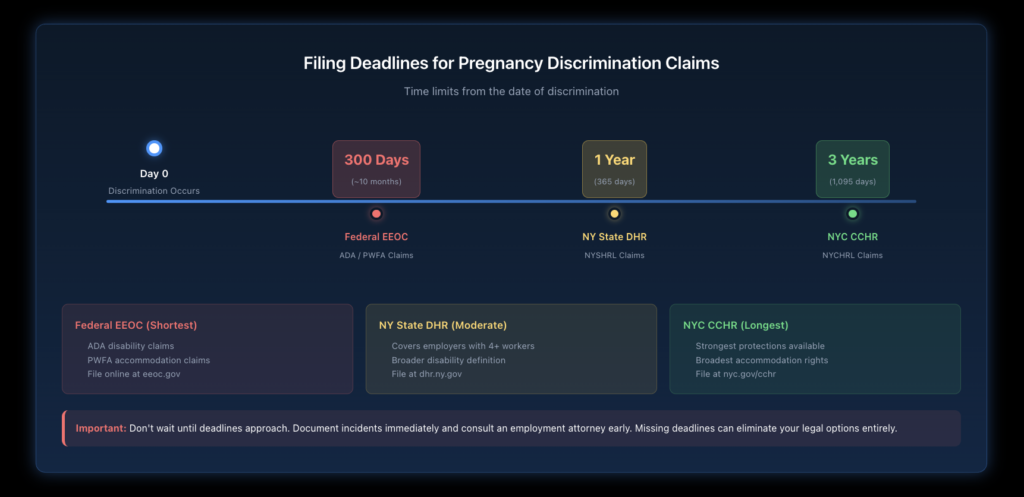
Understanding filing deadlines is crucial if you experience discrimination. For federal EEOC claims under the ADA or PWFA, you typically have 300 days to file in New York (because the state has its own enforcement agency). New York State Division of Human Rights complaints must be filed within one year. NYC Commission on Human Rights complaints can be filed within three years of the discriminatory act.
These different timeframes affect strategy. If your employer denied accommodations several months ago, you may still have options under city law even if federal deadlines are approaching. An employment attorney can help identify which claims remain viable and which forum offers the strongest protections.
What Should You Do If Your Employer Denies Accommodations?
If your employer refuses to accommodate a pregnancy-related medical condition, don’t assume their decision is final or correct. Many employers misunderstand their obligations or wrongly believe that pregnancy complications don’t trigger accommodation duties. Start by documenting everything and seeking clarification.
Request a written explanation for the denial. Understanding your employer’s reasoning helps identify whether they’re claiming undue hardship, disputing that you have a qualifying condition, or simply ignoring their legal obligations. Their response shapes your next steps.
How Can You Challenge Denial Decisions?
Consider escalating within your organization first. If your direct supervisor denied the request, human resources or disability services coordinators may have different authority or understanding. Present medical documentation clearly explaining your condition’s functional limitations and the medical necessity of requested accommodations.
If internal escalation fails, external remedies become necessary. You can file administrative complaints with the EEOC, New York State Division of Human Rights, or NYC Commission on Human Rights. Each agency will investigate and may pursue your claim or issue a right-to-sue letter allowing you to proceed in court.
What Evidence Should You Preserve?
Documentation becomes crucial if you need to pursue legal claims. Save all written communications about your condition, accommodation requests, and employer responses. Keep copies of medical records and healthcare provider statements supporting your accommodation needs. Document witnesses to verbal conversations and any changes in treatment following your accommodation request.
Note any inconsistencies in how your employer treats other employees with disabilities or non-pregnancy-related limitations. If they provide light duty to workers with back injuries but refuse similar accommodations for pregnancy-related back pain, that differential treatment suggests discrimination.
Can Employers Force Pregnant Workers to Take Leave Instead of Accommodating Them?
No. Both the ADA and PWFA prohibit employers from forcing pregnant workers into leave when reasonable accommodations would allow continued employment. This protection addresses a common employer tactic—pushing pregnant workers out of the workplace rather than making simple adjustments.
Under the PWFA specifically, employers cannot require workers to take leave if another accommodation exists that doesn’t cause undue hardship and allows the employee to continue working. Similarly, employers cannot deny employment opportunities to pregnant workers who request accommodations or require workers to accept accommodations they don’t want.
What If Leave Is Actually Necessary?
Sometimes pregnancy complications genuinely require medical leave—extended bed rest for placenta previa, recovery time following pregnancy loss, or hospitalization for severe preeclampsia. In these situations, leave itself becomes the reasonable accommodation.
The Family and Medical Leave Act provides up to 12 weeks of unpaid, job-protected leave for qualifying employees. When FMLA leave isn’t sufficient, the ADA may require additional leave as a reasonable accommodation if the employer can’t show undue hardship. New York’s Paid Family Leave program provides additional benefits for prenatal care and bonding time.
What Happens After You Return from Leave?
Upon returning from pregnancy-related leave, you’re entitled to return to your original position or an equivalent one with the same pay, benefits, and working conditions. Employers cannot demote you, reduce your hours, or reassign you to less favorable positions because you took pregnancy leave.
If your pregnancy-related condition requires ongoing accommodations after returning, you retain the right to request them. Many conditions, like gestational diabetes, can continue affecting workers postpartum and may require continued workplace adjustments.
What Are Your Rights If Pregnancy Complications Affect Job Performance?
Employers cannot penalize workers for performance limitations caused by pregnancy-related disabilities if reasonable accommodations would address those limitations. If you’re struggling to meet productivity standards because of untreated or unaccommodated pregnancy complications, the solution is accommodation—not discipline.
This protection requires communication. You must inform your employer of your condition and request accommodations. Employers aren’t required to accommodate disabilities they don’t know about. Once you’ve made your needs known, any adverse employment action based on performance issues traceable to your pregnancy-related condition may constitute discrimination.
Can Performance Standards Be Modified?
Yes, in some circumstances. Modifying performance standards can be a reasonable accommodation if the modification doesn’t eliminate essential job functions. For example, temporarily reducing productivity quotas during high-risk pregnancy weeks, extending deadlines for projects during periods of severe morning sickness, or adjusting attendance policies to accommodate frequent medical appointments.
However, employers aren’t required to eliminate essential job functions entirely. If your pregnancy-related condition prevents you from performing core duties even with accommodations, other solutions like temporary reassignment or leave may be more appropriate.
What About Pre-Existing Performance Problems?
If you had documented performance problems before your pregnancy-related condition developed, employers retain the right to address those issues. The ADA doesn’t insulate workers from consequences of pre-existing performance deficiencies simply because they later develop disabilities.
However, employers cannot use pregnancy as a pretext for addressing manufactured performance concerns. If your performance reviews were consistently positive before you announced your pregnancy or requested accommodations, sudden criticism may suggest discrimination rather than legitimate performance management.
Ready to Protect Your Rights?
If you’re experiencing pregnancy-related medical conditions and your employer is denying accommodations, discriminating against you, or pressuring you to leave your job, Nisar Law Group can help. Our employment attorneys have extensive experience protecting pregnant workers’ rights under federal, state, and city laws throughout New York and New Jersey. Contact us today for a consultation to discuss your situation and explore your legal options.
Frequently Asked Questions About Pregnancy-Related Medical Conditions and ADA Protection
No, pregnancy itself is not classified as a disability under the ADA. However, many pregnancy-related medical conditions can qualify as disabilities when they substantially limit major life activities. Conditions like gestational diabetes, preeclampsia, hyperemesis gravidarum, pregnancy-related sciatica, and postpartum depression frequently meet the ADA’s disability threshold and entitle workers to reasonable accommodations.
The ADA requires proving that your condition substantially limits a major life activity to qualify for protection. The PWFA has a lower threshold—any known limitation related to pregnancy, childbirth, or related medical conditions can trigger accommodation rights, including minor or episodic limitations. Both laws require employers to provide reasonable accommodations, but the PWFA covers situations where conditions might not meet the ADA’s disability definition.
Yes, both New York State and New York City laws provide broader protection than federal law. The New York State Human Rights Law explicitly treats pregnancy-related conditions as disabilities requiring accommodation without the ADA’s substantial limitation analysis. NYC’s Human Rights Law goes even further, covering employers with just four employees and presuming that almost any accommodation that doesn’t cause undue hardship must be provided.
Start by requesting a written explanation for the denial and providing clear medical documentation of your condition and needed accommodations. Escalate within your organization if possible. If internal efforts fail, you can file complaints with the EEOC, New York State Division of Human Rights, or NYC Commission on Human Rights. Document everything and consider consulting an employment attorney to understand your options.
No. Under both the ADA and PWFA, employers cannot force pregnant workers to take leave when reasonable accommodations would allow them to continue working. Employers also cannot require you to accept unwanted accommodations or deny employment opportunities because you’ve requested accommodations. Leave should only be required when it’s the only effective accommodation for your condition.
Filing deadlines vary by agency. Federal EEOC complaints must typically be filed within 300 days in New York. New York State Division of Human Rights complaints must be filed within one year. NYC Commission on Human Rights complaints can be filed within three years, providing the longest window for pursuing claims under city law.
Yes, employers can request reasonable documentation to verify your pregnancy-related condition and understand your functional limitations and accommodation needs. However, they cannot demand your entire medical history or unnecessary personal information. Documentation should be limited to information necessary for accommodation decisions and must be kept confidential in separate medical files.

