

Yes, parental leave policies can discriminate when they’re built on outdated assumptions about who should be the primary caregiver. Under federal law, employers must provide parental leave on equal terms to both mothers and fathers for bonding and caregiving—any policy that offers more time or flexibility to one parent based on gender violates Title VII of the Civil Rights Act. In New York, employees benefit from additional state protections that further prohibit these stereotyped distinctions in the workplace.
The EEOC has made clear that employers cannot rely on assumptions about which parent will be the “primary caregiver” when those assumptions are rooted in gender rather than individual circumstances. If you’ve been denied parental leave benefits that were offered to colleagues of a different gender, or if your employer has made assumptions about your caregiving role based on stereotypes, you may have a valid discrimination claim.
Key Takeaways
- Gender-neutral parental leave is required: Title VII mandates that employers provide parental leave (for bonding with a child) on equal terms to men and women.
- Medical leave differs from bonding leave: Employers can limit pregnancy-related medical leave to birth mothers, but bonding leave must be equal.
- Stereotyping is illegal: Denying leave or opportunities based on assumptions about “primary caregivers” violates federal law.
- New York provides enhanced protections: The state’s Paid Family Leave program offers up to 12 weeks of paid leave to all parents regardless of gender.
- Documentation matters: Track all communications about leave policies and any differential treatment you observe.
Disclaimer: This article provides general information for informational purposes only and should not be considered a substitute for legal advice. It is essential to consult with an experienced employment lawyer at our law firm to discuss the specific facts of your case and understand your legal rights and options. This information does not create an attorney-client relationship.
What Does Federal Law Say About Gender-Neutral Parental Leave?
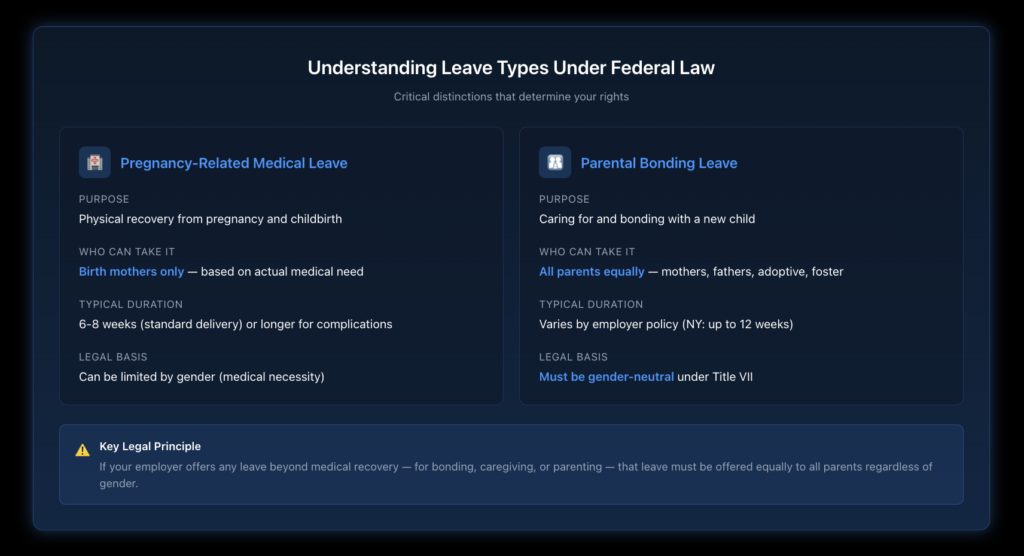
Federal law is clear on this point: while pregnancy-related medical leave can be limited to employees who are actually pregnant or recovering from childbirth, leave for bonding with a new child must be provided equally to men and women. This distinction is critical because many employers conflate these two types of leave.
How Does Title VII Protect Parents From Discrimination?
Title VII of the Civil Rights Act, as amended by the Pregnancy Discrimination Act, prohibits sex-based discrimination in all aspects of employment—including leave policies. The EEOC’s enforcement guidance specifically addresses how this applies to caregiving responsibilities.
The key principle is straightforward: if an employer provides parental leave for bonding with a new child, that leave must be available to mothers and fathers on identical terms. An employer cannot offer mothers 16 weeks of bonding leave while limiting fathers to 2 weeks. Such policies reflect and reinforce the stereotype that women are naturally the primary caregivers—and that stereotype has no place in employment decisions.
What’s the Difference Between Medical Leave and Bonding Leave?
Understanding this distinction is essential for evaluating whether a leave policy discriminates:
Pregnancy-related medical leave covers the period when the birth mother is physically recovering from pregnancy and childbirth. This type of leave can legally be limited to individuals who are actually pregnant or recovering from delivery. The duration depends on medical necessity—typically 6-8 weeks for a standard delivery or longer for complications or cesarean births.
Parental bonding leave is time provided to care for and bond with a new child. This leave must be offered equally to all parents regardless of gender. It applies to birth parents (after medical recovery), adoptive parents, and foster parents. There’s no legitimate medical reason to offer different amounts of bonding time based on a parent’s gender.
Why Do “Primary Caregiver” Policies Often Violate the Law?
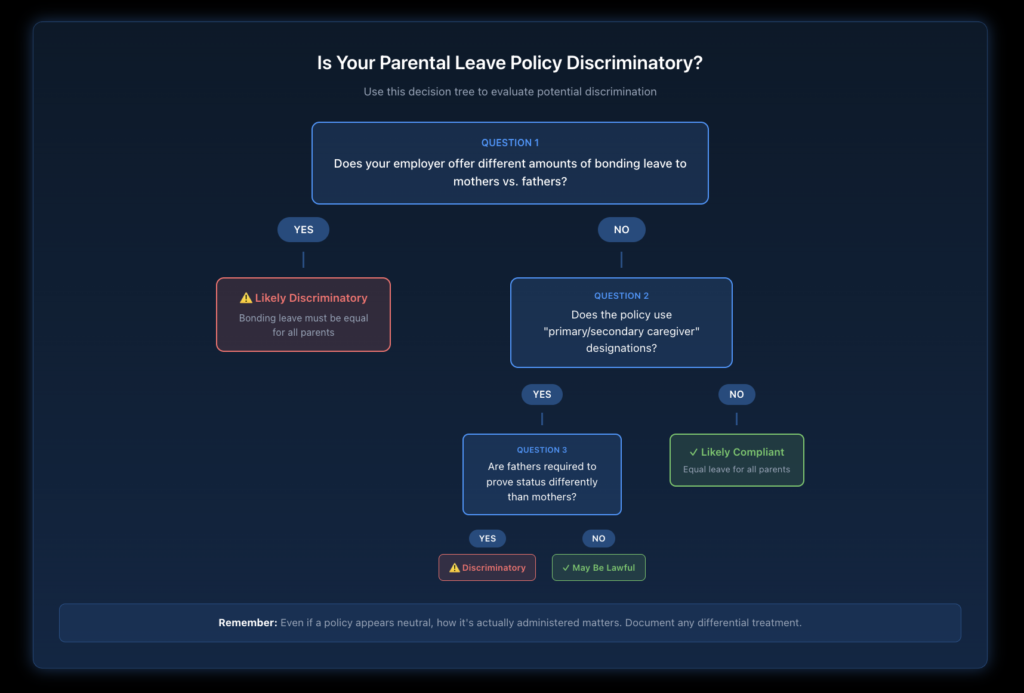
Many employers have adopted “primary caregiver” and “secondary caregiver” designations in their leave policies, offering significantly more leave to primary caregivers. On paper, these policies appear gender-neutral. In practice, they often discriminate.
The problem arises when employers administer these policies in ways that assume mothers are primary caregivers and fathers are secondary caregivers. The EEOC has investigated and taken action against companies where:
- Human resources automatically designated birth mothers as primary caregivers
- Fathers faced additional burdens to prove “primary caregiver” status that mothers didn’t face
- The policy language defined primary caregivers in ways that effectively excluded most fathers
If your employer has a primary/secondary caregiver policy, examine how it’s actually implemented. Does the company make it equally easy for fathers and mothers to qualify as primary caregivers? If not, the policy may violate Title VII regardless of its neutral language.
What New York-Specific Protections Apply to Parental Leave?
New York offers some of the strongest parental leave protections in the nation, going beyond federal minimums to provide paid, job-protected time off for all parents.
How Does New York Paid Family Leave Work?
The New York Paid Family Leave program provides eligible employees with up to 12 weeks of job-protected, paid time off to bond with a newly born, adopted, or fostered child. For 2025, employees receive 67% of their average weekly wage, up to a maximum of $1,177.32 per week.
Critically, this benefit is completely gender-neutral. Both mothers and fathers are entitled to the same 12 weeks of bonding leave under the same terms. The program specifically recognizes that all parents—regardless of gender—deserve time to bond with their children.
To be eligible, you must:
- Work for a covered employer (all private employers in New York)
- Work 20 or more hours per week and have been employed for at least 26 consecutive weeks, OR
- Work less than 20 hours per week and have worked 175 days for your employer.
How Does New York Paid Family Leave Compare to FMLA?
The Family and Medical Leave Act provides up to 12 weeks of unpaid, job-protected leave for bonding with a new child. However, FMLA only covers employers with 50 or more employees, and you must have worked at least 1,250 hours in the past year to qualify.
New York’s Paid Family Leave fills significant gaps in federal protection:
- It covers all private employers regardless of size
- It provides partial wage replacement (FMLA is unpaid)
- It has more accessible eligibility requirements
- It can be used in addition to or in coordination with FMLA
Many New York employees can combine both protections, using FMLA leave for medical recovery and NY PFL for additional bonding time.
Does the New York State Human Rights Law Provide Additional Protection?
The New York State Human Rights Law and the NYC Human Rights Law prohibit sex discrimination in employment, including discrimination based on gender stereotypes. These laws provide broader protections than federal law in several ways:
- The State Human Rights Law covers employers with 4 or more employees
- The NYC Human Rights Law covers employers with 4 or more employees in the city
- Both laws explicitly prohibit caregiver discrimination
- Filing deadlines are longer (1 year for state, 3 years for NYC vs. 300 days for EEOC)
If you face discrimination related to parental leave in New York, you have multiple avenues for filing complaints and may benefit from these enhanced state and local protections.
What Does Gender Stereotyping Look Like in Parental Leave Decisions?
Gender stereotyping in the workplace has been illegal since the Supreme Court’s landmark ruling in Price Waterhouse v. Hopkins. That case established that employment decisions based on expectations about how men and women “should” behave constitute sex discrimination under Title VII.
What Are Common Examples of Stereotyping in Leave Policies?
Parental leave discrimination based on gender stereotypes can take many forms:
Policy-level stereotyping occurs when the leave policy itself treats parents differently based on gender. Examples include offering mothers 12 weeks of bonding leave while offering fathers only 2 weeks, or automatically designating birth mothers as “primary caregivers” entitled to enhanced benefits.
Administrative stereotyping happens when a facially neutral policy is applied in discriminatory ways. Human resources might require fathers to submit additional documentation to prove they’re the primary caregiver, or supervisors might discourage men from taking their full leave entitlement.
Cultural stereotyping manifests through informal pressure and assumptions. Male employees might face ridicule for taking parental leave or receive messages that doing so will hurt their career advancement. Mothers might be assumed to want reduced responsibilities after returning from leave, even when they’ve expressed otherwise.
How Did the Price Waterhouse Case Establish the Law on Stereotyping?
In Price Waterhouse v. Hopkins, the Supreme Court ruled that Title VII prohibits employment decisions based on gender stereotypes—not just discrimination based on biological sex. Ann Hopkins was denied a partnership at an accounting firm after being told to “walk more femininely, talk more femininely, dress more femininely, wear makeup, have her hair styled, and wear jewelry.”
The Court held that “we are beyond the day when an employer could evaluate employees by assuming or insisting that they matched the stereotype associated with their group.” This principle applies directly to parental leave policies: employers cannot assume that women will be the primary caregivers and men will be secondary caregivers simply because of their gender.
What If My Employer’s Policy Seems Neutral But Is Applied Unfairly?
A policy that looks gender-neutral on paper can still be discriminatory if it’s administered in ways that favor one gender over another. Courts and the EEOC examine how policies actually function, not just what they say.
Red flags that a facially neutral policy may be discriminatory include:
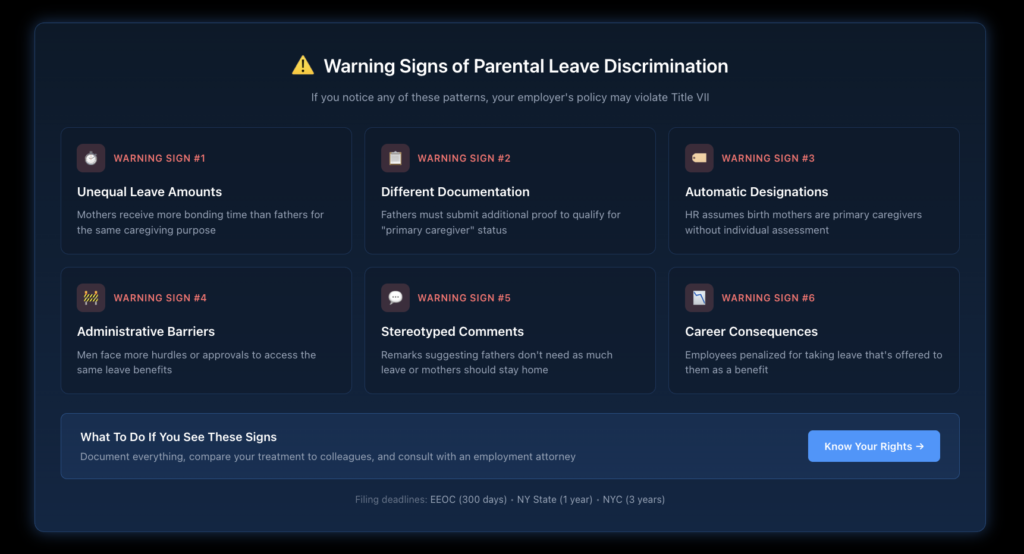
- Different documentation requirements for men and women claiming primary caregiver status
- Informal guidance from HR that assumes mothers are primary caregivers
- Different levels of supervisor approval are required based on the employee’s gender
- Patterns showing that men who request primary caregiver status are routinely denied, while women are approved
If you suspect your employer’s leave policy discriminates in practice, document every interaction and compare your experience to that of colleagues of a different gender.
What Rights Do Fathers Have to Parental Leave?
Fathers have the same legal right to parental leave for bonding with a new child as mothers do. Despite this legal reality, many employers continue to treat fathers’ leave requests differently—and many fathers don’t realize they have the right to push back.
Can Employers Deny Fathers the Same Leave Mothers Receive?
No. If an employer provides leave beyond pregnancy-related medical recovery—meaning leave specifically for bonding with and caring for a new child—that leave must be available to fathers on the same terms as mothers. The EEOC has made this explicitly clear: “if an employer extends leave to new mothers beyond the period of recuperation from childbirth, it cannot lawfully refuse to provide an equivalent amount of leave to new fathers for the same purpose.”
Several high-profile enforcement actions have reinforced this principle. Companies have paid millions of dollars to settle claims that their parental leave policies discriminated against fathers by offering them less leave or making it harder for them to qualify for enhanced benefits.
What Should Fathers Do If They Face Resistance to Taking Leave?
If you’re a father facing barriers to taking parental leave, take these steps:
Request the policy in writing. Ask your HR department for a written copy of the parental leave policy. Having documentation makes it easier to identify discriminatory provisions or administration.
Compare your treatment to mothers. If mothers in your workplace receive different benefits or face fewer hurdles, document these differences specifically.
Document all communications. Save emails, take notes on conversations, and keep records of any statements suggesting that fathers aren’t expected to take full leave or serve as primary caregivers.
Request equal treatment formally. If your initial request for leave is denied or limited, submit a formal written request citing your right to equal treatment under Title VII and applicable state laws.
Consider filing a complaint. If your employer continues to deny you equal leave benefits, you can file a charge with the EEOC or the applicable state or local agency.
How Can Employers Create Truly Gender-Neutral Policies?
Employers who want to avoid discrimination liability—and who genuinely want to support all parents—should structure their policies carefully:
Separate medical leave from bonding leave. Clearly distinguish between leave for pregnancy-related recovery (which can be limited to birth mothers based on medical need) and leave for bonding with a new child (which must be equal).
Avoid primary/secondary caregiver designations. Unless the employer can administer these categories in a truly gender-neutral way, they create significant legal risk. Consider simply offering the same amount of leave to all new parents.
Train HR and supervisors. Ensure everyone involved in administering leave understands that gender-based assumptions are prohibited. A supervisor’s offhand comment that “dads don’t really need that much time off” can become evidence of discriminatory intent.
Audit the policy’s implementation. Review whether fathers and mothers are actually approved for leave at the same rates and for the same durations.
How Do Parental Leave Stereotypes Affect Career Advancement?
The discrimination doesn’t always stop at the leave policy itself. Employees—particularly women—often face negative career consequences after taking parental leave, rooted in the same stereotypes about caregiving roles.
What Is the “Motherhood Penalty” in the Workplace?
Research consistently shows that mothers face disadvantages in hiring, pay, and promotion compared to equally qualified women without children. This “motherhood penalty” stems from employer assumptions that mothers will be less committed to work, less available for overtime or travel, and more likely to leave the workforce.
These assumptions constitute illegal sex discrimination when they result in adverse employment decisions. The EEOC’s guidance on caregiver discrimination specifically addresses treating female caregivers differently from male caregivers or treating mothers differently from childless women.
What Protections Exist Against Retaliation for Taking Leave?
Taking parental leave is a protected activity under multiple laws. Employers cannot retaliate against employees for requesting or taking leave they’re entitled to. Retaliation can take many forms:
- Termination or demotion after returning from leave
- Negative performance reviews based on the leave period
- Exclusion from projects, meetings, or advancement opportunities
- Reassignment to less desirable positions or shifts
- Hostile treatment from supervisors or coworkers
Both FMLA and New York Paid Family Leave include strong anti-retaliation protections. If you experience negative consequences after taking parental leave, document everything and consult with an employment attorney about your options.
What Should You Do If You Face Discrimination After Returning From Leave?
If you experience adverse treatment after taking parental leave:
Document the change. Compare your treatment before and after leaving. Note changes in assignments, evaluations, access to advancement opportunities, or how supervisors and colleagues interact with you.
Review your performance history. Strong performance reviews before leave, followed by criticism after leave, can be evidence of discrimination, especially if the criticism relates to perceived commitment or availability.
Identify comparators. Are employees who didn’t take parental leave (or who took less leave) treated differently? Are employees of a different gender treated differently after taking leave?
Report through internal channels. Many employers have policies requiring you to report discrimination concerns before taking external action. Follow these procedures, but keep copies of everything you submit.
Know your filing deadlines. Claims must be filed within specific timeframes—180 or 300 days with the EEOC (depending on your state), one year with the New York State Division of Human Rights, or three years under the NYC Human Rights Law.
How Do You Document and Report Parental Leave Discrimination?
If you believe your employer’s parental leave policy or its administration discriminates based on gender, effective documentation and understanding your reporting options are essential.
What Evidence Helps Prove Parental Leave Discrimination?
Strong evidence of discrimination includes:
Policy documents. Written policies showing different leave amounts or eligibility requirements based on gender, or “primary caregiver” definitions that effectively exclude one gender.
Communications. Emails, messages, or written notes documenting statements about gender roles, caregiving expectations, or differential treatment.
Comparator evidence. Specific examples of how employees of a different gender were treated differently—approved for more leave, faced fewer barriers to qualifying for enhanced benefits, or experienced less retaliation after taking leave.
Statistical patterns. Data showing that primary caregiver requests from fathers are denied at higher rates than similar requests from mothers, or that mothers experience more adverse actions after returning from leave.
Witness statements. Colleagues who can corroborate discriminatory statements or differential treatment.
Where Can You File a Complaint About Leave Discrimination?
Several agencies handle parental leave discrimination complaints:
Equal Employment Opportunity Commission (EEOC): Enforces federal employment discrimination laws, including Title VII. You generally have 300 days from the discriminatory act to file in states with state enforcement agencies like New York.
New York State Division of Human Rights: Handles claims under the State Human Rights Law. Filing deadline is one year from the discriminatory act.
NYC Commission on Human Rights: For employees in New York City, offers the broadest protections and longest filing deadline (three years).
You can often file with one agency and have it cross-filed with others through worksharing agreements. An employment attorney can help you determine the best strategy for your specific situation.
Ready to Take Action?
If you’ve experienced discrimination related to parental leave policies or gender stereotypes in the workplace, Nisar Law Group can help. Our employment law attorneys have extensive experience protecting employee rights across New York and New Jersey. We understand how parental leave discrimination works in practice—and we know how to build effective cases against employers who violate the law.
Contact us today for a consultation to discuss your situation and learn about your options.
Frequently Asked Questions About Parental Leave and Gender Stereotypes
Not for bonding leave. While employers can limit pregnancy-related medical leave to birth mothers recovering from pregnancy and childbirth, any leave provided specifically for bonding with and caring for a new child must be offered equally to mothers and fathers. The EEOC has clearly stated that if an employer extends leave beyond the period of recuperation from childbirth, it must provide equivalent leave to fathers for the same purpose.
Examine how the policy is actually administered. If the company makes it harder for fathers to qualify as primary caregivers, or if HR assumes birth mothers are automatically the primary caregiver, the policy may violate Title VII even if it appears gender-neutral on paper. Document any differential treatment and compare your experience to employees of a different gender before deciding whether to file a complaint.
Yes, absolutely. New York’s Paid Family Leave program is completely gender-neutral. Both mothers and fathers are entitled to up to 12 weeks of paid, job-protected leave to bond with a newly born, adopted, or fostered child. For 2025, employees receive 67% of their average weekly wage up to $1,177.32 per week, regardless of gender.
No. Both FMLA and New York Paid Family Leave include strong anti-retaliation protections. Employers cannot terminate, demote, or otherwise punish employees for requesting or taking parental leave they’re entitled to. If you experience adverse treatment after taking leave, document everything and consult with an employment attorney about your options.
Legally, the only legitimate difference is pregnancy-related medical leave—the time a birth mother needs to physically recover from pregnancy and childbirth. This medical leave can be limited to those who actually gave birth. However, “bonding leave” or “parental leave” for caring for a new child must be provided equally to all parents regardless of gender. The terms “maternity leave” and “paternity leave” can be misleading because they suggest a distinction that federal law doesn’t recognize for bonding time.
Deadlines vary by agency. For the EEOC, you generally have 300 days from the discriminatory act in New York. For the New York State Division of Human Rights, the deadline is one year. For the NYC Commission on Human Rights, you have three years. Because these deadlines are strict, you should consult with an attorney promptly if you believe you’ve experienced discrimination.
New York law sets minimum requirements for parental leave, but it doesn’t authorize discrimination. Any state law mandating parental leave applies equally to all genders. If your employer claims a discriminatory policy is required by law, request the specific legal citation and consult with an employment attorney to evaluate the claim.

