

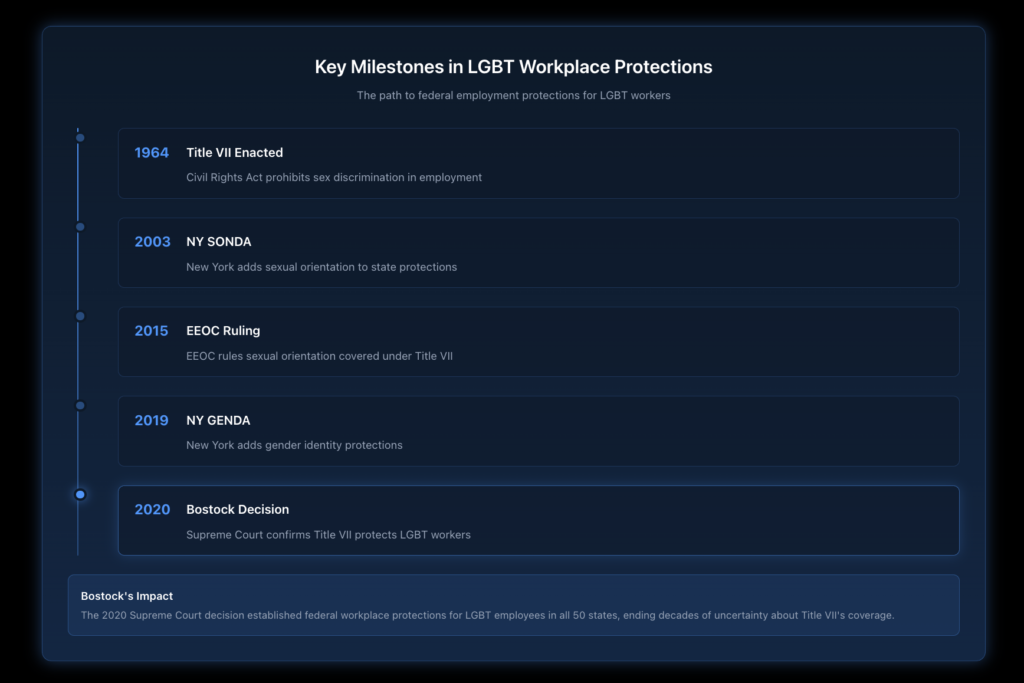
Bostock v. Clayton County is the 2020 Supreme Court ruling that made it illegal under federal law for employers to fire or refuse to hire someone for being gay or transgender. The Court held 6-3 that such discrimination is “sex discrimination” under Title VII, giving LGBT workers in all 50 states federal employment protections.
The ruling was straightforward in its logic: if you fire a man for being attracted to men but wouldn’t fire a woman for the same attraction, you’re treating him differently because of his sex. That’s exactly what Title VII prohibits. The same reasoning applies to transgender employees—penalizing someone for identifying with a different gender than their biological sex necessarily involves considering their sex.
For LGBTQ workers facing workplace discrimination, Bostock transformed the legal landscape. Before June 2020, workers in over half the states had no federal protection against being fired for their sexual orientation or gender identity. Now they do—though New York employees have even stronger protections under state and city law that go beyond what federal law provides.
Key Takeaways
- Federal protection is nationwide. Title VII now covers sexual orientation and gender identity discrimination for employers with 15+ workers in every state.
- The core ruling remains intact. Despite shifts in federal enforcement priorities, Bostock has not been overturned, and employers cannot legally fire you for being gay or transgender.
- New York offers broader coverage. State and NYC laws protect workers at companies with just 4 employees and provide longer filing deadlines.
- Filing deadlines are strict. You have 300 days to file with the EEOC, one year for NY State, or three years for NYC court filings—miss these and you may lose your claim.
- Documentation matters. Save everything: emails, texts, performance reviews, and notes about what was said and when.
Disclaimer: This article provides general information for informational purposes only and should not be considered a substitute for legal advice. It is essential to consult with an experienced employment lawyer at our law firm to discuss the specific facts of your case and understand your legal rights and options. This information does not create an attorney-client relationship.
What Was the Supreme Court's Decision in Bostock v. Clayton County?
The Supreme Court ruled that firing someone for being gay or transgender violates Title VII’s prohibition on sex discrimination. Justice Neil Gorsuch wrote the majority opinion, joined by Chief Justice Roberts and Justices Ginsburg, Breyer, Sotomayor, and Kagan.
The decision was notable for its textualist approach. Gorsuch, known as a conservative justice, argued that the plain text of Title VII—which prohibits discrimination “because of sex”—necessarily covers sexual orientation and gender identity. No creative interpretation required.
How Did the Court Reach This Conclusion?
The Court used a simple but powerful logical test: change only the employee’s sex and see if the outcome changes.
Take a man attracted to other men. If his employer fires him for that attraction but wouldn’t fire a woman attracted to men, then the man’s sex is clearly a factor in the decision. That’s sex discrimination under Title VII, even if the employer frames it as being about “sexual orientation.”
The same analysis works for gender identity discrimination. An employer who fires a transgender woman (assigned male at birth, identifies as female) but wouldn’t fire a cisgender woman presenting the same way has discriminated based on sex.
What Cases Were Consolidated with Bostock?
The Supreme Court decided three cases together, each representing a different type of discrimination:
Gerald Bostock worked as a child welfare services coordinator in Clayton County, Georgia, for over a decade. After joining a gay recreational softball league, he was fired for “conduct unbecoming of a county employee.” His case challenged sexual orientation discrimination.
Donald Zarda worked as a skydiving instructor at Altitude Express in New York. He was terminated days after casually mentioning he was gay. His case also addressed sexual orientation.
Aimee Stephens worked at R.G. & G.R. Harris Funeral Homes in Michigan. After six years of employment, she informed her employer that she would begin living and working as a woman. She was fired before she could transition at work. Her case addressed transgender discrimination.
Both Zarda and Stephens passed away before the ruling, but their estates continued the fight and helped establish protections for millions of workers.
What Impact Does Bostock Have on LGBTQ+ Employees?
The practical impact has been enormous. Before Bostock, federal protection against sexual orientation discrimination existed only in states that had enacted their own laws—roughly 22 states and D.C. Workers in the remaining 28 states had no clear federal recourse if fired for being gay or transgender.
Now, every LGBT employee at a covered employer has federal protection, regardless of where they live or work.
What Employment Decisions Are Covered?
Bostock’s protections extend to every aspect of employment:
- Hiring and firing – Employers cannot refuse to hire or terminate someone for being LGBT
- Promotions and demotions – Sexual orientation and gender identity cannot factor into advancement decisions
- Compensation – Pay and benefits must be equal regardless of LGBT status
- Job assignments – Employers cannot relegate LGBT workers to less desirable positions
- Training opportunities – Access to professional development must be equal
- Terms and conditions – All workplace policies must apply equally
If an employer treats you worse in any of these areas because you’re gay or transgender, that’s a potential Title VII violation.
Who Is Protected Under the Ruling?
Title VII coverage applies to:
- Employees of private employers with 15 or more workers
- State and local government employees
- Employees of educational institutions
- Employment agencies and labor unions
Federal employees have separate protections under different statutes but enjoy comparable rights.
Who isn’t covered federally? Workers at small businesses with fewer than 15 employees and independent contractors don’t fall under Title VII. However, New York state and city laws fill this gap for workers in our area.
Does Bostock Protect Gender Identity?
Yes—explicitly and unequivocally. The Supreme Court addressed transgender employees directly in its ruling, holding that discrimination against transgender individuals is inherently sex discrimination.
The Court’s reasoning was clear: you cannot discriminate against someone for being transgender without taking their sex into account. If an employer fires an employee identified as male at birth for now identifying as female, but wouldn’t fire an employee identified as female at birth for the same presentation, the employer has discriminated based on sex.
How Does This Apply to Transgender Workers?
Transgender protections under Bostock cover:
- Transitioning employees – Employers cannot fire workers who announce plans to transition
- Transgender status itself – An employer cannot terminate someone simply for being transgender, regardless of whether they’ve transitioned.
- Medical treatment – Firing someone for seeking gender-affirming care likely violates Title VII
What About Gender Expression and Transition?
Courts have applied Bostock’s reasoning to harassment and adverse employment actions involving gender expression. An employer who enforces dress codes differently based on sex—tolerating certain presentations for female employees but not male employees, or vice versa—is engaging in sex discrimination.
This doesn’t mean employers can’t have dress codes. It means they can’t enforce them in ways that single out transgender employees or treat similarly situated employees differently based on sex.
Does Bostock Affect Bathroom Policies?
This is the most contested area post-Bostock. Justice Gorsuch explicitly stated the Court was “not purport[ing] to address bathrooms, locker rooms, or anything else of the kind” in its decision. He left those questions for another day.
The EEOC previously issued guidance suggesting that denying transgender employees access to facilities consistent with their gender identity could constitute harassment. However, this guidance has been rescinded under the current administration.
What Is the Current State of Bathroom Access Laws?
The legal landscape is genuinely unsettled. Some federal courts have applied Bostock’s reasoning to facility access, finding that excluding transgender employees from appropriate bathrooms constitutes sex discrimination. Other courts have distinguished bathroom policies from hiring and firing decisions, declining to extend Bostock.
What’s clear: Bostock itself doesn’t directly require anything regarding bathrooms. What’s unclear: whether the reasoning in Bostock will eventually extend to facility access as courts continue to grapple with the issue.
What Should Employees Know About This Issue?
If you’re facing bathroom-related discrimination at work, the strength of your legal claim may depend on your circuit court’s interpretation of Bostock and whether you have state or local protections. In New York, the state Human Rights Law and NYC Human Rights Law provide additional protections that may cover facility access issues even if federal law doesn’t clearly apply.
Why Was Bostock Fired?
Gerald Bostock’s story illustrates how discrimination often works in practice—rarely overt, frequently disguised.
Bostock worked for Clayton County, Georgia, for over a decade as a child welfare services coordinator. He won awards for his work. He was well-regarded by colleagues. Nothing in his employment record suggested problems.
In 2013, Bostock joined a gay recreational softball league—the Hotlanta Softball League. Shortly after, influential members of the community allegedly made disparaging comments about his participation. Soon, the county conducted an audit of program funds Bostock managed and fired him for “conduct unbecoming of a county employee.”
Was This Pretextual Termination?
The pattern is classic pretextual termination: a long-tenured employee with a strong record suddenly faces scrutiny and discipline after revealing information about their LGBT status. The stated reason for termination—vague “conduct unbecoming”—provided cover for what was actually discrimination.
Employers rarely announce discriminatory motives. They cite performance issues, policy violations, restructuring, or attitude problems. The key to proving discrimination is often showing that the stated reason doesn’t hold up: the employee’s record was actually strong, the policy wasn’t consistently enforced, or similarly situated non-LGBT employees weren’t disciplined the same way.
What Can Workers Learn from Bostock’s Experience?
Bostock’s case offers practical lessons:
Document your performance. Keep copies of positive reviews, awards, commendations, and any written praise. Bostock’s strong track record helped demonstrate that the county’s stated reason was pretextual.
Note the timing. If adverse treatment begins shortly after you come out, disclose a same-sex relationship, or begin transitioning, that timing can be powerful evidence of discrimination.
Preserve communications. Save emails, texts, and Slack messages—especially anything suggesting bias. Effective documentation can make or break a discrimination case.
Identify witnesses. Think about who saw what happened and might corroborate your account.
Is Bostock Still Good Law?
Yes—Bostock remains binding Supreme Court precedent. The ruling has not been overturned, modified, or undermined by subsequent decisions. Its core holding—that firing someone for being gay or transgender violates Title VII—is fully enforceable federal law.
What About Recent Enforcement Changes?
Federal enforcement priorities have shifted, particularly regarding issues beyond hiring and firing. The current EEOC has:
- Rescinded previous guidance on gender identity and bathroom access
- Announced narrower enforcement priorities focused on “protecting women” rather than transgender individuals
- Removed materials from its website addressing gender identity protections
However, these administrative changes don’t alter Bostock’s holding. The EEOC cannot overrule the Supreme Court. If your employer fires you for being gay or transgender, you still have a federal claim under Title VII—regardless of the EEOC’s current enforcement posture.
What has changed: the EEOC may be less likely to pursue your claim aggressively or issue right-to-sue letters promptly. What hasn’t changed: your right to bring a private lawsuit.
How Do State Laws Interact with Bostock?
State laws provide crucial additional protections. New York’s Sexual Orientation Non-Discrimination Act (SONDA) has prohibited sexual orientation discrimination since 2003, and the Gender Expression Non-Discrimination Act (GENDA) added explicit gender identity and expression protections in 2019.
These state laws:
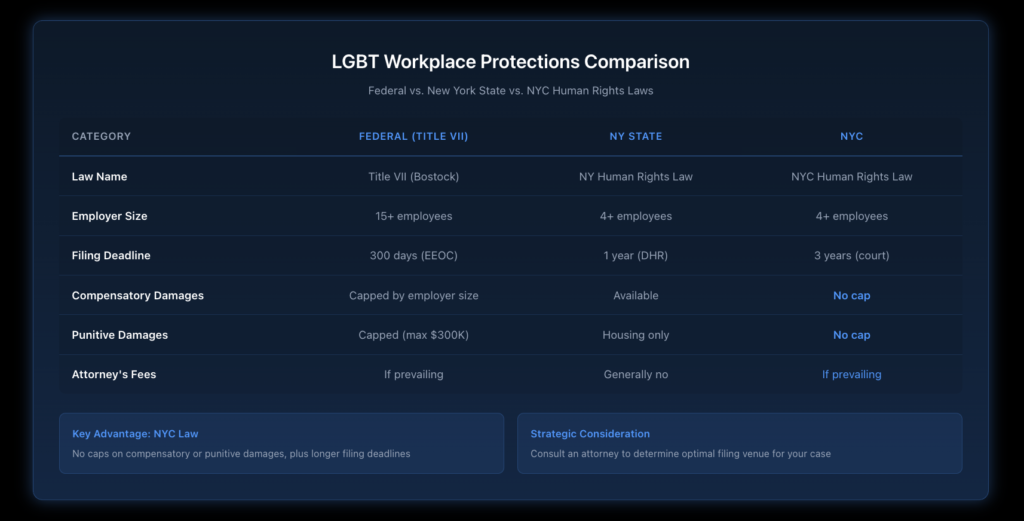
- Cover employers with 4+ employees (vs. Title VII’s 15-employee threshold)
- Provide a one-year filing deadline with the state Division of Human Rights
- Allow direct court filings with a three-year statute of limitations
- Don’t depend on federal enforcement priorities
What Protections Do New York LGBT Workers Have?
New York employees have some of the strongest LGBT workplace protections in the country. Three layers of law—federal, state, and city—provide overlapping safeguards.
What Does State Law Provide?
The New York State Human Rights Law prohibits discrimination based on sexual orientation, gender identity, and gender expression. Key features:
- Covers smaller employers. State law applies to employers with just four employees, capturing many small businesses exempt from federal law.
- A broad definition of sexual orientation. SONDA defines sexual orientation as “heterosexuality, homosexuality, bisexuality, or asexuality.”—New York was the first state to explicitly include asexuality.
- Actual or perceived status. Protection applies whether discrimination is based on your actual orientation/identity or what someone perceives it to be.
- One-year filing deadline. Complaints must be filed with the NY Division of Human Rights within one year of the discrimination.
What Additional Protections Does NYC Offer?
The New York City Human Rights Law is among the most protective in the nation:
- Four-employee threshold. Same as state law.
- Three-year statute of limitations. Significantly longer than federal or state administrative deadlines.
- No damage caps. Unlike federal law, NYC doesn’t cap compensatory or punitive damages.
- Attorney’s fees available. Prevailing plaintiffs can recover legal costs.
- Broader coverage. Includes independent contractors in some circumstances.
For NYC workers, the city’s Human Rights Law often provides the strongest avenue for relief.
How Do You File a Discrimination Claim?
If you’ve experienced LGBT workplace discrimination, you have multiple options for pursuing a claim. The right choice depends on your employer’s size, where you work, when the discrimination occurred, and what remedies you’re seeking.
What Are the Federal Filing Requirements?
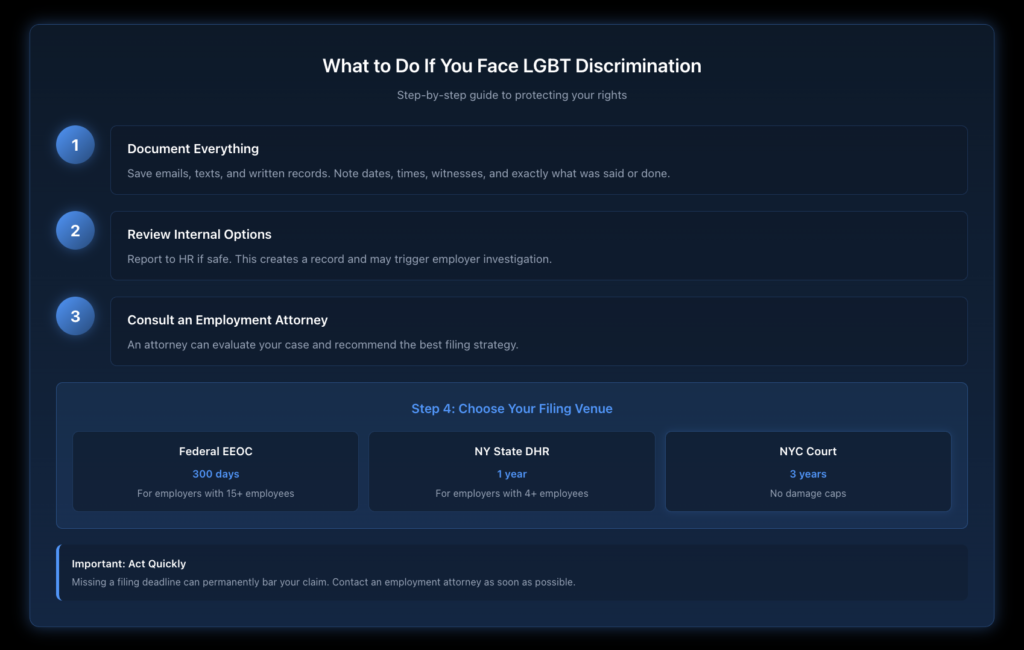
To pursue a Title VII claim, you must first file a charge with the EEOC. In New York, you have 300 days from the discriminatory act to file (states without their own agencies have 180 days).
The EEOC will:
- Notify your employer of the charge
- Investigate your allegations
- Attempt to resolve the matter through mediation
- Either take action itself or issue a “right to sue” letter
Once you receive a right-to-sue letter, you have 90 days to file a lawsuit in federal court.
What Are the State and Local Options?
New York State Division of Human Rights:
- File within one year of the discrimination
- The agency investigates and can hold hearings
- Filing with the state preserves your rights while the claim is pending
Direct court filing (state law):
- File within three years of the discrimination
- Skip administrative proceedings entirely
- Go directly to the state court
NYC Commission on Human Rights:
- File within one year for the administrative process
- Three years for direct court filing
- Additional remedies available under city law
Can You File Multiple Claims?
Federal and state claims can generally proceed together, but you typically must choose between filing with the state Division of Human Rights or going directly to state court. An experienced employment attorney can help you determine the optimal strategy—which often depends on your specific damages, the strength of your evidence, and strategic considerations about which forum is most favorable.
What Remedies Are Available?
Successful discrimination claims can result in significant relief, both monetary and non-monetary.
What Monetary Damages Can You Recover?
- Back pay. Wages and benefits you would have earned but for the discrimination.
- Front pay. Future lost earnings if reinstatement isn’t feasible.
- Compensatory damages. Payment for emotional distress, humiliation, and suffering.
- Punitive damages. Additional damages to punish particularly egregious conduct (available under federal and NYC law, limited under state law).
Federal law caps compensatory and punitive damages based on employer size:
- 15-100 employees: $50,000
- 101-200 employees: $100,000
- 201-500 employees: $200,000
- 500+ employees: $300,000
NYC law has no such caps, making city claims potentially more valuable for significant damages.
What Non-Monetary Relief Is Possible?
Courts can order:
- Reinstatement to your position
- Promotion if you were wrongfully denied advancement
- Policy changes to prevent future discrimination
- Anti-discrimination training for managers and employees
- Expungement of negative information from your personnel file
Need Legal Help?
If you’re experiencing discrimination based on your sexual orientation or gender identity, the employment attorneys at Nisar Law Group can help you understand your rights and options. We represent LGBT workers throughout New York and New Jersey in discrimination, harassment, and retaliation cases.
Contact us today for a consultation to discuss your situation.
Frequently Asked Questions About Bostock v. Clayton County
The Supreme Court ruled 6-3 that Title VII of the Civil Rights Act of 1964 prohibits employment discrimination based on sexual orientation and gender identity. Justice Gorsuch’s majority opinion held that you cannot discriminate against someone for being gay or transgender without discriminating based on sex, which Title VII has prohibited since 1964. The decision applies nationwide to all employers with 15 or more employees.
Yes, Bostock remains a binding Supreme Court precedent and has not been overturned or modified. While EEOC enforcement priorities have shifted under the current administration—particularly regarding bathroom access and pronoun policies—the core holding that employers cannot fire or refuse to hire someone for being gay or transgender is fully enforceable. Private lawsuits remain available regardless of federal enforcement posture.
Bostock established federal employment protections for LGBT workers in all 50 states. Before the ruling, workers in more than half the states had no clear federal protection against sexual orientation or gender identity discrimination. The decision has been cited in over 250 subsequent cases and influenced protections in housing, healthcare, and education under other federal anti-discrimination laws.
Yes, explicitly. The Supreme Court held that discrimination against transgender employees is sex discrimination under Title VII. You cannot penalize someone for identifying with a gender different from their biological sex without taking their sex into account. This protection covers being transgender, transitioning at work, and seeking gender-affirming medical care.
Not directly. Justice Gorsuch explicitly stated the Court was not addressing “bathrooms, locker rooms, or anything else of the kind.” Lower courts have split on whether Bostock’s reasoning extends to facility access. The legal landscape remains unsettled, though New York state and city laws may provide additional protections that federal law doesn’t clearly cover.
Gerald Bostock worked for Clayton County, Georgia, for over a decade with an excellent performance record. After joining a gay recreational softball league in 2013, the county conducted an audit and fired him for “conduct unbecoming a county employee.” The Supreme Court’s ruling vindicated his claim that this vague justification was a pretext for sexual orientation discrimination.
Deadlines vary by venue: 300 days for federal EEOC charges in states like New York with their own enforcement agencies, one year for filing with the NY Division of Human Rights, and three years for direct court filings under New York State or City law. Missing these deadlines can permanently bar your claim, so consult an attorney promptly.
Successful claims can recover back pay, front pay, compensatory damages for emotional distress, and potentially punitive damages. Non-monetary relief includes reinstatement, policy changes, and anti-discrimination training. Federal law caps certain damages based on employer size (maximum $300,000 for large employers), while NYC law has no caps.

