

Systemic racism in employment refers to discriminatory patterns, policies, and practices embedded within workplace structures that disadvantage employees and job applicants based on race, whether intentionally or through seemingly neutral policies that produce unequal outcomes. Unlike individual acts of bias, systemic discrimination creates institutional barriers that affect entire groups of workers across hiring, promotion, compensation, and termination decisions. Federal law under Title VII of the Civil Rights Act prohibits these practices, and employees in New York have additional protections under state and city human rights laws that make challenging systemic workplace racism both possible and actionable.
Key Takeaways
- Systemic racism in employment involves patterns, policies, or practices that create widespread discriminatory effects—even without proof of intentional bias.
- The EEOC defines systemic discrimination as having “broad impact on an industry, profession, company, or geographic location”.
- Two legal theories apply: disparate treatment (intentional discrimination against a group) and disparate impact (neutral policies with discriminatory effects).
- The “four-fifths rule” helps identify potential discrimination—if a protected group’s selection rate falls below 80% of the highest group’s rate, adverse impact may exist.
- New York employees have stronger protections through the NYSHRL and NYCHRL than federal law provides.
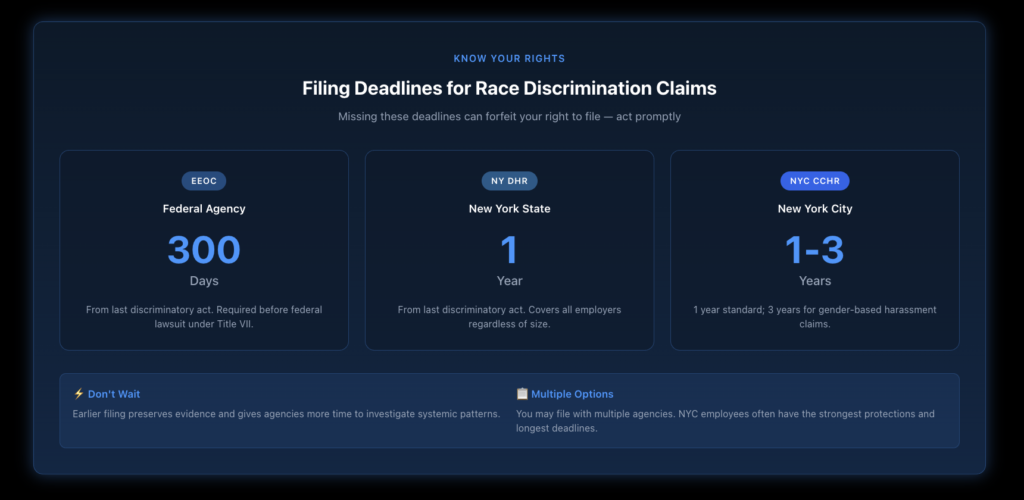
- Filing deadlines vary: 300 days for EEOC, 1 year for NY State, and 3 years for NYC claims involving harassment.
Disclaimer: This article provides general information for informational purposes only and should not be considered a substitute for legal advice. It is essential to consult with an experienced employment lawyer at our law firm to discuss the specific facts of your case and understand your legal rights and options. This information does not create an attorney-client relationship.
What Makes Discrimination "Systemic" Rather Than Individual?
The Equal Employment Opportunity Commission characterizes systemic discrimination as “bias that is built into systems, originating in the way work is organized.” This differs fundamentally from isolated incidents where one supervisor treats one employee unfairly.
How Does Systemic Discrimination Manifest in Workplaces?
Systemic racism operates through organizational structures that disadvantage certain groups of workers. It shows up in hiring practices that filter out qualified candidates, promotion pathways that favor certain groups, and policies that appear neutral but produce racially skewed outcomes.
Consider a company requiring all applicants to have criminal background checks without considering whether convictions relate to job duties. While the policy applies equally to everyone, it can disproportionately exclude qualified candidates from certain racial groups due to well-documented disparities in the criminal justice system.
What Role Do Institutional Patterns Play?
Systemic discrimination creates what courts call “built-in headwinds” for minority workers. These patterns develop over time as informal practices become standard operating procedures. Word-of-mouth recruiting that draws from predominantly white social networks, subjective promotion criteria that favor those who “fit in,” and performance evaluation systems with racially biased metrics all contribute to institutional barriers.
The New York State Division of Human Rights investigates these patterns and can order employers to change discriminatory policies, pay damages, and implement corrective measures.
What Legal Frameworks Address Systemic Racism in Employment?
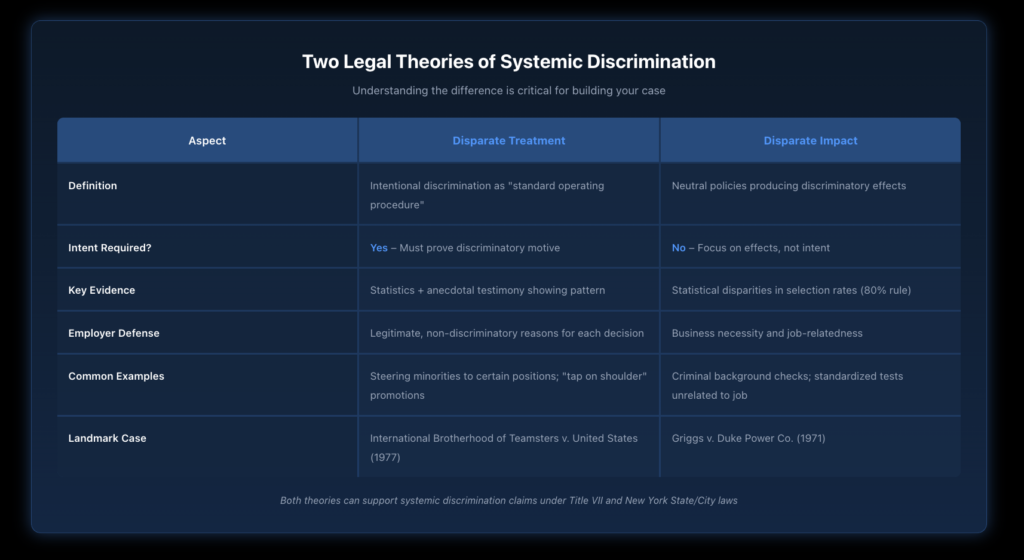
Two distinct legal theories help employees challenge systemic racism: disparate treatment and disparate impact. Understanding both is essential for building effective claims.
What Is Pattern or Practice Disparate Treatment?
Pattern or practice cases involve evidence that intentional discrimination was an employer’s “standard operating procedure.” To establish this, employees typically combine statistical evidence showing racial disparities with anecdotal testimony from workers who experienced or witnessed discrimination.
The Supreme Court established the framework for these cases in International Brotherhood of Teamsters v. United States, creating a two-phase approach. First, plaintiffs demonstrate the existence of a discriminatory pattern through statistics and testimony. If successful, the burden shifts to the employer to show that each challenged decision had legitimate, non-discriminatory reasons.
How Does Disparate Impact Theory Work?
Disparate impact, established in the landmark Griggs v. Duke Power decision, allows employees to challenge facially neutral policies that produce discriminatory effects—without proving intentional bias. The Supreme Court held that employment practices “fair in form, but discriminatory in operation” violate Title VII.
Under disparate impact theory, if an employer’s policy disproportionately affects members of a protected class, the employer must demonstrate the policy is “job-related and consistent with business necessity.” Even then, employees can prevail by showing that alternative practices would achieve the same goals with less discriminatory impact.
How Is Systemic Discrimination Identified and Measured?
Statistical analysis plays a central role in identifying and proving systemic discrimination in the workplace. The EEOC and courts rely on established benchmarks to determine when racial disparities suggest unlawful discrimination.
What Is the Four-Fifths Rule?
The Uniform Guidelines on Employee Selection Procedures established the four-fifths (or 80%) rule as a practical tool for identifying adverse impact. If the selection rate for any racial group falls below 80% of the rate for the group with the highest selection rate, this indicates potential discrimination warranting further investigation.
For example, if an employer hires 50% of white applicants but only 30% of Black applicants, the ratio is 60%—well below the 80% threshold. This triggers scrutiny but doesn’t automatically prove discrimination. Employers can defend such disparities by demonstrating legitimate business necessity.
What Types of Statistical Evidence Matter?
Effective systemic discrimination cases typically examine workforce composition compared to qualified labor pools, selection rates across demographic groups, promotion and advancement patterns, compensation disparities, disciplinary action rates, and termination statistics.
The EEOC’s Office of Enterprise Data and Analytics provides sophisticated statistical support for systemic investigations, analyzing employer data to identify patterns that individual workers might never see.
What Protections Do New York Employees Have?
New York employees benefit from some of the nation’s strongest anti-discrimination laws. Federal, state, and city protections work together to create multiple avenues for challenging systemic racism.
How Does Title VII Apply to Systemic Cases?
Title VII covers employers with 15 or more employees and prohibits both intentional discrimination and policies with unjustified disparate impact. The EEOC can pursue systemic cases through individual charges expanded into class investigations, Commissioner Charges initiated without an individual complaint, or pattern or practice lawsuits under Section 707.
In fiscal year 2023, the EEOC filed 25 lawsuits challenging systemic discrimination—nearly double the number filed in each of the previous three years—recovering over $11 million for 806 victims.
What Additional Rights Does New York State Law Provide?
The New York State Human Rights Law (NYSHRL) applies to all employers regardless of size, significantly expanding coverage beyond federal law. The NYSHRL prohibits discrimination based on race, color, and national origin, protects against harassment that “subjects an individual to inferior terms, conditions, or privileges of employment”—a lower standard than federal law’s “severe or pervasive” requirement.
Employees can file complaints with the New York State Division of Human Rights within one year of the discriminatory act. The Division investigates and can award damages, require policy changes, and impose civil penalties.
Why Is NYC Human Rights Law Particularly Powerful?
The New York City Human Rights Law (NYCHRL) provides even broader protections for employees in the five boroughs. It applies to employers with four or more workers and requires only showing that an employee was “treated less well” because of race, eliminating the need to prove “materially adverse” employment actions.
For systemic claims, the NYCHRL’s liberal construction mandate means courts must interpret the law in favor of expanded employee protections. NYC employees also have three years to file harassment-related claims, compared to one year under state law.
What Employment Practices Commonly Involve Systemic Racism?
Certain workplace practices frequently serve as vehicles for systemic discrimination. Recognizing these patterns helps employees identify when their experiences may reflect broader institutional problems.
How Do Hiring Practices Create Systemic Barriers?
Recruitment strategies that rely on employee referrals in predominantly white workforces perpetuate existing demographic imbalances. Background check policies that automatically disqualify applicants without individualized assessment often disproportionately affect Black and Hispanic candidates.
Standardized testing requirements unrelated to actual job performance—the exact issue in Griggs v. Duke Power—continue causing discriminatory effects. The EEOC has successfully challenged IQ tests, physical ability requirements, and subjective interview criteria that screen out qualified minority candidates at higher rates.
What Promotion and Advancement Issues Arise?
“Tap on the shoulder” promotion practices, where managers select candidates based on subjective perceptions of potential, frequently disadvantage employees of color who lack the same social connections with predominantly white leadership. Vague criteria like “executive presence” or “culture fit” often mask racial bias in employment decisions.
Companies maintaining segregated job categories—whether through formal policies or informal practices—face significant systemic discrimination liability. When minority employees remain concentrated in lower-paying positions despite qualifications for advancement, statistical patterns can support pattern or practice claims.
How Do Discipline and Termination Practices Reflect Systemic Issues?
Racially disparate disciplinary practices represent another common form of systemic discrimination. When employees of color receive harsher penalties for similar infractions or face heightened scrutiny compared to white colleagues, these patterns can support both individual and class-based claims.
Mass layoffs and restructurings require particular scrutiny. If reductions in force disproportionately affect minority employees, employers must be prepared to demonstrate legitimate, non-discriminatory selection criteria applied consistently.
How Can Employees Document and Challenge Systemic Discrimination?
Building a successful systemic discrimination case requires systematic documentation and strategic action. Individual employees can contribute evidence while also pursuing their own claims.
What Documentation Should Employees Gather?
Employees suspecting systemic discrimination should document demographic information they observe about hiring, promotions, and terminations. Keep records of statements suggesting bias from supervisors or colleagues, policies that seem to disadvantage certain groups, and your own experiences and those of similarly situated coworkers.
Personnel policies, job postings, performance evaluation criteria, and internal communications can all become relevant evidence. If you have access to workforce demographic data through company reports or diversity initiatives, this information may prove valuable.
What Filing Options Exist?
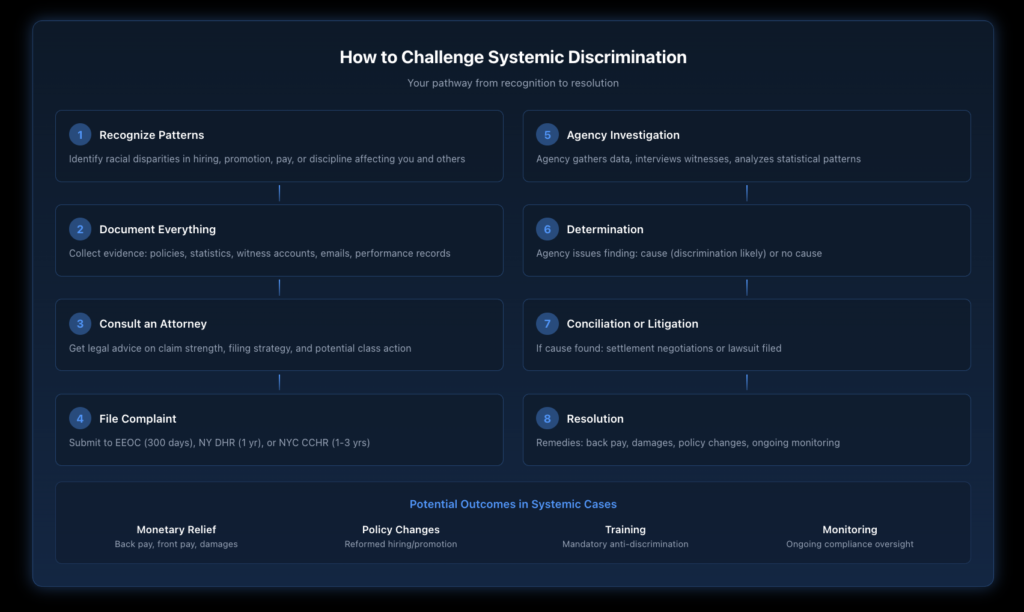
Employees can pursue claims through multiple channels. Filing with the EEOC initiates a federal investigation and preserves your right to sue. New York State and NYC agencies offer additional options with different deadlines and standards. Private lawsuits allow employees to seek damages directly, though timing and strategy matter significantly.
Connecting with other affected employees can strengthen systemic claims. Class actions and collective efforts amplify individual voices and provide broader access to evidence. An experienced employment discrimination attorney can help evaluate which approach best fits your situation.
What Remedies Are Available?
Successful systemic discrimination cases can result in back pay and front pay for lost wages, compensatory damages for emotional distress, punitive damages in cases of willful discrimination, injunctive relief requiring policy changes, and attorneys’ fees and costs.
Perhaps most significantly, systemic remedies often include structural reforms: changes to hiring practices, mandatory training, diversity reporting requirements, and ongoing monitoring. These changes benefit not just individual plaintiffs but future employees as well.
What Role Does the EEOC Play in Systemic Enforcement?
The EEOC maintains a dedicated systemic enforcement program as a top agency priority. Understanding how this program works can help employees leverage federal resources.
How Does the EEOC Identify Systemic Cases?
EEOC investigators, lead systemic coordinators, and attorneys review individual charges for potential systemic issues. When patterns emerge—multiple charges against the same employer, statistical red flags in EEO-1 data, or information from community organizations—the agency may expand investigations beyond individual complaints.
Commissioner Charges allow the EEOC to initiate investigations without individual complaints, while Directed Investigations under the Age Discrimination in Employment Act and Equal Pay Act provide additional tools for proactive enforcement.
What Happens During Systemic Investigations?
Systemic investigations involve extensive data collection and analysis. The EEOC may request years of personnel records, policy documents, and demographic data. On-site inspections, witness interviews, and expert statistical analysis help build comprehensive pictures of employer practices.
If the EEOC finds reasonable cause, it first attempts conciliation with the employer. Failing settlement, the agency can file suit—without the class certification requirements that constrain private litigation. This authority makes EEOC systemic lawsuits particularly powerful tools for addressing institutional discrimination.
Ready to Take Action Against Systemic Workplace Discrimination?
If you believe you’ve experienced or witnessed systemic racism in your workplace, you don’t have to navigate this complex legal landscape alone. Nisar Law Group represents employees facing race and national origin discrimination across New York and New Jersey, with extensive experience in both individual claims and cases involving broader discriminatory patterns. Our attorneys understand how to document systemic issues, preserve critical evidence, and pursue the remedies that can make real differences—both for you and for future employees. Contact us today for a consultation to discuss your situation.
Frequently Asked Questions About Systemic Racism in Employment
Systemic discrimination in the workplace refers to patterns, policies, or practices that create barriers for employees based on race or other protected characteristics. Unlike individual bias, systemic discrimination is embedded in organizational structures and affects entire groups of workers. It can occur through intentional pattern or practice discrimination or through neutral policies that produce discriminatory effects without intent. The EEOC defines it as discrimination with “broad impact on an industry, profession, company, or geographic location.”
Employment demonstrates systemic racism through persistent racial disparities in hiring, promotion, compensation, and termination despite legal prohibitions. Statistical data consistently show minority workers concentrated in lower-paying positions, underrepresented in management, and subjected to harsher discipline. These outcomes often result from institutional practices—like word-of-mouth recruiting, subjective promotion criteria, or criminal background policies—that perpetuate historical inequities even without conscious intent.
Systemic racism qualifies as actionable discrimination when patterns, policies, or practices disadvantage employees based on race across multiple decisions or affect multiple workers. Courts and agencies look for statistical evidence of racial disparities, anecdotal testimony corroborating discriminatory patterns, and institutional practices creating barriers. Under disparate impact theory, even facially neutral policies qualify if they produce discriminatory effects that employers cannot justify through business necessity.
Proving systemic discrimination typically requires combining statistical evidence with testimony and documentation. Statistical analysis compares selection rates, promotion patterns, and workforce composition across racial groups. The four-fifths rule provides initial guidance—selection rates below 80% of the highest group suggest potential discrimination. Anecdotal evidence from affected employees demonstrates how discriminatory patterns operated in practice. For disparate treatment claims, proof includes evidence that discrimination was the employer’s standard operating procedure.
The 80% rule, or four-fifths rule, is a benchmark established in the Uniform Guidelines on Employee Selection Procedures for identifying adverse impact. If the selection rate for any protected group falls below 80% of the selection rate for the group with the highest rate, this indicates potential discrimination warranting further investigation. For example, if 50% of white applicants are hired but only 35% of Black applicants, the ratio is 70%—below the 80% threshold. This triggers scrutiny but does not automatically establish illegal discrimination.
Effective discrimination evidence includes documentation of discriminatory statements or conduct, personnel records showing disparate treatment, statistical data demonstrating racial disparities, testimony from witnesses, company policies with discriminatory effects, and your own contemporaneous notes and records. For systemic cases, aggregated data showing patterns across multiple employees or decisions strengthens claims significantly. Both direct evidence of intent and circumstantial evidence creating inferences of discrimination can support viable claims.
Yes, employees can sue employers for racial discrimination under federal Title VII, New York State Human Rights Law, and New York City Human Rights Law. Lawsuits may seek compensatory damages for lost wages and emotional distress, punitive damages for willful discrimination, injunctive relief requiring policy changes, and attorneys’ fees. Before filing federal court suits under Title VII, employees generally must first file EEOC charges. State and city claims may proceed directly to court or through administrative agencies.
Employment racism operates at individual, institutional, and structural levels. Individual racism involves personal prejudice and discriminatory acts by specific people. Institutional racism refers to discriminatory policies and practices within particular organizations—the focus of systemic discrimination claims. Structural racism encompasses broader societal patterns that create and maintain racial inequities across institutions, including historical segregation, educational disparities, and wealth gaps that affect employment opportunities even absent specific employer misconduct.

