

When your employment ends—whether through layoffs, discrimination, or wrongful termination—the severance agreement you’re handed isn’t just paperwork. It’s a negotiation opportunity that could determine your financial stability during transition and protect your legal rights for years to come. Most employees sign without realizing they have leverage, accepting what’s often the employer’s lowest acceptable offer.
The reality is that employers expect negotiation. They build flexibility into initial offers, and employees who understand what’s negotiable—and how to ask for it—consistently secure better outcomes than those who simply accept the first terms presented.
Key Takeaways
- Severance agreements are almost always negotiable, regardless of what HR tells you.
- Employees over 40 have specific legal protections under the Older Workers Benefit Protection Act, including 21 days to review and 7 days to revoke after signing.
- Continued benefits often provide more value than additional cash due to high COBRA premiums.
- Release of claims provisions determine which legal rights you’re waiving—understand them before signing.
- If your termination involved discrimination or harassment, you likely have significant negotiation leverage.
- Non-compete clauses, reference terms, and confidentiality provisions are frequently negotiable.
- Never sign under pressure—legitimate employers understand you need time to review.
Disclaimer: This article provides general information for informational purposes only and should not be considered a substitute for legal advice. It is essential to consult with an experienced employment lawyer at our law firm to discuss the specific facts of your case and understand your legal rights and options. This information does not create an attorney-client relationship.
Why Does Your Starting Position Matter in Severance Negotiations?
Before examining the terms in front of you, understanding why you’re receiving a severance offer shapes your entire negotiation strategy. Employers don’t offer severance out of generosity—they’re buying something: your signature on a release of claims.
What Gives You Leverage in Severance Discussions?
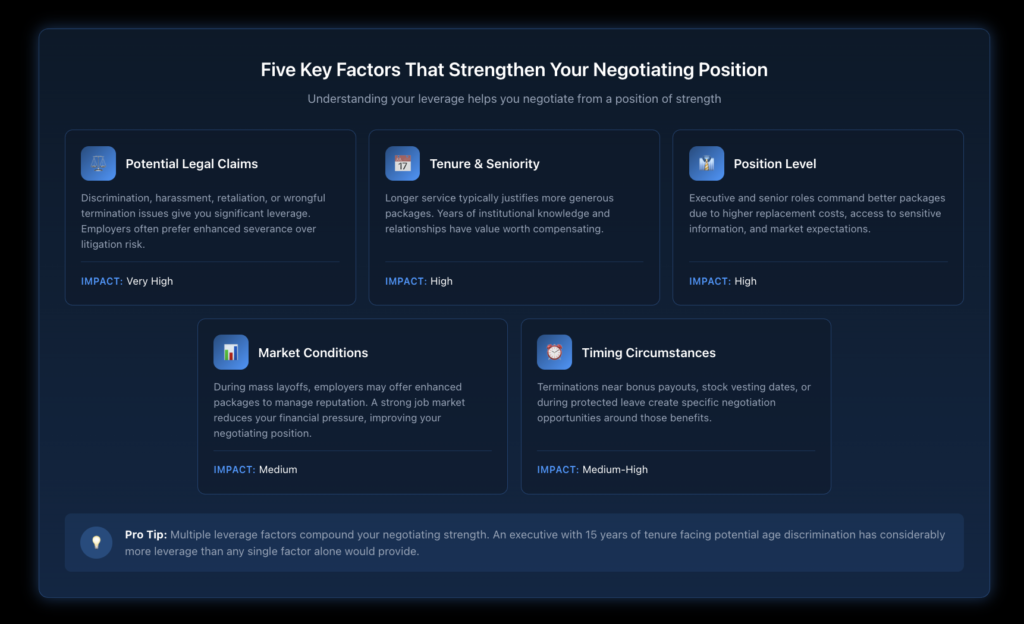
Your leverage depends largely on what the employer stands to lose if you don’t sign. If you’re facing workplace discrimination or believe your termination was wrongful, your severance negotiation takes on a completely different dynamic. Employers may offer enhanced packages specifically to avoid potential legal claims—they’re not just paying for your departure, they’re purchasing peace of mind.
If your termination followed reporting discrimination or harassment, you have additional leverage. Retaliation protections under federal and state law mean that employers face significant liability for terminating employees who engaged in protected activities like filing complaints or participating in investigations.
How Do Timing Requirements Affect Your Negotiation?
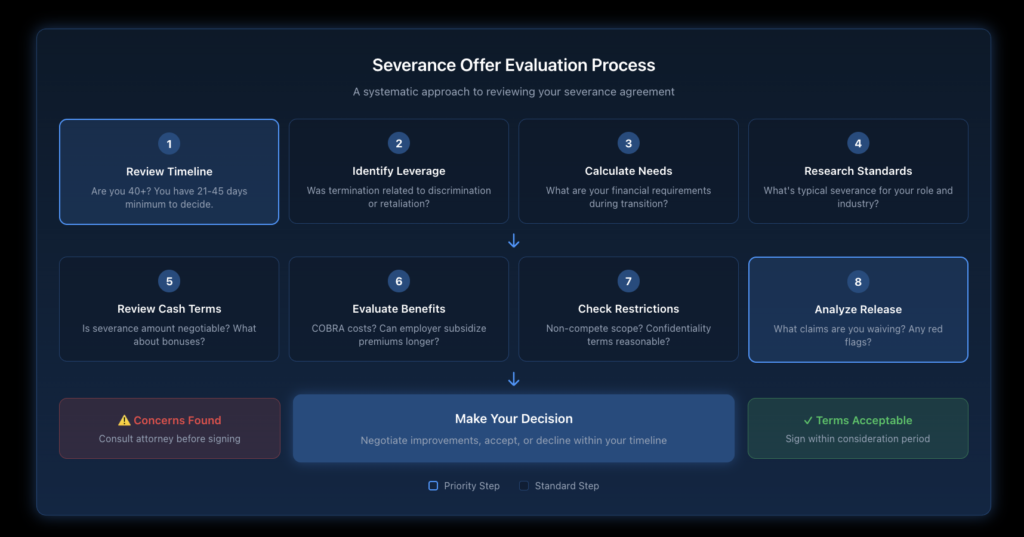
The Older Workers Benefit Protection Act (OWBPA) provides specific protections for employees age 40 and older. Under these EEOC-enforced regulations, you’re entitled to at least 21 days to consider an individual severance agreement—45 days if you’re part of a group layoff. After signing, you have 7 days to revoke your acceptance.
These aren’t suggestions; they’re legal requirements. If your employer pressures you to sign faster, that pressure itself may indicate they’re concerned about potential claims.

What Components Beyond Salary Should You Negotiate?
Most people focus exclusively on the cash amount, but severance packages contain multiple negotiable elements. Strategic negotiators address the full picture.
How Can Benefits Continuation Save You Money?
Extended health coverage often provides more value than additional severance pay. COBRA continuation coverage can cost $600-$1,500 monthly for family coverage—that’s $7,200-$18,000 annually out of pocket. According to the Department of Labor’s COBRA guidelines, employers must offer continuation coverage for 18 months following termination, but they’re not required to subsidize it.
Negotiating employer-paid premiums for 6-12 months can save you more than an equivalent cash increase, often with better tax treatment. This is particularly valuable if you have ongoing medical needs or family members who depend on your coverage.
What Professional Transition Support Can You Request?
Outplacement services help with job searching, resume development, and interview coaching. These programs typically cost $3,000-$15,000 when purchased independently, but employers often have existing contracts that let them provide these services at minimal cost to themselves while delivering significant value to you.
Reference agreements matter more than many employees realize. Negotiate specific language about what information will be provided to future employers. This becomes especially critical if your termination involved performance disputes or any allegations of misconduct—you need written assurance about what your former employer will and won’t say.
How Do Restrictive Covenants Affect Your Future Employment?
Non-compete and non-solicitation clauses can severely limit your employment options after departure. While the FTC’s 2024 non-compete rule attempted to ban most non-competes, federal court injunctions have blocked nationwide enforcement. State laws vary significantly—California, Minnesota, North Dakota, and Oklahoma ban non-competes entirely, while other states allow them with restrictions.
These provisions are frequently negotiable in terms of duration, geographic scope, and specific limitations. A 24-month nationwide non-compete might be negotiated down to 6 months within your immediate market, or eliminated entirely in exchange for stronger confidentiality provisions.
What Strategic Approach Should You Take to Negotiations?
Successful severance negotiation requires preparation, not confrontation. Most employers expect some back-and-forth and have built flexibility into their initial offers.
How Should You Prepare Before Responding?
Calculate your actual financial needs: how long might your job search take, what are your monthly expenses, and what’s the true cost of benefits you’ll lose? Research industry standards for severance at your position level—this gives you data points for your requests.
Document everything before negotiations begin. If your termination involved potential legal issues—discrimination, harassment, or retaliation—gather evidence of these concerns. You don’t need to threaten litigation, but understanding your potential claims helps you assess what the employer might be willing to offer to avoid them.
What Negotiation Wins Are Most Common?
Based on employment law patterns, employees most frequently secure improvements in these areas:
Extended severance periods are often negotiable, especially when potential legal claims exist. Standard offers of 2-4 weeks per year of service frequently increase to 6-8 weeks with negotiation.
Benefit continuation extensions beyond COBRA minimums are common. Many employers will pay premiums for 6-12 months to avoid litigation risks and maintain goodwill.
Modified restrictive covenants happen regularly when employees push back. Geographic restrictions, duration limits, and industry-specific exclusions are all subject to negotiation.
Bonus and commission payments that might otherwise be forfeited can sometimes be preserved or prorated, particularly if you were close to earning them when terminated.
What Special Considerations Apply to Discrimination Cases?
When your termination follows discrimination or harassment issues, severance negotiations involve additional complexity—and opportunity.
How Do Legal Claims Strengthen Your Position?
The Civil Rights Act of 1991 and other employment laws provide damages remedies for discrimination that can exceed typical severance amounts. If you have viable claims for age discrimination, gender discrimination, race or national origin discrimination, or other protected characteristics, these claims create significant leverage.
Retaliation protection under various employment laws means that if your termination followed protected activities—like filing discrimination complaints or participating in investigations—you have additional legal theories that strengthen your position.
What Negotiation Strategies Work for Legal Claims?
If you have potential discrimination or harassment claims, consider these approaches:
Address underlying legal issues directly in severance discussions. Rather than simply accepting a standard package, acknowledge the potential claims and negotiate enhanced terms accordingly. You don’t need to make explicit threats—employers’ attorneys will understand the implications.
Include investigation closure as part of the agreement. If harassment or discrimination complaints are pending, negotiate terms that address these issues comprehensively, including how any open investigations will be resolved.
Request neutral references that specifically address concerns about negative characterization. If your termination was contentious, a written agreement about reference language protects against post-employment retaliation.
What Rights Are You Actually Waiving?
The release of claims section is often the most important part of any severance agreement. Understanding what legal rights you’re waiving helps you evaluate whether the compensation is adequate.
What Claims Do Severance Agreements Typically Release?
Most severance agreements include releases covering discrimination claims under federal and state law, harassment and hostile work environment claims, wrongful termination and retaliation claims, wage and hour violations, and breach of contract claims.
The breadth of these releases varies significantly. Some are narrow and specific; others are sweeping. Pay attention to language like “any and all claims” versus more limited releases tied to specific circumstances of your departure.
What Rights Cannot Be Legally Waived?
Certain rights cannot be waived in severance agreements regardless of what the document says. According to EEOC guidance, you cannot waive your right to file charges with government agencies like the EEOC, though you may waive your right to monetary recovery from such charges. You also cannot waive future discrimination or harassment claims, unemployment compensation rights, workers’ compensation claims, or claims regarding vested benefits under ERISA-governed retirement plans.
If an agreement attempts to waive these non-waivable rights, that provision is unenforceable—and may signal that the employer’s attorneys weren’t careful with the drafting, suggesting other terms might be negotiable.
What Red Flags Should Prompt Careful Review?
Certain terms in severance agreements should raise immediate concerns and prompt legal consultation before signing.
What Language Indicates Potential Problems?
Overly broad release language that waives rights beyond typical employment claims may indicate the employer has concerns about broader legal exposure. If a release covers “any claims of any kind whatsoever,” ask what specific concerns prompted such expansive language.
Unusual confidentiality terms that go beyond standard non-disclosure may suggest the employer is particularly concerned about certain information becoming public. What don’t they want you to discuss?
Accelerated decision timelines that pressure you to sign quickly, especially if you’re over 40, may violate OWBPA requirements for proper consideration periods. This pressure itself could invalidate the waiver.
Clawback provisions that allow the employer to recover severance payments under broad circumstances create ongoing risk even after you’ve signed.
Ready to Protect Your Rights During Severance Negotiations?
Your severance negotiation impacts both your immediate financial situation and your long-term career prospects. When potential discrimination, harassment, or wrongful termination issues are involved, the stakes become even higher—and the opportunity for a better outcome increases significantly.
Don’t sign any severance agreement, especially one involving potential legal claims, without understanding your rights and options. Professional guidance helps you evaluate the adequacy of the offer, identify negotiation opportunities, and protect your interests throughout the process.
At Nisar Law Group, we help employees navigate complex severance negotiations, particularly when discrimination, harassment, or wrongful termination issues are involved. Contact us for a confidential consultation to discuss your situation and explore your options for maximizing your severance package while protecting your legal rights.
Frequently Asked Questions About Severance Negotiation
Almost always yes. Employers typically build flexibility into initial severance offers because they expect some negotiation. Even small improvements in cash, benefits continuation, or restrictive covenant terms can provide significant value during your transition. The key is approaching negotiations professionally and focusing on specific, reasonable requests rather than making demands. Employees who negotiate often secure 20-50% improvements over initial offers, particularly when they can articulate why enhanced terms are justified.
Watch for several warning signs: unusually short deadlines to sign (especially if you’re over 40 and given less than 21 days), overly broad release language covering claims beyond your employment relationship, provisions that attempt to prevent you from filing charges with the EEOC or other agencies, clawback provisions with vague triggers, and non-compete clauses with unreasonable geographic scope or duration. Any term that seems designed to rush your decision or limit your ability to seek legal advice should prompt careful review.
Generally no. Initial offers are starting points for negotiation, not take-it-or-leave-it propositions. Employers expect counteroffers and have typically built room for improvement into their first proposal. Take the full consideration period you’re entitled to, review all terms carefully, consider consulting an attorney, and prepare a thoughtful counteroffer addressing your specific priorities. Even if the employer accepts a few changes, the process helps ensure you understand exactly what you’re agreeing to.
A common benchmark is one to two weeks of salary per year of service, but this varies significantly by industry, position level, and circumstances. Executive positions often command more generous packages, while layoffs affecting large groups may follow stricter formulas. More important than any formula is evaluating the total package—including benefits, stock vesting, bonuses, and non-monetary terms—against your specific situation and what you’d be waiving by signing.
The risk is minimal when done professionally. Employers rarely rescind offers simply because employees attempt to negotiate—doing so could expose them to retaliation claims. The key is approaching negotiations constructively: express appreciation for the offer, explain why certain modifications would be helpful, and propose reasonable alternatives. Avoid ultimatums or threats unless you’re prepared to walk away. Most employers prefer to reach a mutually acceptable agreement rather than have a disgruntled former employee.
This depends entirely on your agreement’s specific terms. Some severance agreements continue payments regardless of new employment; others reduce or eliminate payments if you start a new job. Some require you to notify your former employer of new employment. Review your agreement’s language carefully—look for terms like “offset,” “mitigation,” or provisions about notifying the employer of new employment. If the terms aren’t clear or seem problematic, this is a negotiable point.
Ask about the deadline for responding and whether extensions are possible, how the severance amount was calculated and whether it’s negotiable, what happens to health benefits and whether the employer will subsidize COBRA, whether you’ll be paid for accrued vacation or sick time, what references the company will provide, whether any non-compete or non-solicitation provisions apply, and what claims you’re being asked to release. Take notes and request the agreement in writing to review later—never sign anything in the initial meeting.
