

Yes, you can request time off for religious holidays under Title VII of the Civil Rights Act, which requires employers to provide reasonable religious accommodations unless doing so would create a substantial hardship for the business. Your employer cannot force you to choose between observing your faith and keeping your job. Whether you observe mainstream holidays like Rosh Hashanah and Eid al-Fitr or less common religious observances, you have the right to request schedule adjustments that allow you to practice your beliefs.
New York employees have even stronger protections. The New York State Human Rights Law and NYC Human Rights Law provide broader coverage and longer filing deadlines than federal law. New York employers face a higher threshold when claiming accommodation creates hardship, making it more difficult for them to deny legitimate requests for religious time off.
Key Takeaways
- Federal law requires employers to accommodate religious observances unless it causes substantial business hardship.
- You don’t need to use PTO for religious holidays if a reasonable accommodation exists.
- Employers cannot retaliate against you for requesting religious time off.
- New York law offers stronger protections than federal standards, with one-year state and three-year NYC filing deadlines.
- Schedule swaps, flexible hours, and unpaid leave are common accommodations.
- Your request doesn’t need formal language—simply explaining your religious need is sufficient.
- Employers bear the burden of proving accommodation would cause undue hardship.
Disclaimer: This article provides general information for informational purposes only and should not be considered a substitute for legal advice. It is essential to consult with an experienced employment lawyer at our law firm to discuss the specific facts of your case and understand your legal rights and options. This information does not create an attorney-client relationship.
What Qualifies as a Religious Holiday Under Federal Law?
Religious holidays aren’t limited to widely recognized observances like Christmas or Yom Kippur. Federal law protects sincerely held religious beliefs, which means your employer must consider accommodation requests for any observance important to your faith—even if it’s not traditional or widely practiced. This includes protections for atheists and non-religious beliefs as well as traditional faith practices.
Courts look at sincerity, not popularity. If you genuinely observe a religious practice as part of your belief system, it deserves protection. This includes Sabbath observance, prayer times, religious festivals, fasting periods, and holy days specific to your tradition. The EEOC’s guidance on religious accommodations confirms that new, uncommon, or individually held beliefs receive the same protection as mainstream religious practices.
Does My Employer Have to Approve Every Religious Holiday Request?
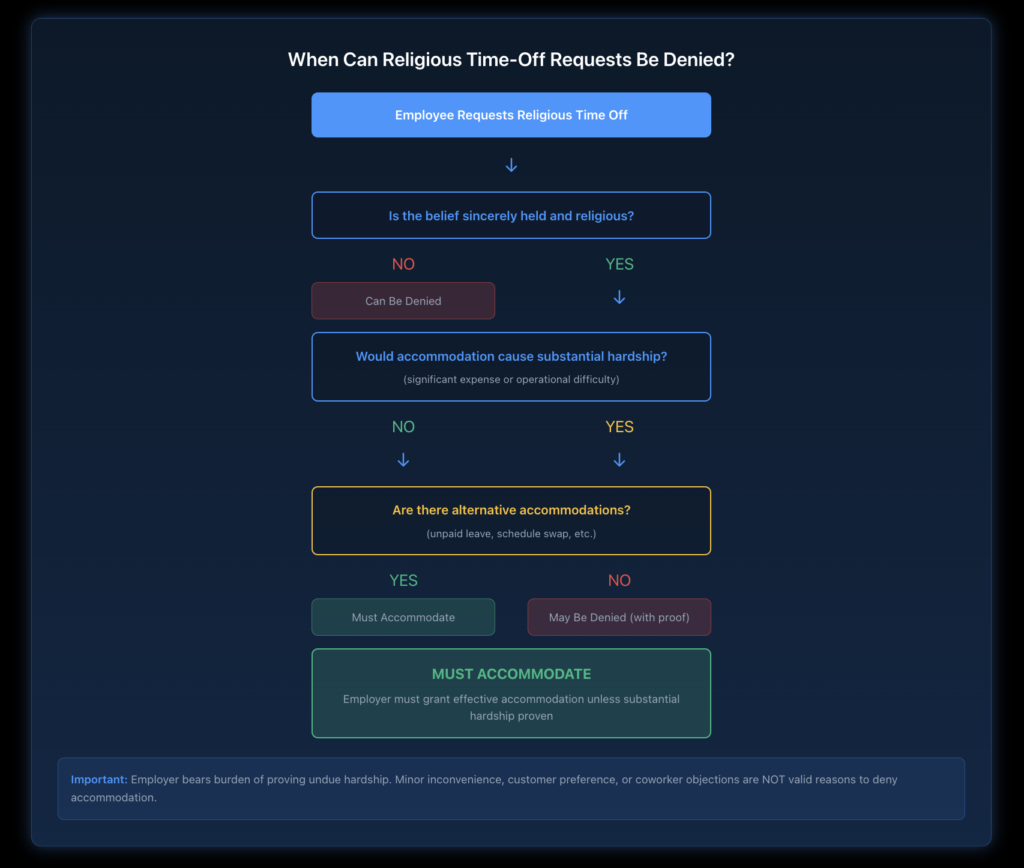
Not automatically. While employers must make reasonable efforts to accommodate religious observances, they can deny requests that create substantial hardship. The keyword is “substantial”—the Supreme Court’s 2023 decision in Groff v. DeJoy raised the bar significantly, making it harder for employers to claim hardship.
Your employer cannot deny accommodation simply because it’s inconvenient or because coworkers don’t like covering your shift. They must show concrete evidence that granting your request would cause significant operational difficulty or expense in the overall context of their business. Customer preference or coworker objections based on religious bias don’t count as legitimate hardship.
Can My Employer Make Me Use PTO for Religious Observances?
It depends on whether other reasonable accommodations exist. Employers cannot automatically require you to burn vacation days or personal time for religious observances if alternatives like schedule adjustments or shift swaps wouldn’t burden operations.
Many employers offer unpaid leave as an accommodation, especially when paid time off doesn’t align with your religious needs. If your employer has policies allowing shift trades or flexible scheduling, requiring PTO use might not be reasonable. The accommodation process should be interactive—your employer needs to work with you to find solutions that respect your faith without unnecessary burden, just as they must consider religious grooming and dress practices.
How Do I Request Time Off for Religious Reasons?
What Should I Include in My Accommodation Request?
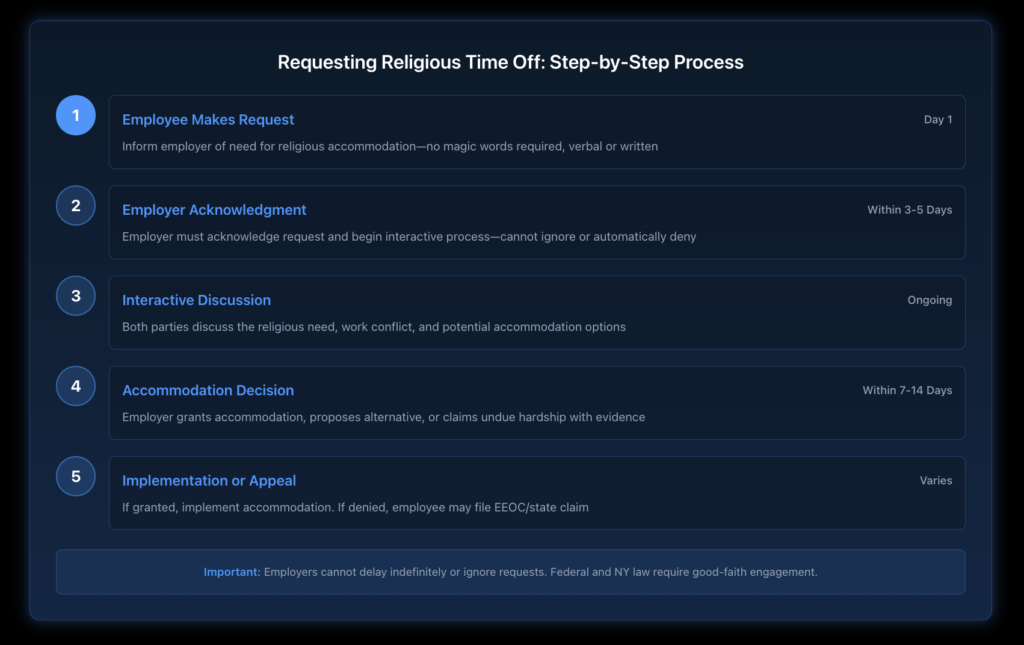
Keep it straightforward. You don’t need legal language or formal documentation to request religious accommodation. Simply explain that you need time off for a religious observance and identify the specific dates involved. According to EEOC guidance, no “magic words” are required—your employer just needs to understand you’re requesting a religious accommodation.
Your request might look like: “I observe the Sabbath from sundown Friday to sundown Saturday. I need to leave work by 4 PM on Fridays during the winter months.” Or: “I’ll need three days off for Diwali celebrations from November 10-12. Can we discuss scheduling options?”
Should I Submit My Request in Writing?
Written requests create documentation, which helps if disputes arise later. While oral requests are legally valid, written communication provides clear evidence of what you asked for and when. Email works perfectly—it’s simple, creates a timestamp, and gives both parties a record.
Your written request should identify: the religious observance requiring accommodation, specific dates or times needed, and your willingness to discuss potential solutions. You don’t need to explain your entire faith tradition or justify why the observance matters to you. Your sincerely held belief is sufficient.
How Far in Advance Should I Make My Request?
Make your request as soon as you know about the conflict. Many religious holidays follow lunar or traditional calendars, so dates may shift yearly. Request accommodation once you have confirmed dates—don’t wait until the week before.
Early requests give your employer time to arrange reasonable accommodations through schedule adjustments or finding coverage. However, even last-minute requests deserve consideration when religious obligations arise unexpectedly. Employers must engage in good-faith discussion regardless of timing.
What Religious Accommodations Can I Request Besides Time Off?
Can I Request Flexible Start Times for Daily Prayers?
Yes. Religious accommodation extends beyond holidays to daily practices. If your faith requires prayer at specific times, employers must consider schedule flexibility that allows you to fulfill these obligations. This might mean adjusting your start time, allowing extended breaks, or providing a private space for prayer.
Manufacturing, healthcare, and retail environments often accommodate prayer schedules through rotating break times or allowing employees to make up time. The key is finding solutions that don’t significantly disrupt operations. Conflicts between religious beliefs and job duties often have creative solutions that work for both parties.
What if My Religious Observance Conflicts With My Work Schedule Permanently?
Permanent conflicts require more substantial accommodations, but employers still must engage meaningfully. If you observe a weekly Sabbath, for example, your employer might offer: schedule changes that permanently exclude Sabbath hours, voluntary shift swaps with coworkers, or reassignment to a different shift or position that doesn’t conflict with your observance.
In Nisar Law’s experience representing New York employees, permanent schedule accommodations are often successful when employees demonstrate flexibility and employers truly engage in the interactive process. The NYC Human Rights Law specifically recognizes that accommodations may need to be ongoing rather than one-time adjustments.
Can I Request Unpaid Leave if My Employer Has No Other Options?
Absolutely. Unpaid leave is a common reasonable accommodation when schedule adjustments aren’t possible. If you’ve exhausted PTO or your employer doesn’t offer paid religious holidays, requesting unpaid time off allows you to observe your faith without economic penalty.
Employers cannot deny unpaid leave simply because they prefer not to grant it. Unless your absence would cause substantial operational hardship—which they must prove—unpaid leave represents a reasonable accommodation that doesn’t burden the business financially.
What Is the Undue Hardship Standard for Religious Time Off?
How Do Courts Define Undue Hardship for Schedule Accommodations?
The Supreme Court’s 2023 Groff decision fundamentally changed this analysis. Previously, employers could claim “more than de minimis cost” created hardship—an extremely low bar. Now, employers must show the burden is “substantial in the overall context” of their business, considering factors like company size, operating costs, and the nature of the accommodation. This landmark Supreme Court decision reshaped religious accommodation law.
For religious time-off requests, this means your employer cannot claim hardship based on minor inconvenience. They need concrete evidence that your absence would significantly disrupt operations, impose considerable expense, or infringe on other employees’ rights. Government guidance emphasizes that costs must be analyzed in relation to the employer’s overall resources.
Can My Employer Claim Coworker Objections Create Undue Hardship?
Not unless those objections are based on legitimate operational concerns. Coworkers objecting because they disagree with your faith, don’t want to cover shifts, or harbor religious bias cannot form the basis of undue hardship. Federal law explicitly prohibits employers from using customer or coworker prejudice as justification for denying accommodation. Note that ministerial exception rules apply differently for religious organizations.
However, if granting your request would require coworkers to work excessive overtime, perform hazardous work they’re not trained for, or violate a legitimate seniority system, that might constitute hardship. The focus is on actual operational impact, not subjective discomfort.
Does My Company Size Affect What Accommodations Are Required?
Yes, but not in the way many employers claim. Smaller businesses have more flexibility to argue that certain accommodations create substantial hardship, but they’re not exempt from the requirement to accommodate. A small business might legitimately struggle to cover shifts when it has minimal staff, whereas a large corporation with dozens of employees typically cannot make that argument.
New York law recognizes these differences but still requires meaningful accommodation efforts. The New York State Attorney General’s guidance notes that establishing clear accommodation policies helps businesses of all sizes meet their legal obligations while managing operational needs.
What Are My Rights Under New York Law?
How Does New York Law Differ From Federal Protections?
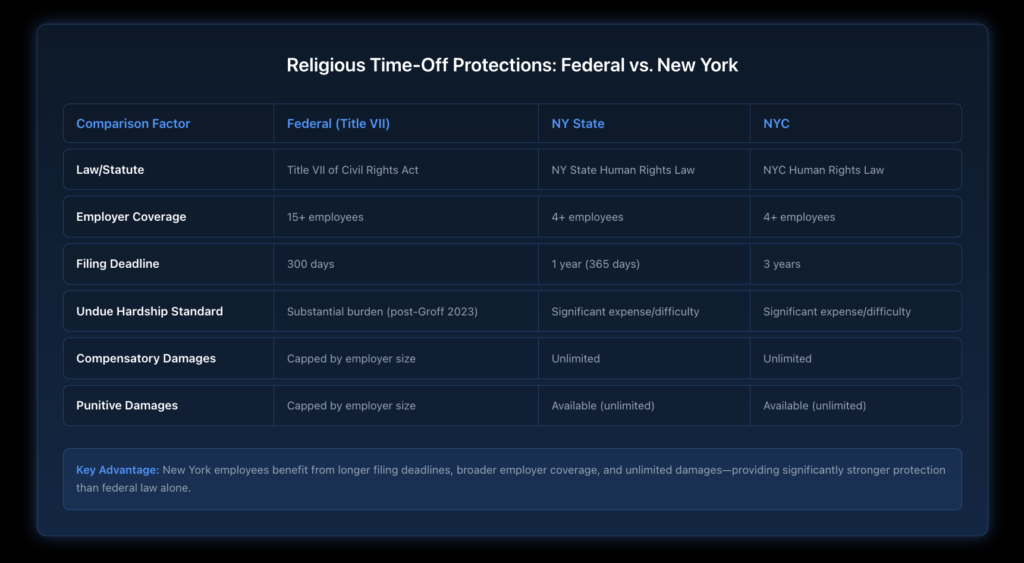
New York provides significantly stronger protections. First, New York State Human Rights Law covers employers with four or more employees, while federal Title VII requires 15. This means small business employees have protection even when federal law doesn’t apply.
Second, filing deadlines are much longer. You have 300 days to file with the EEOC, but New York State gives you one year, and NYC residents have three years. These extended deadlines provide more time to pursue claims without rushing into litigation.
Third, New York courts interpret undue hardship more strictly against employers. While the Groff decision raised federal standards, New York’s religious discrimination law has long required substantial proof of hardship, making it easier for employees to prevail.
Can I File Complaints With Both EEOC and State Agencies?
Yes, and you should. Filing with multiple agencies maximizes your options without waiving rights. The EEOC, New York State Division of Human Rights, and NYC Commission on Human Rights work together through work-sharing agreements, so filing with one often automatically files with others.
Each agency investigates independently, and you can ultimately choose which path provides the best remedies. New York agencies often move faster than EEOC investigations, and NYC Human Rights Law offers some of the strongest protections in the nation. Strategic filing timing can preserve all your options while the case develops.
What Damages Can I Recover if My Employer Denies Religious Accommodations?
New York law allows comprehensive remedies. You may recover: back pay for wages lost due to denial of accommodation, front pay if you can’t return to your job, emotional distress damages for the harm caused by discrimination, and punitive damages if your employer acted with malice or reckless indifference.
Additionally, courts can order injunctive relief requiring your employer to accommodate your religious practice going forward, revise discriminatory policies, and provide anti-discrimination training. Religious discrimination cases often settle before trial, but knowing your full range of remedies strengthens your negotiating position. NYC’s detailed accommodation procedures provide additional guidance on the interactive process.
What if My Employer Retaliates for Requesting Religious Time Off?
Can My Employer Discipline Me for Making an Accommodation Request?
No. Retaliation for requesting religious accommodation violates federal and New York law. Your employer cannot deny you promotions or raises, give you poor performance reviews, assign undesirable work, reduce your hours, or create a hostile work environment because you asked for religious accommodation.
Even if your employer ultimately denies the accommodation based on claimed hardship, they cannot punish you for making the request. The right to request accommodation is fundamental, and retaliation for exercising that right creates a separate legal claim.
What Should I Do if My Employer Threatens Termination?
Document everything immediately. Save all emails, texts, and communications about your accommodation request and any negative responses. Write down conversations with dates, times, and witnesses. Take photos of any written warnings or discipline notices.
Then consult an employment attorney. Threats of termination for religious accommodation requests often constitute unlawful retaliation or religious discrimination. An attorney can help you understand your rights, potentially negotiate with your employer, and preserve evidence for potential claims with the EEOC or state agencies based on the Supreme Court’s guidance.
How Do I Prove Retaliation for Religious Accommodation Requests?
Establish three elements: you engaged in protected activity (requesting accommodation), your employer took adverse action against you, and a causal connection exists between the two. Timing is often key—if your employer disciplines or terminates you shortly after your accommodation request, that suggests retaliation.
Direct evidence like emails stating “we’re firing you because you asked for religious time off” is rare. Most retaliation cases rely on circumstantial evidence: proximity in time between protected activity and adverse action, changes in treatment after the request, pretextual reasons for discipline, or patterns of hostility toward religious practices.
What Common Mistakes Do Employers Make With Religious Time-Off Requests?
Why Do Employers Often Mishandle Religious Accommodation Requests?
Many employers don’t understand the legal requirements or underestimate employee protections. Common mistakes include: automatically denying requests without evaluating alternatives, claiming inconvenience equals hardship, requiring employees to find their own coverage, retaliating against workers who request accommodation, or failing to engage in any meaningful interactive process.
Some employers mistakenly believe they can treat religious time off differently from other leave requests. Others don’t recognize that accommodating one religion while denying others constitutes discrimination. Proselytizing concerns sometimes lead employers to suppress all religious expression, which violates accommodation requirements.
Can My Employer Require Proof of My Religious Beliefs?
Employers can ask for limited information to verify your request is religiously motivated and sincerely held, but they cannot conduct invasive inquiries. They might ask about the nature of your religious practice, how it conflicts with work requirements, and what accommodation would eliminate the conflict.
However, they cannot require: letters from clergy, detailed explanations of your entire faith tradition, proof that others share your beliefs, or documentation that your practice is required by formal religious doctrine. The focus is on whether you sincerely believe the practice is religiously necessary, not whether theologians or religious authorities agree.
Do Employers Have to Grant the Exact Accommodation I Request?
Not necessarily. Employers can propose alternative accommodations that effectively eliminate the conflict, even if different from what you suggested. However, they must give primary consideration to your preference and cannot simply impose whatever solution they find easiest.
If multiple reasonable accommodations exist, meaningful dialogue should determine which works best for both parties. Your employer cannot choose an ineffective accommodation that doesn’t actually address your religious need or forces you to violate your beliefs. The accommodation must be real, not merely symbolic.
Need Legal Help With Religious Accommodation Denials?
If your employer denied your request for religious time off, retaliated against you for seeking accommodation, or discriminated against, based on your religious practices, Nisar Law Group can help. Our New York employment law attorneys have extensive experience protecting employee religious rights across all industries. We handle cases involving holiday conflicts, Sabbath observance, daily prayer needs, and religious grooming practices. Contact us today for a consultation to discuss how we can help you assert your rights under federal and New York law.
Frequently Asked Questions About Religious Holidays and Time-Off Requests
Religious holidays can be excused absences if your employer provides reasonable accommodation. Under federal and New York law, employers must accommodate religious observances unless doing so creates substantial hardship. This means your employer should work with you to adjust schedules, allow shift swaps, or provide unpaid leave so you can observe religious holidays without risking termination or discipline. Whether absence is “excused” depends on whether the employer granted accommodation or wrongfully denied it. If denied, the absence might not be formally excused, but the denial itself may violate discrimination laws.
You don’t automatically need to use PTO if other reasonable accommodations exist. Employers cannot require you to exhaust vacation or personal days for religious observances when alternatives like schedule adjustments, shift swaps, or unpaid leave would work equally well without burdening operations. However, if no other accommodation is available and you want to be paid for the time off, using PTO may be necessary. The key is that requiring PTO use shouldn’t be the employer’s automatic response—they must first consider whether other solutions exist that don’t force you to sacrifice earned leave for religious practice.
This question reflects a misunderstanding of accommodation law. Religious accommodation isn’t about which faiths get preferential treatment—it’s about ensuring all employees can observe their sincerely held religious practices regardless of tradition. Some religions have more observed holidays, others have weekly Sabbath requirements, and still others require daily prayer times. Federal and New York law require employers to accommodate all religious observances equally, whether you’re Christian, Jewish, Muslim, Hindu, Buddhist, Sikh, or practice any other faith. No religion “gets” more days off—employees receive the accommodation they need for their specific religious practice.
Yes, you can request a day off for religious events, and your employer must consider a reasonable accommodation. Religious events include not just traditional holidays but also lifecycle celebrations, religious ceremonies, pilgrimage obligations, or other significant observances important to your faith. Your employer should work with you to find solutions like schedule swaps with coworkers, using flexible leave policies, or allowing unpaid time off. You don’t need to prove the event is universally recognized or widely celebrated—what matters is that the event holds sincere religious significance for you and you need workplace accommodation to observe it properly.
Employers can schedule work on religious holidays, but they must accommodate employees who cannot work due to religious observance. The law doesn’t prohibit scheduling work on Christmas, Yom Kippur, Eid, Diwali, or any other religious holiday. However, if an employee informs the employer that working violates their religious beliefs, the employer must provide reasonable accommodation unless doing so causes substantial business hardship. This might mean allowing the employee to swap shifts, take unpaid leave, or adjust their schedule. Simply scheduling everyone to work on a religious holiday isn’t discriminatory, but refusing to accommodate individuals who need time off for religious reasons violates the law.
Your employer cannot fire you for taking time off to observe religious practices if you requested accommodation in advance and they failed to properly consider your request. However, if you simply call out without prior notice and without allowing your employer to accommodate you, they might treat it as unauthorized absence under normal attendance policies. The difference is whether you engaged in the accommodation process. If you made a timely request, your employer denied it without a valid hardship justification, and you took the time off anyway to observe your faith, termination would likely constitute religious discrimination. Always request accommodation proactively rather than just calling out.
Religious accommodations can be denied only when granting them would cause substantial hardship to the employer’s business operations. This is a high bar—employers must show that accommodation would require significant expense or difficulty in the overall context of their operations, considering factors like company size, operating costs, and the nature of the accommodation requested. Simple inconvenience, minor costs, or coworker complaints about covering shifts don’t constitute substantial hardship. If your employer denies accommodation, they should document the specific operational burden and explain why no alternative accommodation would work. Denials without meaningful analysis often violate the law.
Religious compensatory time off allows employees to make up work time missed for religious observances at different times. For example, if you need to leave early on Fridays for Sabbath observance, you might arrive early on other days or work additional hours earlier in the week to compensate. This accommodation benefits both parties—you fulfill your religious obligations while maintaining full-time hours, and your employer gets the work done without reducing productivity. Compensatory arrangements require agreement between you and your employer about how the time will be made up. It’s particularly common for employees with regular weekly religious observances rather than occasional holiday requests.

