

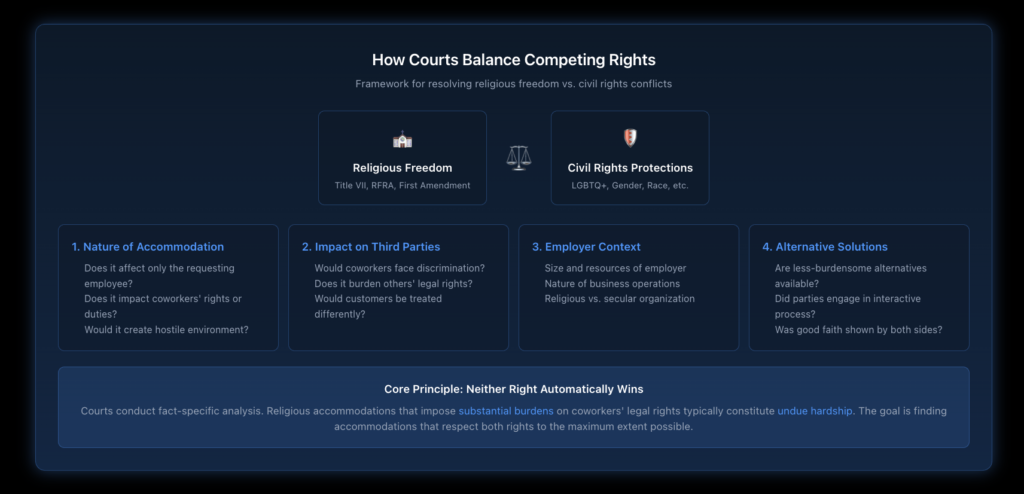
When an employee’s religious beliefs conflict with another worker’s civil rights—such as protections against discrimination based on sexual orientation, gender identity, or sex—courts must determine which right takes priority. The short answer: neither right automatically wins. Courts use a fact-specific balancing approach that considers the nature of each claim, the type of employer involved, and whether accommodating one right would substantially burden another person’s legally protected interests.
This tension has intensified following landmark decisions like Bostock v. Clayton County (2020), which extended Title VII protections to LGBTQ+ employees, and Groff v. DeJoy (2023), which strengthened religious accommodation requirements. Understanding how these rights interact—and where the boundaries lie—is essential for any employee navigating a workplace where faith and civil rights may collide.
Key Takeaways
- Religious freedom and other civil rights (LGBTQ+ protections, gender equality, etc.) both receive strong legal protection under federal and state law, but neither is absolute.
- The Supreme Court’s Groff v. DeJoy decision requires employers to show “substantial increased costs” to deny religious accommodations—a higher bar than before.
- Most private employers cannot use religious beliefs to discriminate against protected classes; narrow religious exemptions exist primarily for houses of worship and ministerial employees.
- New York State and New York City laws provide some of the strongest protections in the nation for both religious employees and LGBTQ+ workers.
- When rights genuinely conflict, courts balance the burden on each party rather than automatically favoring one right over another.
Disclaimer: This article provides general information for informational purposes only and should not be considered a substitute for legal advice. It is essential to consult with an experienced employment lawyer at our law firm to discuss the specific facts of your case and understand your legal rights and options. This information does not create an attorney-client relationship.
What Constitutional Protections Govern Religious Freedom in Employment?
The First Amendment’s Free Exercise Clause protects individuals from government interference with religious practice. However, this constitutional protection applies directly only to government employers—not private businesses. For private sector employees, statutory protections under Title VII of the Civil Rights Act of 1964 provide the primary shield against religious discrimination in the workplace.
What Does “Religious Freedom” Actually Mean at Work?
Religious freedom in employment has two distinct components. First, employers cannot discriminate against employees because of their religious beliefs or practices. Second, employers must reasonably accommodate employees’ religious observances unless doing so would cause undue hardship.
The EEOC defines protected religious beliefs broadly to include not only traditional organized religions like Christianity, Judaism, Islam, Hinduism, and Buddhism, but also sincerely held ethical or moral beliefs that function like religion in a person’s life. Atheism and non-religious philosophical convictions also receive protection.
How Has the Groff Decision Changed Religious Accommodation Requirements?
Before 2023, courts interpreted “undue hardship” to mean anything more than a minimal cost to the employer—a very low bar that made it easy to deny accommodation requests. The Supreme Court’s unanimous decision in Groff v. DeJoy fundamentally changed this standard.
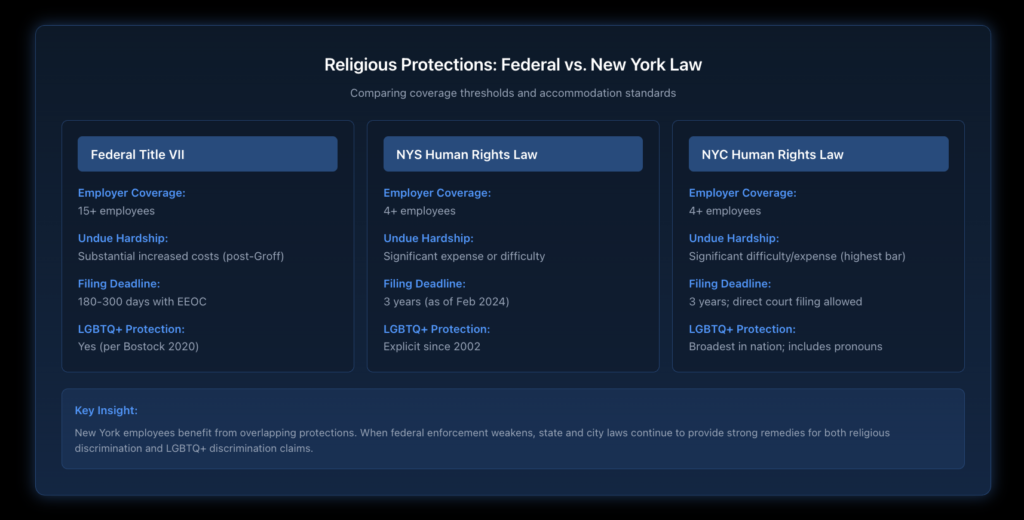
Now, employers must demonstrate that granting a religious accommodation would result in “substantial increased costs in relation to the conduct of its particular business.” This higher threshold means more accommodation requests will succeed, and employers must engage more seriously in finding workable solutions rather than summarily denying requests.
How Do LGBTQ+ Rights Interact With Religious Freedom Claims?
The intersection of religious liberty and LGBTQ+ rights represents one of the most contested areas in employment law. Following the Supreme Court’s Bostock decision, Title VII’s prohibition on sex discrimination includes sexual orientation and gender identity discrimination. This created new questions about what happens when an employer’s religious beliefs conflict with these protections.
Can Religious Employers Discriminate Against LGBTQ+ Employees?
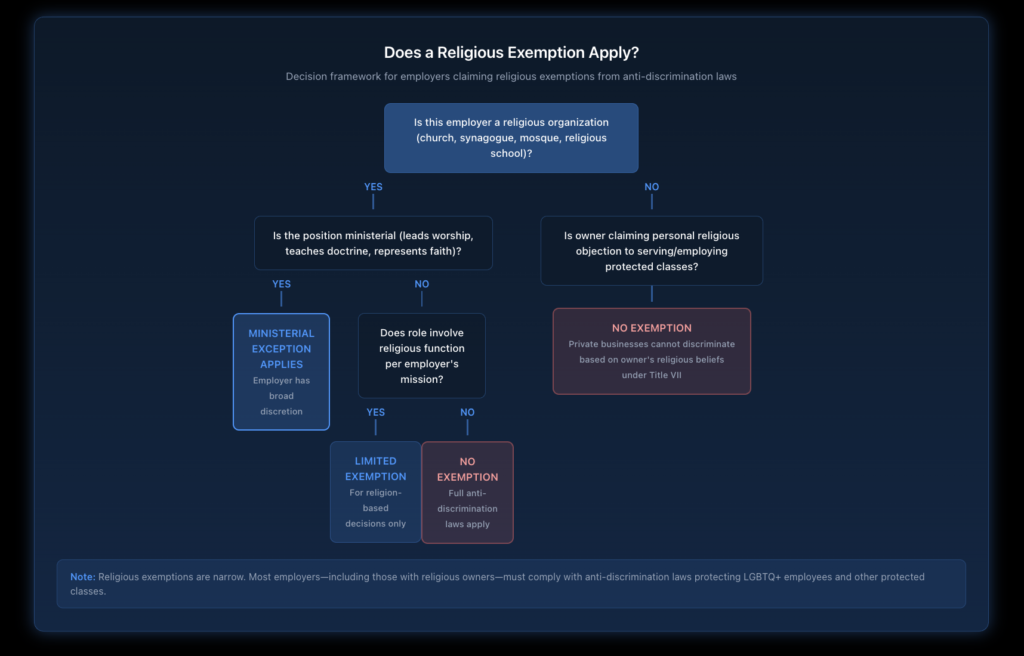
The answer depends heavily on the type of employer and the position involved. For most private employers—including those owned by religious individuals—the answer is generally no. Title VII’s protections apply regardless of the employer’s personal religious convictions.
However, two narrow exceptions exist. The ministerial exception allows religious organizations to make employment decisions about ministers and other religious leaders without government interference. This constitutional doctrine recognizes that forcing a church to employ a minister who contradicts its beliefs would violate the Establishment Clause.
What About Religious Exemptions for Business Owners?
Private business owners sometimes claim that serving or employing LGBTQ+ individuals violates their religious beliefs. Courts have generally rejected these claims in the employment context. The EEOC has emphasized that religious beliefs don’t override civil rights laws for most employers.
As one court noted, allowing individual religious exemptions from anti-discrimination laws would essentially give employers a license to discriminate, undermining the entire framework of civil rights protection. The New York State Human Rights Law requires employers to accommodate religious practices, but not in ways that discriminate against other protected classes.
What Happens When Religious Employees Object to Working With LGBTQ+ Colleagues?
This scenario presents the clearest tension between competing rights. An employee whose religious beliefs prohibit supporting same-sex relationships might request accommodation to avoid participating in a coworker’s same-sex wedding celebration, processing benefits for same-sex partners, or using preferred pronouns for transgender colleagues.
Must Employers Accommodate Religious Objections to Coworkers?
Courts have held that religious accommodations cannot impose substantial burdens on other employees’ rights. If granting a religious employee’s request would subject LGBTQ+ coworkers to different treatment or a hostile environment, that accommodation likely constitutes undue hardship.
The EEOC’s guidance on religious discrimination explicitly states that accommodations that “reasonably threaten to create a hostile work environment” constitute undue hardship. Coworker objections based solely on hostility to religion—or customer prejudices—do not justify denying accommodations. But protecting coworkers from discrimination is a legitimate basis for limiting accommodations.
How Do Courts Balance These Competing Interests?
Rather than creating bright-line rules, courts engage in fact-specific balancing. Relevant factors include whether the accommodation affects only the requesting employee or impacts coworkers, whether alternative accommodations exist that don’t burden others, the employer’s size and resources, and whether the accommodation would effectively nullify other employees’ civil rights protections.
What Are the Limits of Religious Freedom in Employment?
Religious freedom, like all rights, has boundaries. Understanding these limits helps employees on both sides of these disputes assess their legal positions.
Can Religious Beliefs Justify Any Workplace Conduct?
No. Courts distinguish between beliefs, which receive absolute protection, and conduct, which the government may regulate when necessary. An employer cannot fire someone for believing homosexuality is sinful, but an employer can prohibit an employee from proselytizing in ways that create hostility toward LGBTQ+ colleagues.
Similarly, the Religious Freedom Restoration Act (RFRA) provides additional protections against government actions that substantially burden religious exercise, but these protections don’t extend to private employer actions and don’t authorize discrimination against protected classes.
What Protection Does New York Law Provide?
New York offers some of the nation’s strongest protections for both religious employees and LGBTQ+ workers. The New York State Human Rights Law explicitly prohibits discrimination based on religion, sexual orientation, and gender identity in workplaces with four or more employees—broader coverage than federal law’s 15-employee threshold.
The NYC Human Rights Law goes even further, applying to employers with four or more employees and using a “significant difficulty or expense” standard for undue hardship rather than the federal “substantial cost” standard. This means NYC employers must work harder to accommodate religious practices before claiming hardship.
How Should Employees Navigate These Complex Situations?
Whether you’re seeking religious accommodation or concerned about religious-based discrimination, practical strategies can help protect your rights.
What Steps Should Religious Employees Take?
If your religious beliefs conflict with a workplace requirement, document your beliefs and the conflict clearly. Request accommodation in writing, explaining your specific religious need. Be flexible about potential alternatives—courts look favorably on employees who work collaboratively rather than making demands. If your employer denies your request, ask for a written explanation of why the accommodation would cause undue hardship.
What If You’re Facing Religion-Based Discrimination?
Employees who experience discrimination based on religious beliefs—or who face harassment from coworkers citing religious objections to their identity—should document incidents thoroughly. New York law provides strong protections regardless of changes at the federal level. Filing deadlines matter: you have three years to file with the New York State Division of Human Rights for acts occurring after February 2024, and three years for sexual harassment claims occurring after August 2020.
What Does the Future Hold for Religious Freedom and Civil Rights?
The legal landscape continues evolving. Recent federal administration changes have signaled increased emphasis on religious liberty claims, while states like New York maintain robust civil rights protections. Courts will continue grappling with these tensions case by case.
Understanding that both sets of rights receive serious legal protection—and that neither automatically trumps the other—helps employees approach these situations with realistic expectations. The goal isn’t to eliminate either religious freedom or civil rights protections, but to find workable accommodations that respect both to the greatest extent possible.
Need Legal Help?
If you’re facing a workplace situation where religious beliefs and civil rights appear to conflict—whether you’re seeking religious accommodation or experiencing discrimination—Nisar Law Group can help you understand your rights under federal, New York State, and New York City law. Our employment attorneys have extensive experience navigating these complex intersections. Contact us today for a consultation to discuss your specific circumstances.
Frequently Asked Questions About Religious Freedom vs. Other Protected Rights
The First Amendment contains two religion clauses: the Establishment Clause prevents government from establishing an official religion or favoring one religion over others, while the Free Exercise Clause protects individuals’ right to practice their religion without government interference. In employment, the Free Exercise Clause applies directly only to government employers, while private sector employees rely primarily on Title VII’s statutory protections against religious discrimination.
Religious freedom is protected because the founders recognized that government interference in matters of conscience poses a fundamental threat to individual liberty. The First Amendment reflects this principle by prohibiting Congress from passing laws that restrict religious practice. Courts have extended this protection through the Fourteenth Amendment to apply to state and local governments, recognizing that forcing individuals to violate sincere religious beliefs imposes a significant burden on personal autonomy.
Religious freedom protects beliefs absolutely, but allows regulation of conduct when necessary to protect compelling government interests. Religious practices may be limited when they would cause substantial harm to others, violate criminal law, or undermine the civil rights of other protected groups. Courts balance the burden on religious exercise against the government’s interest in preventing discrimination, maintaining public safety, and protecting third parties from harm.
Most employers cannot use religious beliefs to discriminate against employees in protected classes. Title VII prohibits discrimination based on religion, sex, race, and national origin—and after Bostock, this includes sexual orientation and gender identity. Narrow exemptions exist for religious organizations hiring for ministerial positions and for some positions in organizations with explicitly religious missions, but these exemptions are limited.
Courts have consistently held that religious accommodations cannot impose substantial burdens on other employees’ legal rights. If granting an accommodation would create a hostile work environment for LGBTQ+ coworkers or subject them to discriminatory treatment, that accommodation likely constitutes undue hardship. Employers must balance the religious employee’s needs against the rights of other workers.
No. The ministerial exception applies only to employees who perform essential religious functions, such as leading worship services, teaching religious doctrine, or representing the organization in religious matters. A janitor, accountant, or cafeteria worker at a religious organization typically does not qualify for the ministerial exception, meaning standard anti-discrimination laws protect their employment.
New York laws provide broader protection than federal law in several ways. The New York State Human Rights Law covers employers with four or more employees (compared to Title VII’s 15-employee threshold), explicitly includes sexual orientation and gender identity as protected classes, and has longer filing deadlines. The NYC Human Rights Law provides even stronger protections with a higher standard that employers must meet to claim undue hardship.
This remains a contested legal question. Some employees claim sincere religious objections to using pronouns that differ from their biological sex. However, deliberately misgendering a transgender coworker could contribute to a hostile work environment, which courts recognize as a harm to that coworker. The outcome depends on specific facts, including whether alternative accommodations exist and whether the religious employee’s conduct substantially burdens the transgender coworker’s ability to work free from harassment.

