

Yes, you generally have the right to wear religious attire and follow faith-based grooming practices at work. Under federal and New York law, employers must accommodate religious dress and grooming unless doing so creates an undue hardship. This includes head coverings such as hijabs and turbans, religious jewelry such as crosses and kippot, facial hair required by faith, and specific clothing mandated by religious beliefs. Your employer cannot force you to violate sincere religious practices simply to comply with standard dress codes or appearance policies.
Key Takeaways
- Federal and state law protect religious dress and grooming practices under Title VII and the New York State Human Rights Law.
- Employers must accommodate religious attire unless it causes significant difficulty or expense (undue hardship).
- You don’t need to prove your religion is “mainstream” – sincere personal beliefs receive protection.
- New York law provides broader protections than federal law, with a three-year filing deadline versus 300 days for EEOC complaints.
- Common accommodations include exceptions to dress codes, modified uniforms, and adjusted grooming standards.
- Employers who refuse reasonable accommodations face legal liability for religious discrimination.
Disclaimer: This article provides general information for informational purposes only and should not be considered a substitute for legal advice. It is essential to consult with an experienced employment lawyer at our law firm to discuss the specific facts of your case and understand your legal rights and options. This information does not create an attorney-client relationship.
What Legal Protections Exist for Religious Dress and Grooming?
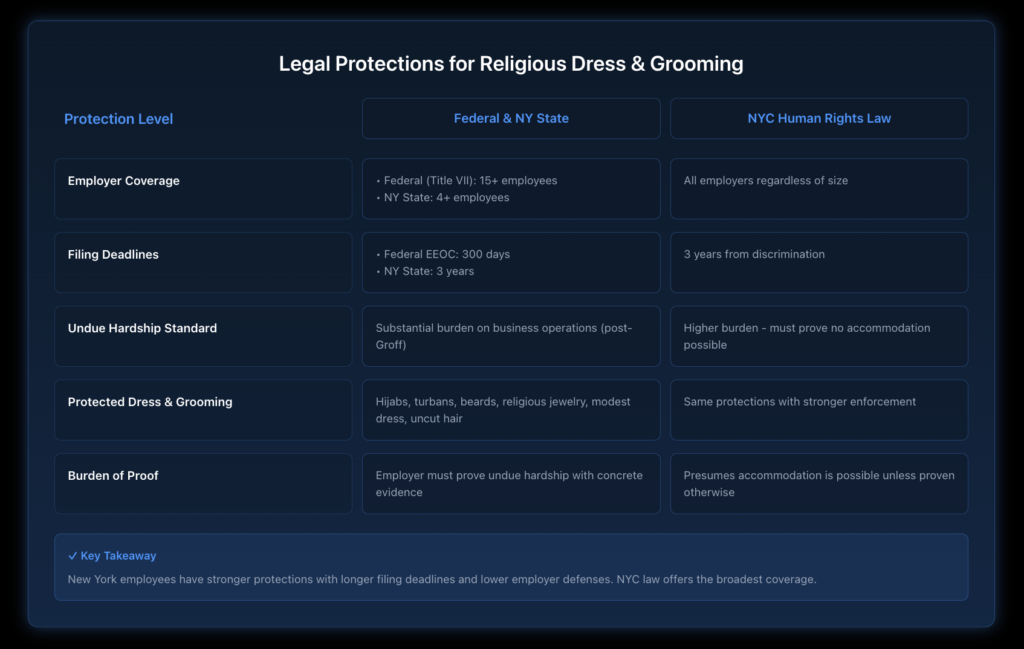
Multiple layers of legal protection safeguard your right to religious expression through appearance. Title VII of the Civil Rights Act of 1964 prohibits employers with 15 or more employees from discriminating based on religion. This includes requiring you to abandon religious dress or grooming practices without a legitimate business justification.
The New York State Human Rights Law extends these protections to employers with four or more employees. New York City’s Human Rights Law goes even further, covering all employers regardless of size and establishing employee-friendly standards for religious discrimination claims.
How Does Title VII Protect Religious Appearance?
Title VII requires employers to accommodate religious observances and practices unless accommodation causes undue hardship. Courts interpret “religious observances and practices” broadly to include dress, grooming, and appearance standards dictated by faith. The Equal Employment Opportunity Commission (EEOC) actively enforces these protections and has issued detailed guidance clarifying employer obligations.
Recent Supreme Court decisions have strengthened these protections. In Groff v. DeJoy (2023), the Court clarified that employers face a higher bar to prove undue hardship than previously understood. This decision directly impacts religious accommodation cases involving dress and grooming.
What Additional Protections Does New York Law Provide?
New York law often provides stronger protections than federal law. The State Human Rights Law prohibits discrimination based on “creed,” which courts interpret expansively. You can file discrimination claims in New York up to three years after the discriminatory act – significantly longer than the 300-day federal deadline through the EEOC.
New York City’s law is particularly protective. It requires employers to prove that no accommodation is possible before denying religious dress or grooming requests. The city’s Commission on Human Rights presumes employees are entitled to accommodations unless employers demonstrate a substantial burden.
What Types of Religious Dress and Grooming Receive Protection?
Protection extends to a wide range of appearance practices grounded in sincere religious belief. The law doesn’t limit protection to practices required by formal religious doctrine – your personal religious observance matters.
Which Head Coverings and Headwear Are Protected?
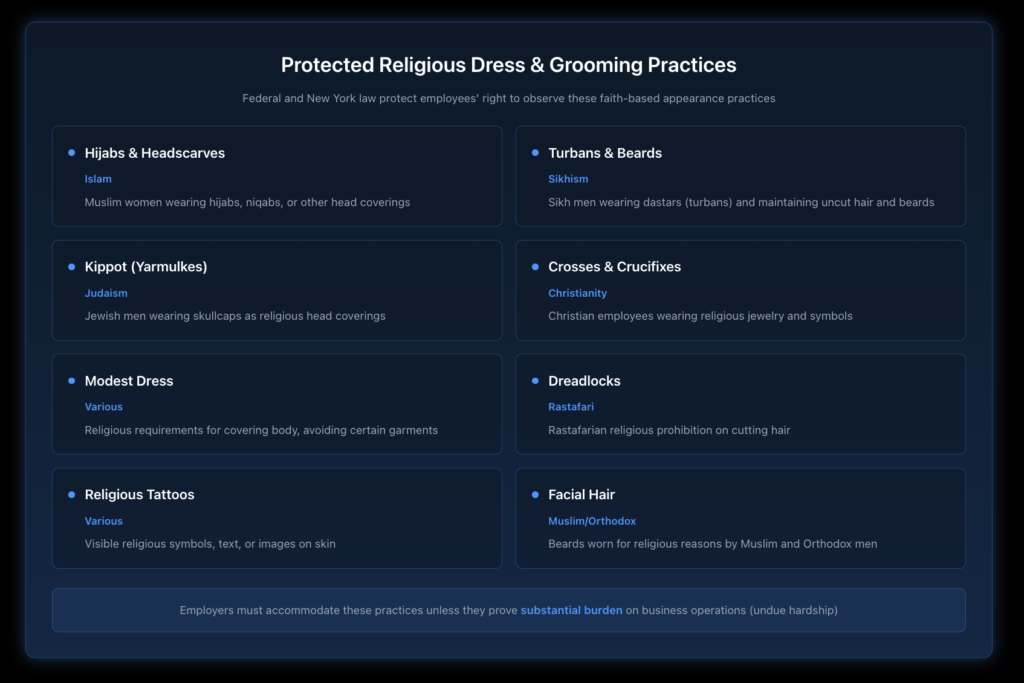
Religious head coverings receive robust legal protection. Muslim women who wear hijabs, niqabs, or burkas cannot be forced to remove them at work. Sikh men must be accommodated in wearing turbans (dastars) and beards as required by their faith. Jewish men can wear kippot (yarmulkes) in the workplace. Christian women who cover their heads for religious reasons have equal protection.
The EEOC has successfully litigated numerous cases involving religious headwear. Employers cannot refuse to hire someone because they wear a hijab, turban, or other religious head covering. Requiring removal of such items typically violates federal and state law unless the employer proves genuine undue hardship.
What About Religious Jewelry and Symbols?
Wearing religious jewelry and symbols generally receives protection. Employees can typically wear crosses, Stars of David, religious medallions, or other faith symbols. Your employer cannot single out religious jewelry while permitting secular jewelry of similar size and prominence.
Some employers argue that visible religious symbols might offend customers or create perceptions of religious endorsement. Courts generally reject these arguments. Customer preference alone doesn’t justify denying religious practices in most circumstances. Employers need concrete evidence of business necessity, not speculative concerns.
Are Facial Hair and Hairstyle Practices Protected?
Faith-based grooming practices receive the same protection as religious clothing. Sikh men cannot be required to shave beards or trim hair, as Sikhism prohibits cutting body hair. Muslim men who maintain beards for religious reasons must be accommodated. Rastafarians who wear dreadlocks as part of their faith receive protection.
Some industries with legitimate safety concerns – like food service or certain manufacturing roles – may have more flexibility. However, even in these contexts, employers must explore alternatives before denying accommodations. Options might include beard covers, modified equipment, or reassignment to positions without the same safety requirements.
What Are Examples of Reasonable Religious Accommodations?
Reasonable accommodations modify standard workplace policies to respect religious practices. Most accommodations cost employers nothing or very little, making them clearly reasonable under the law.
How Do Employers Modify Dress Codes?
The most common accommodation involves exceptions to general dress codes. If your workplace requires professional business attire, your employer can accommodate a hijab, turban, or modest religious garments within that framework. Uniform requirements can be modified to allow religious head coverings in the employer’s colors or with company logos.
Many employers successfully accommodate religious dress without any operational impact. Abercrombie & Fitch, for example, faced significant legal action for refusing to hire applicants wearing hijabs under its “Look Policy.” The company ultimately changed its practices after multiple EEOC lawsuits demonstrated these refusals violated the law.
What About Safety Equipment and Grooming Standards?
Employers with legitimate safety requirements must still consider accommodations. Rather than blanket bans on beards or head coverings, employers should explore modified safety equipment. For example, companies can provide larger respirators that fit over beards or modified hard hats that accommodate religious head coverings.
The key is the interactive process – employers must engage with employees to identify workable solutions. Automatically denying religious accommodations without exploring alternatives violates the law. If multiple accommodation options exist, employees generally can choose their preferred option.
When Can Customer-Facing Roles Require Modified Dress?
Customer-facing positions don’t automatically justify denying religious dress. Courts consistently hold that customer preference isn’t sufficient grounds for refusing accommodation. Your employer cannot force you to remove a hijab, crucifix, or turban because customers might feel more comfortable with employees who don’t display religious identity.
However, in very limited circumstances involving safety or security, some modifications might be necessary. For example, employees at secure facilities might need to briefly remove head coverings for identification purposes, then immediately replace them. These situations require careful analysis and usually demand the least restrictive alternative.
When Can Employers Legally Deny Religious Dress Accommodations?
Employers can only deny religious dress accommodations when they prove undue hardship. This is a higher bar than many employers realize. Inconvenience, minor costs, or customer complaints typically don’t qualify as undue hardship.
What Constitutes Undue Hardship Under Federal Law?
Under federal law, undue hardship means “substantial increased costs” or “substantial disruption” to business operations. After Groff v. DeJoy, employers must show that accommodation would create an actual substantial burden on operations – not just speculation or minor inconvenience.
Courts examine several factors: the nature of the workplace, the type of job, the actual cost of accommodation, and whether less restrictive alternatives exist. An employer claiming undue hardship must present concrete evidence, not assumptions. The Department of Labor provides guidance on evaluating undue hardship claims.
How Do New York Standards Differ?
New York employers face an even higher burden. The state law requires showing that accommodation would cause “undue hardship on the conduct of the employer’s business.” Courts interpret this standard employee-favorably. The New York State Division of Human Rights and the NYC Commission on Human Rights both presume accommodation is possible unless employers prove otherwise with strong evidence.
This means New York employers have less room to deny religious dress accommodations than employers in many other states. If you work in New York and face discrimination, state or city agencies might offer better protection than federal EEOC complaints.
What Arguments Typically Fail?
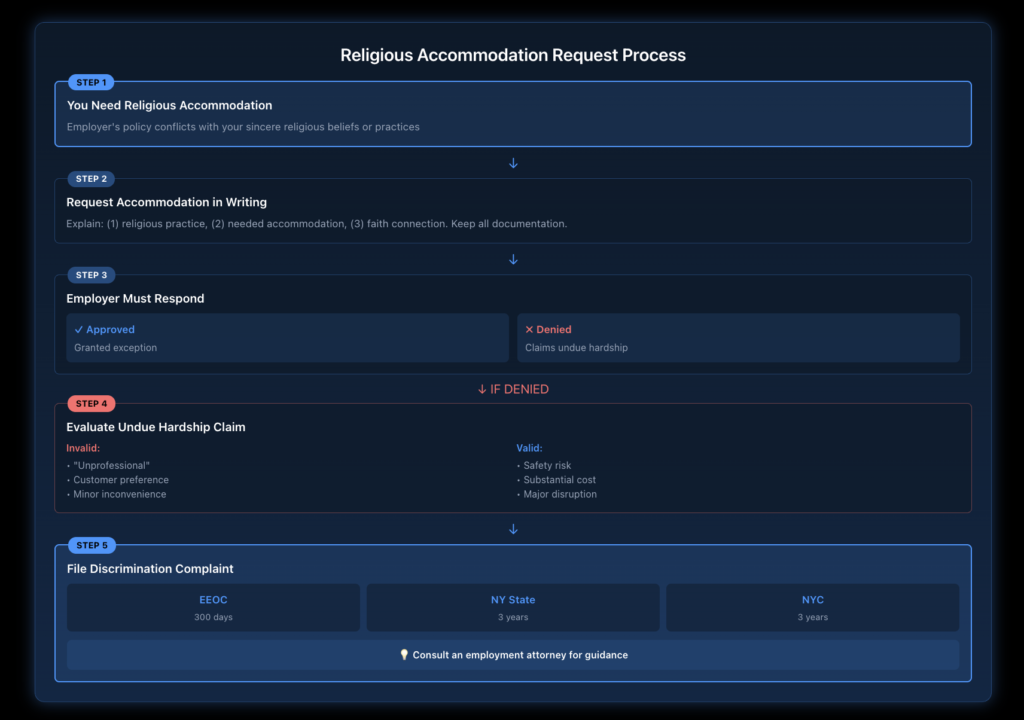
Several common employer arguments consistently fail in religious accommodation cases. “It looks unprofessional” doesn’t qualify as undue hardship. “Our customers prefer it” isn’t sufficient justification. “We’ve never done it before” isn’t a valid defense. “Other employees might object” typically doesn’t create undue hardship either.
Courts also reject arguments that accommodation would require the employer to violate other laws or regulations – unless the employer can prove this claim with specificity. Often, employers assume conflicts that don’t actually exist upon closer examination.
What Should You Do If Your Employer Denies Accommodation?
If your employer denies your religious dress or grooming accommodation, you have several options for pursuing your rights. Acting promptly protects your legal claims.
How Do You Document Your Accommodation Request?
Put your accommodation request in writing. Email works well because it creates a timestamp and a paper trail. Explain what religious practice you’re observing, what accommodation you need, and how it relates to your sincere religious belief. You don’t need to provide extensive religious justification – a clear explanation of your practice and need should suffice.
Keep copies of all communications about your request. Document verbal conversations in writing afterward. Note who you spoke with, when, and what was said. If your employer denies your request, ask for the denial in writing. If they won’t provide a written denial, send a follow-up email confirming what you understood from the conversation.
Can Your Employer Retaliate for Requesting Accommodations?
No. Retaliation for requesting religious accommodations violates federal and state law. If your employer fires you, demotes you, gives you poor performance reviews, or otherwise punishes you after you request accommodation, you may have both a religious discrimination claim and a retaliation claim.
Retaliation claims can be easier to prove than underlying discrimination claims. If negative actions follow closely after your accommodation request, temporal proximity helps establish causation. Courts are skeptical when employers claim legitimate reasons for adverse actions that coincidentally occur right after employees assert their rights.
Where Can You File Discrimination Complaints?
You have multiple options for filing religious discrimination complaints. At the federal level, you can file with the EEOC within 300 days of the discriminatory act. The EEOC investigates complaints and may sue your employer on your behalf if it finds discrimination occurred.
In New York State, you can file with the Division of Human Rights within three years. In New York City, you can file with the Commission on Human Rights, also within three years. You can file with multiple agencies simultaneously – you’re not limited to one forum.
Filing with an agency doesn’t prevent you from eventually filing a private lawsuit. Many people file with agencies first to create a record, then pursue private litigation if the agency doesn’t resolve the matter satisfactorily. Having an attorney review your situation early helps you understand which filing options best serve your interests.
Should You Contact an Employment Attorney?
Yes. Religious discrimination cases involve complex legal questions about the sincerity of belief, reasonableness of accommodation, and undue hardship defenses. An experienced employment attorney can evaluate your case, help you document discrimination, and pursue your claims effectively.
Many employment attorneys offer free consultations and work on contingency fee arrangements – meaning you don’t pay unless you recover compensation. This makes legal representation accessible even if you’re experiencing financial stress from job loss or discrimination. Attorneys can also help you understand whether you have related claims for wrongful termination, hostile work environment, or other violations.
What Damages Can You Recover in Religious Discrimination Cases?
If you prove religious discrimination in refusing to accommodate your dress or grooming practices, you may recover several types of compensation. The specific remedies depend on whether you file federally, in state court, or through New York City’s process.
What Economic Damages Are Available?
Economic damages compensate for financial losses from discrimination. This includes back pay – the wages you lost because of discrimination. If you were fired for wearing a hijab or maintaining a religious beard, you can recover the income you would have earned until you find comparable employment.
Front pay might be available if you can’t be reinstated to your position. This compensates for future lost earnings if returning to your former employer isn’t feasible. You can also recover benefits you lost, including health insurance, retirement contributions, and bonuses you would have earned.
Can You Recover Emotional Distress Damages?
Yes. Religious discrimination cases often involve significant emotional harm. Being forced to choose between your faith and your job causes real psychological suffering. Courts recognize that discrimination based on deeply held religious beliefs is particularly harmful.
To recover emotional distress damages, you’ll typically need evidence of the harm you experienced. This might include testimony from mental health professionals, your own testimony about the impact, or testimony from family and friends who observed changes in your emotional state. The more severe and prolonged the discrimination, the higher the potential emotional distress damages may be.
Are Punitive Damages Possible?
In cases involving particularly egregious conduct, punitive damages may be available. These damages punish employers and deter future discrimination. Federal law caps punitive damages based on employer size, but New York law doesn’t impose similar caps for state law claims.
You’re more likely to see punitive damages when employers knowingly violate your rights, show reckless disregard for the law, or continue discrimination after being told it was illegal. Firing someone for wearing religious attire after they’ve explained their legal rights might support punitive damages.
What Other Remedies Might Courts Order?
Beyond monetary damages, courts can order injunctive relief requiring employers to change discriminatory policies. This might include revising dress codes to explicitly permit religious dress, implementing training on religious accommodation obligations, or reinstating you to your position.
Attorney’s fees are often available in employment discrimination cases. If you prevail, your employer typically pays your attorney’s fees and litigation costs. This makes pursuing discrimination claims more financially feasible and holds employers accountable for forcing employees to litigate their rights.
How Do Religious Dress Rights Intersect with Other Legal Issues?
Religious dress and grooming protections don’t exist in isolation. They interact with other employment law areas in ways that affect both your rights and your employer’s obligations.
What About Religious Dress and Gender Discrimination?
Some religious dress practices are gender-specific, creating potential overlap with gender discrimination law. For example, some faiths require women to dress modestly or cover their hair while not imposing similar requirements on men. Employers cannot refuse to accommodate these practices on grounds that they’re “gender discriminatory.”
However, employers must be careful not to enforce dress codes in ways that themselves become discriminatory. Requiring women to wear headscarves when their religion doesn’t require it, or prohibiting men from wearing religious head coverings while permitting women to do so, could violate both religious freedom and gender equality principles.
How Does Religious Dress Relate to Workplace Safety?
Safety is one area where employers have more flexibility, but even safety concerns don’t automatically override religious rights. Employers must prove that no safe accommodation exists before denying religious dress or grooming practices.
In many cases, alternatives make both safety and religious accommodation possible. Modified safety equipment, alternative job assignments, or adjusted procedures can often resolve conflicts. The Occupational Safety and Health Administration (OSHA) has provided guidance on balancing religious accommodation with safety requirements in various industries.
Can Schools and Healthcare Require Dress Code Compliance?
Schools, hospitals, and other institutions with specific professional dress expectations must still accommodate religious practices. While these environments may have legitimate reasons for certain appearance standards, religious accommodation law still applies.
Healthcare facilities concerned about infection control can often accommodate religious head coverings by requiring them to be laundered daily or providing disposable covers. Schools can modify uniform requirements to permit religious dress. The key is finding solutions that serve both institutional needs and employee rights.
What About Remote Work and Religious Dress?
As remote work becomes more common, questions arise about religious dress expectations during video calls. Generally, employers have less justification for restricting religious dress that appears only on video. If you’re not interacting with clients in person, arguments about customer preference or professional appearance carry less weight.
However, if your role requires video appearances with clients or public-facing presentations, some of the same analysis applies as with in-person customer interaction. Even then, the same principles govern: customer preference alone rarely justifies denying accommodation.
Need Legal Help with Religious Dress Discrimination?
If you’re facing workplace discrimination because of your religious dress or grooming practices, Nisar Law Group can help. Our employment law attorneys have extensive experience protecting employee rights throughout New York and New Jersey. We understand both federal protections and New York’s stronger state and local laws. Contact us today for a consultation to discuss your case and explore your legal options.
Frequently Asked Questions About Religious Dress and Grooming at Work
Yes, you can wear religious attire at work in most circumstances. Federal law and New York law protect your right to religious dress unless your employer proves that accommodating your attire would cause undue hardship to business operations. This includes hijabs, turbans, modest religious clothing, crosses, and other faith-based attire. Your employer must make reasonable efforts to accommodate your religious dress before denying your request.
Generally, no, you cannot be forced to hide religious jewelry at work. If your employer permits employees to wear secular jewelry of similar size and visibility, they cannot single out religious jewelry for prohibition. However, if your employer has a legitimate business justification for a no-jewelry policy that applies equally to everyone, that might be permissible. Customer preference alone doesn’t justify requiring you to hide religious symbols.
Workplace dress codes must accommodate religious attire unless the employer proves undue hardship. This means dress codes should include exceptions for religious dress, or employers must grant individual accommodations upon request. Even in industries with strict uniform requirements, employers typically must find ways to incorporate religious dress into the uniform system. New York law is particularly protective, requiring employers to prove they cannot accommodate religious dress rather than placing the burden on employees.
No, employers typically cannot deny religious practices simply because they conflict with the desired company image or brand identity. Courts have consistently held that customer preference and corporate branding concerns don’t constitute undue hardship for religious accommodation purposes. Your employer needs to demonstrate concrete, substantial business harm – not just aesthetic preferences or concerns about customer reactions – to legally deny religious dress accommodation.
Yes, you can generally wear religious clothes even in customer-facing positions. Courts have rejected arguments that customer preference justifies denying religious dress accommodations. Your employer cannot force you to remove a hijab, turban, or modest religious clothing because customers might prefer employees without visible religious identity. Only in extremely rare circumstances involving genuine safety or security concerns might limited modifications be legally required.
Yes, you can wear a crucifix at work as an expression of your Christian faith. Religious jewelry receives the same legal protection as other religious dress. Unless your employer has a legitimate, equally-applied policy prohibiting all jewelry for safety or hygiene reasons, they cannot require you to remove religious symbols. The size and obtrusiveness of the crucifix might affect analysis, but ordinary religious jewelry is almost always protected.
No, firing you for following religious dress or grooming practices violates federal and state discrimination law. If you were terminated after requesting accommodation for religious attire, maintaining a religious beard, or wearing religious head coverings, you likely have a wrongful termination claim. You may be entitled to back pay, emotional distress damages, and other compensation. Document the circumstances of your termination and consult an employment attorney promptly.
Common religious dress accommodations include permitting hijabs, turbans, and other head coverings; allowing religious jewelry like crosses, Stars of David, or religious medallions; exempting employees from beard-shaving requirements; permitting modest religious clothing even when it differs from standard uniform; and modifying grooming standards to accommodate uncut hair or dreadlocks required by faith. Employers can often make these accommodations at little or no cost, making them clearly reasonable under the law.

