

Federal and New York law protect a surprisingly broad range of religious beliefs in the workplace—far beyond traditional organized religions. Under Title VII of the Civil Rights Act and state protections, employers must accommodate sincerely held religious, ethical, or moral beliefs unless doing so creates an undue hardship. This includes beliefs tied to organized religions like Christianity, Islam, Judaism, Hinduism, Buddhism, and Sikhism, as well as less conventional spiritual practices, atheism, and deeply held moral or ethical convictions. The key factor isn’t whether your belief system is mainstream or organized—it’s whether you hold it sincerely and it addresses fundamental questions about existence, purpose, or morality.
Key Takeaways
- Religious belief protection extends far beyond organized religions to include personal spiritual practices, atheism, and deeply held ethical or moral convictions.
- The sincerity test matters more than popularity—courts evaluate whether you genuinely hold the belief, not whether it’s widespread or traditional.
- New York provides broader protections than federal law, covering more belief systems and offering stronger accommodation requirements.
- Employers cannot question the theological basis of your beliefs, but may inquire whether you sincerely hold them.
- You have the right to workplace accommodations for religious practices unless they create significant operational difficulties for your employer.
Disclaimer: This article provides general information for informational purposes only and should not be considered a substitute for legal advice. It is essential to consult with an experienced employment lawyer at our law firm to discuss the specific facts of your case and understand your legal rights and options. This information does not create an attorney-client relationship.
How Does Federal Law Define "Religion"?
Title VII’s religious protections go well beyond what most people consider traditional religion. The Equal Employment Opportunity Commission (EEOC) defines religion to include all aspects of religious observance, practice, and belief. This encompasses traditional organized religions, but also extends to sincerely held religious, ethical, or moral beliefs about what is right and wrong, even if they aren’t connected to a formal religious institution.
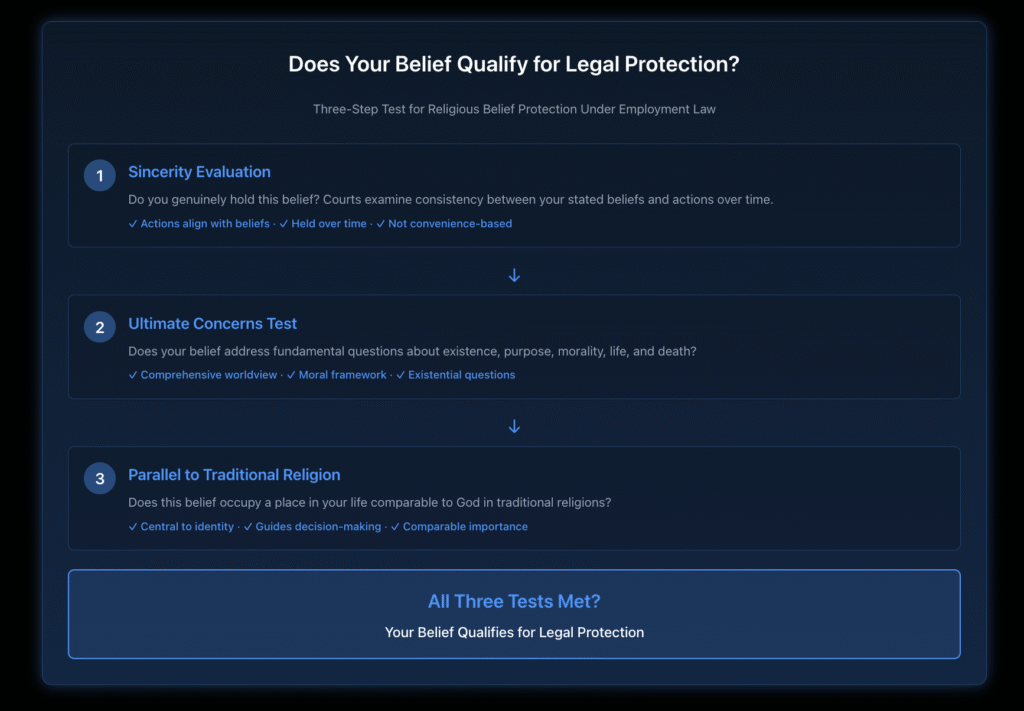
The Supreme Court has emphasized that the definition should be construed broadly. Religious beliefs don’t need to be consistent with the views of organized religions, and they don’t need to be shared by others. What matters is that the individual sincerely holds the belief and that it addresses ultimate ideas about life, purpose, and death in a way that occupies a place parallel to that filled by God in traditional religions.
What Types of Beliefs Qualify for Protection?
Courts have recognized protection for a wide spectrum of belief systems. Traditionally theistic religions like Christianity, Islam, Judaism, and Hinduism clearly qualify. But protection extends equally to non-theistic beliefs, including Buddhism (which doesn’t require belief in a deity), certain forms of ethical veganism based on deeply held moral convictions, and even atheist beliefs about the non-existence of God.
The EEOC has affirmed that religious discrimination protections apply regardless of whether the belief is part of a formal church or sect. This means personal spiritual practices, individualized interpretations of religious texts, and emerging belief systems all potentially qualify. The test isn’t about the belief’s popularity or organizational structure—it’s about how fundamental the belief is to the individual’s understanding of existence and morality.
Can Employers Question My Religious Sincerity?
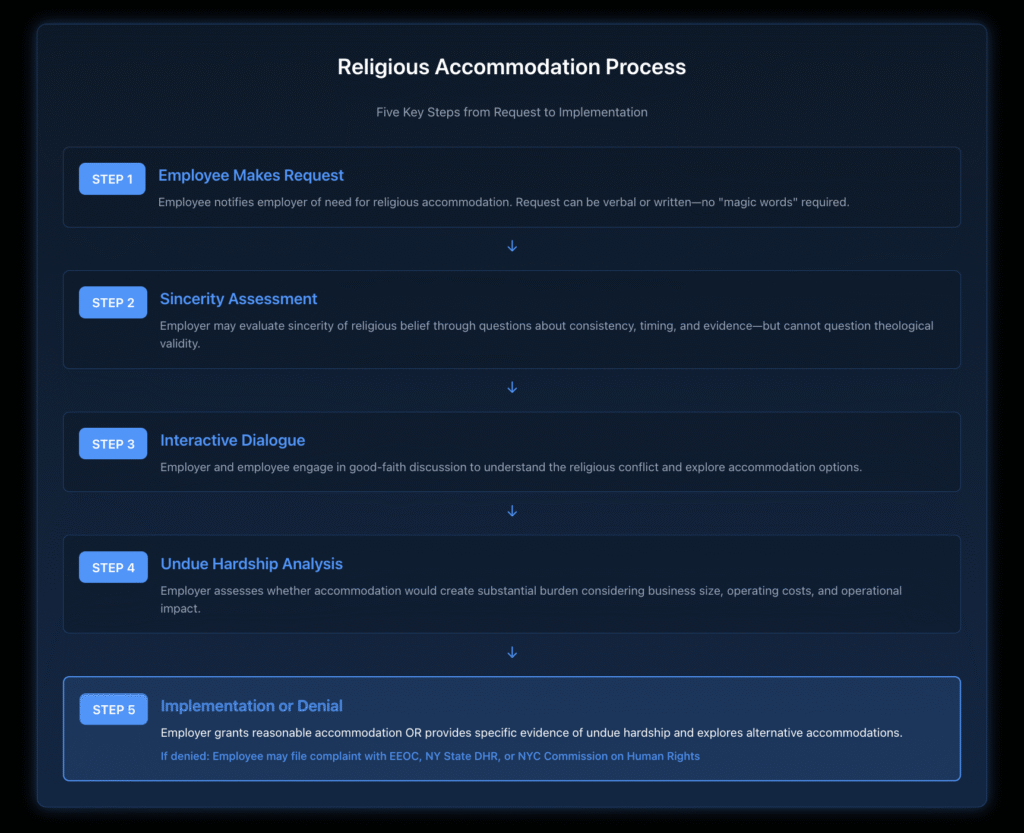
Employers can inquire into the sincerity of your religious belief, but they cannot question its validity or reasonableness. This distinction is crucial. An employer may ask questions to determine whether you genuinely hold the belief you claim, but they cannot judge whether your interpretation of religious doctrine is correct or whether your belief system makes logical sense.
The sincerity inquiry typically focuses on objective evidence. Do you demonstrate consistency between your stated beliefs and your actions? Have you held this belief over time, or did it suddenly appear when requesting accommodation? Are you seeking accommodation only for beliefs that happen to align with your personal preferences? Courts look at your conduct and consistency, not the theological soundness of your beliefs.
However, employers must be careful not to cross the line into questioning the religious basis itself. They cannot say “that’s not a real religious belief” or “your interpretation of Scripture is wrong.” Even if your beliefs differ from mainstream interpretations within your faith tradition, that’s irrelevant. The First Amendment protects your right to interpret religious doctrine as you see fit.
What Beliefs Fall Outside Legal Protection?
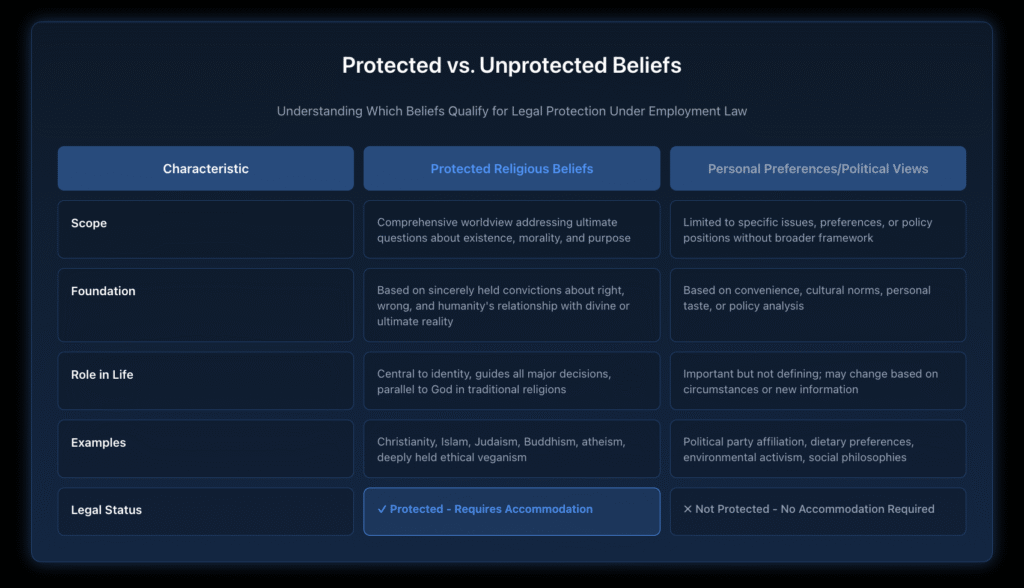
Not every strongly held belief qualifies as “religious” under employment discrimination law. Personal preferences, political views, and social philosophies generally don’t meet the legal standard, even if you feel passionate about them. The distinction turns on whether the belief addresses ultimate questions about existence, morality, and purpose in a comprehensive way.
Do Political or Social Views Count as Religious Beliefs?
Political ideologies and social philosophies typically don’t qualify for religious protection, even when held with great conviction. Supporting a particular political party, advocating for environmental causes, or holding strong views about economic systems doesn’t automatically trigger workplace accommodation rights.
The key difference is scope and foundation. Religious beliefs typically provide a comprehensive worldview that addresses fundamental questions about right and wrong, the nature of existence, and humanity’s place in the universe. Political views, while potentially deriving from religious beliefs, usually address specific policy questions without providing this broader framework.
That said, the line can blur. Some political movements have quasi-religious characteristics, and some religious beliefs have significant political dimensions. Courts examine whether the belief system at issue functions like religion in the person’s life—addressing ultimate concerns and occupying a central role in their identity and decision-making.
Are Personal Preferences Protected?
Personal preferences, cultural practices, and lifestyle choices don’t automatically qualify as religious beliefs. Simply preferring not to work on Sundays because you enjoy leisure time, or objecting to a dress code because you prefer different clothing, doesn’t create legal protection.
The distinction hinges on the basis of your preference. If you avoid pork because you dislike the taste, that’s a personal preference. If you avoid pork because you believe God prohibits its consumption, that’s a religious belief. The source and nature of the conviction matter, not just the resulting behavior.
However, religious practices often blend with cultural identity in ways that complicate these distinctions. Many religious traditions are deeply intertwined with ethnic, national, or cultural identity. Religious grooming and dress requirements illustrate this intersection—Sikh turbans, Muslim hijabs, and Jewish yarmulkes are simultaneously religious observances and cultural markers.
How Does New York Law Differ From Federal Standards?
New York’s religious discrimination protections exceed federal minimums in significant ways. The New York State Human Rights Law and New York City Human Rights Law provide broader coverage and stronger accommodation requirements than Title VII.
What Additional Protections Does New York Provide?
New York law has a more expansive definition of religious practice and a lower threshold for accommodation. While federal law allows employers to deny accommodations that create “more than a de minimis cost,” New York uses a more employee-friendly standard. Employers must demonstrate that accommodation would create genuine hardship or significant difficulty, not merely inconvenience.
New York also explicitly protects religious observance and practices, including the right to observe a Sabbath or holy day, to adhere to religious dress and grooming standards, and to take time off for religious reasons. The NYC Human Rights Law specifically requires employers to grant requests for religious holidays and observances unless doing so would cause undue hardship to the employer’s business.
Additionally, New York law provides stronger protections against coercion. Employers cannot force employees to participate in religious activities or express religious views as a condition of employment. This protection applies regardless of the employer’s own religious character or mission.
How Do Courts Interpret “Undue Hardship” in New York?
New York courts interpret undue hardship more narrowly than federal courts historically have. While the Supreme Court recently clarified that federal law requires showing “substantial increased costs” rather than just “more than de minimis cost,” New York law already provided this higher standard.
New York employers must show that accommodation would genuinely disrupt business operations, not merely create minor administrative inconvenience. Cost alone rarely justifies denying accommodation unless the expense is truly significant relative to the employer’s resources. Similarly, coworker preferences or discomfort don’t constitute undue hardship.
This creates stronger protections for New York employees seeking religious accommodations. If your employer claims accommodation would create hardship, they must provide specific evidence of significant operational disruption or substantial cost, not vague assertions of inconvenience.
What Role Does Sincerity Play in Religious Belief Claims?
Sincerity is the cornerstone of religious belief protection. Courts and employers may question whether you genuinely hold a belief, but once sincerity is established, your beliefs receive protection regardless of how unusual or unorthodox they might be.
How Do Courts Evaluate Sincerity?
The sincerity evaluation looks at consistency and credibility, not theological correctness. Courts consider whether your actions align with your stated beliefs over time. Do you demonstrate commitment to the belief through your behavior? Did you hold this belief before the accommodation request became relevant? Are you seeking accommodation only when convenient?
Objective evidence matters significantly. Prior requests for similar accommodations, membership in religious organizations, regular attendance at services, and consistent adherence to religious practices all support sincerity. However, lack of formal religious affiliation doesn’t undermine sincerity—you don’t need to be part of an organized religion to hold sincere religious beliefs.
The timing of your claim receives scrutiny. If you suddenly discover a religious objection to a work requirement you previously performed without complaint, employers may legitimately question your sincerity. However, religious conversions and evolving beliefs are protected—people genuinely change their beliefs, and that change may occur at any time.
What Evidence Supports a Sincerity Finding?
Documentary evidence can bolster your sincerity claim. Religious texts you follow, membership records from faith communities, correspondence discussing your beliefs, and social media posts reflecting your religious views all demonstrate sincerity. Personal testimony also matters—your ability to articulate why you hold certain beliefs and how they influence your life carries weight.
Consistency across life domains strengthens sincerity claims. If you request accommodation to avoid working on your Sabbath, do you also consistently observe that Sabbath outside work? If you cite religious dress requirements, do you adhere to them in other contexts? Courts look for patterns of behavior reflecting genuine religious commitment.
However, perfect consistency isn’t required. People of faith often struggle with adherence to their beliefs, and occasional lapses don’t necessarily prove insincerity. The question is whether you genuinely strive to follow your beliefs, not whether you achieve perfection.
Can Atheism or Agnosticism Qualify as Protected Beliefs?
Yes. Federal and New York law protect the absence of religious belief equally with religious belief. The EEOC has explicitly stated that Title VII’s protections extend to atheist and agnostic employees, and New York law provides similar protection.
What Protections Do Non-Religious Employees Have?
Non-religious employees cannot be discriminated against based on their lack of belief. This means employers cannot require participation in religious activities, cannot favor religious employees over non-religious ones in hiring or promotion decisions, and cannot create hostile work environments where non-religious employees feel pressured to adopt or express religious views.
The same accommodation principles apply to non-religious beliefs. If an employer provides accommodation for religious practices—such as allowing religious employees to swap shifts to observe holy days—they must provide equivalent accommodation for non-religious employees seeking time off for comparable personal commitments.
However, atheism and agnosticism as mere absence of belief don’t typically require affirmative accommodations in the way active religious practices do. You won’t need time off to not observe religious holidays or accommodation to not wear religious garments. The protection primarily prevents discrimination and coercion rather than requiring employers to accommodate non-belief.
Can Secular Ethical Beliefs Receive Protection?
Some deeply held secular ethical beliefs may qualify for protection if they function like religion in your life. The key test is whether the ethical system addresses ultimate questions about morality and existence in a comprehensive way that parallels religious belief.
Courts have recognized protection for certain forms of ethical veganism rooted in deeply held moral convictions about the sanctity of animal life. Similarly, conscientious objection to military service based on profound moral opposition to all war (not just inconvenient wars) has received protection.
The belief must be more than a personal preference or political view. It must represent a comprehensive moral philosophy that shapes your understanding of right and wrong across all areas of life. Environmental activism alone doesn’t qualify, but a deeply held belief system addressing humanity’s moral obligations to creation might.
How Do Courts Handle Conflicts Between Religious Beliefs?
Workplaces increasingly involve employees with diverse and sometimes conflicting religious beliefs. When one employee’s religious practice conflicts with another’s religious beliefs, employers face complex accommodation challenges.
Can My Religious Freedom Trump Others’ Rights?
Your right to religious accommodation doesn’t automatically override other employees’ legal protections. Conflicts between religious beliefs and other protected rights require careful balancing, with neither right automatically supreme.
For example, if you hold sincere religious beliefs opposed to same-sex marriage, you still cannot discriminate against LGBTQ coworkers or refuse to work with them. Your religious freedom protects your right to hold and express your beliefs, but it doesn’t permit you to violate others’ rights to workplace equality.
Similarly, employers can restrict religious expression that creates a hostile work environment for other employees. If your religious practices involve proselytizing that makes coworkers uncomfortable, your employer may restrict when and how you engage in such expression, even though your beliefs themselves remain protected.
How Do Employers Balance Competing Religious Accommodation Requests?
When multiple employees request accommodations that conflict with each other, employers must seek solutions that accommodate both to the extent possible. This might involve creative scheduling, allowing multiple employees to swap shifts or days off, or finding other ways to honor different religious observances.
If a genuine conflict exists that cannot be resolved, employers typically must evaluate which accommodation request creates less disruption. However, they cannot favor majority religions over minority ones or traditional beliefs over unconventional ones. The analysis must focus on operational impact, not on judging which beliefs are more worthy of respect.
New York law particularly emphasizes the duty to engage in an interactive process. When accommodation requests conflict, employers must work collaboratively with all affected employees to find workable solutions rather than simply denying accommodations because conflicts exist.
Ready to Protect Your Religious Rights at Work?
If you’re facing religious discrimination or your employer has denied a reasonable religious accommodation request, Nisar Law Group can help. Our employment law attorneys have extensive experience protecting employee rights across New York and New Jersey, including cases involving religious belief discrimination, denied accommodations, and retaliation for asserting religious rights. Contact us today for a consultation to discuss your case and learn about your legal options.
Frequently Asked Questions About Religious Belief Protections
Yes, religious beliefs receive broad legal protection under Title VII of the Civil Rights Act, the New York State Human Rights Law, and the New York City Human Rights Law. These laws prohibit discrimination based on religion and require employers to reasonably accommodate sincere religious beliefs unless doing so creates undue hardship. Protection extends to traditional organized religions, non-traditional spiritual practices, atheism, and deeply held ethical or moral beliefs that function like religion in your life.
The 14th Amendment requires states to provide equal protection under the law, which has been interpreted to include religious freedom protections. Through incorporation, the 14th Amendment applies the First Amendment’s religion clauses to state and local governments, preventing them from establishing religion or prohibiting its free exercise. In employment contexts, this means state employers and agencies must respect employees’ religious rights and cannot favor or disfavor particular religions.
Employment law protects both religious belief and religious practice. Under federal and New York law, religion encompasses belief or non-belief in God, adherence to religious doctrine, participation in religious observance, and compliance with religious practices. The law prohibits discrimination based on your religious identity and requires accommodation of religious practices unless the accommodation would create significant difficulty or expense for the employer.
The EEOC defines religion broadly to include all aspects of religious observance, practice, and belief. Religion includes traditional theistic beliefs, non-theistic beliefs like Buddhism, the absence of religious belief (atheism), and sincerely held ethical or moral beliefs that address fundamental questions about existence and morality. The definition focuses on the role the belief plays in your life and whether you sincerely hold it, not on whether the belief is organized, mainstream, or shared by others.
No, religious freedom is not absolute. While the Constitution protects religious belief and practice, this protection has limits when religious practice conflicts with compelling government interests or others’ legal rights. In employment contexts, employers can deny religious accommodation when it would create undue hardship, and religious beliefs cannot be used to justify discrimination against protected groups. However, restrictions on religious practice must be narrowly tailored and cannot target religion specifically.
Employment law protects sincerely held beliefs about religion, whether those beliefs align with traditional religious doctrine or represent personal spiritual convictions. The key requirements are that you sincerely hold the belief, that it addresses ultimate questions about existence and morality, and that it occupies a place in your life comparable to traditional religious belief. Courts evaluate sincerity through your actions and consistency over time, but cannot judge the validity or reasonableness of your beliefs once sincerity is established.

