

When workplace harassment becomes unbearable, you need to know whether your situation crosses from merely unpleasant to legally actionable. A hostile work environment exists when harassment based on your protected characteristics—like race, gender, religion, age, or disability—becomes so severe or pervasive that it fundamentally alters your working conditions. The legal threshold matters because it determines whether you have grounds for a formal complaint, what damages you might recover, and how urgently you need to act to protect your rights.
Understanding where your situation falls on this spectrum helps you make strategic decisions about documentation, internal reporting, and potential legal action. This guide breaks down exactly what courts look for, how to build your case, and what options you have for resolution.
Key Takeaways
- A hostile work environment requires harassment based on a protected characteristic—not just general workplace conflict or rudeness.
- The harassment must be either “severe” (a single extreme incident) or “pervasive” (a pattern of conduct that alters your working conditions).
- Your employer must have known or should have known about the harassment and failed to take appropriate action.
- New York City Human Rights Law provides broader protections than federal law, covering harassment that amounts to more than “petty slights.
- Documentation is critical—electronic communications, detailed incident logs, and witness information strengthen your case significantly.
- EEOC filing deadlines are strict: 180 days federally, extended to 300 days in states with fair employment agencies.
Disclaimer: This article provides general information for informational purposes only and should not be considered a substitute for legal advice. It is essential to consult with an experienced employment lawyer at our law firm to discuss the specific facts of your case and understand your legal rights and options. This information does not create an attorney-client relationship.
What Legal Elements Must You Prove for a Hostile Environment Claim?
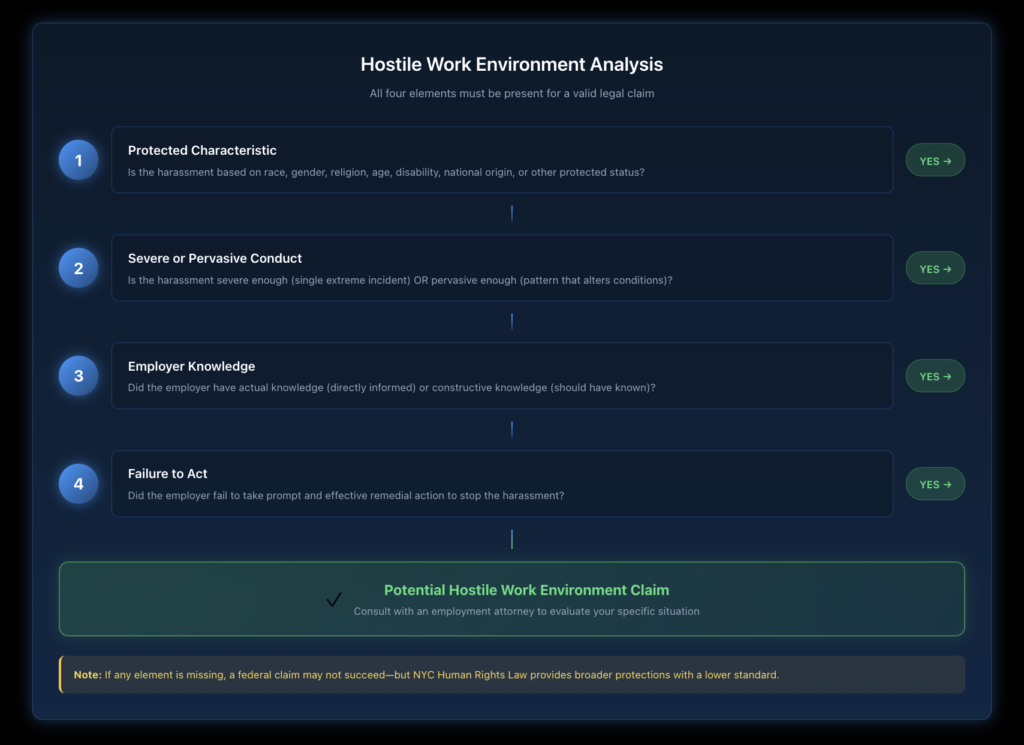
To succeed with a hostile work environment claim, you need to establish several specific legal elements. Miss even one, and your case likely won’t survive in court.
Is the Harassment Based on a Protected Characteristic?
The harassment must target you because of characteristics protected under federal or state anti-discrimination laws. Federal protections cover race, color, religion, sex (including gender identity and sexual orientation following the Bostock v. Clayton County decision), national origin, age (40+), disability, and genetic information.
New York State and City laws extend these protections further, covering additional characteristics like marital status, familial status, and immigration status. General workplace bullying that isn’t connected to a protected characteristic doesn’t qualify as a hostile work environment under these statutes, even if it’s severe.
Was the Conduct Unwelcome?
You must demonstrate that the harassment was unwelcome—that you didn’t invite it, encourage it, or participate willingly. Courts examine your words and actions to determine whether the conduct was truly unwelcome. This doesn’t mean you need to have explicitly objected every time, but your response to the behavior matters.
Does the Harassment Meet the Severe or Pervasive Standard?
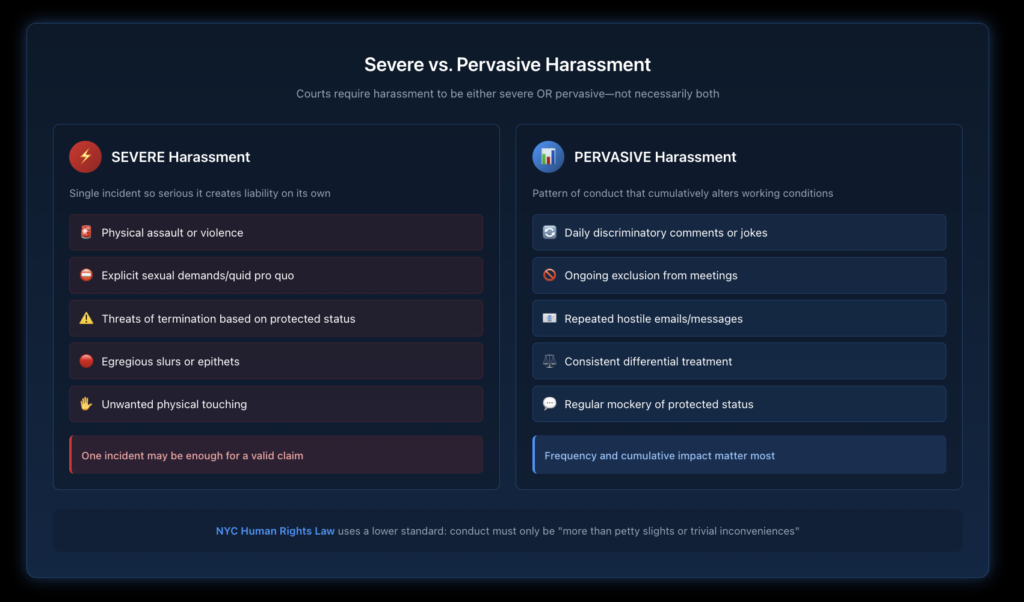
Courts apply a “severe or pervasive” test to determine whether harassment legally alters working conditions. You don’t need both—one or the other suffices.
Severe harassment might be a single extremely serious incident. Physical assault, explicit threats, or egregious sexual misconduct can meet this threshold on their own. A single incident of physical touching with sexual intent, for example, might be severe enough to create liability.
Pervasive harassment involves frequent, smaller incidents that cumulatively create an abusive environment. Daily discriminatory comments, regular exclusion from meetings based on your protected status, or ongoing hostile communications can meet this standard through their frequency and cumulative impact.
Did Your Employer Know and Fail to Act?
Your employer must have had actual or constructive knowledge of the harassment. Actual knowledge means they were directly informed through complaints or witnessed the behavior. Constructive knowledge means the harassment was so open and obvious that management should have known about it.
Once an employer has knowledge, they must take prompt and effective remedial action. The EEOC’s enforcement data shows that harassment charges have increased by over 47% in recent years, with monetary recoveries reaching $202 million in FY 2023. Employers who ignore complaints or implement ineffective responses face significant liability exposure.
What Behaviors Create a Hostile Work Environment?
A wide range of conduct can contribute to a hostile environment when tied to protected characteristics. Understanding these categories helps you recognize when workplace behavior crosses legal boundaries.
What Verbal Conduct Qualifies as Harassment?
Discriminatory slurs, offensive jokes targeting protected characteristics, derogatory comments, and hostile written communications can create hostile environments when they’re frequent and severe. The context matters—isolated incidents typically don’t qualify, but patterns of verbal abuse based on race, gender, religion, or other protected characteristics can cross the legal threshold.
Email harassment, text messages, and social media communications increasingly appear in hostile environment cases. Digital harassment in remote and hybrid workplaces can be particularly damaging because it creates permanent records and can reach victims outside normal work hours.
What Physical Conduct Crosses the Line?
Unwanted touching, blocking someone’s path, invading personal space, or displaying offensive materials can contribute to hostile environments. Physical harassment often meets the “severe” standard more easily than verbal harassment because courts recognize the serious impact of unwanted physical contact.
Intimidation tactics like following someone, making threatening gestures, or damaging personal property also contribute to hostile environment claims when connected to protected characteristics. A single serious physical incident may be enough to establish liability.
How Does Exclusion and Isolation Factor In?
Systematically excluding employees from meetings, work assignments, or social functions because of protected characteristics can create hostile environments. This type of harassment is often subtle but can be equally damaging to victims’ careers and working conditions.
Professional isolation—like withholding important information, excluding someone from decision-making, or preventing access to necessary resources—becomes legally significant when it’s based on discriminatory motives. These patterns often strengthen claims because they show how the hostile environment affected your actual ability to do your job.
How Do Courts Evaluate Your Hostile Environment Claim?
Courts use both objective and subjective standards when evaluating hostile environment claims. Understanding this dual analysis helps you assess the strength of your potential case.
What Is the Reasonable Person Standard?
The objective component asks whether a reasonable person in your position would find the environment hostile or abusive. This prevents claims based on hypersensitivity while ensuring legitimate harassment is recognized. Courts consider factors like the frequency of the conduct, its severity, whether it was physically threatening or humiliating, and whether it unreasonably interfered with work performance.
How Does Your Subjective Experience Matter?
You must also show that you personally perceived the environment as hostile. This subjective component ensures that harassment claims address real harm experienced by actual victims. Both standards must be met—the conduct must be objectively severe enough, and you must have actually experienced it as hostile.
What Role Does Context Play?
Context significantly affects how courts evaluate harassment. The same comment might be actionable in one setting but not another. Courts consider factors like the workplace culture, the relationship between the parties, whether the conduct occurred publicly or privately, and how the victim responded.
When Is Your Employer Liable for Hostile Environments?
Employer liability varies depending on who creates the hostile environment and what the employer knew about it.
How Does Supervisor Harassment Affect Liability?
When supervisors with authority over hiring, firing, promotions, or job assignments engage in harassment, employers typically face strict liability for their actions. The Supreme Court’s decisions in Faragher v. City of Boca Raton and Burlington Industries v. Ellerth established that employers can defend against supervisor harassment claims only if they prove they exercised reasonable care to prevent and correct harassment, and the employee unreasonably failed to use available complaint procedures.
This defense isn’t available when the harassment results in a tangible employment action like termination, demotion, or loss of wages. In those cases, the employer is automatically liable.
What About Coworker Harassment?
For harassment by coworkers, employers are liable when they knew or should have known about the harassment and failed to take prompt corrective action. This knowledge standard makes documenting and reporting harassment crucial for establishing liability.
Courts look at whether employers had effective anti-harassment policies, whether those policies were communicated to employees, and whether the employer responded appropriately when complaints were made.
Can Third Parties Create Liability?
Employers can also face liability for harassment by non-employees, like customers, vendors, or contractors, when the employer knew or should have known about the conduct and failed to take appropriate action. This is particularly relevant in customer-facing industries where employees may face harassment from the public.
How Should You Document Hostile Environment Harassment?
Quality documentation often determines the difference between a successful claim and one that fails. Creating effective records requires understanding what information matters most.
What Should You Include in Your Documentation?
Record the who, what, when, where, and why of each harassment incident. Capture specific dates, times, locations, witnesses present, exact words used, and your response to each incident. The more specific your records, the more credible your account becomes.
Save emails, text messages, voicemails, and any written communications related to the harassment. Take photos of offensive materials, graffiti, or other physical evidence. Keep copies of performance reviews, attendance records, and other employment documents that might show patterns of differential treatment.
How Can You Document Safely?
Use personal devices and accounts rather than company systems when possible. Email documentation to your personal account, but be careful not to violate company policies about confidential information. Consider keeping a written journal at home that can’t be accessed by your employer.
Document your emotional and physical reactions to harassment, including sleep disruption, anxiety, depression, or physical symptoms. These records help establish the impact of harassment on your working conditions and overall well-being, which affects damage calculations if you pursue legal action.
Why Do Witnesses Matter?
Witnesses can significantly strengthen hostile environment cases. Even if colleagues don’t want to get involved initially, proper documentation of their presence preserves the option to contact them later. Keep detailed records of who was present during harassment incidents, noting not just names but also positions and how much of the incident each person would have witnessed.
What Are Your Reporting Options and Strategies?
Strategic reporting helps establish your employer’s knowledge while building your legal case.
Should You Report Internally First?
Most companies have established procedures for reporting harassment, typically through HR departments or management chains. Following these procedures is usually required before pursuing legal action, and failure to report internally can weaken your legal position.
Review your employee handbook for specific reporting requirements, deadlines, and procedures. Report harassment promptly after it occurs, but ensure you have adequate documentation first. Provide specific details about incidents, including dates, witnesses, and the discriminatory basis for the harassment.
How Should You Document Your Internal Reports?
Request written confirmation of your complaint and any investigation results. Ask about the company’s timeline for investigating and resolving harassment complaints. Follow up regularly to ensure your complaint receives appropriate attention.
If you make verbal complaints, follow up with an email summarizing what you reported and to whom. This creates a record even if the company doesn’t acknowledge your complaint in writing.
When Should You File with Government Agencies?
If internal reporting doesn’t resolve the harassment, you can file charges with the Equal Employment Opportunity Commission (EEOC) or state/local fair employment agencies. These agencies investigate complaints and can pursue enforcement actions against employers.
What Filing Deadlines Apply to Your Claim?
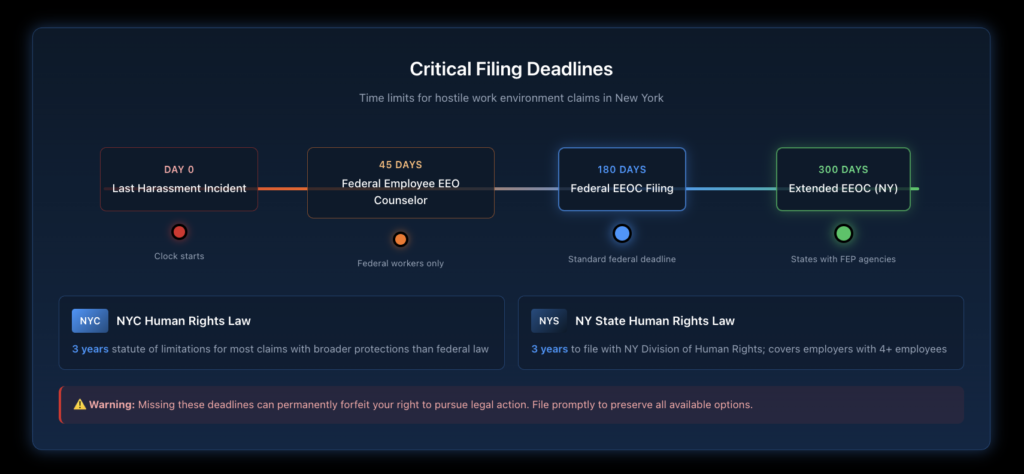
Strict deadlines govern hostile environment claims, and missing them can forfeit your legal rights.
What Are the Federal Filing Requirements?
Title VII requires filing charges with the EEOC within 180 days of the last harassment incident, extended to 300 days in states with fair employment agencies like New York. The EEOC received 88,531 new charges of discrimination in FY 2024, reflecting an increase of more than 9% over the previous year, showing that workers are increasingly aware of their rights.
The continuing violation doctrine may extend deadlines when harassment is ongoing, but you shouldn’t rely on this exception. File complaints promptly to preserve all available legal options.
How Do New York State and City Laws Differ?
New York provides additional protections beyond federal law. The New York State Human Rights Law covers employers with four or more employees, compared to Title VII’s 15-employee threshold. The statute of limitations is three years for most claims.
The NYC Human Rights Law provides the broadest protections, setting a lower bar than federal law. Rather than requiring “severe or pervasive” conduct, NYC law prohibits harassment that amounts to more than “petty slights or trivial inconveniences.” This means conduct that might not violate federal law could still be actionable under city law.
What Damages Can You Recover for Hostile Environment Claims?
Successful hostile environment claims can result in various forms of compensation designed to make victims whole.
What Economic Damages Are Available?
Back pay covers lost wages due to harassment-related absences, demotions, or constructive discharge. Front pay compensates for future lost earnings when reinstatement isn’t feasible. Economic damages also include medical expenses for harassment-related treatment and other out-of-pocket costs.
What Are Compensatory and Punitive Damages?
Compensatory damages address emotional distress, mental anguish, and other non-economic harm resulting from the hostile environment. Punitive damages may be available in cases involving intentional discrimination or reckless indifference to employees’ rights—though federal law caps these damages based on employer size.
Can You Get Non-Monetary Relief?
Courts can order non-monetary remedies like policy changes, training programs, or modifications to workplace procedures. Reinstatement, promotion, or transfer to a different department may be appropriate when harassment has affected your job status. These equitable remedies aim to prevent future harassment and create safer working environments.
How Does a Hostile Environment Differ from General Workplace Toxicity?
Many people confuse hostile work environments with generally toxic workplaces. Understanding the distinction helps you evaluate your situation accurately.
What Isn’t a Legally Hostile Environment?
A mean boss, difficult coworkers, or high-pressure work culture don’t automatically create a hostile work environment in the legal sense. General incivility, isolated offensive comments, or personality conflicts typically don’t meet the legal threshold unless they’re connected to protected characteristics.
Poor management, unfair treatment that affects everyone equally, or a stressful work environment—while unpleasant—generally aren’t actionable unless the conduct targets you because of your protected status.
What Makes Your Situation Different?
The key distinction is whether the hostile conduct relates to a protected characteristic. Workplace retaliation for reporting discrimination is also legally protected—if you faced negative consequences after complaining about harassment, that retaliation itself may be actionable.
If you’re experiencing harassment tied to your race, gender, religion, age, disability, national origin, or other protected characteristic, you may have legal options even if the conduct doesn’t rise to the level of a hostile environment. Consulting with an employment attorney can help you understand your specific rights.
Ready to Take Action?
If you’re experiencing workplace harassment that may constitute a hostile work environment, you don’t have to navigate this alone. Nisar Law Group represents employees throughout New York and New Jersey who face discrimination, harassment, and hostile work conditions.
We can help you evaluate whether your situation meets legal standards, develop effective documentation strategies, and understand your options for internal reporting, agency complaints, or litigation. The sooner you act, the better positioned you’ll be to protect your rights and your career.
Contact us for a confidential consultation to discuss your situation and learn about your legal options.
Frequently Asked Questions About Hostile Work Environments
Proving a hostile work environment requires demonstrating several legal elements: the harassment was based on a protected characteristic, the conduct was unwelcome, it was severe or pervasive enough to alter your working conditions, and your employer knew about it but failed to take appropriate action. Documentation is critical—electronic communications, detailed incident logs with dates and witnesses, medical records showing stress-related symptoms, and evidence of your employer’s knowledge all strengthen your case. The more contemporaneous and specific your records, the more persuasive they become in legal proceedings.
Courts don’t officially categorize hostile environments into three types, but harassment typically manifests in three main forms: verbal harassment, including discriminatory comments, slurs, and offensive jokes; physical harassment, including unwanted touching, intimidation, and displaying offensive materials; and environmental harassment, including exclusion from meetings, withholding resources, or systematic professional isolation. What makes each type legally actionable is its connection to a protected characteristic and whether it meets the severe or pervasive standard for altering working conditions.
Whether litigation makes sense depends on the strength of your evidence, the severity of the harassment, what damages you’ve suffered, and your goals for resolution. Successful claims can result in significant compensation, including back pay, compensatory damages for emotional distress, and sometimes punitive damages. However, litigation is time-consuming and emotionally demanding. Many cases settle before trial, and the EEOC process can sometimes achieve results without formal litigation. An employment attorney can help you evaluate your options and determine the most effective path forward for your specific situation.
Proving targeting requires showing a pattern of different treatment connected to your protected status. Compare how you’re treated versus similarly situated colleagues who don’t share your protected characteristic. Document specific incidents with dates, witnesses, and details. Save communications showing the differential treatment. Track changes in assignments, opportunities, or evaluations that coincide with the alleged targeting. Performance reviews, emails, meeting invitations, and testimony from coworkers who witnessed the conduct all help establish that you were singled out because of protected characteristics rather than legitimate business reasons.
Examples include racial slurs or jokes targeting someone’s ethnicity, sexual comments or unwanted advances, derogatory remarks about someone’s religion or religious practices, age-related comments like calling older workers “dinosaurs,” mocking someone’s disability or accent, displaying offensive images or materials, physical intimidation like blocking doorways or invading personal space, excluding someone from meetings or communications because of their protected status, and retaliating against employees who report harassment. The behavior becomes legally actionable when it’s frequent enough to create a pattern or severe enough that a single incident alters working conditions.
Neither is ideal, and the answer depends on your specific circumstances. If you resign, you may lose eligibility for unemployment benefits and potentially weaken some legal claims. However, remaining in an intolerable situation can worsen your physical and mental health. If conditions become so intolerable that a reasonable person would feel compelled to resign, you may have a “constructive discharge” claim—essentially treating your resignation as an involuntary termination. Before making any decisions, document the conditions thoroughly and consult with an employment attorney who can advise you on how to protect your legal rights while also protecting your well-being.
Gaslighting in HR contexts occurs when employers or HR representatives manipulate employees into questioning their own perceptions of harassment or discrimination. Examples include dismissing valid complaints as oversensitivity, denying that documented incidents occurred, suggesting the employee misremembered events, or recharacterizing discriminatory conduct as “just a joke” or “normal workplace behavior.” This psychological manipulation can make employees doubt whether they experienced harassment at all. Document your experiences independently, keep records outside company systems, and consider consulting with an attorney if HR responses seem designed to invalidate your legitimate concerns rather than address them.
Avoid making statements you can’t support with evidence, as this can undermine your credibility. Don’t exaggerate incidents or speculate about the harasser’s motives. Avoid ultimatums like “if you don’t fire them, I’ll sue”—this can trigger defensive responses rather than genuine investigation. Don’t discuss your complaint with coworkers before speaking with HR, as this can complicate investigations. Focus on specific facts: what happened, when, where, who was present, and how it affected your work. Stick to what you personally experienced or witnessed rather than hearsay. Keep a copy of everything you submit and document the HR response for your records.
Related Resources
- What Legally Constitutes a Hostile Work Environment
- Severe or Pervasive: The Legal Standard Explained
- Employer Liability for Hostile Work Environments
- Reporting Hostile Behavior: Best Practices
- Documenting Hostile Conduct Effectively
- Bystander Intervention in Hostile Environments
- Emotional Impact and Damages in Hostile Environment Cases
- Virtual Workplaces and Hostile Environment Claims
- Rehabilitation of Toxic Workplace Cultures
- Workplace Retaliation: Identifying, Proving, and Fighting Back
- Title IX Protections in Educational Institutions
- Discrimination in Higher Education Settings
- Bullying and Harassment in Schools: Legal Remedies
- Faculty Rights and Academic Freedom

