

Sexual harassment falls into two legally distinct categories: quid pro quo and hostile work environment. Understanding which type you’re experiencing changes everything about how you document it, report it, and protect your legal rights. If you’re facing unwanted sexual advances at work, this guide breaks down exactly what evidence you need, what makes each type illegal, and the specific steps to take right now.
Both types violate federal law under Title VII of the Civil Rights Act, but they work differently. Quid pro quo involves direct exchanges – sexual favors for job benefits or threats. A hostile environment involves pervasive conduct that makes your workplace intolerable. Many situations involve both.
Key Takeaways
- Quid pro quo harassment occurs when someone with authority conditions job benefits on sexual favors or punishes you for refusing.
- A hostile work environment involves severe or pervasive conduct that interferes with your ability to do your job.
- One incident of quid pro quo can violate federal law; a hostile environment typically requires a pattern.
- Employer liability differs: strict liability applies for supervisor quid pro quo, while hostile environment requires proof that the employer knew or should have known.
- New York law provides broader protections – harassment doesn’t need to be “severe or pervasive” to be illegal under state law.
- Filing deadlines range from 180 days (EEOC) to three years (NYC Human Rights Law).
Disclaimer: This article provides general information for informational purposes only and should not be considered a substitute for legal advice. It is essential to consult with an experienced employment lawyer at our law firm to discuss the specific facts of your case and understand your legal rights and options. This information does not create an attorney-client relationship.
What Is Quid Pro Quo Sexual Harassment?
Quid pro quo literally means “this for that.” In employment law, it describes situations where someone with power over your job makes sexual demands in exchange for workplace benefits – or threatens consequences if you refuse.
The key element is a direct connection between the sexual conduct and your employment status. Your supervisor doesn’t need to spell it out explicitly. Courts recognize that these propositions often come wrapped in suggestion rather than direct statements.
What Are the Elements of a Quid Pro Quo Claim?
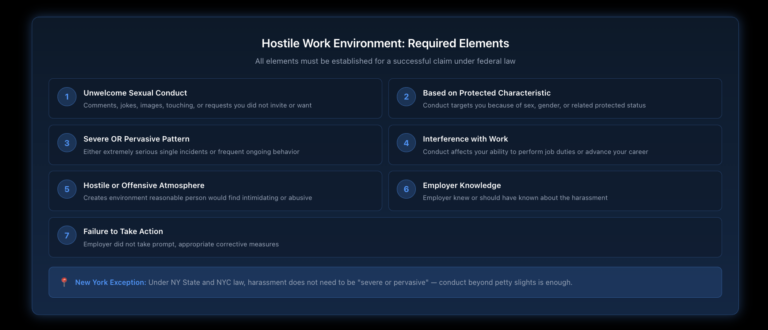
To establish quid pro quo harassment, you need to show four things. First, the harasser made unwelcome sexual advances or requests. Second, that person had authority over your employment. Third, you faced tangible employment consequences – positive or negative – tied to your response. Fourth, there’s a causal connection between the harassment and the job action.
Think your situation might qualify? Here’s the critical point: even one incident of quid pro quo harassment violates federal law. You don’t need to show a pattern of behavior when a supervisor conditions your job on sexual compliance.
How Does Quid Pro Quo Appear in Real Workplaces?
Modern quid pro quo harassment often looks more subtle than movie depictions. A manager might suggest you’ll “go far” if you’re “friendly” to them outside work, then give you poor performance reviews after you decline their invitations. That establishes quid pro quo even without explicit threats.
Consider another scenario: your supervisor texts repeatedly asking for dates, you politely refuse, and suddenly your overtime hours disappear. The temporal proximity between rejection and lost income creates strong evidence of a quid pro quo violation.
The power dynamics involved matter significantly in these cases. Courts look at whether the harasser had actual authority over hiring, firing, promotions, or job assignments – not just a fancy title.
What Is Hostile Work Environment Harassment?
Hostile work environment harassment works differently from quid pro quo. Instead of a single decision-maker demanding sexual favors, you’re dealing with pervasive conduct that makes it impossible to do your job effectively.
The legal standard requires showing the harassment was severe or pervasive enough that a reasonable person would find the workplace hostile or abusive. This can come from supervisors, coworkers, or even customers and vendors.
What Do “Severe” and “Pervasive” Actually Mean?
These two words carry specific legal weight. Severe means the conduct was extremely serious – even one incident might qualify if it’s bad enough. Physical assault, explicit sexual propositions, or showing pornographic materials typically meet this standard.
Pervasive means the harassment happens frequently enough to alter your work environment. Daily sexual comments, even if individually “minor,” can create illegal harassment through their cumulative effect. The EEOC considers factors like how often the conduct occurred, whether it was physically threatening or humiliating, and whether it unreasonably interfered with your work.
What Conduct Creates a Hostile Environment?
The behavior doesn’t need to target you directly. Constant sexual jokes, displaying pornographic images, or regular crude discussions about colleagues’ bodies can poison your work environment even when you’re not the subject.
Courts look at the totality of circumstances: the frequency and severity of conduct, whether it was physically threatening or humiliating, whether it interfered with work performance, and the psychological harm to the victim. Under the New York State Human Rights Law, you don’t even need to prove the conduct was severe or pervasive – any harassment beyond “petty slights or trivial inconveniences” violates state law.
How Do These Two Types of Harassment Differ?
Understanding the distinctions helps you gather the right evidence and take appropriate action. The differences affect everything from who can be held liable to what you need to prove.
Who Can Commit Each Type of Harassment?
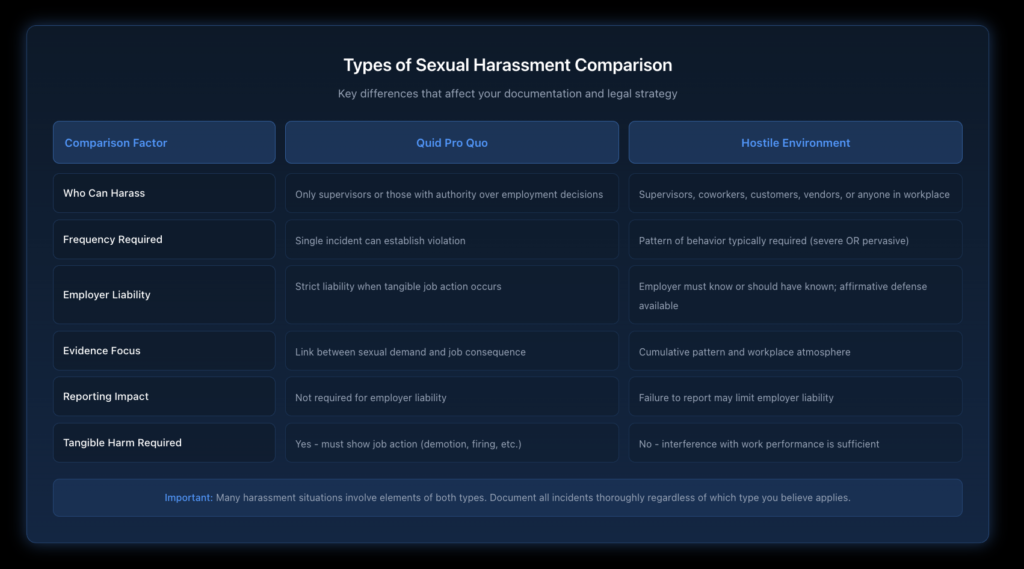
Quid pro quo harassment requires someone with actual authority over your employment – typically a supervisor, manager, or executive who can affect your job status. Coworkers cannot commit quid pro quo harassment because they lack the power to condition employment on sexual compliance.
Hostile work environment harassment can come from anyone in the workplace: supervisors, coworkers, subordinates, customers, vendors, or contractors. The key question is whether the employer knew or should have known about the conduct and failed to take corrective action.
What About Employer Liability?
This distinction matters enormously for your case. For quid pro quo harassment by supervisors that results in tangible employment action, employers face strict liability. That means the company is responsible regardless of whether management knew about the harassment.
For hostile work environment cases, employers have potential defenses. Under the Faragher-Ellerth framework, employers can avoid liability if they had reasonable preventive and corrective policies that they unreasonably failed to use. This is why internal reporting matters – it can prevent employers from claiming they didn’t know.
How do evidence requirements differ?
For quid pro quo claims, focus on documenting the specific exchange and its connection to job actions. One clear incident with proof linking it to adverse consequences can establish your case.
For hostile environment claims, you need to show a pattern. Individual incidents that seem minor can become powerful evidence when documented consistently over time. Keep detailed logs of every incident, no matter how “small” it seems.
Can You Experience Both Types Simultaneously?
Many situations involve both harassment types. Your supervisor might make sexual advances (potential quid pro quo) while also creating a generally hostile environment through constant sexual comments.
Courts will analyze both theories. If your supervisor propositioned you once and you refused, that single incident might support a quid pro quo claim if you face retaliation. But if that same supervisor also makes daily sexual jokes and comments about women’s bodies, you’re also experiencing hostile environment harassment.
Intersectional claims can strengthen your case. For example, if you’re experiencing sexual harassment combined with discrimination based on race, religion, or another protected characteristic, both violations can be addressed together.
How Should You Document Each Type of Harassment?
Your documentation approach should match the harassment type you’re experiencing. Strategic record-keeping creates the foundation for any legal action.
What Should You Document for Quid Pro Quo?
Focus on the specific exchange. Save every email, text, or written communication where advances were made. Write down verbal propositions immediately with the date, time, location, exact words used, any witnesses present, and your response.
Create a timeline showing the connection between refusing advances and negative job consequences. If you declined dinner on March 1st and received a poor review on March 15th, that temporal proximity strengthens your case significantly.
Preserve evidence of your job performance before and after the harassment. Good performance reviews followed by sudden criticism after you rejected advances demonstrates the link between harassment and pretextual discipline.
What Should You Document for a Hostile Environment?
Focus on frequency and cumulative impact. Keep a detailed log of every incident, including date, time, location, people present, what was said or done, your exact response, and the immediate impact on your work.
Take photos of offensive materials displayed in the workplace. Screenshot inappropriate emails, messages, or images. Record how the environment affects your work performance, including sick days taken, projects affected, or changes in your productivity.
Effective documentation doesn’t require perfect recall – contemporaneous notes carry significant weight even if they’re brief. Email yourself a summary after each incident to create a timestamped record.
What Are the Filing Deadlines and Reporting Options?
Time limits vary depending on where you file. Understanding these deadlines protects your ability to pursue all available remedies.
What Are Federal Deadlines?
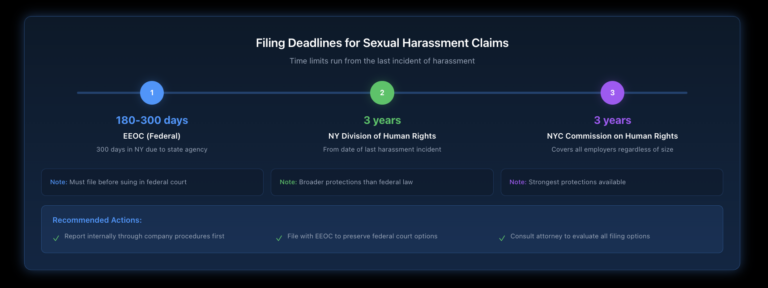
The EEOC requires filing within 180 days of the harassment. This extends to 300 days in states with fair employment practices agencies, including New York. The clock starts from the last incident of harassment, not the first.
For quid pro quo harassment, your deadline typically begins when you suffer the tangible employment action – the demotion, termination, or loss of benefits – not when the proposition was made.
For hostile environment cases, each new incident potentially resets your filing deadline. However, waiting too long can weaken your case, especially if your employer argues you didn’t find the conduct unwelcome.
What Are New York State Deadlines?
New York provides significantly longer filing windows. Under the New York State Human Rights Law, you have three years to file a workplace sexual harassment complaint with the Division of Human Rights.
For employees in New York City, the NYC Human Rights Law also allows three years to file with the NYC Commission on Human Rights. NYC law applies to all employers regardless of size, providing protection even when federal law doesn’t apply.
Should You Report Internally First?
Before filing with government agencies, check your employee handbook for harassment policies. Most employers require internal reports first. Following these procedures preserves your legal claims, triggers your employer’s duty to investigate, creates a paper trail, and may resolve the situation without litigation.
Report in writing, even if you also report verbally. Email creates timestamps and prevents disputes about what you reported. If your employer has a sexual harassment training program, you likely received information about reporting procedures – follow them carefully.
What Landmark Cases Shaped These Legal Standards?
The Supreme Court established our current framework through several important decisions. Understanding this history helps you see how courts analyze these claims.
In Meritor Savings Bank v. Vinson (1986), the Court first recognized both types of sexual harassment as sex discrimination under Title VII. This case established that employers could be liable for creating a hostile work environment, not just for quid pro quo exchanges.
Burlington Industries v. Ellerth (1998) and Faragher v. City of Boca Raton (1998) clarified employer liability rules. For quid pro quo cases involving tangible employment actions, employers face strict liability. But for hostile environment cases without tangible actions, employers can assert an affirmative defense if they had reasonable preventive policies that the employee unreasonably failed to use.
Pennsylvania State Police v. Suders (2004) added that constructive discharge – when harassment becomes so intolerable you’re forced to quit – counts as a tangible employment action, potentially supporting strict liability.
How Can You Build the Strongest Possible Case?
Whether you’re facing quid pro quo or hostile environment harassment, certain actions strengthen any claim.
What Documentation Practices Help Most?
Contemporaneous documentation carries the most weight. Write everything down when it happens – courts give more credibility to records made at the time rather than memories reconstructed later.
Consistent reporting builds credibility. Tell HR, a supervisor, or a trusted colleague about the harassment. Multiple consistent reports over time demonstrate that you found the conduct unwelcome and tried to address it.
Preserve all evidence carefully. Don’t delete texts, emails, or voicemails, even if they’re upsetting. Forward copies to a personal email account you control. Screenshot messages in case they’re later deleted.
What External Resources Should You Contact?
The EEOC provides free investigation services and explains your rights. Your state’s fair employment agency – in New York, the Division of Human Rights – offers additional protections and longer filing deadlines.
Keep medical records if you seek counseling or treatment for harassment-related stress. Document how the harassment has affected your physical and mental health, your work performance, and your career trajectory.
How Can You Protect Yourself from Retaliation?
Federal and state laws prohibit retaliation for reporting sexual harassment or participating in investigations. Retaliation includes any adverse action that would discourage a reasonable person from reporting harassment.
Common retaliatory actions include termination, demotion, pay cuts, reduced hours, unfavorable schedule changes, exclusion from meetings or projects, negative performance reviews, and impossible deadlines. If you face any of these after reporting harassment, that’s a separate legal violation – even if the underlying harassment claim doesn’t succeed.
Document retaliation just as carefully as the original harassment. Note the timeline between your protected activity (reporting) and any adverse actions. Temporal proximity – adverse actions happening shortly after your complaint – creates strong evidence of retaliatory motive.
Ready to Take Action Against Sexual Harassment?
Sexual harassment cases require strategic decisions about documentation, reporting, and timing. The distinction between quid pro quo and hostile environment affects every aspect of your case – from what evidence matters most to whether your employer faces automatic liability.
If you’re experiencing unwanted sexual conduct at work, don’t wait until the situation becomes unbearable or your filing deadlines pass. Start documenting now, report through proper channels, and understand your rights under federal, state, and local law.
Nisar Law Group helps employees navigate these complexities while protecting their careers and legal rights. Our employment attorneys analyze whether you’re facing one or both types of harassment, identify the strongest legal theories for your situation, and develop strategic approaches tailored to your goals. Contact us today for a confidential consultation about your sexual harassment case.
Frequently Asked Questions About Types of Sexual Harassment
Quid pro quo harassment occurs when someone with authority over your job conditions employment benefits on sexual favors or punishes you for refusing advances. It requires a direct link between sexual conduct and job consequences, and even one incident can violate the law. Hostile work environment harassment involves pervasive unwelcome conduct that makes your workplace intolerable – it typically requires showing a pattern of behavior severe or frequent enough to interfere with your ability to work. The two types differ in who can commit them, what evidence you need, and how employer liability is determined.
For quid pro quo claims, document the specific exchange and its connection to job actions through emails, texts, or detailed contemporaneous notes. Preserve evidence showing your performance before and after rejecting advances. For hostile environment claims, keep a detailed log of every incident, including dates, times, witnesses, exact words used, and impact on your work. Save screenshots of inappropriate messages, photos of offensive materials displayed at work, and records showing how harassment affected your productivity and well-being. Contemporaneous documentation created at the time ofthe incidents carries the most weight with courts.
You need to establish four elements: the harasser made unwelcome sexual advances, that person had authority over your employment, you faced tangible job consequences tied to your response, and there’s a causal connection between harassment and the job action. Evidence includes communications showing the proposition, documentation of your job performance before and after, records of adverse actions following rejection, and any witnesses who can corroborate the exchange or its aftermath. Timeline evidence showing close proximity between refusing advances and negative consequences is particularly powerful.
Under federal law, workplace harassment becomes illegal when it’s severe enough to create a hostile environment or results in adverse employment decisions. The conduct must be unwelcome and based on a protected characteristic like sex. New York provides broader protection – under state law, harassment doesn’t need to be severe or pervasive to be illegal. Any unwelcome conduct based on gender that rises above petty slights or trivial inconveniences can violate the New York State Human Rights Law. Both verbal and physical conduct can constitute harassment, including inappropriate comments, jokes, touching, displaying offensive materials, and making sexual requests.
Simple teasing, offhand comments, or isolated incidents that aren’t very serious generally don’t meet the legal threshold under federal law. Conduct that a reasonable person wouldn’t find hostile or abusive isn’t actionable. Legitimate job-related criticism or discipline, personality conflicts unrelated to protected characteristics, and general rudeness that doesn’t target someone based on sex or other protected status typically don’t qualify. However, New York’s broader standard means conduct that might not violate federal law could still be illegal under state or city law, so having an experienced attorney evaluate your specific situation is important.
Hostile work environment claims are more common than quid pro quo claims because they encompass a broader range of conduct and can involve harassment from coworkers, not just supervisors. Sexual harassment remains one of the most frequently filed types of employment discrimination charges with the EEOC. Many cases involve elements of both types – for example, a supervisor who makes explicit propositions while also creating a generally hostile atmosphere through ongoing comments and conduct. Retaliation claims often accompany harassment claims, as employees who report misconduct frequently face backlash from their employers.
Yes. Under both quid pro quo and hostile environment theories, you don’t necessarily need to be the direct target. If you witness quid pro quo harassment affecting a coworker and it creates a hostile environment for you, or if pervasive sexual conduct in your workplace makes it difficult for you to perform your job, regardless of whether comments were directed at you, you may have a valid claim. Courts recognize that a workplace saturated with sexual commentary, offensive images, or discriminatory behavior can harm all employees exposed to it, not just those specifically targeted.

