

When your sincerely held religious beliefs clash with specific job requirements, you have a legal right to request an accommodation—and your employer has a legal obligation to seriously consider it. Under Title VII of the Civil Rights Act, employers must work with you to find a reasonable solution unless they can prove that accommodating your religious practice would cause substantial hardship to their business operations. This protection extends beyond traditional religions to cover any sincerely held religious, ethical, or moral beliefs.
Key Takeaways
- Employees can refuse job duties that violate their religious beliefs and request alternative arrangements.
- Employers must engage in an interactive process to find workable accommodations.
- The Supreme Court’s 2023 Groff v. DeJoy decision significantly strengthened employee protections by requiring employers to prove “substantial increased costs” rather than mere inconvenience.
- New York employees have even stronger protections under state and city human rights laws.
- Healthcare workers have additional conscience protections under federal law.
- Common accommodations include task reassignment, shift swaps, and modified duties.
- Retaliation for requesting religious accommodation is illegal.
Disclaimer: This article provides general information for informational purposes only and should not be considered a substitute for legal advice. It is essential to consult with an experienced employment lawyer at our law firm to discuss the specific facts of your case and understand your legal rights and options. This information does not create an attorney-client relationship.
What Types of Job Duty Conflicts Qualify for Accommodation?
Religious belief and job duty conflicts arise in many forms. The law protects employees who object to performing specific tasks, not just those seeking schedule changes or dress code exceptions. Understanding what constitutes a religious belief under the law helps you determine whether your situation qualifies for protection.
What Are Common Religious Objections to Job Tasks?
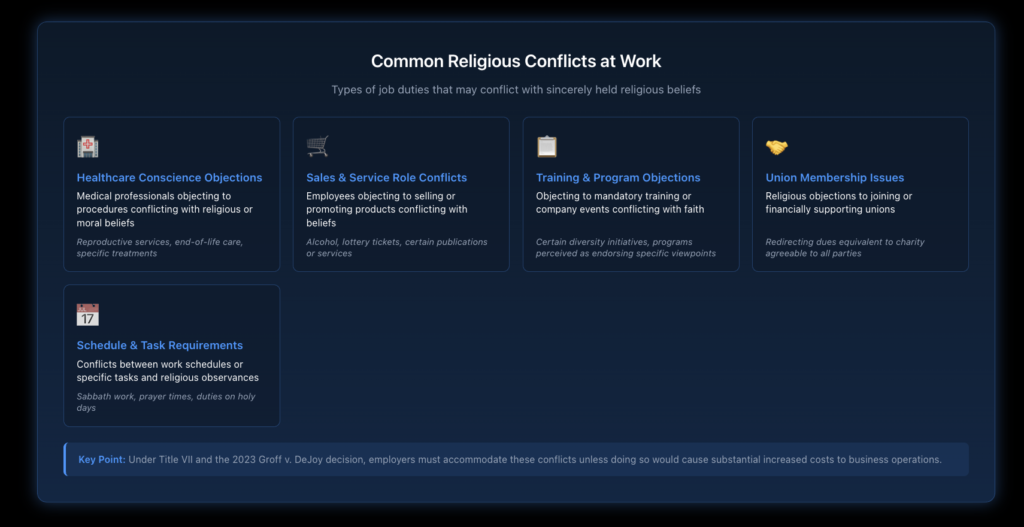
Employees frequently encounter conflicts in these situations:
Healthcare settings: Medical professionals may object to participating in procedures they consider morally objectionable, including certain reproductive services, end-of-life care decisions, or specific treatments. The HHS Office for Civil Rights enforces federal conscience protections specifically designed for healthcare workers who refuse on religious or moral grounds to participate in certain services.
Sales and service roles: An employee might object to selling products that conflict with their beliefs—alcohol, lottery tickets, or certain publications. Others may resist promoting services they find morally problematic.
Participation in training or company programs: Some employees object to attending training programs or company events that include content conflicting with their beliefs, such as certain diversity initiatives or programs they perceive as endorsing particular viewpoints.
Union membership: Employees with religious objections to joining or financially supporting unions have specific protections allowing them to donate equivalent dues to charity instead.
How Does Religious Accommodation for Job Duties Differ From Schedule Conflicts?
While religious holiday and time-off requests involve scheduling adjustments, job duty conflicts require employers to reconsider what tasks you perform. This distinction matters because solutions differ significantly.
For scheduling conflicts, employers might offer shift swaps or flexible hours. For job duty conflicts, the accommodation might involve reassigning specific tasks to colleagues, modifying your role, or transferring you to a different position where the conflict doesn’t arise.
What Does the Law Require Employers to Do?
Title VII requires employers to reasonably accommodate religious beliefs unless doing so creates undue hardship. This means employers cannot simply refuse your request—they must engage in a genuine effort to find solutions.
What Changed After the Groff v. DeJoy Supreme Court Decision?
The June 2023 Supreme Court decision in Groff v. DeJoy dramatically changed the legal landscape. For nearly 50 years, courts allowed employers to deny accommodations that caused more than “de minimis” (minimal) costs. This low bar made it relatively easy for employers to refuse religious accommodation requests.
The Supreme Court unanimously rejected this standard. Now, employers must demonstrate that granting your request would result in “substantial increased costs in relation to the conduct of their particular business.” This is a significant burden shift that benefits employees.
What this means practically: your employer can no longer cite minor inconveniences, modest scheduling challenges, or coworker complaints alone as reasons to deny your request. They must show genuine substantial hardship to business operations.
How Should the Accommodation Process Work?
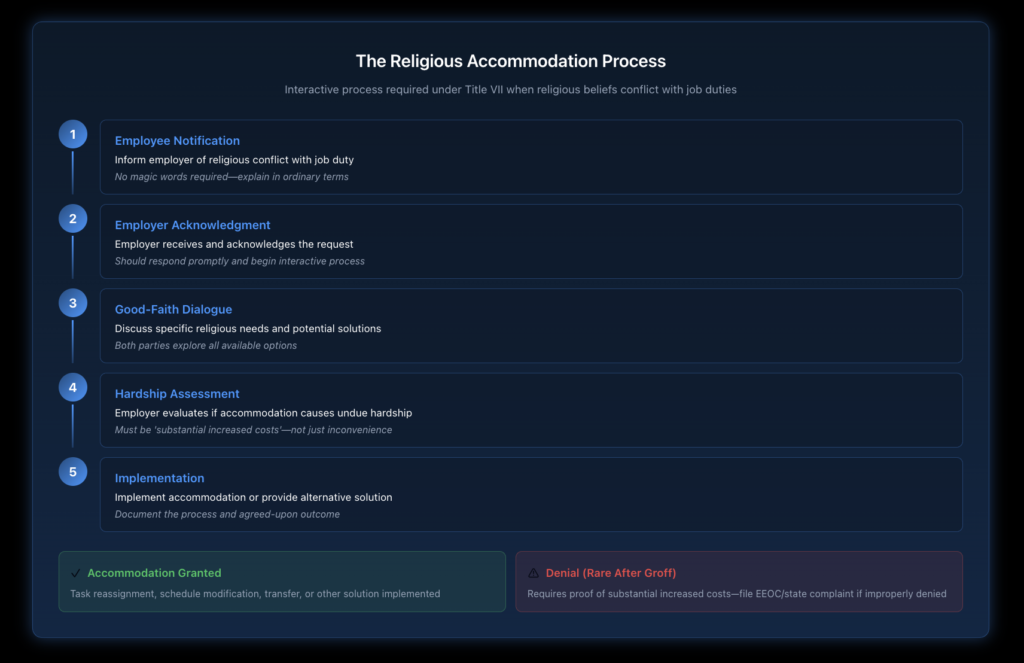
Once you notify your employer about a conflict between your religious beliefs and job duties, an interactive process should begin. The Department of Labor outlines this process for federal employees, and similar principles apply broadly.
Your employer should:
- Acknowledge your request promptly
- Engage in good-faith dialogue about your specific religious needs
- Explore all available accommodation options
- Assess whether potential solutions create undue hardship
- Implement a reasonable accommodation that resolves the conflict
- Document the process and outcome
You don’t need to use specific legal terminology when making your request. Courts recognise that employees may simply explain their religious conflict in ordinary terms.
What Accommodations Can Employees Request for Job Duty Conflicts?
The EEOC identifies several accommodation strategies that apply to job duty conflicts:
Can You Be Reassigned Away From Objectionable Tasks?
Yes. If you object to specific tasks but can perform all other aspects of your job, your employer may reassign those particular duties to colleagues who have no objection. This works well when the objectionable task is a minor part of your role, and others can absorb it without significant disruption.
For example, a pharmacist who objects to dispensing certain medications might be accommodated if colleagues can handle those prescriptions without substantially disrupting pharmacy operations.
Can You Request a Transfer or Job Modification?
Employers may offer lateral transfers to positions where the religious conflict doesn’t exist. While employers aren’t required to create new positions, they should consider existing openings that match your qualifications.
Modifying job duties to remove or reduce conflict-causing tasks is another option, provided such modifications don’t fundamentally alter the position’s essential functions.
What If No Accommodation Seems Possible?
Even when initial requests seem difficult to accommodate, employers must explore alternatives before denying the request. The law requires genuine effort, not just immediate rejection. Understanding religious accommodation and undue hardship standards helps employees evaluate whether employer denials are legally justified.
What Special Protections Exist for Healthcare Workers?
Healthcare employees have enhanced protections beyond Title VII. Federal conscience laws protect healthcare workers who refuse to participate in procedures conflicting with their religious or moral convictions.
What Are the Church Amendments?
The Church Amendments, enacted in the 1970s, protect healthcare workers from discrimination for refusing to perform sterilisations, abortions, or other procedures conflicting with their religious beliefs or moral convictions. These protections apply to entities receiving certain federal funds.
What About the Weldon Amendment?
The Weldon Amendment prohibits federal funds from going to agencies or programs that discriminate against healthcare entities refusing to provide, pay for, or refer for abortions based on religious or moral objections. This covers individual providers, hospitals, and insurance plans.
How Do These Conscience Protections Interact With Title VII?
Healthcare workers benefit from both Title VII’s religious accommodation requirements and specific conscience protections. However, healthcare employers must balance employee conscience rights against patient care obligations and nondiscrimination duties toward patients.
What Protections Do New York Employees Have?
New York provides significantly stronger religious accommodation protections than federal law alone.
How Does New York State Human Rights Law Protect Religious Practice?
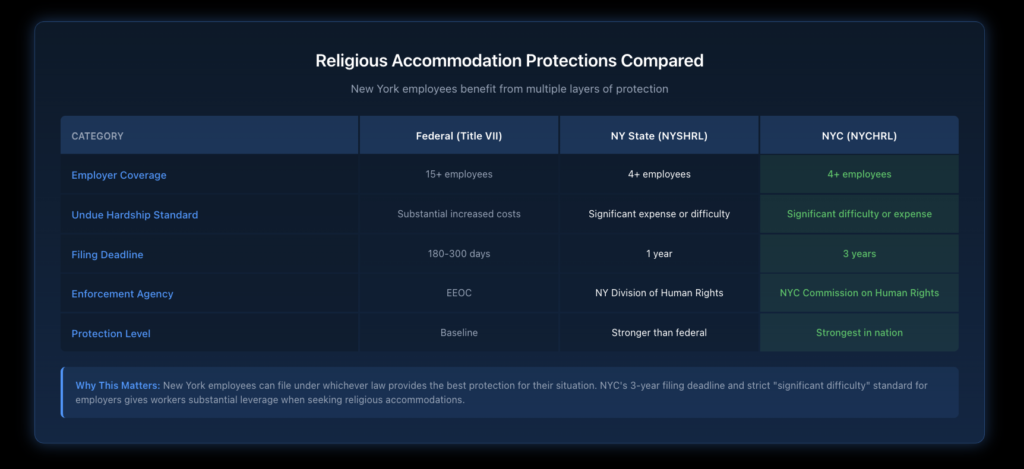
The New York State Human Rights Law applies to employers with four or more employees—far broader than Title VII’s 15-employee threshold. The state law defines undue hardship as “significant expense or difficulty,” which courts interpret as more protective than even the new federal standard.
The New York State Division of Human Rights guidance on religious accommodations emphasises that employers must permit workers to observe religious practices, including those affecting job duties, unless a genuine hardship exists.
What Additional Protections Does NYC Human Rights Law Provide?
New York City Human Rights Law offers the strongest religious discrimination protections in the nation. NYC employers must prove accommodations would cause “significant difficulty or expense”—an even tougher standard. This comprehensive protection extends to employees facing religious discrimination in the workplace across all aspects of employment.
What Can Employers Legally Consider When Evaluating Requests?
While employers must seriously consider religious accommodation requests, they can evaluate genuine business impacts.
When Can an Employer Deny a Religious Accommodation?
Employers may deny accommodations only when they can demonstrate substantial increased costs. Legitimate factors include:
Significant financial burden: Costs that are substantial relative to the employer’s size and resources—not just any expense.
Workplace safety: Accommodations that genuinely compromise safety may constitute undue hardship, though employers must explore alternatives before denying requests.
Essential job functions: If your religious objection conflicts with duties that define the position’s core purpose, accommodation may not be possible without fundamentally changing the job.
Legal compliance: Employers cannot accommodate requests that would require them to violate other laws.
What Factors Cannot Justify Denial?
Post-Groff, employers cannot rely on:
- Minor costs or inconveniences
- Coworker complaints or resentment alone
- Speculative concerns about morale
- Customer preferences or biases
- Hypothetical future problems
The employer bears the burden of proving undue hardship with specific evidence, not assumptions.
What Steps Should You Take If Your Beliefs Conflict With Job Duties?
Protecting your rights requires strategic action from the beginning.
How Do You Request an Accommodation Properly?
Communicate your religious conflict clearly and promptly. While verbal requests are legally sufficient, written documentation creates valuable records. Include:
- The specific religious belief or practice creating the conflict
- Which job duties conflict with your beliefs
- Your willingness to discuss potential solutions
- Any accommodations you believe would resolve the conflict
You don’t need to prove your religious beliefs are correct or that your religion requires the position you’re taking. Sincerely held beliefs receive protection even if other adherents of your faith don’t share them.
What Documentation Should You Keep?
Maintain records of all communications regarding your accommodation request:
- Copies of written requests and employer responses
- Notes from conversations with supervisors and HR
- Emails and messages discussing your situation
- Any changes to your schedule, duties, or treatment
- Witness information if others observed relevant interactions
This documentation becomes crucial if disputes arise later about whether proper procedures were followed.
What If Your Employer Refuses to Accommodate?
If your employer denies your request or fails to engage meaningfully, you have options:
File a complaint with the EEOC: Federal complaints must be filed within 180 days (extended to 300 days in states with local enforcement agencies like New York).
File with the New York State Division of Human Rights: State complaints must be filed within one year.
File with the NYC Commission on Human Rights: City complaints can be filed within three years.
Understanding how to properly request religious accommodations helps you build a strong case if litigation becomes necessary.
What Happens If Your Employer Retaliates?
Retaliation for requesting religious accommodation is illegal under both federal and state law. Protected activity includes requesting accommodation, filing complaints, or opposing discriminatory practices.
What Does Retaliation Look Like?
Retaliatory actions may include:
- Demotion or undesirable reassignment
- Reduction in hours or pay
- Negative performance reviews following accommodation requests
- Termination or constructive discharge
- Hostile treatment creates a difficult work environment
If you experience adverse actions shortly after requesting religious accommodation, the timing itself suggests retaliation. Employers claiming legitimate reasons for adverse actions bear increasing scrutiny when those actions follow protected activity.
How Does This Intersect With Other Workplace Rights?
Religious accommodation rights interact with other protected categories in complex ways.
What About Conflicts With Other Employees’ Rights?
Sometimes religious accommodation requests conflict with other employees’ rights or protected characteristics. The balance between religious freedom and other protected rights presents challenging questions that our courts continue to address.
Employers cannot accommodate religious beliefs in ways that substantially burden other employees or create discriminatory treatment. However, requesting that coworkers occasionally cover duties you cannot perform for religious reasons is not automatically unlawful—it depends on the overall impact.
How Do Ministerial Exceptions Apply?
The ministerial exception to religious discrimination laws allows religious organizations significant latitude in employment decisions involving ministerial positions. If you work for a religious employer in a ministerial role, standard accommodation rules may not apply to your situation.
Ready to Protect Your Religious Rights?
When your sincerely held religious beliefs conflict with job duties, you don’t have to choose between your faith and your livelihood. The law provides robust protections—especially after Groff—for employees seeking religious accommodation.
If your employer has denied your accommodation request, retaliated against you for asserting your rights, or failed to engage in good-faith dialogue about your religious needs, Nisar Law Group can help. Our employment law attorneys understand the complex interplay of federal, state, and local religious discrimination laws. Contact us today for a consultation to discuss your situation.
Frequently Asked Questions About Faith and Job Duty Conflicts
Jobs frequently involve duties that may conflict with employees’ religious beliefs, but employers cannot force you to violate your faith without first attempting accommodation. When you notify your employer of a religious conflict, they must engage in an interactive process to find solutions. Only if accommodation would cause substantially increased costs to business operations can employers lawfully require you to perform objectionable duties or face consequences.
Religious discrimination occurs when employers treat employees differently because of their beliefs or fail to accommodate religious practices. Examples include firing an employee who requests time off for religious observances, refusing to allow religious dress without legitimate safety concerns, assigning undesirable duties after someone requests religious accommodation, or creating a hostile environment through mockery of religious practices.
Employers can deny religious time-off requests only if granting them would cause genuine undue hardship—meaning substantial increased costs relative to business operations. Minor scheduling inconveniences, the need for shift swaps, or modest overtime costs generally don’t qualify as undue hardship after the Supreme Court’s Groff decision. New York employers face even stricter standards requiring “significant expense or difficulty.”
Proving religious discrimination requires showing you have a sincerely held religious belief that conflicts with a job requirement, you informed your employer of this conflict, and you experienced adverse treatment as a result. Document all communications about your accommodation request, keep records of employer responses, note any changes in treatment after your request, and gather witness information. Timing evidence showing adverse actions shortly after accommodation requests supports retaliation claims.
Employers must respect religious beliefs by engaging in good-faith accommodation efforts when conflicts arise. This doesn’t mean employers must agree with your beliefs or allow any requested accommodation—but they cannot dismiss requests without seriously considering alternatives. Employers violate the law by mocking religious beliefs, assuming accommodation is impossible without analysis, or taking adverse action against employees who assert religious rights.
Firing employees because of their religious beliefs or for requesting religious accommodation violates federal and state law. However, employers may terminate employees who refuse to perform essential job functions after genuine accommodation efforts prove impossible without undue hardship. The key question is whether the employer properly engaged in the interactive process and whether the denial was truly justified by substantial business impact, not mere inconvenience.
A religiously hostile work environment exists when harassment based on religion becomes severe or pervasive enough to alter employment conditions. This includes repeated mockery of religious beliefs, pressure to abandon religious practices, exclusion from opportunities because of faith, offensive remarks about religion, or coercion to participate in religious activities against your will. Single incidents may qualify if sufficiently severe.
Common accommodations for job duty conflicts include reassigning specific tasks to willing colleagues, modifying job responsibilities to remove conflicting duties, transferring to positions where conflicts don’t exist, and allowing alternative methods of completing work. For healthcare workers, this might mean excusing them from procedures conflicting with their conscience, while other providers cover those services.

