

Yes, federal law explicitly protects atheists and employees with non-religious beliefs from workplace discrimination. Title VII of the Civil Rights Act of 1964 protects not only people who belong to traditional organized religions but also individuals who hold sincerely held ethical or moral beliefs—including those who reject religion entirely. The EEOC has consistently affirmed that individuals who do not practice any religion are protected from discrimination on the basis of their lack of religious belief.
Key Takeaways
- Title VII protects atheists, agnostics, and secular humanists from workplace discrimination.
- New York provides additional protections under state and city human rights laws.
- Employers cannot force employees to participate in religious activities.
- Non-religious employees can request accommodations for ethical or moral beliefs.
- The 2023 Groff v. DeJoy decision strengthened accommodation requirements for all belief systems.
- You have 300 days to file a discrimination claim with the EEOC in New York.
Disclaimer: This article provides general information for informational purposes only and should not be considered a substitute for legal advice. It is essential to consult with an experienced employment lawyer at our law firm to discuss the specific facts of your case and understand your legal rights and options. This information does not create an attorney-client relationship.
What Legal Protections Exist for Atheists in the Workplace?
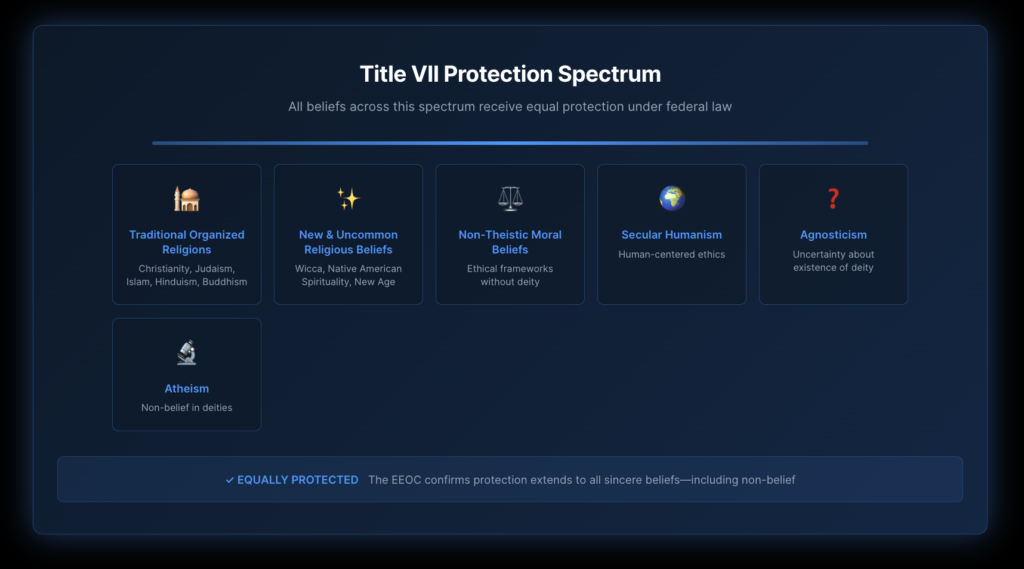
Federal employment law takes a broad view of religious protection that encompasses the full spectrum of belief—including non-belief. Under Title VII’s framework for religious discrimination, the EEOC defines “religion” to include theistic beliefs as well as non-theistic moral or ethical beliefs held with the strength of traditional religious views.
This means your employer cannot treat you unfavorably because you’re an atheist, agnostic, secular humanist, or simply someone who doesn’t subscribe to any particular religious worldview. The EEOC’s guidance on religious discrimination explicitly states that protection extends to “others who have sincerely held religious, ethical or moral beliefs” and specifically protects individuals who do not practice any religion.
The practical implications are significant. Your employer cannot refuse to hire you because you don’t attend church. They cannot pass you over for promotion because you don’t share their religious views. They cannot terminate your employment because you identify as an atheist or decline to participate in workplace prayer.
How Does New York Law Strengthen These Protections?
New York employees enjoy some of the strongest protections in the nation for non-religious beliefs. The New York State Human Rights Law protects against discrimination based on “creed”—a term interpreted broadly to include the absence of religious belief. The New York Attorney General’s Religious Rights Initiative confirms that protected beliefs include those not part of a formal religion or sect.
The New York City Human Rights Law provides even more expansive coverage. It prohibits discrimination in employment based on actual or perceived religion or creed and applies to employers with as few as four employees—compared to Title VII’s 15-employee threshold.
One key advantage of New York law is the filing deadline. While federal claims must be filed with the EEOC within 300 days of the discriminatory act, New York State Division of Human Rights complaints now have a three-year statute of limitations for incidents occurring after February 15, 2024. This gives you substantially more time to evaluate your situation and seek legal counsel.
What Types of Discrimination Do Non-Religious Employees Face?
Non-religious employees encounter several distinct forms of workplace discrimination. Understanding these patterns helps you recognize when your rights have been violated.
Hiring and Promotion Barriers: Some employers—particularly in certain industries or geographic regions—may screen out candidates who don’t share their religious beliefs. This can manifest as pointed questions about church attendance during interviews or unexplained rejection of otherwise qualified candidates.
Forced Religious Participation: Perhaps the most common issue involves hostile work environment claims arising from mandatory religious activities. If your employer requires attendance at prayer meetings, religious retreats, or faith-based team-building exercises, and you’re an atheist or non-religious person, you have the right to request an exemption.
Harassment Based on Non-Belief: Persistent comments about your lack of faith, attempts to convert you, or hostile treatment because you don’t share colleagues’ religious views can create an actionable hostile work environment. The harassment doesn’t need to mention religion explicitly—if the adverse treatment stems from your non-religious status, it’s still discrimination.
Retaliation for Declining Religious Activities: If you experience employer retaliation after requesting to be excused from religious activities or after objecting to religious pressure in the workplace, that retaliation itself violates employment law.
Can Employers Force You to Participate in Religious Activities?
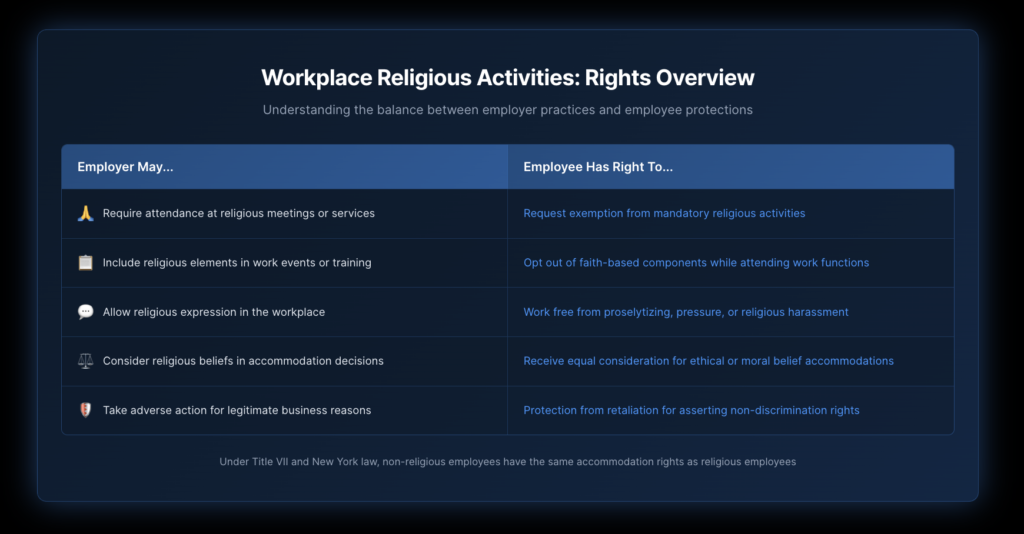
No. The EEOC is unequivocal on this point: an employee cannot be forced to participate (or not participate) in a religious activity as a condition of employment. This protection applies regardless of whether you’re religious, non-religious, or simply practice a different faith than the one being promoted.
The EEOC’s comprehensive guidance on religious discrimination addresses this directly. If your workplace opens meetings with prayer, holds religious ceremonies, or incorporates faith-based elements into its culture, you have the right to be excused without facing adverse consequences.
When requesting accommodations, you should clearly communicate that your non-participation is based on your sincerely held beliefs—whether those are atheistic, agnostic, or simply a personal conviction that religious activities are private matters. Document your request in writing and keep copies of all communications.
How Has Recent Case Law Affected Non-Religious Employee Rights?
The 2023 Supreme Court decision in Groff v. DeJoy significantly strengthened accommodation requirements for all employees seeking religious or belief-based accommodations. While the case involved a Christian employee seeking Sunday observance, its holding applies equally to non-religious employees.
Previously, employers could deny accommodations by showing merely “more than de minimis” cost or burden. The Supreme Court clarified that undue hardship requires showing a “substantial” burden in the overall context of the employer’s business. This higher standard makes it harder for employers to reflexively deny accommodation requests.
For non-religious employees, this means your request to be excused from religious activities, avoid certain work assignments that conflict with your ethical beliefs, or otherwise practice your non-religious worldview deserves serious consideration from your employer. They cannot simply claim minor inconvenience—they must demonstrate substantial hardship.
What Should You Do If You Experience Discrimination Based on Non-Belief?
If you believe you’re experiencing discrimination because of your atheism or non-religious beliefs, taking strategic action early protects your legal options.
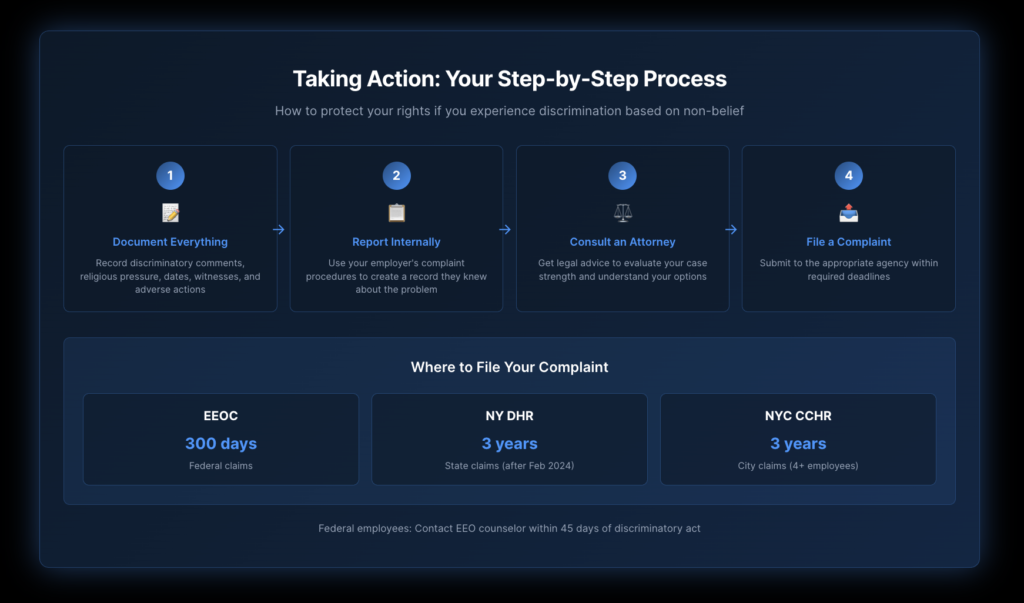
Document Everything: Keep detailed records of discriminatory comments, religious pressure, and any adverse employment actions. Note dates, witnesses, and the specific words used. Effective documentation can make or break a discrimination case.
Follow Internal Procedures: Most employers have reporting procedures for discrimination complaints. Using these channels creates a record that your employer knew about the problem and demonstrates you gave them an opportunity to address it.
Understand Your Deadlines: In New York, you generally have 300 days to file with the EEOC or one to three years to file with state or city agencies, depending on when the discrimination occurred. Federal employees face even shorter deadlines—just 45 days to contact an EEO counselor.
Know What Constitutes Proof: When proving your termination was discriminatory, you don’t need a smoking gun. Circumstantial evidence—such as timing, inconsistent treatment, or pretextual explanations—can establish discrimination.
How Do Reasonable Accommodations Work for Non-Religious Employees?
The concept of reasonable accommodations extends beyond traditional religious observances. If you hold sincerely held ethical or moral beliefs that conflict with workplace requirements, you may be entitled to accommodation.
For example, a secular humanist who objects to participating in religious ceremonies has the same right to accommodation as a religious employee whose faith conflicts with a work requirement. The Department of Labor’s guidance confirms that accommodation obligations apply to sincere moral and ethical beliefs.
The accommodation process typically involves an interactive dialogue between employee and employer. You explain the conflict; your employer explores options. Reasonable accommodations might include scheduling adjustments, modified duties, or simple exemptions from specific activities.
Employers cannot deny accommodation simply because it’s inconvenient. Under the EEOC’s employer guidance, they must demonstrate that accommodation would impose substantial increased costs in relation to their particular business operations.
What Happens When Religious Expression Creates a Hostile Environment for Non-Religious Employees?
When coworkers’ or supervisors’ religious expression becomes persistent, unwelcome, and targeted, it can cross the line into actionable harassment. The key factors are whether the conduct is severe or pervasive enough to alter your working conditions and create an abusive environment.
Isolated comments about religion typically don’t meet this threshold. However, sustained proselytizing after you’ve asked it to stop, religious slurs directed at your non-belief, threats of spiritual consequences, or systematic exclusion based on your atheism can establish a hostile work environment claim.
Employers have an obligation to prevent and address religious harassment—including harassment directed at non-religious employees. If you’ve reported unwelcome religious conduct and your employer fails to take corrective action, they may be liable for the resulting hostile environment.
The intersection of religious exemptions and discrimination law continues to evolve, but the core principle remains: your right to work free from religious harassment doesn’t depend on having a religion yourself.
What Remedies Are Available If Your Rights Are Violated?
Employees who prove discrimination based on non-religious beliefs can recover various forms of relief. Available remedies may include reinstatement if you were wrongfully terminated, back pay and front pay for lost wages, compensatory damages for emotional distress, and, in some cases, punitive damages.
New York law often provides more generous remedies than federal law. The NYC Human Rights Law, in particular, is interpreted liberally to accomplish its remedial purposes and may support larger damage awards.
Beyond individual relief, successful discrimination claims can result in injunctive relief requiring employers to change policies, implement training, and take other steps to prevent future discrimination.
Protect Your Rights as a Non-Religious Employee
Whether you’re an atheist facing pressure to participate in workplace prayer, an agnostic passed over for promotion because you don’t share the boss’s faith, or a secular humanist whose ethical beliefs conflict with certain job duties, you have legal protections. New York’s employment laws are among the strongest in the nation for protecting employees across the entire spectrum of belief—including those who hold no religious belief at all.
If you’re experiencing discrimination because of your non-religious beliefs, understanding your rights is the first step toward protecting them. An experienced employment attorney can evaluate your situation, explain your options, and help you pursue the remedies you deserve.
Contact Nisar Law Group today for a confidential consultation about your workplace discrimination concerns.
Frequently Asked Questions About Atheism and Non-Religious Belief Protection
Yes, atheists are protected under Title VII of the Civil Rights Act and New York human rights laws. The EEOC explicitly confirms that individuals who do not practice any religion are protected from discrimination on the basis of their lack of religious belief. Protection extends to atheists, agnostics, secular humanists, and anyone whose moral or ethical beliefs are sincerely held, even if those beliefs reject religious doctrine entirely.
Employers must reasonably accommodate sincerely held moral or ethical beliefs to the same extent they accommodate religious beliefs—unless doing so would cause undue hardship. After the 2023 Groff v. DeJoy Supreme Court decision, undue hardship requires showing a substantial burden on business operations, not merely a minor inconvenience. This means requests to be excused from religious activities or to avoid duties conflicting with secular ethical beliefs deserve serious employer consideration.
No, terminating an employee because they are an atheist, agnostic, or non-religious constitutes illegal discrimination under federal and New York law. If you can demonstrate that your non-religious beliefs were a motivating factor in your termination—through direct evidence, circumstantial evidence, or by showing the employer’s stated reasons were pretextual—you may have a valid discrimination claim.
No, you have no legal obligation to disclose your religious beliefs or non-beliefs to your employer. However, if you need an accommodation related to your beliefs—such as exemption from mandatory religious activities—you’ll need to explain enough about the conflict for your employer to understand why accommodation is necessary. Even then, you need only provide sufficient information about the belief and the conflict, not detailed explanations of your entire worldview.
Absolutely. Title VII protects employees from discrimination based on religion—and that protection expressly includes discrimination against employees because they lack religious beliefs. You can file claims with the EEOC, the New York State Division of Human Rights, or the NYC Commission on Human Rights if you’ve experienced adverse treatment because of your atheism, agnosticism, or secular beliefs.

