

The Uniformed Services Employment and Reemployment Rights Act (USERRA) guarantees that service members who leave civilian jobs for military duty have the right to return to those jobs with the same seniority, status, and pay they would have earned if they had never left. If you’re a member of the Armed Forces, National Guard, Reserves, or other uniformed services, federal law protects your civilian career from being derailed by your military obligations. Your employer cannot deny you reemployment, demote you upon return, or discriminate against you because of your service—and if they do, you have legal remedies available.
Key Takeaways
- USERRA applies to nearly all employers regardless of size and protects all categories of uniformed service, including active duty, Reserve, and National Guard members.
- You have five years of cumulative military service with an employer before losing reemployment rights, though many exceptions extend this limit.
- The “escalator principle” means you’re entitled to return to the position you would have held had you remained continuously employed, including any promotions or raises.
- Employers cannot discriminate against you in hiring, promotion, or any employment decision based on your past, present, or future military service.
- You must meet specific timelines for requesting reemployment based on how long you were away, from the next workday for short absences to 90 days for deployments over 180 days.
- USERRA has no statute of limitations for filing complaints with the Department of Labor, giving you flexibility in pursuing your rights.
Disclaimer: This article provides general information for informational purposes only and should not be considered a substitute for legal advice. It is essential to consult with an experienced employment lawyer at our law firm to discuss the specific facts of your case and understand your legal rights and options. This information does not create an attorney-client relationship.
Who Does USERRA Protect?
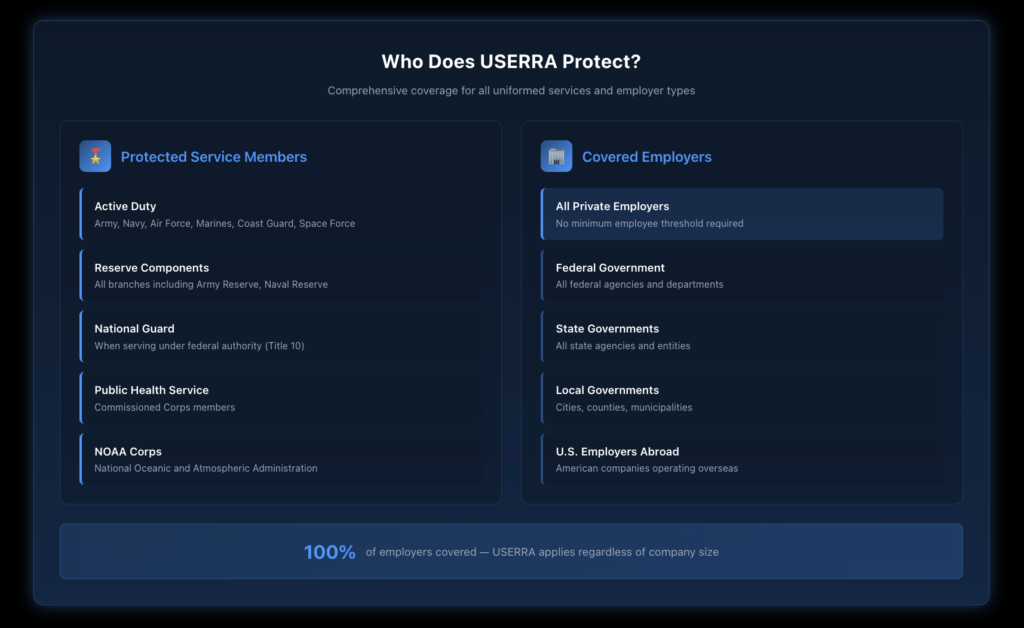
USERRA provides comprehensive employment protections for anyone who serves in the uniformed services, whether voluntarily or involuntarily. This includes active duty members, Reserve components, National Guard members (when engaged in federal service), and even the Commissioned Corps of the Public Health Service and National Oceanic and Atmospheric Administration.
What Types of Military Service Qualify for Protection?
The law covers an exceptionally broad range of military service and training activities. Active duty deployments obviously qualify, but so do weekend drills, annual training, fitness-for-duty examinations, and funeral honors duty. If your military obligation requires you to be absent from your civilian job, USERRA likely protects you.
Your service doesn’t need to be involuntary to qualify for protection. Whether you enlisted voluntarily, were activated from the Reserves, or called up from the National Guard, your reemployment rights remain the same. This equal treatment of voluntary and involuntary service ensures that patriotic decisions to serve don’t cost you your civilian career.
Are Part-Time and Temporary Employees Protected?
Yes. USERRA rights extend to employees regardless of whether they hold part-time, temporary, probationary, or seasonal positions. The only exception involves positions that were truly brief and nonrecurrent with no reasonable expectation of continued employment. If you have an ongoing employment relationship, USERRA protects it.
What Are the Five Eligibility Requirements for Reemployment?
To exercise your reemployment rights under USERRA, you must satisfy five basic eligibility criteria. Meeting these requirements ensures your entitlement to return to work with your pre-service employer.
Did You Give Proper Notice to Your Employer?
You must provide advance written or verbal notice to your employer before leaving for military service. The law doesn’t require a specific amount of notice—just that you give notice when feasible. If military necessity prevents advance notice, or if giving notice is otherwise impossible or unreasonable, you’re excused from this requirement.
Documentation isn’t mandatory before you leave, but your employer may request copies of military orders upon your return if your absence exceeded 30 days. However, they cannot delay your reemployment while waiting for documentation if orders aren’t readily available.
Have You Exceeded the Five-Year Service Limit?
USERRA establishes a five-year cumulative limit on military service with a single employer while still retaining full reemployment rights. This limit applies to your total time away from that specific employer—not your overall military service. Importantly, numerous exceptions exist for services that don’t count toward this limit, including:
- Service required beyond five years to complete an initial period of obligated service
- Service during a war or national emergency declared by Congress or the President
- Service for training, annual training, and inactive duty training
- Service performed to fulfill additional training requirements determined necessary by military authorities
- Service is performed involuntarily when the member cannot obtain release from service
Were You Discharged Under Honorable Conditions?
You cannot claim reemployment rights if you received a dishonorable discharge, bad conduct discharge, or were dismissed by court-martial. Other than honorable discharges may also disqualify you, depending on the characterization. If your service ended under any other conditions, you retain your reemployment rights.
Did You Report Back Within Required Timeframes?
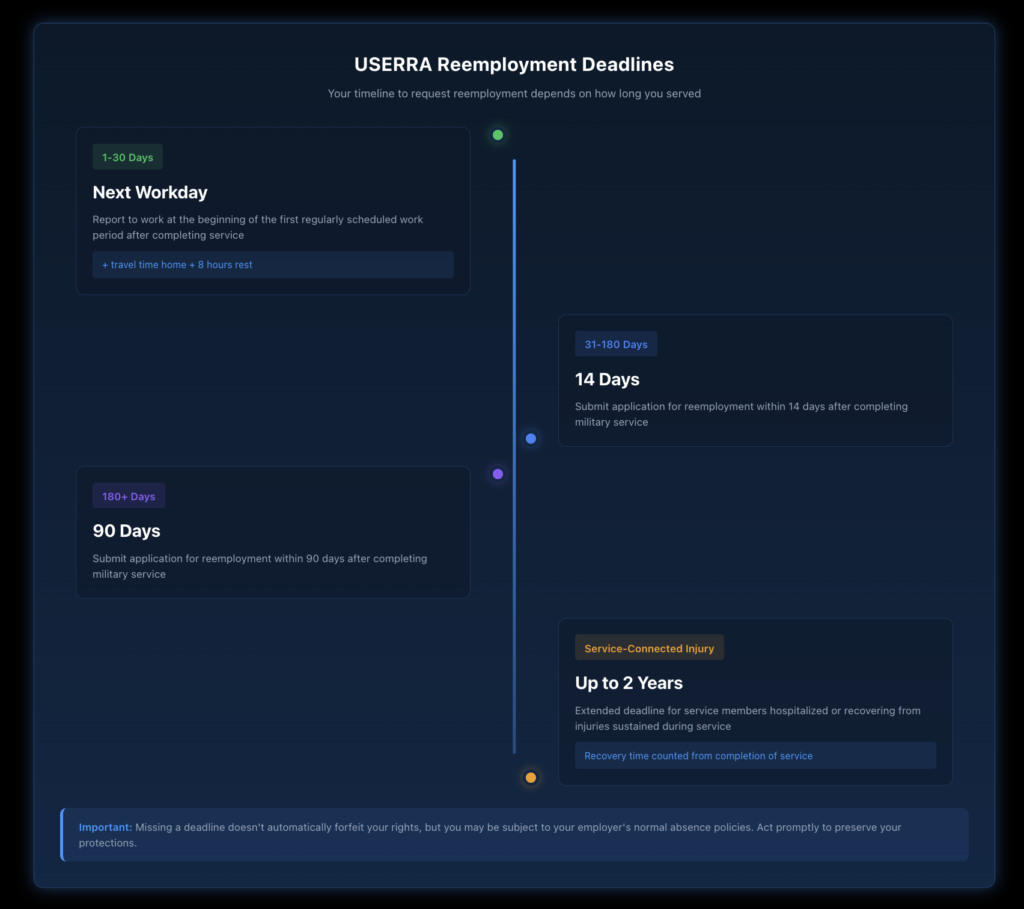
Your obligation to report back to work or request reemployment depends on how long you were gone for military service:
Service of 1-30 days: You must report to work at the beginning of the first regularly scheduled work period on the first full calendar day following completion of service, plus time for safe travel home and an eight-hour rest period.
Service of 31-180 days: You must submit an application for reemployment within 14 days after completing service.
Service exceeding 180 days: You must submit an application for reemployment within 90 days after completing service.
If you’re recovering from a service-connected injury or illness, you have up to two years from the date you complete service to report back or apply for reemployment.
How Does the Escalator Principle Work?
One of USERRA’s most powerful provisions is the “escalator principle,” which ensures you don’t fall behind in your career due to military service. Rather than simply getting your old job back, you’re entitled to the position you would have attained had you remained continuously employed.
What Position Must Your Employer Offer You?
Your employer must place you in the position you would have held with reasonable certainty if you had remained continuously employed. If your department reorganized and your former position was eliminated, you’re entitled to whatever position you would have been moved into. If your company gives automatic raises after certain time periods, you’re entitled to those raises. If employees with your tenure typically get promoted, you should receive that promotion.
This principle works both ways—the escalator can move down too. If layoffs had affected your position regardless of your military service, your employer isn’t required to keep a job open that wouldn’t have existed anyway.
What If You Need Retraining?
Employers must make reasonable efforts to qualify you for your reemployment position. If you’ve been away for an extended deployment and your skills need refreshing, or if workplace technology has evolved during your absence, your employer must provide training to bring you up to speed. This training must be at the employer’s expense, not yours.
If reasonable efforts cannot qualify you for the escalator position, you’re still entitled to your pre-service position. If you cannot perform that position either, you must be offered a position of comparable seniority, status, and pay.
What Protections Does USERRA Provide Against Discrimination?
USERRA prohibits employment discrimination based on military service at every stage of the employment relationship. This protection covers hiring decisions, promotions, discipline, compensation, and termination. Employers cannot make adverse decisions based on your past service, current obligations, or anticipated future military duty.
What Employment Decisions Are Protected?
Your employer cannot refuse to hire you because you’re in the Reserves and might be deployed. They cannot deny you a promotion because you might need to take military leave for annual training. They cannot reduce your bonus because you were deployed during part of the performance period. Any employment decision influenced by your military service potentially violates USERRA.
The law specifically prohibits employers from retaliating against you for exercising USERRA rights, filing a complaint, or testifying in a USERRA proceeding. Even employees who have never served in the military are protected from retaliation for helping a service member assert their rights.
How Do New York Laws Enhance These Protections?
Service members working in New York benefit from additional state and local protections beyond federal law. The New York State Human Rights Law prohibits discrimination based on military status in employment, housing, and public accommodations. The New York City Human Rights Law added similar protections effective November 2017, giving veterans and active service members recourse through the NYC Commission on Human Rights.
These state and local protections may offer different remedies or procedures than federal USERRA claims. Service members should evaluate which venue offers the best path to resolving their specific situation. New York State provides particularly strong protections for disabled veterans through its broad disability discrimination laws.

What Benefits Must Continue During Military Service?
USERRA ensures that military service doesn’t interrupt your employment benefits. While some benefits continue automatically, others require you to take specific actions to maintain coverage.
Can You Keep Your Health Insurance?
You have the right to continue your employer-sponsored health insurance for up to 24 months during military service. For absences of 30 days or less, coverage continues as if you were still working, and you can only be charged your normal employee contribution. For longer absences, you may be required to pay up to 102% of the full premium cost.
When you return from service, your health insurance must be reinstated immediately without waiting periods or exclusions for pre-existing conditions—unless the condition is service-connected. You’re essentially treated as if you had never left for purposes of health coverage eligibility.
What Happens to Your Pension?
USERRA provides robust pension protections. Your military service counts as continuous employment for purposes of vesting and benefit accrual. If your employer maintains a defined benefit plan, your benefits must be calculated as if you had worked continuously during your military service. For defined contribution plans, employers must make any contributions they would have made if you had been employed and receiving compensation.
How Do You Enforce Your USERRA Rights?
If your employer violates USERRA, you have several options for enforcing your rights. You can file a complaint with the federal government, pursue private litigation, or, in some cases, use state enforcement mechanisms.
Where Do You File a USERRA Complaint?
The Department of Labor’s Veterans’ Employment and Training Service (DOL-VETS) investigates USERRA complaints against all employers. You can file online using Form e1010 or submit a written complaint. Unlike many employment laws, USERRA has no statute of limitations for filing with DOL-VETS, though acting promptly helps preserve evidence and memories.
If DOL-VETS cannot resolve your complaint, you can request a referral to the Department of Justice for litigation against private or state employers, or to the Office of Special Counsel for federal employer violations. You also retain the right to file a private lawsuit in federal or state court without exhausting administrative remedies.
What Remedies Are Available?
Successful USERRA claims can result in:
- Immediate reinstatement to your proper position
- Lost wages and benefits from the date of the violation
- Liquidated damages equal to lost wages and benefits if the violation was willful
- Correction of personnel records
- Attorney’s fees and costs
For federal employees, cases may be heard by the Merit Systems Protection Board, which can order similar relief plus correction of official personnel files.
Can You Use the ESGR for Informal Resolution?
Before filing a formal complaint, many service members work with the Employer Support of the Guard and Reserve (ESGR), a Department of Defense agency that provides free mediation services. ESGR ombudsmen can often resolve employer misunderstandings about USERRA requirements without formal legal proceedings. If ESGR cannot resolve the matter, they’ll assist in referring your complaint to DOL-VETS.
How Does USERRA Differ From FMLA?
While both laws protect job absences, USERRA and the Family and Medical Leave Act serve different purposes and offer different protections. USERRA protects military service absences regardless of employer size, while FMLA only applies to employers with 50 or more employees within a 75-mile radius.
FMLA provides 12 weeks of unpaid leave per year for qualifying medical or family reasons. USERRA allows cumulative absences of up to five years (with many exceptions extending this limit) for military service. FMLA requires you to have worked for your employer for at least 12 months; USERRA protections begin from your first day of employment.
The two laws can work together. Military family members may qualify for FMLA leave for qualifying exigencies related to a service member’s deployment, or to care for a service member with a serious injury or illness.
Ready to Protect Your Rights?
If you’re a service member facing employment problems related to your military status, don’t let your employer get away with violating federal law. Whether you’ve been denied reemployment, demoted upon return from duty, or discriminated against because of your service obligations, you have legal options.
Nisar Law Group represents service members and veterans throughout New York in USERRA and military discrimination cases. Our employment attorneys understand both the technical requirements of USERRA and the broader protections available under New York state and city human rights laws. Contact us today to discuss your situation and learn how we can help protect the career you’ve worked to build while serving your country.
Frequently Asked Questions About USERRA
USERRA covers reemployment rights, anti-discrimination protections, and benefits continuation for members of all uniformed services. This includes active duty, Reserve, National Guard (federal status), Public Health Service Commissioned Corps, and National Oceanic and Atmospheric Administration Commissioned Corps. The law protects your right to return to your civilian job after military service, prohibits employers from discriminating based on military status, and requires continuation of certain benefits during and after service.
No, employers cannot deny leave for legitimate military service. USERRA requires all employers—regardless of size—to grant leave for uniformed service obligations. Unlike other types of leave, there’s no employer approval process for military leave. You simply need to provide notice when feasible, though military necessity may excuse advance notice. An employer who denies military leave or retaliates against you for taking it violates federal law.
USERRA allows cumulative military service of up to five years with a single employer while maintaining reemployment rights. However, numerous exceptions can extend this period significantly. Service during national emergencies, involuntary active duty extensions, training requirements, and initial obligated service periods beyond five years don’t count toward the limit. Many service members never reach the cap despite lengthy careers.
Yes, basic training qualifies as uniformed service under USERRA. Whether you’re attending initial entry training, officer candidate school, or any other required military training, your civilian job is protected. Your employer must grant leave for training and reemploy you upon completion, provided you meet the standard eligibility criteria, including proper notice and timely return.
No, USERRA doesn’t require employers to pay you during military service. However, employers must allow you to use accrued paid leave (vacation, personal time) during military absence if you choose. Many employers voluntarily provide paid military leave or differential pay to make up the difference between military and civilian wages. Some states mandate paid military leave for certain employers.
The Department of Labor’s Veterans’ Employment and Training Service (DOL-VETS) investigates all USERRA complaints. Federal employee claims may also involve the Office of Special Counsel and Merit Systems Protection Board. If DOL-VETS cannot resolve a complaint, it may refer the case to the Department of Justice for litigation against private or state employers. Service members can also file private lawsuits without using the DOL-VETS process.
Employers may request documentation of military service after you return from absences exceeding 30 days, but they cannot delay your reemployment while waiting for it. Acceptable documentation includes DD-214s, leave and earnings statements, military orders, or letters from commanding officers. If documentation isn’t readily available due to military operations, your employer must reemploy you based on your representation of service while you obtain proper documentation.
Upon return, you’re entitled to prompt reemployment in the position you would have attained with continuous employment (the escalator position), or if not qualified for that position, your pre-service position. You receive all seniority-based benefits as if you’d worked continuously, immediate health insurance reinstatement without waiting periods, and protection against termination without cause for six months to one year, depending on your absence length.
