

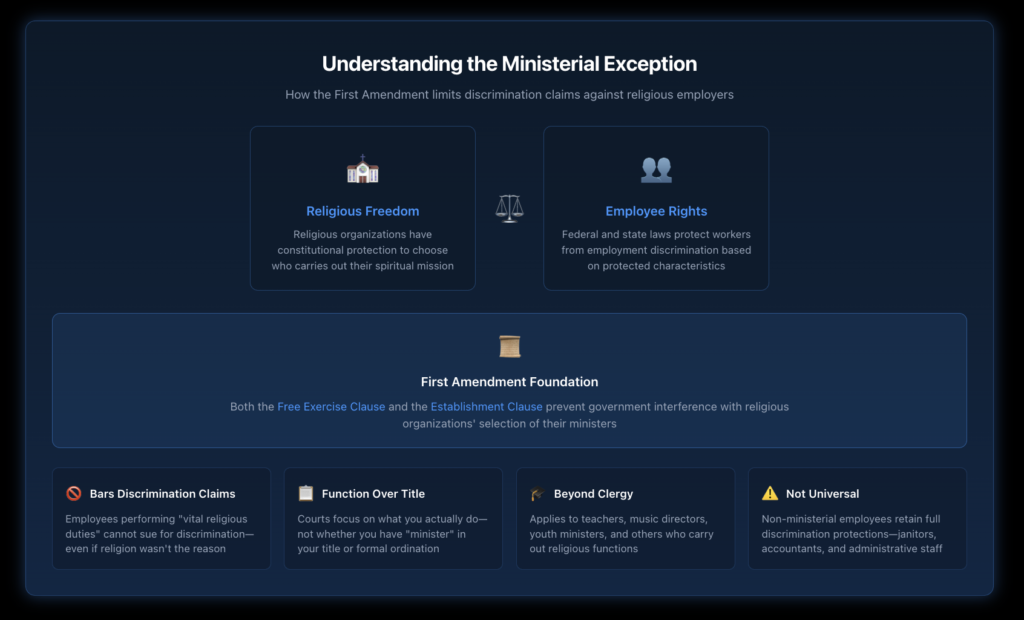
The ministerial exception is a constitutional doctrine that prevents employees of religious organizations from pursuing employment discrimination claims when their jobs involve religious functions. If you work for a church, religious school, or faith-based organization in a role that involves teaching, leading worship, or otherwise carrying out the organization’s religious mission, you may be barred from filing discrimination complaints under Title VII, the ADA, the ADEA, and other federal employment laws—regardless of whether your employer’s decision was actually motivated by religious reasons.
This exception exists because the First Amendment protects religious institutions’ right to choose who will “personify their beliefs” and “minister to the faithful” without government interference.
Key Takeaways
- The ministerial exception bars employment discrimination lawsuits by employees who perform “vital religious duties” for religious organizations—even if the discrimination had nothing to do with religion.
- You don’t need the title “minister” or formal ordination for the exception to apply; courts focus on what you actually do in your role.
- The exception applies to teachers at religious schools, music directors, youth ministers, and others who carry out religious functions—not just clergy.
- Religious organizations remain subject to discrimination laws based on race, sex, age, and disability for employees who don’t qualify as “ministers”.
- New York State Human Rights Law contains similar exemptions for religious organizations operating in the state.
Disclaimer: This article provides general information for informational purposes only and should not be considered a substitute for legal advice. It is essential to consult with an experienced employment lawyer at our law firm to discuss the specific facts of your case and understand your legal rights and options. This information does not create an attorney-client relationship.
How Did the Ministerial Exception Develop?
The ministerial exception traces back to lower federal court decisions in the 1970s, but the U.S. Supreme Court didn’t formally recognize it until 2012 in the landmark Hosanna-Tabor Evangelical Lutheran Church and School v. EEOC case.
What Happened in Hosanna-Tabor?
Cheryl Perich was a “called” teacher at a Lutheran school in Michigan who taught both secular and religious subjects. After developing narcolepsy and going on disability leave, she was told her position had been filled. When she threatened to file a lawsuit, the church terminated her for “insubordination” and for violating the denomination’s teaching that disputes should be resolved internally.
The Supreme Court unanimously ruled that the First Amendment barred Perich’s discrimination claim, even though her firing arguably violated the Americans with Disabilities Act. Chief Justice John Roberts wrote that both the Establishment Clause and the Free Exercise Clause prevent the government from interfering with a religious organization’s selection of its ministers.
What Did the Supreme Court Clarify in 2020?
Eight years later, the Supreme Court significantly expanded the ministerial exception in Our Lady of Guadalupe School v. Morrissey-Berru. This case involved two Catholic elementary school teachers—one who claimed age discrimination and another who alleged disability discrimination after requesting leave for breast cancer treatment.
In a 7-2 decision, the Court held that the teachers’ employment discrimination claims were barred because they performed “vital religious duties” at the core of their schools’ missions. Justice Samuel Alito wrote that “educating young people in their faith, inculcating its teachings, and training them to live their faith are responsibilities that lie at the very core of the mission of a private religious school.”
Who Qualifies as a "Minister" Under This Exception?
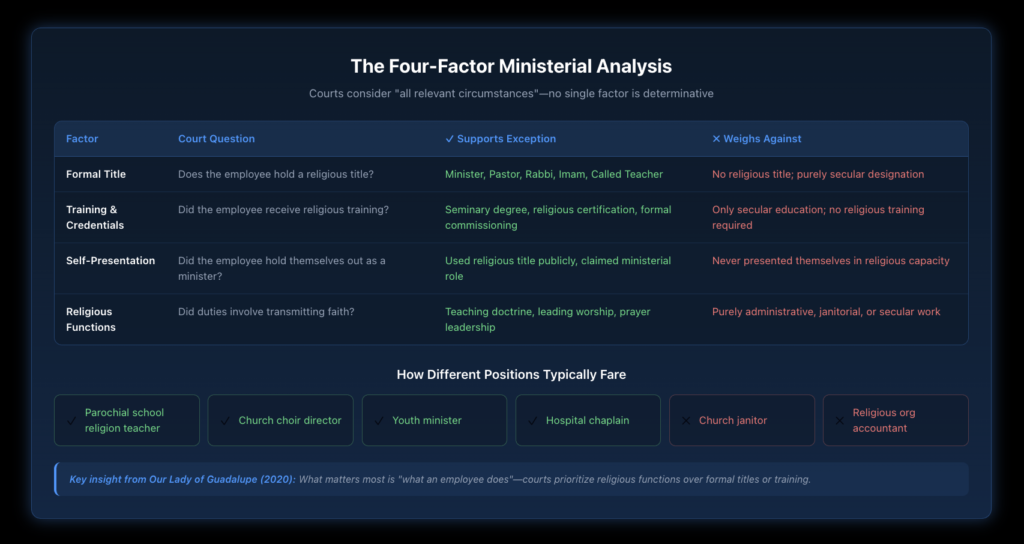
The Supreme Court has explicitly declined to adopt a rigid test for determining who qualifies as a minister. Instead, courts examine “all relevant circumstances” to determine whether each particular position implicates the fundamental purpose of the exception.
What Factors Do Courts Consider?
In Hosanna-Tabor, the Court identified four considerations that were relevant in that case:
- The employee’s formal title
- The substance reflected in that title (including religious training or education)
- Whether the employee used the title or held themselves out as a minister
- The important religious functions the employee performed
However, the Court later clarified in Our Lady of Guadalupe that these factors are not a rigid checklist. What matters most is “what an employee does” and whether they perform vital religious duties.
Which Positions Typically Fall Under the Exception?
Courts have applied the ministerial exception to various positions beyond traditional clergy, including:
- Teachers at religious schools who provide religious instruction
- Music directors and choir directors at churches
- Youth ministers and campus ministers
- Chaplains at religious hospitals
- Directors of religious education programs
The exception is not limited to those with formal religious titles or seminary training. Even lay employees can be covered if they play a significant role in conveying the organization’s religious message.
What Are the Limits of the Ministerial Exception?
While the ministerial exception provides broad protection for religious organizations, it has important boundaries that employees should understand.
Does the Exception Apply to All Religious Organization Employees?
No. The exception only applies to employees who perform vital religious functions. A church’s janitor, accountant, or receptionist typically wouldn’t be covered unless their duties somehow involve carrying out the religious mission. Courts look at what employees actually do, not just who employs them.
Can Religious Organizations Discriminate Based on Race or Sex?
Religious organizations remain subject to Title VII’s prohibitions against discrimination based on race, color, sex, and national origin for employees who don’t qualify as ministers. The EEOC’s guidance on religious discrimination makes clear that while religious organizations can give preference to co-religionists in hiring, they cannot use religion as a pretext for discrimination on other protected bases.
What About the Separate Religious Organization Exemption?
Title VII contains a distinct “religious organization exemption” under Section 702 that allows qualifying religious employers to prefer employees who share their faith—regardless of the specific job. This is different from the ministerial exception:
- The religious organization exemption is statutory (written into Title VII)
- The ministerial exception is constitutional (based on the First Amendment)
- The religious organization exemption allows religious preferences only
- The ministerial exception can bar all discrimination claims, including those based on race and sex
How Does New York Law Address Religious Organization Employment?
New York State Human Rights Law mirrors the federal religious organization exemption. Section 296(11) provides that nothing in the law shall prevent religious organizations from limiting employment to persons of the same religion or denomination, or from taking action to promote their religious principles.
What Protections Exist for NYC Employees?
The New York City Human Rights Law similarly recognizes exemptions for religious organizations but provides some of the broadest employee protections in the country for workers who don’t fall under these exemptions. If you work for a religious organization in New York and believe you’ve experienced unlawful discrimination, it’s worth consulting an attorney to determine whether the ministerial exception or religious organization exemption applies to your situation.
What Are the Filing Deadlines in New York?
Even when exceptions don’t apply, time limits for filing discrimination complaints remain critical:
- 300 days to file with the EEOC (federal)
- 1 year to file with the New York State Division of Human Rights
- 3 years to file under the NYC Human Rights Law
What Should You Do If You're Unsure Whether the Exception Applies?
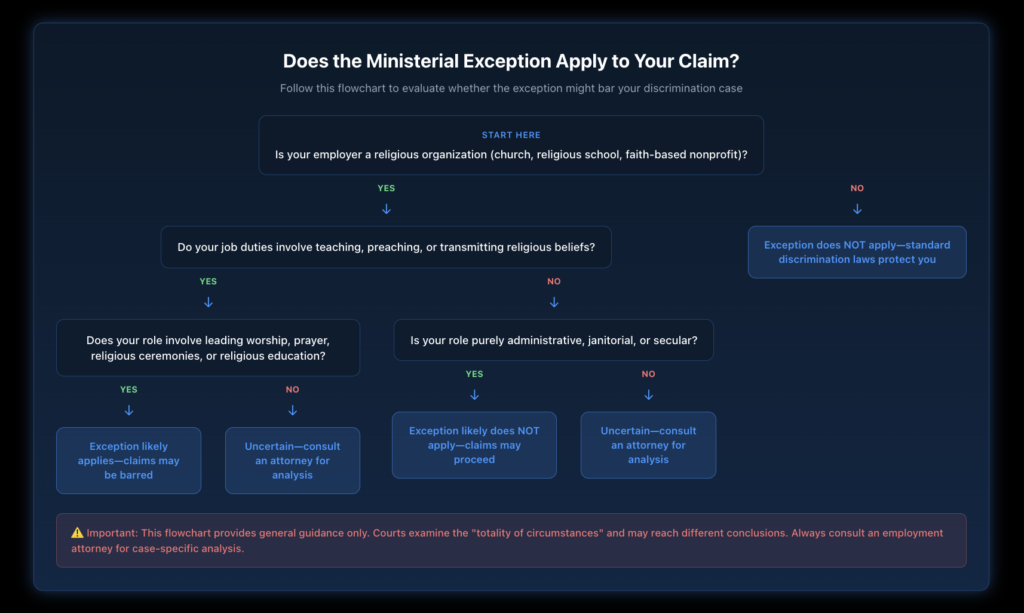
Determining whether the ministerial exception bars your discrimination claim requires careful analysis of your specific circumstances. Courts consider the totality of circumstances, and the line between covered and non-covered positions isn’t always clear.
What Questions Should You Ask Yourself?
Consider the following when evaluating your situation:
- Does my employer qualify as a “religious organization”?
- Do my job duties involve teaching, preaching, or transmitting religious beliefs?
- Does my employment contract reference religious duties or mission?
- Did my employer hold me out as having a religious role?
- Would my religious training and background be relevant to my position?
Why Is Legal Consultation Important?
Because the ministerial exception can completely bar otherwise valid discrimination claims, it’s crucial to understand whether it applies before investing time and resources in pursuing a complaint. An experienced employment attorney can evaluate the specific facts of your situation and advise whether you have viable claims.
Religious organizations may also try to characterize positions as ministerial when they’re not, or may add religious language to job descriptions strategically. Courts look beyond labels to examine the actual nature of the work performed.
How Does This Interact With Religious Accommodation Rights?
The ministerial exception is distinct from the religious accommodation requirements that apply to all employers under Title VII.
What’s the Difference?
- Religious accommodation applies when employees need workplace adjustments for their own religious practices (like schedule changes for Sabbath observance or exemptions from dress codes for religious attire).
- The ministerial exception involves the relationship between religious employers and their ministerial employees.
These are separate legal concepts, though both involve the intersection of religion and employment.
Can Employees of Religious Organizations Request Accommodations?
Employees of religious organizations who aren’t covered by the ministerial exception retain their Title VII rights, including the right to request reasonable religious accommodations. However, courts have recognized that requiring a religious organization to accommodate beliefs inconsistent with its own doctrines could raise constitutional concerns.
Ready to Understand Your Rights?
If you work for a religious organization in New York and believe you’ve experienced discrimination, the ministerial exception may or may not apply to your situation. The determination depends on your specific job duties, not just your employer’s religious status.
Nisar Law Group has extensive experience navigating the complex intersection of religious freedom and employment rights. Our attorneys can evaluate whether your claims may proceed and what options are available. Contact us today for a consultation to discuss your circumstances.
Frequently Asked Questions About the Ministerial Exception
The ministerial exception (often called the ministerial exemption) is a First Amendment-based doctrine that bars employees who perform religious functions for religious organizations from bringing employment discrimination claims in court. The exception protects religious organizations’ constitutional right to select who will carry out their religious mission without government interference, even when employment decisions might otherwise violate anti-discrimination laws.
While Title VII of the Civil Rights Act prohibits employment discrimination based on religion, race, sex, and other protected characteristics, the ministerial exception—derived from the First Amendment rather than the statute itself—prevents certain employees of religious organizations from bringing any discrimination claims. Courts have held that this constitutional protection supersedes Title VII when employees perform vital religious duties at the core of their employer’s mission.
Yes, religious exemptions to employment discrimination laws have been upheld as constitutional. The Supreme Court unanimously recognized the ministerial exception in Hosanna-Tabor and expanded it in Our Lady of Guadalupe, finding that both the Free Exercise Clause and the Establishment Clause require this limitation on government authority to protect religious organizations’ autonomy in selecting their ministers.
Lower federal courts recognized the ministerial exception beginning in the 1970s, with the Fifth Circuit’s 1972 decision in McClure v. Salvation Army being an early landmark case. However, the U.S. Supreme Court didn’t formally recognize and affirm the doctrine until its unanimous 2012 decision in Hosanna-Tabor Evangelical Lutheran Church and School v. EEOC.
Generally, employers cannot fire you because of your religious beliefs, as Title VII prohibits religious discrimination. However, if you work for a religious organization in a ministerial capacity, that organization may make employment decisions based on whether your beliefs align with its doctrines—and the ministerial exception would likely prevent you from challenging that decision in court.
Reasonable religious accommodations can include schedule changes to observe a Sabbath or religious holidays, exceptions to dress codes for religious attire or grooming practices, permission to take breaks for prayer, exemptions from certain job duties that conflict with religious beliefs, and modifications to workplace policies regarding religious expression. Employers must provide these accommodations unless they would cause undue hardship.
To prove religious discrimination, you typically must show that you hold a sincerely held religious belief, that you informed your employer of this belief and any conflict with workplace requirements, that you suffered an adverse employment action, and that your religion was a motivating factor in that action. Evidence can include statements by decision-makers, timing of actions following religious accommodation requests, and disparate treatment compared to employees of other religions.
Religious discrimination occurs when an employer treats you unfavorably because of your religious beliefs, practices, or lack thereof. This includes refusing to hire, firing, demoting, harassing, or otherwise treating you differently based on religion. It also includes failing to reasonably accommodate your sincerely held religious practices when doing so wouldn’t cause undue hardship to the business.
