

When a supervisor or manager ties your job security, promotion, or workplace benefits to sexual favors, you’re facing quid pro quo harassment—one of the most serious forms of workplace misconduct under federal and state employment law. The short answer: document everything, don’t resign immediately, and consult an employment attorney before making decisions that could affect your legal rights.
Quid pro quo (Latin for “this for that”) harassment occurs when someone in a position of authority explicitly or implicitly conditions employment decisions on your willingness to submit to unwelcome sexual conduct. Unlike hostile work environment claims that typically require a pattern of behavior, even a single quid pro quo incident can violate Title VII of the Civil Rights Act of 1964 if it involves an explicit or implied condition tied to your job.
Key Takeaways
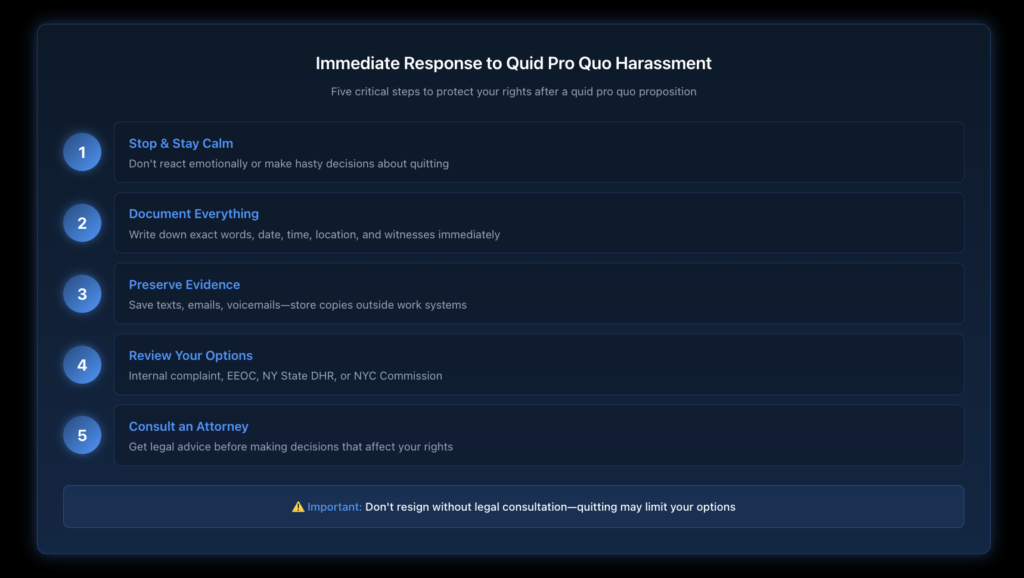
- Document every incident immediately in writing, including dates, times, locations, exact words used, and any witnesses.
- Don’t quit your job without consulting an employment attorney—resignation can limit your legal options.
- New York employees have stronger protections than federal law provides, including longer filing deadlines and no employer size restrictions under NYC law.
- Employers are strictly liable for quid pro quo harassment by supervisors, meaning they cannot claim ignorance as a defense.
- You have multiple filing options: internal complaints, EEOC charges, state agencies, or direct lawsuits.
- Retaliation for reporting harassment is illegal and creates a separate legal claim.
Disclaimer: This article provides general information for informational purposes only and should not be considered a substitute for legal advice. It is essential to consult with an experienced employment lawyer at our law firm to discuss the specific facts of your case and understand your legal rights and options. This information does not create an attorney-client relationship.
What Exactly Makes a Proposition "Quid Pro Quo" Harassment?
The critical element that distinguishes quid pro quo harassment from other workplace misconduct is the connection between sexual conduct and employment consequences. According to EEOC guidance on sexual harassment, this type of harassment occurs when submission to or rejection of unwelcome sexual conduct is used as the basis for employment decisions affecting an individual.
What Are the Legal Elements of a Quid Pro Quo Claim?
To establish quid pro quo harassment under employment law, you generally need to demonstrate that the harasser held supervisory authority over you, made unwelcome sexual advances or requests, and that your response to those advances affected a tangible employment action. The employment consequences can include hiring, firing, promotions, demotions, work assignments, salary decisions, or other significant changes to your employment terms.
The proposition doesn’t need to be explicit. A supervisor who implies that “good things happen” to employees who spend time with them outside work, or who suggests your career advancement depends on your “flexibility,” may be engaging in implicit quid pro quo harassment. Courts and agencies evaluate the totality of circumstances to determine whether a reasonable person would understand the sexual nature of the implied exchange.
Why Does Power Dynamics Matter in These Cases?
Power imbalances in workplace relationships create the foundation for quid pro quo harassment. The harasser’s authority to affect your employment creates the coercive element that transforms an unwelcome advance into actionable harassment. This is why quid pro quo claims specifically require that the harasser hold supervisory or managerial authority—without that power differential, the “exchange” element cannot exist.
Employers are held strictly liable for quid pro quo harassment committed by supervisors. This means the company cannot escape responsibility by claiming they didn’t know about the harassment or that they had anti-harassment policies in place. When a supervisor abuses their authority to demand sexual favors, the employer bears automatic legal responsibility.
What Should You Do Immediately After a Quid Pro Quo Proposition?
The moments and days following a quid pro quo proposition are critical for protecting both your immediate safety and your long-term legal rights. Your instinctive response—whether it’s shock, anger, fear, or confusion—is completely normal, but taking deliberate steps can significantly strengthen your position.
How Should You Document the Incident?
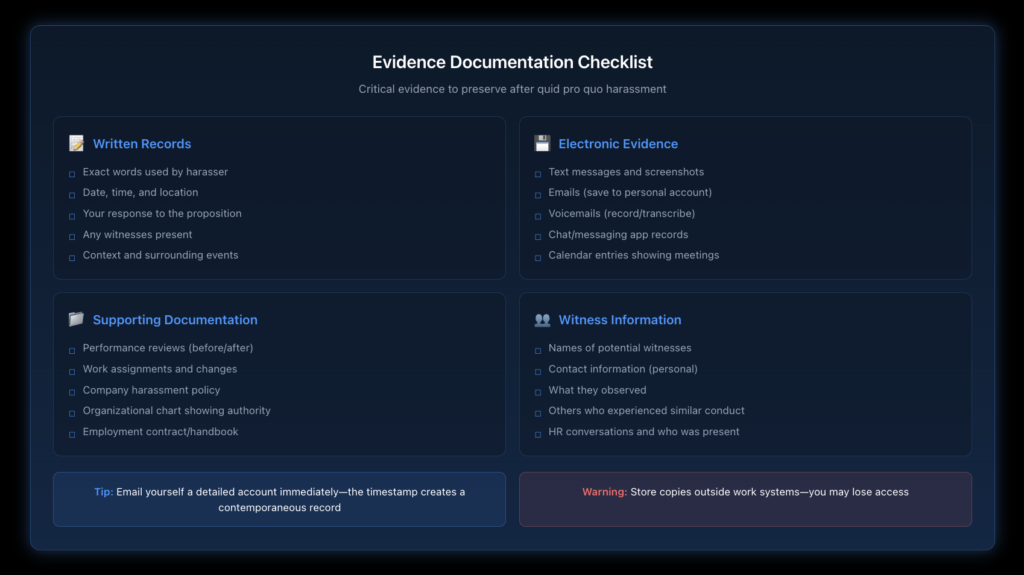
Effective documentation of harassment requires immediate and detailed record-keeping. Within hours of the incident, write down everything you can remember: the exact words used by the harasser, where and when the conversation occurred, anyone who might have witnessed the exchange, and your response. Include details about what you were wearing, what work activities you were engaged in before the incident, and the harasser’s demeanor.
Preserve any physical evidence. If the proposition came via text message, email, or voicemail, save screenshots and create backup copies stored outside your employer’s systems. Personal email accounts, cloud storage, or physical printouts kept at home ensure that evidence remains accessible even if you lose access to work systems.
Create a contemporaneous written record by sending yourself an email immediately after the incident. The timestamp on that email creates an objective record of when you documented the events, which can be powerful evidence that your account is accurate and not influenced by later events.
Should You Confront the Harasser Directly?
While clearly communicating that the conduct is unwelcome strengthens your legal position, direct confrontation isn’t always safe or advisable. The EEOC recognizes that victims may fear repercussions from confronting their harasser, and courts don’t require that you tell the harasser to stop before you can bring a claim.
If you do choose to address the behavior directly, do so in writing when possible. A brief, professional email stating that you found the conversation inappropriate and expect professional interactions going forward creates a written record while maintaining workplace decorum. However, your physical and emotional safety comes first—if direct confrontation feels dangerous, focus on documentation and reporting through other channels.
How Do You Report Quid Pro Quo Harassment?
Reporting harassment triggers important legal protections and creates the formal record necessary for many legal claims. However, the decision of when, how, and to whom you report involves strategic considerations that an employment attorney can help you navigate.
What Are Your Internal Reporting Options?
Most employers have designated channels for harassment complaints—typically human resources departments or compliance officers. Review your employee handbook to understand your company’s specific procedures. While using internal channels isn’t legally required, it can be strategically important because it gives the employer an opportunity to address the situation and creates documentation of their response.
When filing an internal complaint, put your concerns in writing even if the initial conversation is verbal. Request confirmation that your complaint was received and ask about the investigation timeline. Keep copies of all correspondence related to your complaint in your personal files, not just in your work email.
Be aware that internal investigations have limitations. HR ultimately works for the company, and their investigation may prioritize minimizing employer liability over achieving justice for you. Document any promises made during the investigation process, and note if the company fails to follow its own stated procedures.
Can Coworkers Report Harassment They Witness?
Third-party reporting of quid pro quo harassment is not only permitted but protected under anti-retaliation laws. Coworkers who witness harassment or learn about it secondhand can report it to HR, management, or external agencies. The law protects witnesses from retaliation just as it protects direct victims.
If a colleague confides in you about experiencing quid pro quo harassment, encourage them to document the incidents and consider reporting. However, respect their autonomy to make their own decisions about how to proceed. You can offer support by providing information about resources and potentially serving as a witness, but the decision to formally report should ultimately be theirs.
What Legal Protections Apply to Quid Pro Quo Victims in New York?
New York employees benefit from a robust framework of federal, state, and local protections against workplace sexual harassment. Understanding these overlapping laws helps you identify the strongest avenue for your particular situation.
How Does Federal Law Protect Against Quid Pro Quo Harassment?
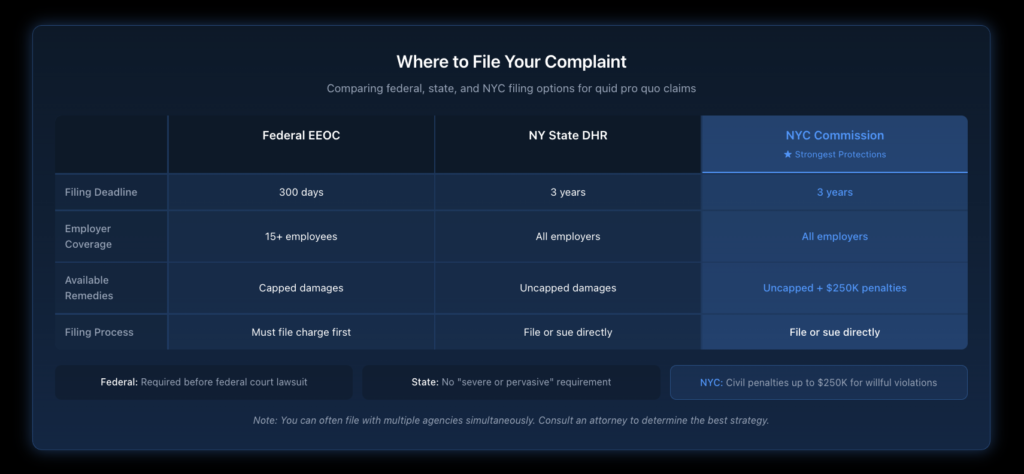
Title VII prohibits sex discrimination, including sexual harassment, in workplaces with 15 or more employees. The EEOC’s fact sheet on sexual harassment explains that unwelcome sexual advances that affect employment decisions constitute illegal discrimination. Federal law provides a damages cap based on employer size, but allows for compensatory and punitive damages in addition to back pay and other economic remedies.
To pursue a federal claim, you must file a charge with the EEOC within 300 days of the discriminatory act. The EEOC investigates and may attempt conciliation; if they don’t resolve the matter, you receive a “right to sue” letter allowing you to proceed in federal court.
What Additional Protections Does New York Provide?
New York State’s sexual harassment prevention laws have eliminated the “severe or pervasive” standard that federal law requires for hostile work environment claims. While quid pro quo claims don’t require this showing, the elimination benefits victims whose situations involve elements of both harassment types.
Under New York State Human Rights Law, you have three years to file a complaint with the Division of Human Rights or to file a lawsuit directly in state court. There’s no employer size minimum—even small employers are covered. The statute of limitations was extended from one year to three years in 2020, reflecting the state’s commitment to combating sexual harassment in the workplace.
Why Are NYC Protections Even Stronger?
The NYC Human Rights Law provides the most expansive protections in the country. Under the Stop Sexual Harassment in NYC Act, all employees in New York City are protected regardless of their employer’s size. The city law specifically eliminated the severe or pervasive standard and extended the statute of limitations for gender-based harassment claims to three years.
Remedies under NYC law include compensatory damages without caps, punitive damages, and civil penalties up to $250,000 for willful violations. The NYC Commission on Human Rights actively investigates complaints and can bring enforcement actions independently.
What Happens After You Report Quid Pro Quo Harassment?
The period following your report can be challenging to navigate. Understanding what to expect helps you prepare for potential responses and recognize problematic behavior that might constitute retaliation.
How Should Employers Respond to Your Complaint?
Responsible employers should promptly investigate harassment complaints, protect the complainant from further harassment during the investigation, and take appropriate corrective action if harassment is substantiated. You should be interviewed about your allegations, receive updates on the investigation’s progress, and be informed of the outcome and any remedial measures.
However, employer responses sometimes fall short of these standards. Watch for signs of an inadequate investigation: unexplained delays, failure to interview obvious witnesses, conclusions that contradict clear evidence, or remedial measures that don’t adequately address the situation. Document any deficiencies in the investigation process, as they may become relevant if you pursue external remedies.
What Constitutes Illegal Retaliation?
Retaliation protection for harassment victims is among the strongest in employment law. Employers cannot take adverse actions against you for reporting harassment, participating in an investigation, or opposing discriminatory practices. Retaliation includes obvious actions like termination or demotion, but also subtler measures like schedule changes, isolation from colleagues, increased scrutiny, or negative performance evaluations that don’t reflect your actual work.
The retaliation prohibition extends beyond your direct supervisor. If anyone at your company takes adverse action against you because of your harassment complaint, that conduct may be illegal regardless of whether the original harasser was involved. Even if the underlying harassment claim is ultimately unsuccessful, retaliation for making a good-faith complaint remains prohibited.
How Do You Distinguish Quid Pro Quo From Hostile Work Environment Claims?
While these two forms of sexual harassment often overlap, understanding their differences affects how your claim is evaluated and what evidence you need to present.
What Makes Quid Pro Quo Legally Distinct?
Quid pro quo harassment requires a connection between sexual conduct and a tangible employment action—you either received a benefit for complying or suffered a consequence for refusing. This exchange element creates strict liability for employers when the harasser is a supervisor. You don’t need to prove the harassment was “severe or pervasive” because a single incident involving explicit or implicit conditioning of job benefits on sexual favors suffices.
In contrast, hostile work environment claims involve conduct that creates an intimidating, offensive, or abusive workplace but may not directly tie sexual conduct to employment decisions. These claims typically require showing that the harassment was unwelcome, based on a protected characteristic, and severe or pervasive enough to alter employment conditions.
Can Your Situation Involve Both Types of Harassment?
Many cases involve elements of both quid pro quo and hostile environment harassment. A supervisor who makes explicit demands for sexual favors (quid pro quo) may also create a generally hostile atmosphere through ongoing inappropriate comments, displays, or other conduct. When your situation involves both harassment types, you should document and report all problematic behavior, not just the most explicit exchange-based incidents.
Understanding the complete guide to quid pro quo harassment helps you recognize when your experiences may support multiple legal theories. An employment attorney can analyze your specific facts to determine which claims are strongest and how to present them most effectively.
What Damages Can You Recover in a Quid Pro Quo Case?
Successful quid pro quo claims can result in significant financial recovery that addresses both your economic losses and the personal impact of the harassment.
What Economic Damages Are Available?
Economic damages compensate you for financial losses directly caused by the harassment. If you were terminated, demoted, or denied a promotion because you rejected sexual advances, you can recover lost wages and benefits. Back pay covers earnings lost between the adverse action and the resolution of your claim. Front pay may be awarded for future lost earnings if reinstatement isn’t feasible.
Lost benefits recovery can include health insurance, retirement contributions, stock options, bonuses, and other compensation you would have received absent the discrimination. Courts also award prejudgment interest on economic damages, reflecting the time value of money you were wrongfully denied.
What Non-Economic Damages Apply?
Compensatory damages for emotional distress recognize that harassment causes harm beyond financial losses. Anxiety, depression, humiliation, damage to reputation, and impact on personal relationships are all compensable. Medical expenses for therapy or treatment related to harassment-induced conditions can be recovered.
Punitive damages are available when the employer’s conduct was particularly egregious or demonstrated reckless disregard for employee rights. While federal law caps combined compensatory and punitive damages based on employer size, New York State and NYC law impose no such caps, making state and local claims potentially more valuable for severe cases.
When Should You Consult an Employment Attorney?
Legal consultation early in the process can prevent costly mistakes and help you make informed decisions about how to proceed. Many employment attorneys offer free initial consultations to evaluate potential claims.
What Questions Should You Ask During a Consultation?
Prepare for your consultation by organizing your documentation and identifying key facts. Ask the attorney about their experience with quid pro quo cases, their assessment of your situation’s strengths and weaknesses, and the potential avenues for resolution. Inquire about their fee structure—many employment attorneys work on contingency, meaning they’re paid a percentage of your recovery rather than upfront fees.
Discuss timing considerations, including filing deadlines and how quickly you need to make decisions. Ask about the potential impact of different choices, like whether filing an internal complaint or an EEOC charge first serves your interests best. The attorney should explain your options clearly and help you understand the potential outcomes of each path.
What Role Does Favorable Treatment Create in These Cases?
Sometimes quid pro quo situations involve benefits rather than threats—a supervisor offers advancement to an employee who agrees to their demands, creating liability issues that affect not just the targeted employee but potentially others who were passed over. Understanding how courts analyze these scenarios helps you recognize the full scope of potentially actionable conduct.
Ready to Take Action?
If you’ve experienced quid pro quo harassment in New York, you don’t have to navigate this challenging situation alone. Nisar Law Group represents employees facing workplace sexual harassment and can help you understand your options, protect your rights, and pursue appropriate remedies. Our employment attorneys have extensive experience handling discrimination and harassment claims throughout New York and New Jersey. Contact us today for a consultation to discuss your situation confidentially.
Frequently Asked Questions About Responding to Quid Pro Quo Propositions
Yes, quid pro quo harassment can violate federal and state law based on a single incident. Unlike hostile work environment claims that typically require a pattern of severe or pervasive conduct, quid pro quo harassment occurs when any employment decision is conditioned on sexual favors. If a supervisor explicitly or implicitly ties a promotion, raise, favorable schedule, or continued employment to your submission to sexual demands even once, that single proposition can constitute actionable harassment. The key element is the connection between sexual conduct and employment consequences, not the frequency of incidents.
Documentation is crucial when harassment occurs privately. Immediately after an incident, create a detailed written record including exact words used, the date, time, location, and context. Save any electronic communications and note any circumstantial evidence, like sudden changes in your work assignments, performance evaluations, or treatment after rejecting advances. Courts recognize that harassment often occurs without witnesses, and cases have succeeded based on credible testimony combined with documented patterns of behavior, timing of adverse actions, and the victim’s contemporaneous accounts.
Yes, you can still have a valid claim even if you initially submitted to the demands. The legal inquiry focuses on whether the conduct was unwelcome, not whether you technically “consented” under coercive circumstances. Courts recognize that employees may comply with sexual demands because they reasonably fear losing their jobs or other adverse consequences. The element of welcomeness considers whether you genuinely desired the sexual conduct versus whether you felt compelled to participate due to the employment-related pressure. Once you communicate that the conduct is unwelcome, any continued pressure or retaliation strengthens your claim.
An employer’s failure to follow its own anti-harassment policy actually strengthens your legal position. While having policies can sometimes provide employers with defenses in hostile environment cases, those defenses don’t apply to quid pro quo harassment by supervisors—employers face strict liability regardless of their policies. However, documenting the employer’s failure to follow stated procedures creates evidence of negligent enforcement that may increase damages, support punitive damages claims, and demonstrate the employer’s inadequate response to known problems.
Filing deadlines vary by agency and jurisdiction. For EEOC charges under federal law, you generally have 300 days from the discriminatory act in states with local enforcement agencies like New York. Under New York State Human Rights Law, you have three years to file with the Division of Human Rights or to file a lawsuit directly. NYC Human Rights Law also provides three years for gender-based harassment claims. These deadlines apply to discrete acts, but be aware that different incidents may have different deadline calculations. Consulting an attorney promptly helps ensure you don’t miss applicable deadlines.
Document the retaliatory conduct thoroughly, including dates, specific actions, and any witnesses. Retaliation claims are often easier to prove than the underlying harassment because there’s typically a clear timeline—your report, followed by adverse treatment. Continue performing your job duties to the best of your ability, and don’t give the employer legitimate performance-related reasons for adverse actions. File a separate retaliation complaint with your employer’s HR and with external agencies like the EEOC, state DHR, or NYC Commission on Human Rights. Retaliation is illegal even if the original harassment claim is ultimately unsuccessful.
While you can request confidentiality when making internal reports, complete anonymity may limit the employer’s ability to investigate effectively and could affect your legal rights. External agencies like the EEOC don’t typically allow anonymous charges because the employer has a right to know who is accusing them and to respond to specific allegations. However, anti-retaliation protections apply once you report, making it illegal for the employer to take adverse action against you. Discuss confidentiality concerns with an employment attorney who can help you weigh the benefits of reporting against your specific circumstances.
The critical distinction is the presence of authority and employment consequences. A coworker asking you on a date, while potentially unwelcome, doesn’t constitute quid pro quo harassment because they lack the power to affect your employment based on your response. Quid pro quo harassment specifically involves someone with supervisory authority over you conditioning employment benefits or threatening employment consequences based on your response to sexual conduct. A supervisor who accepts “no” gracefully and doesn’t let rejection affect work interactions hasn’t engaged in quid pro quo harassment, but one who implies or states that your career depends on your romantic interest crosses the legal line.

