

If you’re pregnant and struggling with certain job duties, you have a legal right to request workplace adjustments that help you stay healthy and employed. Under federal and New York laws, employers must provide reasonable accommodations for pregnancy-related limitations—things like extra bathroom breaks, modified schedules, lighter duties, or a place to sit—unless doing so would cause significant hardship to their business. The Pregnant Workers Fairness Act (PWFA), which took effect in June 2023, dramatically expanded these protections, making it easier than ever for pregnant employees to get the support they need without risking their jobs.
Key Takeaways
- Federal law requires accommodations: The PWFA mandates that employers with 15+ employees provide reasonable accommodations for pregnancy, childbirth, and related medical conditions.
- You don’t need a disability: Unlike the ADA, the PWFA covers even minor pregnancy limitations that don’t rise to the level of disability.
- Common accommodations include: Extra breaks, schedule modifications, light duty, seating, telework options, and time off for prenatal appointments.
- No documentation required for basic requests: Employers cannot demand a doctor’s note for simple accommodations like water breaks or bathroom access.
- New York provides additional protections: State and city laws cover employers with as few as 4 employees and offer broader coverage than federal law.
- Retaliation is illegal: Your employer cannot punish you for requesting or using pregnancy accommodations.
Disclaimer: This article provides general information for informational purposes only and should not be considered a substitute for legal advice. It is essential to consult with an experienced employment lawyer at our law firm to discuss the specific facts of your case and understand your legal rights and options. This information does not create an attorney-client relationship.
What Laws Protect Pregnant Workers' Right to Accommodations?
Multiple federal, state, and local laws work together to protect your right to workplace accommodations during pregnancy. Understanding which laws apply to your situation helps you know exactly what protections you can rely on.
What Does the Pregnant Workers Fairness Act Require?
The PWFA represents a major expansion of rights for pregnant employees. Before this law, pregnant workers often fell through the cracks—too healthy to qualify for disability accommodations under the ADA, but struggling with physical limitations that made their jobs difficult or even dangerous.
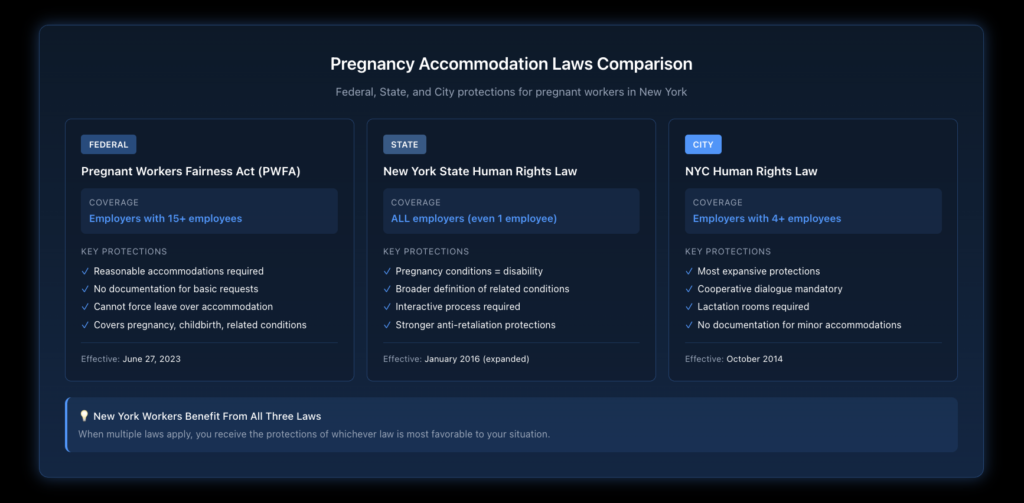
The PWFA changed that by requiring covered employers to provide reasonable accommodations for known limitations related to pregnancy, childbirth, or related medical conditions. The law applies to employers with 15 or more employees and covers both current and prospective employees.
What makes the PWFA particularly powerful is its broad definition of “limitation.” Your condition doesn’t need to meet any threshold of severity. Even minor, temporary limitations qualify for accommodation if they’re related to pregnancy. Morning sickness that makes your commute difficult, back pain that makes standing uncomfortable, or fatigue that affects your concentration—all of these can trigger your right to request accommodations.
How Do New York State and City Laws Expand These Protections?
If you work in New York, you benefit from some of the strongest pregnancy protections in the workplace anywhere in the country. New York State’s Human Rights Law covers all employers regardless of size—even if you’re the only employee, your employer must provide reasonable accommodations for pregnancy-related conditions.
The New York State Division of Human Rights has issued clear guidance establishing that pregnancy-related conditions are covered as disabilities under state law. This means employers must engage in an interactive process with you to identify effective accommodations, and they cannot refuse accommodations simply because you’re pregnant rather than disabled.
New York City’s Human Rights Law goes even further. The NYC Pregnant Workers Fairness Act, enacted in 2014, requires employers to accommodate the needs of employees for their pregnancy, childbirth, or related medical conditions. The law covers employers with four or more employees and explicitly prohibits requiring documentation for many common accommodation requests.
What About the Pregnancy Discrimination Act and ADA?
The Pregnancy Discrimination Act (PDA) has protected pregnant workers since 1978, but it works differently from the PWFA. Under the PDA, employers must treat pregnant employees the same as other employees who are similar in their ability or inability to work. If your employer provides light-duty assignments to workers with injuries or disabilities, they must offer the same to pregnant workers with similar limitations.
The Americans with Disabilities Act also provides important protections when pregnancy complications rise to the level of disability. Conditions like gestational diabetes, severe preeclampsia, or pregnancy-related carpal tunnel syndrome may qualify you for ADA accommodations, which include a broader range of potential modifications.
What Are Examples of Reasonable Accommodations for Pregnant Workers?
The EEOC’s final regulations implementing the PWFA provide extensive guidance on what accommodations employers should consider. The key principle is that accommodations should address your specific limitations while allowing you to continue performing the essential functions of your job.
What Are the Most Common Pregnancy Accommodations?
Some accommodations are so commonly needed and so easy to provide that the EEOC has identified them as “predictable assessments.” For these requests, employers should virtually always grant the accommodation without requiring documentation:
- Carrying or keeping water nearby and drinking as needed – Staying hydrated is essential during pregnancy, and this accommodation costs employers nothing
- Taking additional restroom breaks – Frequent urination is a universal pregnancy symptom, and bathroom access should never be restricted.
- Sitting when your job normally requires standing (and vice versa) – Simple seating accommodations can make an enormous difference for pregnant workers.
- Taking breaks to eat and drink as needed – Blood sugar regulation becomes more important during pregnancy
Beyond these basics, reasonable accommodations for pregnancy can include schedule modifications like adjusted start times to manage morning sickness, reduced hours during the third trimester, or flexibility to attend prenatal appointments without penalty.
What Physical Modifications Can You Request?
Many pregnant workers need modifications to their physical work environment or duties. These might include:
Lifting restrictions is among the most common needs. If your job normally involves heavy lifting, your employer might need to temporarily reassign those tasks to other workers or provide mechanical lifting assistance. The PWFA specifically allows temporary suspension of certain job functions as an accommodation.
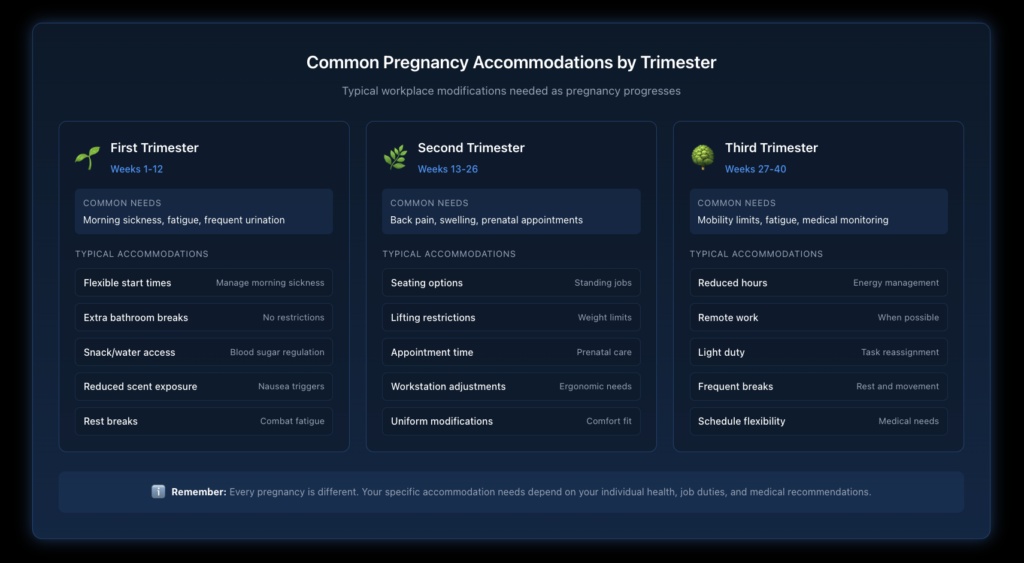
Workstation modifications can address various physical needs. This might include providing a stool or chair at a standing workstation, adjusting desk height, adding a fan for temperature regulation, or moving your workspace closer to restrooms.
Temporary transfer to less strenuous positions may be appropriate when your current role involves significant physical demands that can’t otherwise be accommodated. Your employer should consider whether vacant positions exist that you can perform with your current limitations.
Can You Request Schedule Changes or Remote Work?
Schedule modifications represent one of the most valuable categories of pregnancy accommodations. These might include modified work schedules with later start times if you’re experiencing severe morning sickness, flexible lunch periods for medical appointments, or reduced hours during physically demanding periods of pregnancy.
Remote work has become an increasingly common accommodation, particularly for office-based positions. If your job can be performed from home, telework may be an appropriate accommodation for limitations like fatigue, mobility restrictions, or complications requiring bed rest.
Time off for prenatal appointments is specifically protected. In New York, a new law effective January 2025 provides workers with 20 hours of paid prenatal leave separate from their regular sick leave—recognizing that pregnancy medical care shouldn’t force workers to choose between their health and their paychecks.
How Do You Request Pregnancy Accommodations?
Requesting accommodations doesn’t require magic words or a formal process, but following certain steps can help ensure your request is taken seriously and processed efficiently.
What Should You Include in Your Accommodation Request?
To request an accommodation under the PWFA, you need to communicate two things: that you have a physical or mental condition related to pregnancy, childbirth, or a related medical condition, and that you need a change or adjustment at work because of that condition.
Your request can be verbal or written. You don’t need to use specific legal terminology or mention the PWFA by name. A simple statement like “I’m pregnant and having back pain, and I need to be able to sit down during my shift” is sufficient to trigger your employer’s obligation to respond.
That said, putting your request in writing creates documentation that can be valuable if disputes arise later. Include the date of your request, your specific limitation, and the accommodation you’re requesting. Keep a copy for your records.
When Can Your Employer Require Medical Documentation?
Under the PWFA, employers are not required to seek supporting documentation for accommodation requests—and in many cases, they shouldn’t. The EEOC’s regulations identify situations where requesting documentation would be unreasonable:
For “predictable assessments” (the basic accommodations like water, bathroom breaks, and seating), employers should not require any documentation. The connection between pregnancy and these needs is obvious.
When the limitation is already known to the employer—because it’s visible or you’ve already communicated about it—additional documentation may be unnecessary.

If your employer does reasonably request documentation, they can only require what’s necessary to confirm your limitation and need for accommodation. They cannot demand your complete medical history or make you provide more documentation than necessary.
What Is the Interactive Process?
Once you request an accommodation, your employer should engage in an “interactive process”—an ongoing dialogue to identify an effective accommodation. This concept comes from the ADA framework and applies to pregnancy accommodations as well.
During this process, you and your employer should discuss your specific limitations, potential accommodations that might help, and how those accommodations would affect your ability to perform your job. The goal is to find a solution that works for both parties.
Your employer doesn’t have to provide the exact accommodation you request. If they can offer an equally effective alternative that addresses your limitation, that may satisfy their legal obligation. However, they cannot simply refuse to accommodate you or force you to accept an ineffective solution.
What If Your Employer Denies Your Accommodation Request?
Employer denials of pregnancy accommodation requests still happen despite clear legal requirements. Understanding your options when facing denial helps you protect your rights.
When Is Denial Considered Unlawful?
Your employer can only deny an accommodation request if providing it would cause “undue hardship“—significant difficulty or expense considering the employer’s size, financial resources, and the nature of its operations. This is a high standard that employers rarely meet for common pregnancy accommodations.
An employer violates the PWFA if they fail to provide reasonable accommodations for known limitations, force you to accept an accommodation you didn’t request through the interactive process, deny employment opportunities based on your need for accommodation, or require you to take leave when another reasonable accommodation would let you keep working.
The prohibition against forced leave is particularly important. Some employers try to push pregnant workers onto disability or FMLA leave rather than providing accommodations that would let them continue working. This violates the PWFA unless no other accommodation is possible without undue hardship.
What Are the Signs of Pregnancy Discrimination?
Sometimes accommodation denials are part of broader patterns of pregnancy discrimination. Warning signs include comments suggesting pregnancy makes you less valuable or reliable, sudden negative performance reviews that don’t match your actual work, exclusion from meetings or projects, discussion of your “commitment” or career trajectory, or pressure to disclose your plans for returning after childbirth.
If your employer has accommodated other employees with similar limitations—whether from injuries, disabilities, or other causes—but refuses to accommodate your pregnancy-related needs, that inconsistency suggests discrimination.
How Can You Document and Report Violations?
If you believe your employer is violating your accommodation rights, documentation becomes crucial. Keep records of your accommodation requests and your employer’s responses, any relevant communications about your pregnancy and work performance, changes in how you’re treated after disclosing pregnancy or requesting accommodations, and names of witnesses to discriminatory comments or actions.
You can file complaints with multiple agencies. The EEOC handles federal PWFA violations, while the New York State Division of Human Rights and NYC Commission on Human Rights handle state and local violations. New York’s agencies often provide broader protections and longer filing deadlines.
What Are Special Considerations for Different Work Situations?
Pregnancy accommodation needs vary significantly depending on your job type, industry, and specific circumstances. Understanding how accommodations apply to your situation helps you advocate effectively.
How Do Accommodations Work in Physical Jobs?
Workers in physically demanding jobs—construction, healthcare, manufacturing, retail—often face the greatest challenges getting adequate accommodations. These industries sometimes resist accommodations because of genuine operational challenges, but more often because of assumptions about what pregnant workers can or should do.
If your job involves significant physical demands, potential accommodations might include reassignment of specific physical tasks while you continue other job duties, temporary transfer to a less physically demanding position at the same pay rate, use of assistive equipment or tools, additional break time to rest, or modified schedules to avoid the most demanding shifts.
Your employer cannot assume you’re unable to work simply because you’re pregnant. The decision about what you can safely do should be based on your actual limitations, not stereotypes about pregnant workers.
What If You Have Pregnancy Complications?
Pregnancy-related medical conditions that go beyond typical pregnancy symptoms may trigger additional protections under the ADA. Conditions like gestational diabetes, preeclampsia, severe hyperemesis gravidarism, or pregnancy-related depression can constitute disabilities requiring accommodation.
When your condition qualifies as a disability, you may be entitled to accommodations beyond what the PWFA provides, including modifications that would otherwise cause undue hardship or indefinite rather than temporary changes.
Your employer must maintain confidentiality about your medical information. Documentation you provide for accommodation purposes cannot be shared broadly or used against you in employment decisions.
What Rights Do You Have After Giving Birth?
Your accommodation rights don’t end when your pregnancy does. “Related medical conditions” under the PWFA include recovery from childbirth, postpartum conditions like depression, and lactation.
Breastfeeding accommodations are specifically protected under both the PWFA and the PUMP Act. Employers must provide reasonable break time and a private space (other than a bathroom) for nursing mothers to express milk. New York law requires lactation rooms meeting specific standards, including proximity to running water and refrigeration.
If you experience postpartum depression, anxiety, or other mental health conditions after childbirth, these may also qualify for accommodation under the PWFA or ADA.
Ready to Take Action?
If you’re facing resistance to your pregnancy accommodation requests or believe your employer has violated your rights, you don’t have to navigate this alone. Nisar Law Group has extensive experience protecting the rights of pregnant workers throughout New York and New Jersey. Our employment law attorneys understand the complex interplay of federal, state, and local pregnancy protection laws and can help you determine the best strategy for your situation. Contact us today for a consultation to discuss your accommodation needs and options.
Frequently Asked Questions About Reasonable Accommodations for Pregnant Workers
Reasonable accommodations are changes to your job duties, schedule, workspace, or policies that allow you to continue working safely during pregnancy. Common examples include extra bathroom or water breaks, seating at a standing job, modified work schedules, lighter duty assignments, time off for prenatal appointments, and telework options. Under the Pregnant Workers Fairness Act, employers with 15 or more employees must provide these accommodations unless doing so would cause significant difficulty or expense to their operations.
No—firing someone because of pregnancy is illegal under multiple federal and state laws. The Pregnancy Discrimination Act prohibits termination based on pregnancy, childbirth, or related medical conditions. The PWFA makes it illegal to deny employment opportunities or retaliate against workers who request pregnancy accommodations. New York law provides even broader protections, covering all employers regardless of size. If you’re terminated shortly after announcing your pregnancy or requesting accommodations, this timing may suggest illegal discrimination.
The five most frequently provided pregnancy accommodations are schedule modifications (adjusted start times, flexible hours, reduced schedules), physical workspace changes (seating, workstation adjustments, temperature control), modified job duties (lifting restrictions, reassignment of certain tasks, light duty), break time accommodations (additional restroom breaks, eating and drinking breaks, rest periods), and leave or time off (prenatal appointments, medical procedures, recovery time). The specific accommodations you need depend on your individual limitations and job requirements.
You’re entitled to reasonable accommodations for any physical or mental limitations related to your pregnancy, protection from discrimination in hiring, firing, pay, and job assignments, the right to continue working as long as you’re able to perform your job (with or without accommodations), health insurance coverage for pregnancy on the same terms as other medical conditions, and job-protected leave under FMLA if you qualify. New York workers also have access to Paid Family Leave for bonding after birth and 20 hours of paid prenatal leave for medical appointments.
There’s no legal limit on how many hours a pregnant woman can work—this depends on your individual health, your doctor’s recommendations, and your specific job demands. However, if working long hours creates health problems or physical limitations, you may be entitled to schedule modifications as a reasonable accommodation. Many pregnant workers continue full-time schedules throughout pregnancy, while others need reduced hours, especially in the third trimester. Your healthcare provider can help determine what’s appropriate for your situation.
Specific examples include carrying water and drinking as needed throughout the day, taking additional bathroom breaks without penalty, sitting during a job that normally requires standing, taking breaks to eat snacks for blood sugar management, temporary lifting restrictions with task reassignment, schedule adjustments to accommodate morning sickness, time off for prenatal doctor appointments, temporary transfer to a less physically demanding position, telework when job duties permit, and modified uniforms or dress code for comfort. The EEOC regulations identify the first four items as accommodations that should virtually always be granted without requiring medical documentation.
Not always. For basic accommodations like water breaks, bathroom access, and seating, employers generally should not require medical documentation—the connection between pregnancy and these needs is self-evident. For more complex accommodations, employers may reasonably request documentation confirming your limitation and need for accommodation. However, they cannot require extensive medical records or make you jump through unnecessary hoops. If documentation is requested, it should only confirm your specific limitation and that you need a workplace adjustment because of it.
Your employer can only deny accommodations that would cause “undue hardship”—significant difficulty or expense relative to their resources. For most common pregnancy accommodations at reasonably sized employers, this standard is difficult to meet. If your employer claims undue hardship, ask them to explain specifically what difficulty or expense the accommodation would cause. They should explore alternative accommodations that might work. If you believe the denial is unjustified, you can file a complaint with the EEOC or your state human rights agency, which will evaluate whether the claimed hardship is legitimate.

