

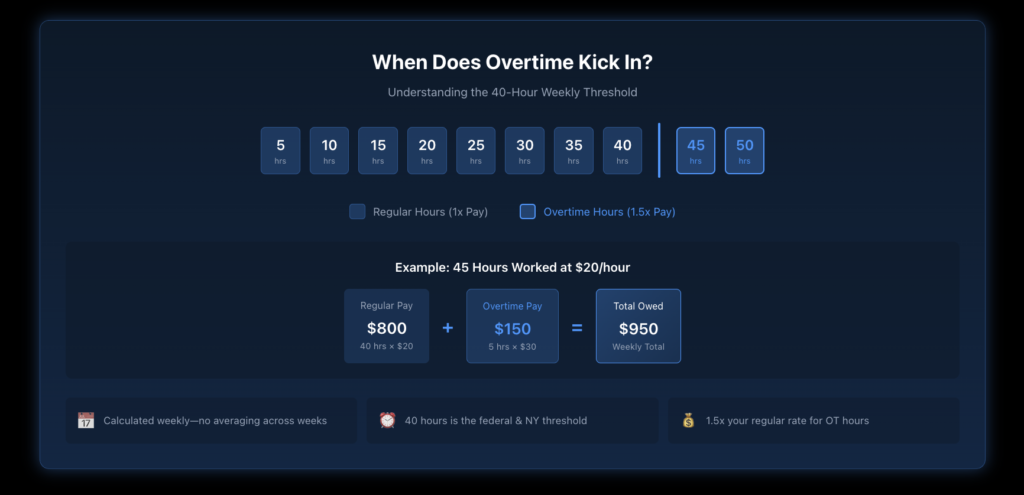
Under federal and New York law, any hours you actually work beyond 40 in a workweek must be compensated at 1.5 times your regular rate of pay. The key question isn’t just “how many hours” but “which hours” actually count toward that 40-hour threshold—and the answer often surprises employees who’ve been underpaid for years.
Key Takeaways
- Overtime kicks in after 40 hours worked in a single workweek—employers cannot average hours across multiple weeks.
- Your “regular rate of pay” includes more than just your hourly wage—bonuses, commissions, and shift differentials factor in.
- Waiting time, on-call time, and travel between job sites typically count as hours worked.
- New York employees often have additional protections beyond federal FLSA requirements.
- Unauthorized overtime must still be paid if your employer knew or should have known you worked the hours.
Disclaimer: This article provides general information for informational purposes only and should not be considered a substitute for legal advice. It is essential to consult with an experienced employment lawyer at our law firm to discuss the specific facts of your case and understand your legal rights and options. This information does not create an attorney-client relationship.
How Does the FLSA Define Overtime Hours?
The Fair Labor Standards Act establishes the foundation for overtime calculations across the country. Under the FLSA, non-exempt employees must receive overtime pay at one and one-half times their regular rate for all hours worked over 40 in a workweek. This applies regardless of whether you’re paid hourly, by salary, commission, or piece rate.
A workweek is any fixed, recurring period of 168 consecutive hours—seven 24-hour periods. Your employer determines when the workweek starts and ends, but once established, they cannot manipulate it to avoid paying overtime. The critical point many workers miss: hours cannot be averaged across two or more weeks.
What Counts as “Hours Worked” Under Federal Law?
According to DOL guidance on hours worked, the term encompasses all time during which you’re required to be on your employer’s premises, on duty, or at a prescribed workplace. This includes periods of inactivity if you’re “engaged to wait”—like a security guard between rounds or a receptionist between calls.
The Department of Labor breaks compensable time into several categories that many employees don’t realize apply to them. Work that isn’t requested but is “suffered or permitted” still counts. If you voluntarily stay late to finish a project and your employer knows about it, those hours must be paid.
Which Activities Must Be Included in Your Hours?
Under federal overtime regulations, several activities you might not expect must be counted toward your weekly hours. Pre-shift and post-shift activities that are integral to your principal work duties—like equipment setup, safety gear donning, or system startups—are compensable time.
Travel between job sites during your workday always counts. If you report to one location in the morning and your employer sends you to another site, every minute of that travel is work time. However, your regular commute from home to your primary work location typically isn’t compensable unless you’re carrying work materials or making required stops.
How Do You Calculate Your Regular Rate of Pay?
Your overtime rate depends entirely on accurately determining your “regular rate,” and this calculation includes more than most employees realize. The Code of Federal Regulations specifies that your regular rate includes all remuneration for employment except certain statutory exclusions.
What Compensation Goes Into Your Regular Rate?
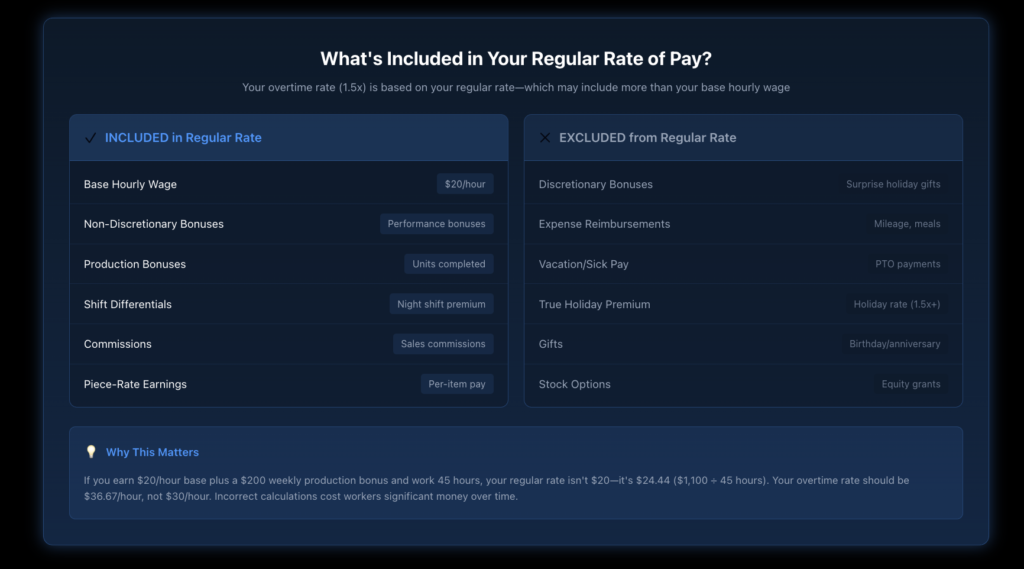
Your regular rate of pay must include your hourly earnings plus the value of non-discretionary bonuses, shift differentials, and production bonuses. If you earn $20 per hour but also receive a $200 weekly production bonus, your overtime calculation must account for both.
Consider an employee who works 45 hours a week at $20/hour and earns a $200 production bonus. The regular rate isn’t simply $20—it’s the total earnings ($900 base + $200 bonus = $1,100) divided by total hours (45), yielding a regular rate of $24.44. Overtime for those 5 hours would be paid at $36.67 per hour (1.5 × $24.44), not $30.
What Payments Are Excluded From the Regular Rate?
Certain payments don’t factor into your regular rate calculation under FLSA guidelines. These exclusions include discretionary bonuses (genuinely surprise gifts), expense reimbursements, payments for periods when no work is performed (sick pay, vacation pay), and certain premium payments for work on holidays or weekends.
The distinction between discretionary and non-discretionary bonuses trips up many employers. A bonus announced at the start of the year with specific performance criteria is non-discretionary—and must be included. True discretionary bonuses are rare and must genuinely be unexpected by employees.
What Are New York's Overtime Requirements?
New York employees benefit from state protections that sometimes exceed federal standards. The New York State Department of Labor administers overtime requirements that work alongside the FLSA. In most cases, you’re entitled to whichever law provides greater protection.
Like federal law, New York requires overtime pay at 1.5 times the regular rate for hours worked beyond 40 in a workweek. However, some occupations exempt under federal law may still be entitled to overtime under New York Labor Law. The state requires overtime at 1.5 times the state minimum wage for their overtime hours, regardless of their actual regular rate.
How Does New York Treat Residential Employees?
New York has unique rules for residential or “live-in” employees. These workers are entitled to overtime only after 44 hours worked in a workweek, rather than 40. This is one area where the state threshold differs from the federal standard for specific worker classifications.
What About Salary Exemptions in New York?
According to the New York Attorney General’s office, salary alone doesn’t determine overtime eligibility. To be exempt from overtime, employees must meet both a salary threshold and a duties test. As of 2025, the salary threshold for overtime exemption in New York City, Long Island, and Westchester is $1,237.50 per week—higher than the federal threshold.
If you earn a salary but don’t meet both the salary and duties tests for exemption, you’re entitled to overtime just like hourly workers. Your employer must track your hours and calculate overtime based on your effective hourly rate.
Which Time Periods Count Toward Your 40 Hours?
Understanding exactly which time periods count toward overtime eligibility requires examining several specific situations that commonly arise in the workplace. The rules can seem technical, but they directly impact your paycheck.
Does Waiting Time Count as Hours Worked?
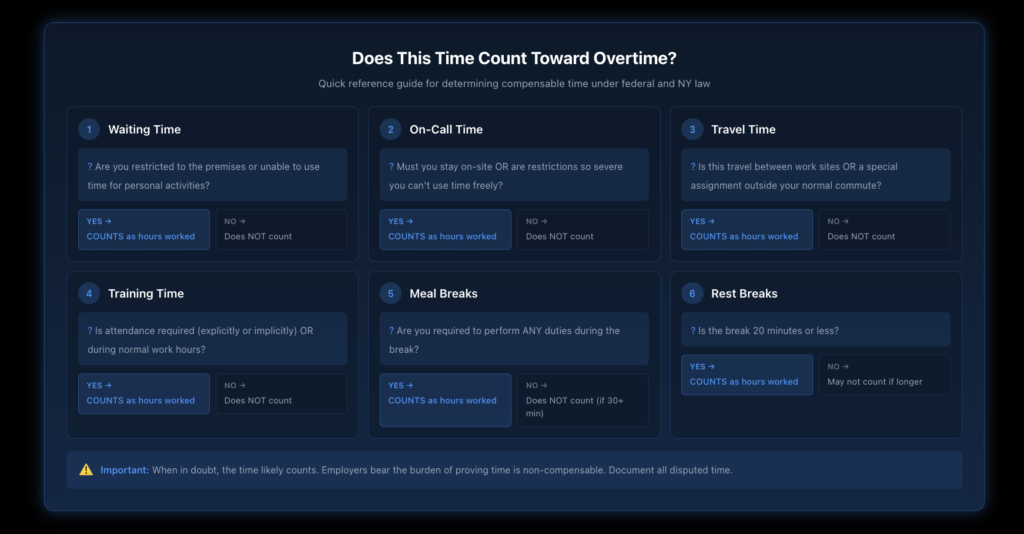
Waiting time is compensable when you’re “engaged to wait” rather than “waiting to be engaged.” The distinction matters enormously. A firefighter playing cards while waiting for an alarm is engaged to wait—that’s work time. An employee free to leave but choosing to wait in the break room for the start of their shift is waiting to be engaged—that’s typically not compensable.
If your employer restricts what you can do during waiting periods, those periods likely count. Can you leave the premises? Can you use the time for personal activities? The more restrictions, the more likely the time is compensable under the wage and hour law.
Is On-Call Time Compensable?
On-call time depends on how significantly it restricts your freedom. If you must remain on your employer’s premises or nearby, that time typically counts. If you simply need to leave contact information and respond within a reasonable timeframe, it usually doesn’t count—unless the restrictions are so severe you can’t effectively use the time for your own purposes.
Some employers in New York have misclassified workers or improperly treated on-call time as non-compensable. If your on-call requirements prevent you from personal activities, medical appointments, or family obligations, those hours may need to be counted.
When Does Travel Time Count?
Regular commuting from home to your usual workplace doesn’t count toward overtime hours. However, several travel scenarios do count under federal wage and hour standards:
Travel between work sites during the day is always compensable. If you report to your office and then drive to a client location, that drive is work time.
Special one-day assignments to another city include travel time, minus your normal commute distance. If you usually commute 30 minutes but drive 2 hours for a special assignment, 1.5 hours count as work time.
Overnight travel during normal work hours counts, even on non-work days. If you normally work 9 to 5, traveling on Saturday from 9 to 5 is compensable.
Do Meal and Rest Breaks Count?
Short breaks of 20 minutes or less are typically compensable work time. Bona fide meal periods of 30 minutes or more don’t count—but only if you’re completely relieved of duties. If you eat at your desk while monitoring equipment or answering phones, that “lunch” is work time.
Many break requirement violations occur when employers deduct meal periods but don’t actually relieve employees of all duties. Interrupted meal breaks—where you’re called back to handle something—may need to be counted entirely.
Is Training Time Compensable?
Mandatory training during work hours obviously counts. Voluntary training outside work hours typically doesn’t—unless it’s directly related to your job, during working hours, involves productive work, or your attendance is effectively required despite being labeled “voluntary.”
If your employer implies that skipping “voluntary” training will affect your job standing or advancement, that training is actually mandatory and compensable.
What Happens With Unauthorized Overtime?
One of the most misunderstood aspects of overtime law: employers must pay for all hours worked, even unauthorized overtime. An employer’s policy against unauthorized overtime doesn’t eliminate the obligation to pay for it. The employer can discipline employees who violate the policy—but they still must pay for the time worked.
This applies to off-the-clock work situations where employees work before clocking in, after clocking out, or during unpaid breaks. If your employer knew or should have known about this work, you’re entitled to compensation.
Can Employers Avoid Overtime Through Advance Notice?
No. An announcement that overtime won’t be paid unless pre-authorized doesn’t override your right to compensation for hours worked. The employer’s remedy is disciplinary action against employees who violate policies—not wage theft.
Similarly, employers cannot require employees to waive overtime rights through employment agreements. New York labor law explicitly prohibits such waivers, and any agreement to work for less than legally required overtime rates is unenforceable.
How Do Different Pay Structures Affect Overtime?
Overtime calculation varies based on how you’re compensated, but the underlying principle remains consistent: determine the regular rate, then multiply by 1.5 for overtime hours.
How Is Overtime Calculated for Salaried Workers?
Salaried non-exempt employees divide their weekly salary by the number of hours it’s intended to cover to find the regular hourly rate. If you earn $800 per week for a 40-hour position and work 45 hours, your regular rate is $20/hour ($800 ÷ 40). Your overtime rate is $30/hour, and you’re owed $150 for those 5 overtime hours.
Understanding exempt versus non-exempt classification is crucial. Many salaried employees assume they’re exempt from overtime when they’re not. The exemption requires meeting specific salary and duties tests—not simply being paid a salary.
What About Commission-Based Employees?
Commission earnings must be included in regular rate calculations. If you earn hourly wages plus commissions, add all compensation for the week and divide by hours worked. The resulting regular rate—higher than your base hourly wage—determines your overtime rate.
How Does Piece Rate Affect Overtime?
Piece-rate workers calculate overtime by dividing total piece-rate earnings by total hours worked to find the regular rate. Overtime is then paid at 1.5 times that rate for hours beyond 40. Some employers improperly calculate piece-rate overtime, constituting wage theft violations.
What Should You Do If You're Not Getting Proper Overtime?
If you believe your employer is violating overtime laws, documentation is your most powerful tool. Keep personal records of your actual hours worked, including start times, end times, and any work performed off-the-clock. Save any communications about overtime policies or denied payments.
You have several options for addressing unpaid overtime. FLSA coverage extends to most workers, and you may be able to file complaints with the Department of Labor or pursue legal claims. In some cases, collective actions for wage violations allow groups of affected employees to pursue claims together.
What Damages Can You Recover?
Under the FLSA and New York law, you may be entitled to recover unpaid overtime wages, liquidated damages (potentially doubling your recovery), and attorney’s fees. Time limits apply—typically two to three years under federal law and six years under New York law—so acting promptly matters.
Ready to Take Action?
If you’re working overtime hours and not receiving proper compensation, you have legal rights that deserve protection. Overtime violations affect workers across industries, from healthcare to hospitality to office environments. The calculations may seem complex, but the core principle is simple: if you work the hours, you deserve the pay.
Our employment attorneys understand the technical requirements of overtime law and how employers commonly violate them. Contact us today to discuss your situation and learn what options may be available to you.
Frequently Asked Questions About Overtime Calculation
Hours included in overtime calculations are all hours you actually work beyond 40 in a single workweek. This encompasses time at your regular workplace, time traveling between job sites, short breaks under 20 minutes, required training, and periods when you’re waiting under your employer’s control. Regular commuting and bona fide meal breaks where you’re completely relieved of duties typically don’t count toward the 40-hour threshold.
For hourly employees, overtime pay is calculated by multiplying your regular hourly rate by 1.5 for each hour worked beyond 40 in a workweek. If your regular rate is $20 per hour, your overtime rate is $30 per hour. Important note: if you receive non-discretionary bonuses or shift differentials, these must be factored into your regular rate before calculating the overtime premium.
Yes, any time worked beyond 40 hours in a workweek—including partial hours like 30 minutes—counts as overtime and must be compensated at 1.5 times your regular rate. Employers cannot round down or ignore small amounts of overtime. If you work 40 hours and 30 minutes, you’re entitled to 30 minutes of overtime pay, regardless of whether it seems like a minor amount.
No. Under both the FLSA and New York law, overtime is calculated on a workweek basis, and averaging hours across multiple weeks is prohibited. If you work 50 hours one week and 30 hours the next, you’re owed 10 hours of overtime for the first week—your employer cannot claim you averaged 40 hours and avoid paying the premium.
Weekend and holiday work is not automatically overtime unless those hours push you beyond 40 for the workweek. If you work Monday through Friday for 32 hours and then work 8 hours on Saturday, you’ve worked 40 regular hours with no overtime. However, some collective bargaining agreements or individual contracts may provide premium pay for weekend or holiday work regardless of total weekly hours.
When you work multiple positions for the same employer at different rates, you calculate a weighted average to determine your regular rate. Add all earnings from both positions for the week, divide by total hours worked, and that weighted average becomes your regular rate. Your overtime rate is 1.5 times this weighted average, not 1.5 times either individual rate.
Yes, travel between work locations during your workday counts as compensable hours worked. If you report to your office, then drive to a client site, then return to the office, all that travel time counts toward your 40-hour weekly threshold. However, your normal commute from home to your first work location and from your last work location to home typically does not count as work time.
If you believe your overtime is being calculated incorrectly, start by documenting your actual hours worked and any overtime payments received. Review your pay stubs for discrepancies. You can file a complaint with the Department of Labor or the New York State Department of Labor, or consult with an employment attorney about your options. Time limits apply to wage claims, so don’t delay seeking information about your rights.

