

Military spouses face unique employment challenges that most workers never encounter. With unemployment rates hovering around 20%—four times the national average—and frequent relocations disrupting career paths, military families often struggle financially despite their service and sacrifice. While USERRA protects service members’ jobs, spouses must navigate a different patchwork of federal programs, executive orders, and state laws to maintain employment stability.
Key Takeaways
- USERRA does not protect military spouse jobs—it only covers the service member, leaving spouses without direct job protection during relocations.
- Executive Order 13473 provides noncompetitive federal hiring authority for spouses of active duty members, disabled veterans, and fallen service members.
- The SCRA now includes license portability provisions allowing spouses to practice on out-of-state professional licenses in their new location.
- MyCAA scholarships offer up to $4,000 for career training and certifications in portable career fields.
- The Military Spouse Hiring Act would expand tax credits for employers who hire military spouses if passed.
- Twenty percent of military spouses are unemployed, spending an average of 23 weeks searching for work after a PCS move.
Disclaimer: This article provides general information for informational purposes only and should not be considered a substitute for legal advice. It is essential to consult with an experienced employment lawyer at our law firm to discuss the specific facts of your case and understand your legal rights and options. This information does not create an attorney-client relationship.
Does USERRA Protect Military Spouse Jobs?
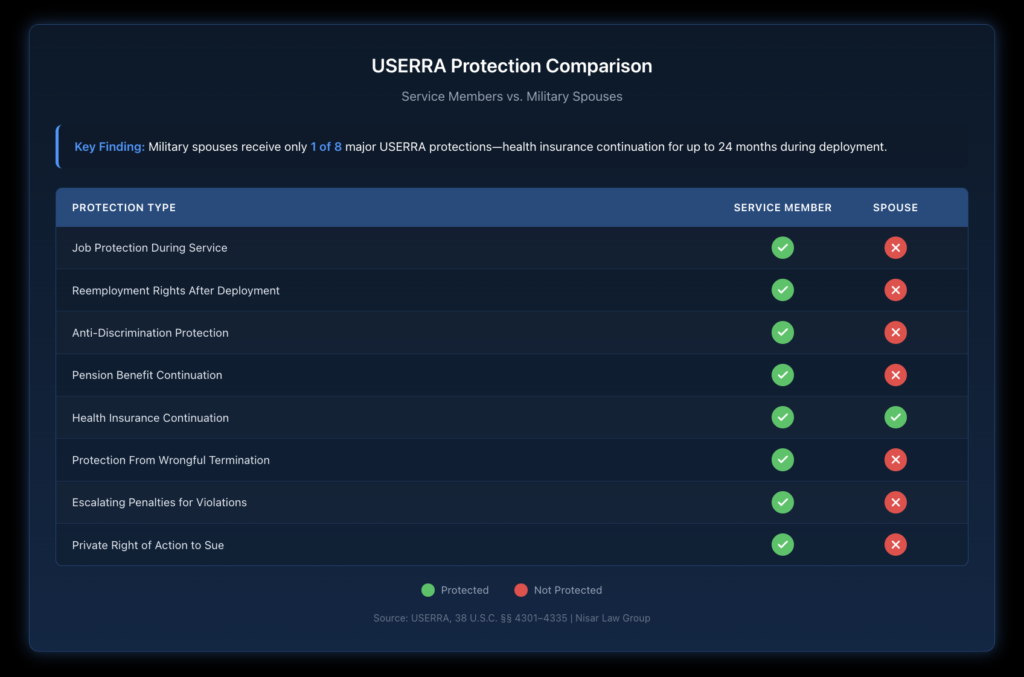
The short answer is no. The Uniformed Services Employment and Reemployment Rights Act provides comprehensive job protection for service members, but these protections do not extend to their spouses. This creates a significant gap in employment security for military families.
What Protections Do Service Members Receive That Spouses Don’t?
Service members enjoy reemployment rights guaranteeing their position (or an equivalent one) when they return from military duty. They receive protection from discrimination based on military status, accumulation of seniority during service, and job-protected leave for training and deployment. Spouses receive none of these direct employment protections under USERRA.
What USERRA Benefits Extend to Family Members?
The only USERRA benefit that touches military spouses involves health insurance. If a spouse is covered under the service member’s employer-sponsored health plan, that coverage can continue for up to 24 months during military service. For leave periods under 31 days, the employer continues paying their normal share. For longer periods, families may need to pay up to 102% of the full premium to maintain coverage.
What Is the Military Spouse Unemployment Crisis?
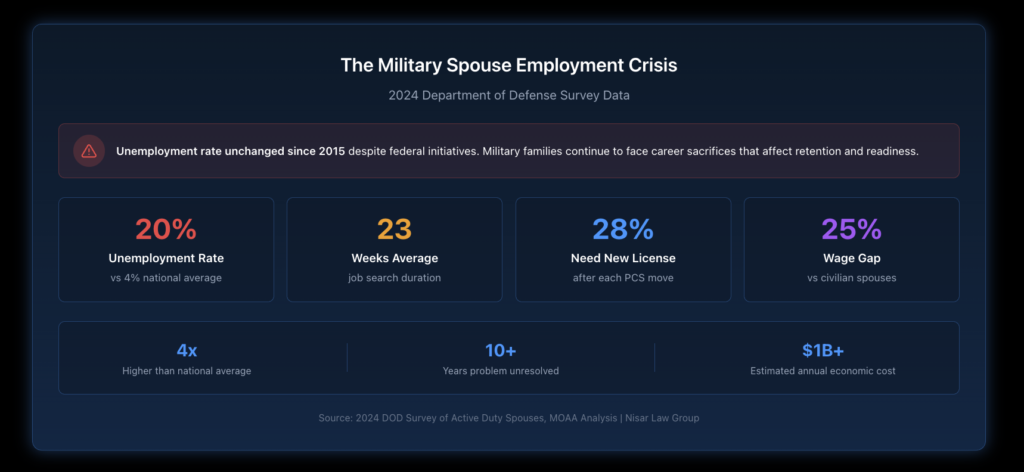
The 2024 Department of Defense Survey of Active Duty Spouses confirms what military families have known for years: spouse unemployment remains stubbornly high despite decades of awareness campaigns and support programs.
Why Is the Unemployment Rate So High?
Military spouses face a 20% unemployment rate—approximately four times the national average. This figure has remained statistically unchanged since 2015. The primary drivers include frequent relocations (PCS moves every two to three years), remote duty station locations, childcare access challenges, and the inability to transfer professional licenses across state lines.
How Does Relocation Impact Spouse Careers?
According to the Marine Corps Association’s analysis of the 2024 survey, spouse unemployment directly impacts force readiness and retention. When spouses support their service member staying in the military, that member is seven times more likely to remain in service. Career disruptions caused by PCS moves create financial instability that pressures families to leave military life entirely.
What Are the Economic Consequences?
Research shows that female military spouses with full-time jobs earn approximately 25% less than their civilian counterparts. Unemployed spouses spend an average of 23 weeks looking for work after a relocation. This wage gap and employment instability represent billions of dollars in lost economic potential annually.
How Does Executive Order 13473 Help Military Spouses Find Federal Jobs?
Executive Order 13473, signed in 2008, created a pathway for military spouses to enter federal employment without competing through traditional examination procedures. This noncompetitive hiring authority has been expanded several times to provide more opportunities.
Who Qualifies for Noncompetitive Hiring Authority?
Under current law, three categories of military spouses qualify for this authority. Spouses of active duty service members are now eligible regardless of whether they’re relocating due to PCS orders—a significant expansion from the original requirements. Spouses of veterans with a 100% service-connected disability rating also qualify. Finally, unremarried surviving spouses of service members who died on active duty maintain eligibility.
What Does Noncompetitive Hiring Actually Mean?
Federal positions marked with the military spouse hiring authority symbol on USAJOBS allow spouses to be considered without going through competitive examination procedures. However, this authority does not guarantee appointment—agencies retain discretion over hiring decisions. Spouses must still meet qualification requirements for each position and provide documentation proving their eligibility.
How Was This Authority Expanded?
Executive Order 13832 in 2018 directed agencies to actively advertise and promote military spouse hiring authority. The FY2019 National Defense Authorization Act removed the requirement that active duty spouses must be relocating due to PCS orders, effectively making all active duty military spouses eligible. The FY2023 NDAA extended these provisions through December 31, 2028.
How Can Military Spouses Transfer Professional Licenses?
Professional license portability has historically been one of the biggest barriers to military spouse employment. Twenty-eight percent of respondents in the 2024 DOD spouse survey reported needing a new professional license after their last PCS move.
What Are the SCRA License Portability Provisions?
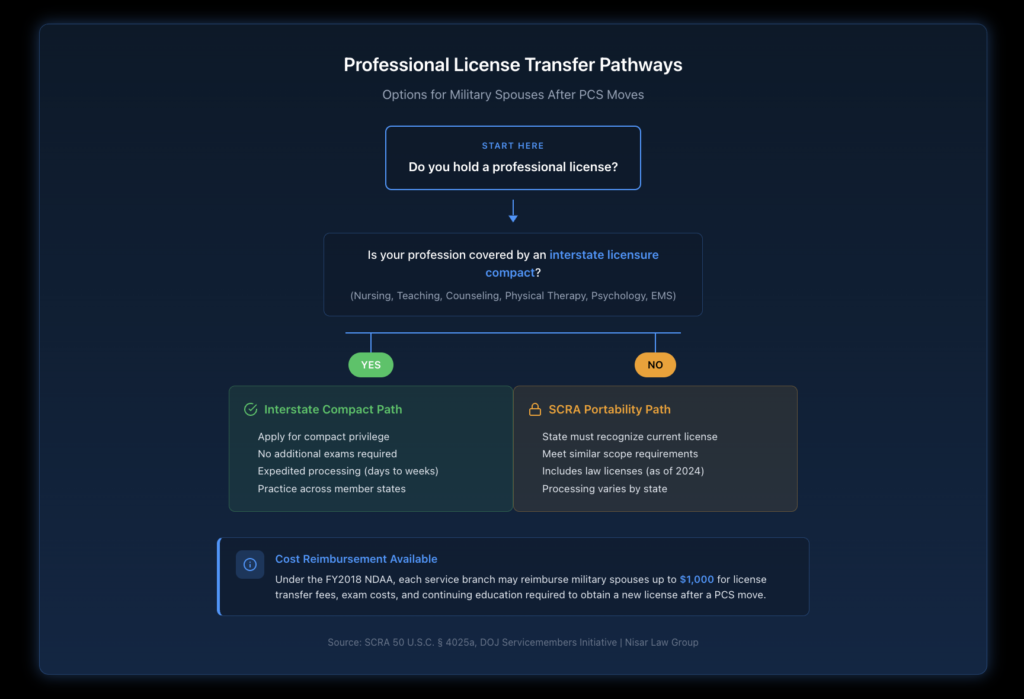
The Veterans Auto and Education Improvement Act of 2022 added groundbreaking license portability provisions to the Servicemembers Civil Relief Act. As of December 2024, service members and their spouses can now have their professional licenses recognized in new states when relocating due to military orders—including law licenses, which were previously excluded.
What Requirements Must Spouses Meet for SCRA Portability?
To qualify for license portability under the SCRA, spouses must submit an application to the new state’s licensing authority that includes proof of military orders, a copy of their current license, and an affidavit confirming they meet certain requirements. The applicant must certify they understand the scope of practice in the new state, have no pending investigations of unprofessional conduct, and maintain good standing with all licensing authorities.
How Do Interstate Compacts Work?
Many professions have established interstate licensure compacts that allow practitioners to work across state lines without obtaining new licenses. These exist for nursing, teaching, counseling, physical therapy, and other fields. If your profession has an active compact covering both your current and destination states, the compact rules apply rather than the SCRA provisions. Military OneSource provides guidance on which compacts may apply to your situation.
Can Employers Reimburse License Transfer Costs?
Yes. The FY2018 NDAA authorized military departments to reimburse qualified relicensing costs for spouses as part of PCS travel allowances. Each service branch may reimburse up to $1,000 per license transfer. The FY2024 NDAA expanded this benefit to spouses of certain service members transitioning from the active component to the reserve component in different jurisdictions.
What Is the MyCAA Scholarship for Military Spouses?
The My Career Advancement Account (MyCAA) scholarship provides up to $4,000 in financial assistance for eligible military spouses pursuing portable careers through education and training programs.
Who Is Eligible for MyCAA Funding?
As of October 2024, the Department of Defense expanded eligibility to spouses of active duty service members in pay grades E-1 through E-9, W-1 through W-3, and O-1 through O-3. Spouses must be able to start and complete their coursework while their sponsor remains on active duty. Spouses married to members of the National Guard and reserves in these same pay grades are eligible if the member is on Title 10 orders.
What Does the Scholarship Cover?
MyCAA pays for tuition costs for education and training courses leading to licenses, certificates, certifications, or associate degrees in portable career fields. The scholarship covers costs for approved testing organizations and examination fees. However, it does not cover fees (registration, technology, parking), non-academic courses, or high school completion programs.
How Can Spouses Access These Funds?
Eligible spouses can establish a free MyCAA account through the Military OneSource portal. The Spouse Education and Career Opportunities (SECO) program provides career coaches who can help spouses identify career paths, evaluate school options, and develop training plans. Financial assistance is distributed in increments of up to $2,000 per fiscal year.
What Legislative Efforts Are Underway to Help Military Spouses?
Congress continues working on legislation to address military spouse employment challenges through tax incentives and expanded protections.
What Is the Military Spouse Hiring Act?
The Military Spouse Hiring Act, introduced with bipartisan support in March 2025, would amend the U.S. tax code to include military spouses in the Work Opportunity Tax Credit (WOTC) program. This would provide tax credits to employers who hire military spouses, creating financial incentives for businesses to tap into this qualified but underemployed talent pool.
Why Does This Legislation Matter?
The bill recognizes that military spouses face unique barriers to employment similar to other WOTC-eligible groups. According to the Military Officers Association of America, employing military spouses is a strategic issue with direct ties to force readiness and retention. Having two household incomes has become a baseline requirement for most military families, and spouse unemployment undermines both family financial stability and military readiness.
What State Protections Exist for Military Spouses?
Beyond federal programs, many states have enacted their own protections for military spouses, though coverage varies significantly.
Do Any States Protect Military Spouses From Termination?
Some states have begun recognizing familial status discrimination that could extend protection to military spouses. New York, for example, provides broader employment protections than federal law in many areas. However, no state currently provides the equivalent of USERRA-style job protection specifically for military spouses who must relocate due to military orders.
What About Unemployment Benefits?
Many states now recognize military spouse unemployment eligibility. Trailing spouse laws in various states allow spouses who quit their jobs due to military PCS orders to collect unemployment benefits. These provisions acknowledge that leaving employment to accompany a relocating service member constitutes a qualifying reason for unemployment compensation. Contact your state workforce agency to understand your specific state’s provisions.
What Steps Can Military Spouses Take to Protect Their Careers?
Given the current gaps in legal protection, military spouses should take proactive steps to safeguard their employment prospects.
How Should Spouses Document Their Employment History?
Keep detailed records of your employment history, performance reviews, and professional accomplishments. When leaving a position due to PCS orders, request reference letters and document your reason for departure. This documentation becomes valuable when applying for new positions or negotiating with potential employers who may be unfamiliar with military family obligations.
What Career Fields Offer the Best Portability?
Healthcare, information technology, education, and remote-capable positions offer the greatest flexibility for military families. The MyCAA program specifically targets portable career fields. Consider pursuing credentials that transfer easily across state lines or professions covered by interstate licensure compacts.
When Should Military Spouses Seek Legal Help?
If you believe you’ve experienced employment discrimination based on your connection to the military, consulting with an employment attorney can help clarify your options. While USERRA doesn’t directly protect spouses, other anti-discrimination laws may apply depending on your circumstances. Some employers may discriminate against military spouses, assuming they’ll relocate soon—this behavior may violate other employment laws.
Ready to Protect Your Employment Rights?
Military spouses facing workplace discrimination, wrongful termination, or other employment issues deserve experienced legal guidance. While federal law doesn’t provide comprehensive job protection for military spouses, you may have claims under state anti-discrimination laws, contract provisions, or other employment protections. Nisar Law Group understands the unique challenges military families face in the workplace. Contact us today for a consultation to discuss your specific situation.
Frequently Asked Questions About Military Spouse Employment Protections
No, military spouses are not exempt from termination under federal law. Unlike service members who receive job protection under USERRA, spouses can be legally terminated even when the reason relates to military-connected relocations. However, termination based on discriminatory reasons unrelated to legitimate business needs may still violate other employment laws.
The 20-20-20 rule applies to divorce situations and military benefits, not employment. It provides that former spouses retain certain military benefits (commissary access, healthcare) if the marriage lasted at least 20 years, the service member served at least 20 years, and at least 20 years of the marriage overlapped with military service. This rule does not provide employment protections.
Many states have “trailing spouse” provisions that allow military spouses to collect unemployment benefits when they quit their jobs due to mandatory military relocations. Eligibility requirements vary by state, so check with your state’s unemployment office. You’ll typically need to provide documentation of military orders requiring the relocation.
Military spouses can apply for NAF (Non-Appropriated Fund) positions, civil service jobs, and contractor positions on military installations. The Military Spouse Preference program gives priority consideration to spouses for DOD civilian positions. Exchange and commissary positions also hire military spouses frequently. Federal jobs posted on USAJOBS may indicate openings available through the military spouse hiring authority.
Visit the Military OneSource website and create a MyCAA account using your DS Logon credentials. Complete your spouse’s profile, work with a SECO career coach to develop an Education and Training Plan, and apply to approved schools. Financial assistance requests can be submitted when you’re within 30 days of your course start date.
Under the 2024 SCRA amendments, virtually all professional licenses and certificates qualify for portability, including law licenses. You must submit an application to the new state’s licensing authority with proof of military orders, a copy of your license, and an affidavit meeting specific requirements. The licensing authority cannot demand additional documentation, like transcripts or test scores, beyond what the SCRA requires.
Currently, military spouses are not included in the Work Opportunity Tax Credit program, though bipartisan legislation pending in Congress would add them. Some states offer their own tax incentives for hiring military spouses or veterans. The Military Spouse Employment Partnership connects spouses with employers committed to military-friendly hiring practices, even without tax incentives.

