

Military service members make significant sacrifices to protect our nation, yet many return home to face discrimination in the civilian workplace. Whether you’re an active duty member, reservist, National Guard member, or veteran, understanding your employment protections is essential for safeguarding your career and livelihood.
Employment discrimination based on military status takes many forms. Some employers refuse to hire veterans based on unfounded assumptions about PTSD or workplace adaptability. Others penalize reservists for attending required training exercises or fail to properly reinstate employees returning from deployment. These actions violate federal and state laws designed to protect those who serve.
Key Takeaways
- Federal law under USERRA prohibits employers from discriminating against employees based on past, present, or future military service obligations.
- New York State and New York City Human Rights Laws provide additional protected class status for military service members and veterans.
- Protected activities include initial hiring, promotions, retention, reemployment after service, and all employment benefits.
- Service members who experience discrimination have multiple enforcement options through the DOL, EEOC, and state agencies.
- Remedies may include reinstatement, back pay, lost benefits, and attorney’s fees for proven violations.
Disclaimer: This article provides general information for informational purposes only and should not be considered a substitute for legal advice. It is essential to consult with an experienced employment lawyer at our law firm to discuss the specific facts of your case and understand your legal rights and options. This information does not create an attorney-client relationship.
What Does Federal Law Say About Military Status Discrimination?
The Uniformed Services Employment and Reemployment Rights Act (USERRA) stands as the primary federal protection for military service members in civilian employment. Enacted in 1994, this law creates comprehensive protections that apply to virtually all employers regardless of size, including private companies, state governments, local governments, and federal agencies.
USERRA protections extend to anyone who serves in the uniformed services, which include the Army, Navy, Air Force, Marine Corps, Coast Guard, Public Health Service Commissioned Corps, and the National Guard and Reserve components. The law also covers those who have applied for membership in any branch or who have service obligations.
What Employment Actions Does USERRA Prohibit?
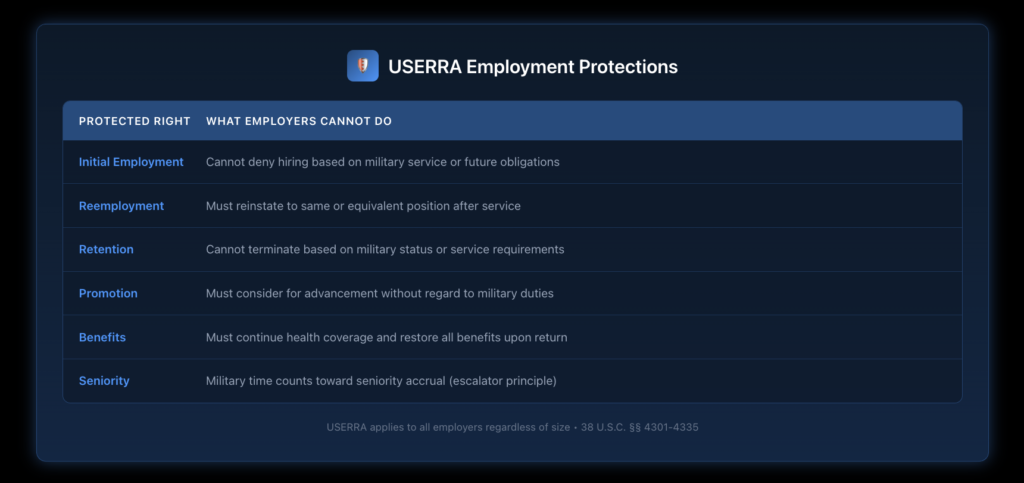
Under USERRA’s anti-discrimination provisions, employers cannot deny any of the following based on military service:
- Initial employment or hiring
- Reemployment after military service
- Retention in employment
- Promotion opportunities
- Any benefit of employment
The “benefit of employment” category is intentionally broad. It encompasses compensation, bonuses, vacation time, retirement contributions, health insurance, seniority accrual, and any other advantage that flows from the employment relationship.
USERRA also contains robust retaliation protections. Employers cannot take adverse action against employees who assert their USERRA rights, file complaints, testify in proceedings, or assist with investigations. These protections extend to non-service members who help enforce USERRA rights.
How Does New York State Law Protect Military Service Members?
New York State provides additional protections through the New York State Human Rights Law, which explicitly recognizes military status as a protected class. This protection applies to employment, housing, public accommodations, and educational institutions.
Under state law, “military status” includes current service members in any branch of the U.S. military, members of military reserves, National Guard and Reserve members, members of state organized militias, and veterans who have been honorably discharged.
The New York State Human Rights Law applies to all employers regardless of size. This provides broader coverage than some federal laws that only apply to employers above certain employee thresholds. The law prohibits discrimination in hiring, firing, compensation, terms and conditions of employment, and any employment-related decisions.
New York’s Military Law provides additional employment protections for state employees. Public employees who serve in the military are entitled to leave without loss of time, service credits, increments, or any other employment rights. They cannot be prejudiced in promotions, transfers, reinstatements, or continued employment.
What Additional Protections Does New York City Provide?
New York City strengthened protections for military personnel in 2017 when the City Council amended the NYC Human Rights Law to include uniformed service status as a protected class. This provides veterans and active military personnel direct protection against discrimination in employment, housing, and public accommodations.
Under the city law, employers cannot discriminate against individuals based on:
- Current or prior service in any branch of the U.S. Armed Forces
- Service in the National Guard or state militias
- Service in the Reserves of any military branch
- Service in the Commissioned Corps of NOAA or Public Health Service
The NYC Commission on Human Rights enforces these protections and investigates complaints of discrimination. Military members have one year from the date of the last discriminatory act to file a complaint, or three years for cases involving gender-based harassment.
What Are Common Examples of Military Service Discrimination?
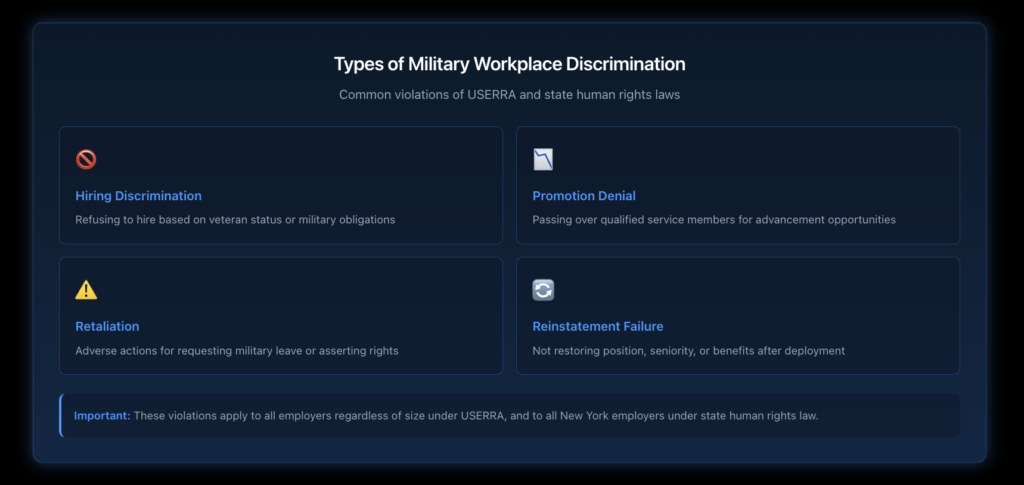
Military discrimination manifests in various ways throughout the employment relationship. Recognizing these patterns helps service members identify when their rights have been violated.
What Does Hiring Discrimination Against Veterans Look Like?
Some employers harbor unfounded biases against hiring veterans. They may assume that former military personnel will struggle to adapt to civilian workplace cultures or that veterans are more likely to have mental health issues. Interview questions probing unnecessarily into combat experiences or expressing concern about PTSD may indicate discriminatory intent.
Employers might also discriminate against applicants who disclose upcoming military obligations. Refusing to hire someone because they’re in the Reserves and will need time for training exercises violates both USERRA and state human rights laws.
How Do Employers Violate Reemployment Rights?
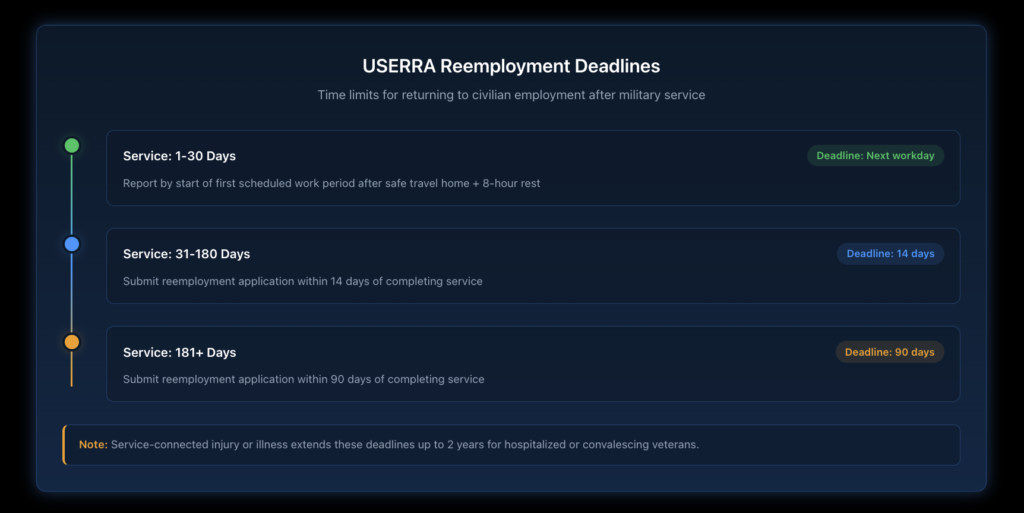
When service members return from military duty, employers must promptly reinstate them. USERRA requires reemployment in the position the employee would have held with reasonable certainty had they remained continuously employed. This “escalator principle” means returning service members often are entitled to promotions or raises that would have occurred during their absence.
Common violations include delaying reinstatement, placing employees in lower positions than they previously held, refusing to restore seniority, and eliminating health insurance and retirement benefits that accumulated during service.
What Constitutes Retaliation for Military Service?
Employers sometimes retaliate against employees for exercising their military service rights. This might include adverse employment actions following requests for military leave, negative performance reviews timed with military obligations, exclusion from meetings or opportunities during service periods, or termination shortly after returning from deployment.
Under the Dole Act amendments to USERRA (signed into law in January 2025), retaliation protections have been significantly strengthened. Employees no longer need to prove the retaliation was specifically job-related or that they experienced a material change in employment conditions.
How Can You Prove Military Discrimination in the Workplace?
Building a successful military discrimination case requires careful documentation and evidence gathering. The process shares similarities with proving other forms of employment discrimination, but USERRA cases have unique elements.
What Evidence Supports a Military Discrimination Claim?
Documentation is critical for any discrimination case. Service members should preserve all military orders, deployment notices, and correspondence with employers about military obligations. Records of leave requests and employer responses help establish patterns of behavior.
Performance reviews before and after military service often reveal discriminatory intent. If evaluations declined after service despite no actual performance changes, this suggests bias. Similarly, records showing similarly-situated non-military employees receiving better treatment support discrimination claims.
Witness statements from coworkers who observed discriminatory comments or treatment provide valuable corroboration. Emails, text messages, or recorded statements where supervisors express frustration about military obligations can be particularly powerful evidence.
What Is the Burden of Proof in USERRA Cases?
USERRA uses a motivating factor standard that is more favorable to employees than some other discrimination laws. Service members must show that their military status was a motivating factor in the employer’s adverse action. They don’t need to prove it was the only factor or even the primary factor.
Once the employee establishes that military status motivated the decision, the burden shifts to the employer to prove they would have taken the same action regardless of military status. This burden-shifting framework recognizes the power imbalance between employers and employees.
What Steps Should You Take If You Face Military Discrimination?
Military service members who experience discrimination have several enforcement options. The path forward depends on individual circumstances, but understanding available options helps you make informed decisions.
How Do You File a USERRA Complaint?
The Department of Labor’s Veterans’ Employment and Training Service (VETS) investigates and resolves USERRA complaints. You can file a complaint online using VETS Form 1010 or contact VETS directly at 1-866-4-USA-DOL.
VETS investigators will collect evidence, conduct witness interviews, and attempt to resolve the complaint. If VETS cannot achieve a resolution, you may request a referral to the Department of Justice (for private and government employers) or the Office of Special Counsel (for federal employers).
Alternatively, you can bypass the VETS process entirely and file a lawsuit directly in federal district court. Many service members consult with military discrimination attorneys to evaluate their options before deciding on a course of action.
What State and Local Options Exist?
New York service members can file complaints with the New York State Division of Human Rights or, for NYC residents, the NYC Commission on Human Rights. State law complaints have a three-year statute of limitations for incidents occurring on or after February 15, 2024.
These agencies investigate discrimination claims and can award remedies, including back pay, reinstatement, compensatory damages for emotional distress, and civil penalties against employers. Some employees pursue parallel complaints at the federal and state levels to maximize their options.
What Remedies Are Available for Military Discrimination?
Successful military discrimination claims can result in substantial remedies designed to make employees whole and deter future violations.
What Damages Can You Recover?
USERRA remedies include reinstatement to the position the employee would have held, full back pay and lost benefits, liquidated damages for willful violations (minimum $50,000 under the Dole Act), and attorney’s fees for prevailing plaintiffs.
State and local law may provide additional remedies, including compensatory damages for emotional distress, punitive damages in egregious cases, and civil penalties payable to the government.
How Are Accommodations for Returning Service Members Handled?
Service members returning with service-connected disabilities have additional protections. USERRA requires employers to make reasonable efforts to help veterans qualify for their positions or similar positions if disabilities affect their qualifications.
These protections interact with the Americans with Disabilities Act, potentially providing dual coverage for disabled veterans. Employers must engage in good-faith interactive processes to identify reasonable accommodations that enable returning service members to perform essential job functions.
Ready to Protect Your Military Employment Rights?
If you believe you’ve experienced discrimination based on your military service or status, taking prompt action protects your rights. The employment law attorneys at Nisar Law Group have extensive experience representing service members in USERRA claims, state human rights complaints, and military discrimination litigation.
Contact Nisar Law Group today for a confidential consultation to discuss your situation and understand your legal options. Our team is committed to protecting those who have served our country.
Frequently Asked Questions About Military Service Discrimination
No, discrimination based on military status is illegal under federal and state law. USERRA prohibits employers from making employment decisions based on an employee’s past, current, or future military service obligations. New York State and New York City Human Rights Laws provide additional protections by recognizing military status as a protected class, meaning veterans and active service members receive the same legal protections as other protected groups, like race, religion, or disability. Employers cannot use military service as a factor in hiring, firing, promotions, compensation, or any other employment decision.
A common example occurs when an employer refuses to reinstate an employee returning from deployment to their previous position or an equivalent role. Another example is when a hiring manager rejects a qualified veteran based on assumptions that former military personnel will have difficulty adapting to civilian work environments. Employers who deny promotions to reservists because they require time off for training exercises, or who terminate employees shortly after they return from military leave, also engage in illegal discrimination. Negative comments about an employee’s military service or penalizing workers for wearing military-related items when other personal items are permitted can also constitute discrimination.
Protected military status encompasses current service in any branch of the U.S. Armed Forces, including the Army, Navy, Air Force, Marine Corps, Coast Guard, and Space Force. It also includes service in the National Guard, military reserves of any branch, organized state militias, and the Commissioned Corps of NOAA and the Public Health Service. Veterans who have received honorable discharges are protected, as are individuals who have applied for membership in any uniformed service or who have future service obligations. The protection extends to the full scope of military-related activity, from initial enlistment through veteran status.
Proving military discrimination requires showing that your military status was a motivating factor in the employer’s adverse action. Gather documentation, including military orders, leave requests, employer responses, and performance reviews before and after service. Preserve emails, text messages, or witness statements reflecting discriminatory comments about your military service. Compare your treatment to similarly situated non-military employees who were treated more favorably. Under USERRA’s burden-shifting framework, once you establish military status as a motivating factor, the employer must prove they would have taken the same action regardless of your service.
Start by documenting everything related to the discriminatory treatment, including dates, witnesses, and any written communications. File an internal complaint with your employer’s HR department if one exists, which creates a record of your concerns. Contact the Department of Labor’s Veterans’ Employment and Training Service (VETS) to file a formal USERRA complaint, or file a complaint with the New York State Division of Human Rights or NYC Commission on Human Rights. Consider consulting with an employment attorney who handles military discrimination cases to understand your full range of options. Act promptly because statutes of limitations apply to discrimination claims.
Yes, military status is a protected class under both New York State and New York City law. The New York State Human Rights Law explicitly includes military status among its protected categories, applying to employment, housing, public accommodations, and education. The NYC Human Rights Law was amended in 2017 to add uniformed service status as a protected class, providing direct protections against discrimination for veterans and active military personnel. These state and local protections supplement federal USERRA protections and may provide broader remedies in some circumstances.

